

Case Background
This judgment arises from a batch of writ petitions filed by teaching and non-teaching employees of the Lalit Narayan Mishra Institute of Economic Development and Social Change, Patna.
The Institute was originally a private educational institution. It was taken over by the State of Bihar under the Bihar Private Educational Institutions (Taking Over) Act, 1987. Under Section 3 of that Act, the Institute vested absolutely in the State Government, free from all encumbrances.
Section 6 of the 1987 Act provided how the service of existing teaching and non-teaching employees would be dealt with. All such staff ceased to be employees of the old institution but continued on an ad hoc basis until the State Government decided whether to absorb them, continue them on contract, or terminate them after an expert committee examined their credentials.
Committees were formed and many staff members, including several petitioners, were “adjusted” and regularised in the Institute’s service by orders of the State Government, with effect from their original dates of appointment in the 1980s.
Over time, different service rules were framed. Service Rules notified on 08.01.2005 dealt with retirement age, contributory provident fund, gratuity and leave encashment. Those rules led to an earlier writ petition (C.W.J.C. No. 3473 of 2015), where employees sought parity with government and university staff in matters like retirement age, pension, and gratuity. The High Court in that case did not accept such a broad claim but directed the State to reconsider their service conditions in light of an earlier notification dated 13.11.1990.
In response, the State framed the Lalit Narayan Mishra Institute of Economic Development and Social Change Institute Service Condition Rules, 2017, under Section 11 of the 1987 Act. These 2017 Rules, notified in the Official Gazette, specifically dealt with pension and related benefits under Rule 9.
However, shortly after, the Education Department issued a letter dated 07.09.2017 purporting to keep Rule 9 “in abeyance”. On 19.12.2017, another notification substituted Rule 9 and confined Institute employees to Employees’ Provident Fund benefits only, thereby taking away pension rights that had just been conferred.
Crucially, this amendment of Rule 9 was not published in the Official Gazette until 23.07.2024, during the hearing of the present writ petitions. In the meantime, many petitioners retired between 2017 and 2024, and they approached the Patna High Court asserting their right to pension under the original 2017 Rules.
What the Court Examined and Decided
The core dispute before the Patna High Court was whether the State could validly withdraw pension benefits earlier granted under the 2017 Rules and whether staff who retired before 23.07.2024 had an enforceable right to pension under the old scheme.
First, the Court examined the statutory framework. Section 11(1) of the 1987 Act enables the State Government to make rules by notification in the Official Gazette. Section 11(2) requires that rules be laid before both Houses of the State Legislature, but this laying requirement is generally treated as directory. What is mandatory, however, is Gazette notification.
Rule 1 of the 2017 Rules confirms that they apply to the entire L.N. Mishra Institute and to all its employees. Rule 1(4) specifically states that the Rules apply to “whole time working teachers/non-teaching employees working at the time of taking over of the institution whose adjustment has been made by the State Government.” The Court held that this provision covers both employees who were in service at the time of takeover and were later adjusted, as well as those appointed thereafter. Thus, there is no split status among Institute employees for the purpose of applying the 2017 Rules.
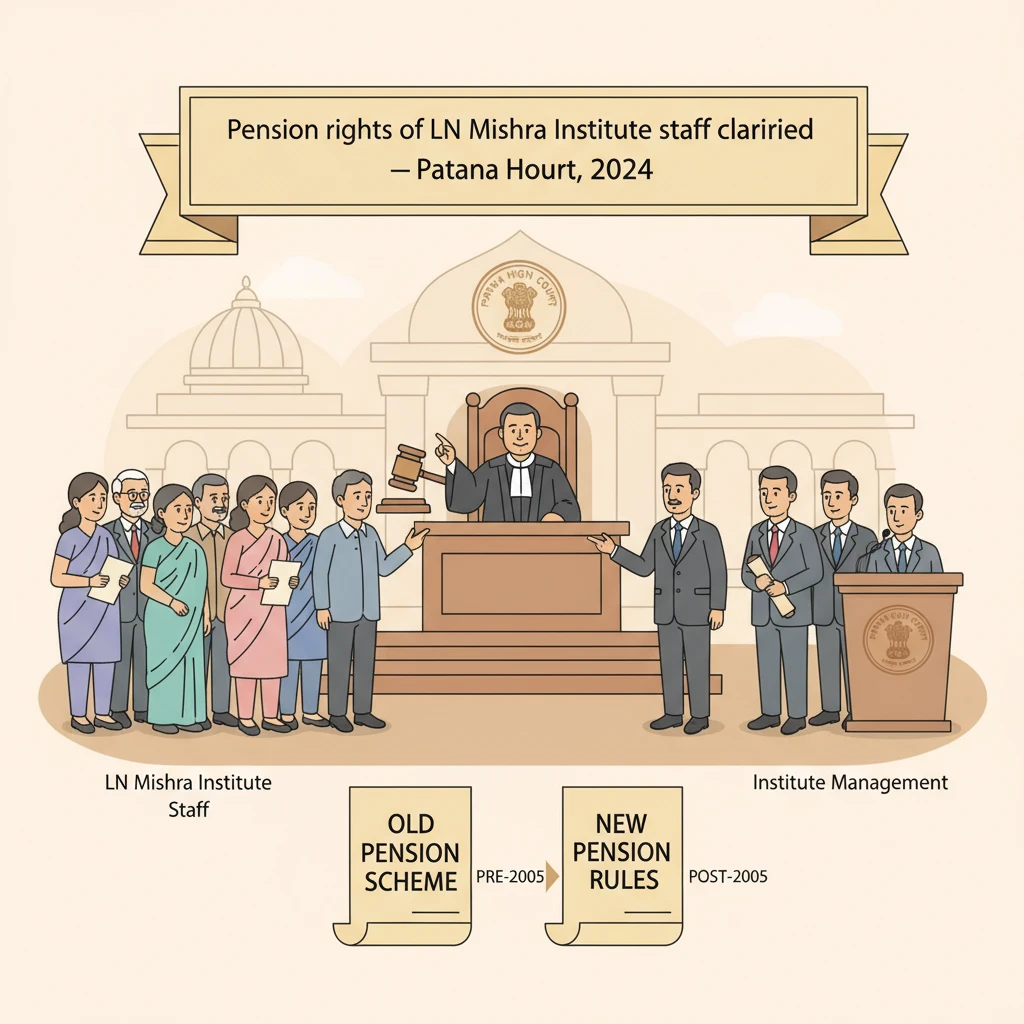
Rule 9 of the 2017 Rules, in its original form, was central to the case. It stated that regular employees appointed and working prior to 01.09.2005 would be governed by the old pension scheme and the Bihar General Provident Fund Scheme. Those appointed after 01.09.2005 would be governed by the new pension rules determined by the State Government. Rule 9 also extended gratuity, leave encashment, medical benefits, and other facilities in line with State Government employees.
The cut-off date of 01.09.2005 was important because the Government of Bihar had adopted a new contributory pension scheme for employees appointed on or after that date, keeping the old pension scheme for those appointed earlier.
The State attempted to avoid the impact of Rule 9 by relying on two administrative steps: the letter dated 07.09.2017 (Annexure-5) from the Additional Secretary keeping Rule 9 in abeyance, and the amendment dated 19.12.2017 (Annexure-6) substituting Rule 9 to say that all employees would only be covered by the Employees Provident Fund Scheme.
On publication, the Advocate General candidly conceded that the amendment of Rule 9 was not published in the Official Gazette until 23.07.2024, even though it was sent for publication earlier. A fresh Gazette notification was produced before the Bench on that date.
The Court relied on the Supreme Court judgment in I.T.C. Bhadrachalam Paperboards v. Mandal Revenue Officer, which holds that publication in the Official Gazette is mandatory for rules or orders when the parent statute prescribes it. The object is not just to inform the public but to provide an official, final version of the rule that courts can rely on.
Applying this principle, the Court held that the amendment to Rule 9 became effective only on 23.07.2024, when it was actually published in the Gazette. Until that date, the original Rule 9 of the 2017 Rules continued to operate.
On the “abeyance” letter of 07.09.2017, the Court was clear that a Joint Secretary or Additional Secretary cannot suspend or keep in abeyance a statutory rule framed by the Government under a statute. If a rule notified in the Gazette is to be withdrawn, suspended, or amended, it must be done by another rule-making action of the Government and published in the Gazette. Therefore, Annexure-5 had no legal force and could not stop the operation of Rule 9.
The Court also declined to accept the argument that employees could not rely on Rule 9 because it was allegedly never implemented in practice. A statutory rule, once validly notified, has legal force irrespective of whether authorities attempt to ignore or sidestep it through internal letters.
The Advocate General further argued that employees could not claim pension before their retirement, and that pension rights crystallise only on the date of retirement as per the rules then in force. For this, he relied on a previous judgment concerning LN Mishra staff (C.W.J.C. No. 3473 of 2015), and the Supreme Court’s approach in pension cases.
The Court agreed that the right to actually receive pension arises on retirement, but it carefully examined how this principle applied here by referring to several Supreme Court decisions relied on by the petitioners, including State of H.P. v. Rajesh Chander Sood, Punjab State Cooperative Agricultural Development Bank Ltd. v. Cooperative Societies, and G. Sadasivan Nair v. Cochin University of Science & Technology.
From these decisions, the Court drew a key distinction:
First, employees who retire while a particular pension scheme is in force acquire a protected entitlement to its benefits. That right cannot be taken away later by retrospective amendments, particularly when pension is a social security measure. Second, for employees still in service, it is permissible for the State to change pension rules prospectively, including by fixing a cut-off date, provided the change is made lawfully.
Applying this to the present case, the Court held that a “dichotomy” would arise between two categories of LN Mishra staff:
One category comprises employees who retired between the Gazette notification of the 2017 Rules (with original Rule 9) and 23.07.2024, when the amendment to Rule 9 was finally notified. For them, the old pension scheme under original Rule 9 was in force throughout their service till retirement. They acquired a legal right to pension under that scheme. That right could not be taken away by an un-gazetted administrative manoeuvre or by a later amendment given effect only in 2024.
The second category comprises those who are still in service on or after 23.07.2024. For them, the newly notified amendment of Rule 9 applies prospectively. Their entitlement to pension, if any, will depend on the outcome of any fresh challenge they may file against that amendment. The Court expressly left the validity of the 23.07.2024 amended Rule 9 open for future challenge.
The Court rejected the State’s further argument that the absence of Gazette publication could be overlooked on the basis of “actual knowledge” among employees, relying on Sri B.K. Srinivasan & Anr. v. State of Karnataka and a Division Bench decision in Supreme Road Transport Private Limited v. State of Bihar. Those decisions only permit alternative modes of publication when the parent statute is silent. Here, Section 11 of the 1987 Act expressly mandates Gazette notification; therefore, that mode must be followed.
Turning to individual writ petitions, the Court then applied these principles:
In C.W.J.C. No. 644 of 2023, the first petitioner was appointed in 1986, adjusted/regularised in 2006, and retired on 31.01.2024. He falls squarely within the period when original Rule 9 was in force and before the 23.07.2024 amendment. The Court held he is entitled to pension under the Old Pension Scheme. The second petitioner, appointed in 1987, is still in service. The Court made no final observation on his entitlement and left him free to challenge the amended Rule 9 if he wishes.
In C.W.J.C. No. 10463 of 2018, the petitioners are non-teaching staff appointed after takeover. They were terminated but later reinstated and thus became regular employees of the Institute by an order dated 17.07.2006. Several among them retired between 2017 and early 2024. The Court held that all petitioners who retired in this interregnum are entitled to pension under the Old Pension Scheme. Those still in service will have to challenge the 23.07.2024 amendment if they seek similar relief.
In C.W.J.C. No. 20846 of 2018, the sole petitioner was in service at the time of takeover and was regularised by the State. He retired in December 2021, well before the 2024 amendment. The Court held he too is entitled to pension under the Old Pension Scheme.
In C.W.J.C. No. 17263 of 2018, the single petitioner was first appointed on 08.07.1987 and was regularised from that very date. He retired on 31.03.2021. The Court held he is entitled to pension under the Old Pension Scheme.
In C.W.J.C. No. 22613 of 2018, both petitioners were appointed in November 1987. They were terminated in 2005 but reinstated in July 2006 and then retired on 30.11.2017. As they retired after the 2017 Rules but long before the valid amendment of 2024, they also are entitled to pension under the Old Pension Scheme.
Finally, the Court disposed of all writ petitions by granting the above reliefs to retired employees and preserving the right of serving staff to challenge the freshly notified amendment to Rule 9. Any pending interlocutory applications were closed.
Why This Judgment Matters
This Patna High Court judgment has concrete consequences for many employees of L.N. Mishra Institute, both retired and serving.
For retired staff who left service between the coming into force of the 2017 Rules and 23.07.2024, the decision confirms that they are entitled to pension under the Old Pension Scheme. They now have judicial recognition that their pension rights cannot be wiped out by un-gazetted letters or delayed amendments.
The judgment also sends a clear message to government departments: statutory rules affecting service and pension cannot be casually changed or kept “in abeyance” by internal correspondence. When an Act requires Gazette notification, that step is mandatory. Without it, employees’ accrued rights continue.
For current employees of the Institute, the judgment does not itself grant pension. Instead, it recognises that a new amended Rule 9 is now in force from 23.07.2024. Their future pension entitlement will depend on whether they challenge that amendment and what the Court decides then. Thus, the decision preserves their right to litigate while making clear that any change must follow lawful procedure.
More broadly, the judgment reinforces the principle that pension, especially where once granted by valid rules, is a form of social security and cannot be lightly taken away, particularly for those who have already retired under an existing scheme.
Legal Issues and Answers
- Issue: Could the State validly take away pension benefits granted under Rule 9 of the 2017 Rules by issuing an un-gazetted “abeyance” letter and a later un-published amendment?
Answer: No. The Court held that under Section 11 of the 1987 Act, any amendment to the Rules must be notified in the Official Gazette. The 2017 Rule 9 remained in force until the amendment was actually published on 23.07.2024. The “abeyance” letter and un-gazetted amendment had no legal effect. - Issue: Are employees who retired between the notification of the 2017 Rules and 23.07.2024 entitled to pension under the Old Pension Scheme?
Answer: Yes. For all employees regularly adjusted/regularised before 01.09.2005 and who retired in this interregnum, the Court held that original Rule 9 applied, giving them a right to pension under the Old Pension Scheme. - Issue: What is the position of employees still in service on or after 23.07.2024 regarding pension entitlement?
Answer: For serving employees, the amended Rule 9 notified on 23.07.2024 governs their future pension rights. The Court did not decide its validity and left such employees free to challenge the amendment in separate proceedings.
Cases Cited by the Court
- I.T.C. Bhadrachalam Paperboards v. Mandal Revenue Officer, (1996) 6 SCC 634
- State of H.P. v. Rajesh Chander Sood, (2016) 10 SCC 77
- Punjab State Coop. Agricultural Development Bank Ltd. v. Coop. Societies, (2022) 4 SCC 363
- G. Sadasivan Nair v. Cochin University of Science & Technology, (2022) 4 SCC 404
- Sri B.K. Srinivasan & Anr. v. State of Karnataka & Ors., AIR 1987 SC 1059
- Railway Board v. C.R. Rangadhamaiah, (1997) 6 SCC 623 (referred within cited case)
- Division Bench judgment in Supreme Road Transport Private Limited v. The State of Bihar & Ors., 2015(1) PLJR 994
- Earlier Patna High Court decision in C.W.J.C. No. 3473 of 2015 (inter partes, regarding service conditions of LN Mishra staff)
Case Details
Case Number: Civil Writ Jurisdiction Case No. 644 of 2023, with CWJC No. 10463 of 2018, CWJC No. 17263 of 2018, CWJC No. 20846 of 2018, CWJC No. 22613 of 2018
Case Title: Dr. Shiv Deo Singh & Anr. v. The State of Bihar & Ors., with connected matters (full party names as in judgment)
Citation: 2024 (4) PLJR 17
CORAM: Hon’ble the Chief Justice K. Vinod Chandran and Hon’ble Mr. Justice Partha Sarthy
Nature of the Case: Writ petitions under Civil Writ Jurisdiction challenging amendment to service condition rules and denial of pension benefits to teaching and non-teaching staff of L.N. Mishra Institute
Advocates:
- For the petitioners in CWJC No. 644 of 2023: Mr. Mrigank Mauli, Senior Advocate; Mr. Krishna Chandra, Advocate
- For the State (in CWJC No. 644 of 2023): Mr. Pawan Kumar, A.C. to Advocate General
- For L.N. Mishra Institute (various cases): Mr. Ravindra Kumar Shukla, Advocate; Mr. Ritu Raj Shukla, Advocate; Mr. Pratyush Pratap Singh, Advocate
- For the petitioners in CWJC Nos. 10463 of 2018 and 20846 of 2018: Mr. Nikhil Kumar Agrawal, Advocate; Mr. Aditi Hansaria, Advocate
- For the State in CWJC Nos. 10463 of 2018 and 20846 of 2018: Mr. P.K. Shahi, Advocate General; Mr. Vikas Kumar, Advocate; Mr. Mrigendra Kumar, A.C. to G.P. 20
- For the petitioner in CWJC No. 17263 of 2018: Mr. Abhinav Shrivastava, Advocate; Mr. Roshan Kumar Mishra, Advocate
- For the State in CWJC No. 17263 of 2018: Mr. Subhash Chandra Mishra, S.C. 16
- For the petitioners in CWJC No. 22613 of 2018: Mr. Kumar Kaushik, Advocate
- For the State in CWJC No. 22613 of 2018: Mr. Raghwanand, G.A.-11; Mr. Pratik Kumar, A.C. to G.A.-11
- For respondents 6 and 7 / Accountant General in CWJC No. 22613 of 2018: Mr. R.K. Shukla, Advocate; Mr. Manish, Advocate; Mr. Chaitnya Swaroop, Advocate
Link to Judgment: Click here to access the full Patna High Court judgment
If you found this explanation helpful and wish to stay informed about how legal developments may affect your rights in Bihar, you may consider following Samvida Law Associates for more updates.







