
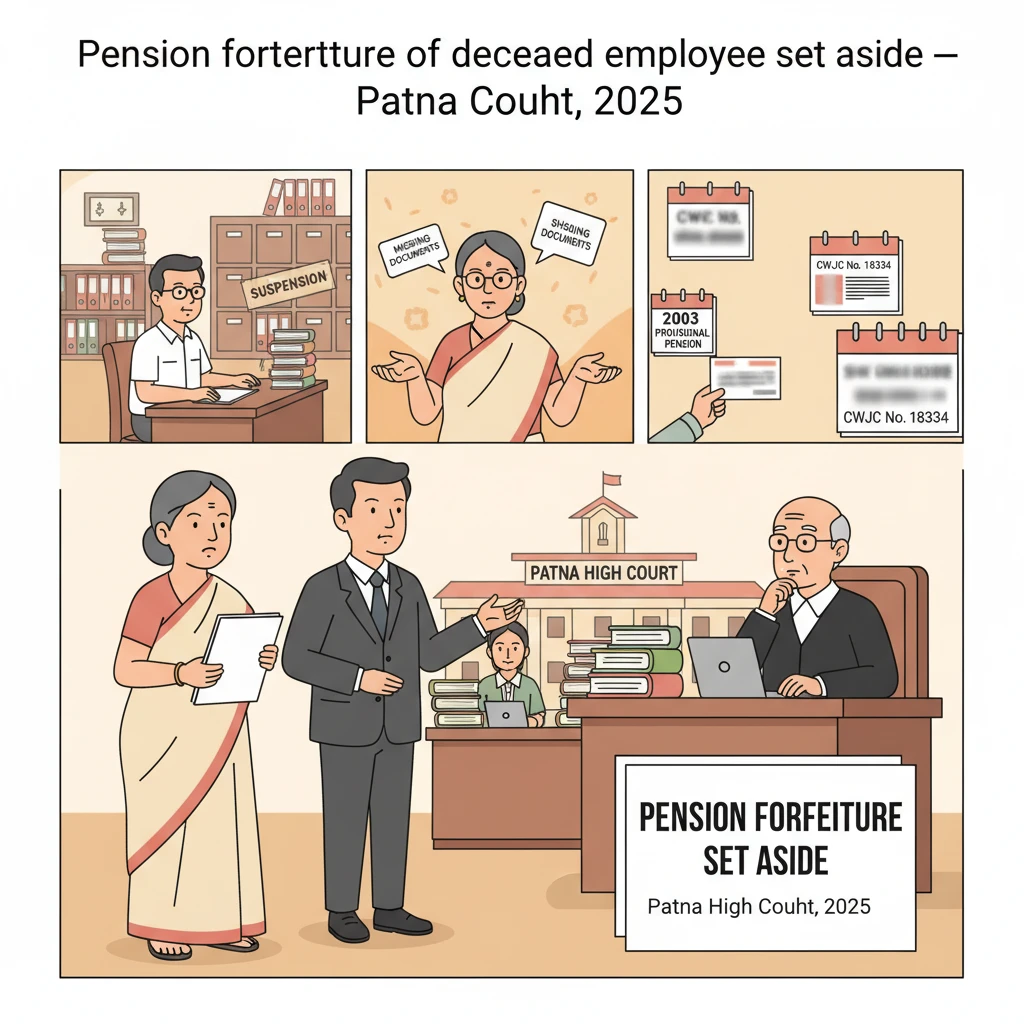
Case Background
The case was brought by a widow whose late husband served in the Health Department, Government of Bihar. He was first appointed as a Computer on temporary basis with effect from 05.08.1965.
In 1971, he was promoted as Junior Statistical Assistant. In 1972, he was further promoted as Senior Statistical Assistant. Later, in 1986, his pay was revised and he was placed in the revised pay-scale of Rs. 1200–1800.
In 1990, allegations arose regarding irregularity in purchase of fallopian tubes. On this basis, a Vigilance case was registered as Vigilance Case No. 100/1992. Parallel to the criminal case, the Health Department decided to start a departmental enquiry against him on the same allegations.
He was placed under suspension by order of the Director-in-Chief, Health Services, vide Memo No. 78 dated 25.10.1991. A charge memo was then issued vide Memo No. 601(5) dated 15.09.1991 under Rule 55 of the Classification, Control and Appeal Rules (CCA Rules).
According to the petitioner, the charge memo did not include any supporting documents. The employee repeatedly demanded documents through his letter dated 24.10.1991, but no documents were supplied. Despite this, the enquiry proceeded in a casual manner and he was not given a proper opportunity with relevant records.
With time, the employee reached the age of superannuation and retired on 30.11.2003. After retirement, he began receiving provisional pension from December 2003. The petitioner’s case is that the departmental proceeding, having been started under the CCA Rules, was never converted into a proceeding under the Bihar Pension Rules after retirement and therefore ought to have come to an end on 30.11.2003.
What the Court Examined and Decided
After retirement, the enquiry officer submitted a report to the Disciplinary Authority, the Director-in-Chief, Health Services. Even though the petitioner says there was no full-fledged enquiry and no proper presentation by any Presenting Officer, the Disciplinary Authority acted upon the enquiry report.
A second show-cause notice was issued to the employee on 22.07.2004. The employee replied, pointing out that the departmental enquiry procedure under the CCA Rules and Bihar Pension Rules had not been followed. He also reiterated that documents relating to the charges had not been furnished.
At the stage of second show-cause, the authority allowed him to file a fresh response by letter dated 08.09.2004, but still no documents relating to the charges were supplied. The employee again demanded the documents in his response.
When the enquiry remained pending and no final order came for a long time, the employee approached the Patna High Court in CWJC No. 18334 of 2011 seeking conclusion of the departmental enquiry. That writ petition was admitted on 25.11.2011 and the State was directed to file a counter affidavit. Later, by order dated 21.09.2022, the writ petition was disposed of with liberty to the petitioner to raise other contentions in a pending case where the penalty order was under challenge.
Meanwhile, the Director-in-Chief, Health Services, acting as Disciplinary Authority, examined the matter. He noted that the relevant file relating to the purchase of fallopian tubes was not available. Due to this, the allegations could not be established. He therefore opined, through his opinion dated 27.11.2012 (Annexure-P/5), that it was not justified to withhold the pension of the petitioner’s husband.
Based on this opinion, the provisional pension continued and was paid till October 2014. Suddenly, from November 2014, payment of provisional pension was stopped. The employee again moved the Patna High Court in CWJC No. 2656 of 2015 for release of his provisional pension.
On 06.04.2015, the Court directed the Director-in-Chief, Health Services to ensure payment of arrears and current provisional pension from November 2014 within one month. The Court also directed that an appropriate order be passed regarding gratuity after obtaining approval from the competent authorities.
Though provisional pension was released, the gratuity issue was not properly decided. The employee then filed a contempt petition, MJC No. 1870 of 2015, alleging non-compliance of the Court’s order. During the contempt case, the department filed a show-cause, annexing Memo No. 89 dated 25.01.2018, citing an old Finance Department circular dated 22.08.1974 to show that the gratuity issue had been considered. On this basis, the contempt petition was dropped, but liberty was given to challenge Health Department Memo No. 536(5) dated 29.04.2019.
Memo No. 536(5) dated 29.04.2019, issued under the signature of the Under Secretary, Health Department, imposed the punishment of forfeiture of 100% pension and gratuity under Rule 139 of the Bihar Pension Rules. This was said to be based on departmental proceedings under Rule 43(b) of the Bihar Pension Rules and the enquiry report of the conducting officer, C.K. Anil, then Additional Secretary.
The widow later filed CWJC No. 8830 of 2020 seeking settlement of retiral dues. During that proceeding, she challenged the punishment order by way of an interlocutory application. The Court directed the authorities to take a final decision on her entitlement and payment of dues, noting that the employee had already died on 16.02.2020 after superannuation as Senior Statistical Assistant.
The widow submitted a detailed representation with relevant documents. No decision was taken, so she again approached the Court in contempt, MJC No. 457 of 2024. In response, the department placed on record a fresh order, Memo No. 517(12) dated 10.06.2024, issued by the Director-in-Chief, Health Services. This order rejected the widow’s claim, upheld the earlier punishment order of 29.04.2019 and confirmed forfeiture of 100% pension.
In view of this 10.06.2024 order, the contempt petition was disposed of on 02.08.2024 with liberty to challenge the order in appropriate proceedings. The present writ petition, CWJC No. 16628 of 2024, was then filed to quash Memo No. 517(12) dated 10.06.2024 and Memo No. 536(5) dated 29.04.2019.
On 19.09.2025, the Court framed important legal questions. It noted that an earlier Director-in-Chief, acting as Disciplinary Authority, had already given a detailed opinion (Annexure-P/5) that full forfeiture of pension was not justified, especially since records of purchase of fallopian tubes were not available. The Court observed that the later Director-in-Chief, by Memo No. 517(12) dated 10.06.2024, had effectively overturned that opinion, without recording any difference of opinion or following legal procedure and without giving hearing, even though by then the employee had already died on 16.02.2020.
The State filed a supplementary counter affidavit. It stated that the earlier Director-in-Chief’s opinion dated 27.11.2012 was only an opinion on the second show-cause and that finally the Health Department, through Memo No. 536(5) dated 29.04.2019, decided to deduct full pension and gratuity under Rule 139 of the Bihar Pension Rules, agreeing with the Enquiry Officer’s findings. However, the Court noted that this did not answer the basic questions of law and procedure.
The Court found that, first, the charge memo was served without the supporting documents required under the CCA Rules. Despite opportunity during the hearing of the writ, the State could not show any material to prove that such documents were ever supplied. In fact, the Disciplinary Authority’s own opinion of 27.11.2012 showed that the relevant records were not available.
Secondly, the Director-in-Chief had expressly opined in 2012 that, without records of purchase of fallopian tubes, no liability could be legally fastened and that forfeiture of pension and other pensionary benefits was not justified. This created a clear position in favour of the employee.
Thirdly, a subsequent officer of the same rank, holding the same post of Director-in-Chief, could not sit in review over the earlier Disciplinary Authority’s findings in the absence of any legal provision or procedure for such review. No difference of opinion was formally recorded, no reasons were given, and no opportunity of hearing was given, particularly after the employee’s death.
The Court emphasised that valuable rights of the petitioner’s husband had been violated. The punishment orders were not supported by any evidence because the very records on which the charges were based were missing.
The Court relied upon the principle laid down by the Supreme Court in Union of India v. H.C. Goel; (1964) 4 SCR 718. In that case, it was held that the conclusion holding a delinquent guilty must be based on cogent evidence. In the absence of such evidence, the conclusion of guilt cannot stand.
Applying that principle, the Court held that the conclusion drawn to issue the punishment of forfeiture of 100% pension and gratuity was contrary to the CCA Rules and based on no evidence. Thus, both orders — Memo No. 517(12) dated 10.06.2024 (by which the departmental authority upheld forfeiture while rejecting the widow’s representation) and Memo No. 536(5) dated 29.04.2019 (original punishment order) — were declared wholly without jurisdiction and unsustainable in law.
Since the original employee had already died, the Court held there was no question of sending the matter back for a fresh enquiry. Instead, it directly granted relief to the widow.
The Court directed Respondent No. 3, the Director-in-Chief, Health Services, Health Department, Government of Bihar, Patna, to pay all consequential benefits, including entire pensionary benefits with full amount of gratuity, to the widow within three months from the date of communication or production of a copy of the judgment. It further ordered that, in case of failure, the petitioner would be entitled to Rs. 25,000 towards cost of litigation.
Accordingly, the writ petition was allowed.
Why This Judgment Matters
This judgment from the Patna High Court is important for retired government employees and their families. It shows that the government cannot take away pension and gratuity without following proper procedure and without clear evidence.
The Court made it clear that:
1) If documents relating to allegations are not supplied to the employee, the departmental enquiry becomes unfair.
2) If the very records of alleged misconduct are missing, punishment cannot be based on mere assumptions.
3) One officer of the same rank cannot simply overturn an earlier reasoned decision of a previous officer in the same post without following legal procedure and giving opportunity of hearing.
For widows and legal heirs, this case reinforces that they can challenge illegal forfeiture of pension even after the employee’s death. It also signals to departments that delaying decisions, ignoring court orders and using old circulars to deny benefits will not be accepted.
Legal Issues and Answers
-
Issue: Whether the Health Department could lawfully forfeit 100% pension and gratuity of a retired employee when relevant records were missing and documents were never supplied to him during the enquiry.
Answer: No. The Patna High Court held that such forfeiture was contrary to the CCA Rules, based on no evidence, and therefore without jurisdiction. -
Issue: Whether a subsequent Director-in-Chief, holding the same rank, could effectively review and reverse an earlier Disciplinary Authority’s favourable opinion without following any prescribed procedure or giving an opportunity of hearing.
Answer: No. The Court found that an officer of the same rank cannot sit in review over his predecessor’s findings in this manner, and the later order was invalid. -
Issue: Whether, after the employee’s death, the matter should be remanded for fresh proceedings.
Answer: No. Since the employee had already died and the punishment orders were unsustainable in law, the Court directly set them aside and ordered payment of all pensionary benefits to the widow.
Cases Cited by the Court
- Union of India v. H.C. Goel; (1964) 4 SCR 718.
Case Details
Case Number: Civil Writ Jurisdiction Case No. 16628 of 2024
Case Title: Puspa Sinha v. The State of Bihar & Ors.
Court: High Court of Judicature at Patna
Coram: Hon’ble Mr. Justice Ajit Kumar
Date of Judgment: 16-10-2025
Citation: 2025(4) PLJR 716
Nature of Case: Civil writ petition challenging departmental punishment order of forfeiture of pension and gratuity
Advocates for Petitioner: Mr. Sanjay Kumar Verma, Advocate; Mr. Ajit Kumar Singh, Advocate; Mr. Onkar, Advocate
Advocate for Respondents: Government Pleader (26)
Key Impugned Orders: Memo No. 536(5) dated 29.04.2019; Memo No. 517(12) dated 10.06.2024
Link to Judgment: View full judgment on the Patna High Court website
If you found this explanation helpful and wish to stay informed about
how legal developments may affect your rights in Bihar,
you may consider following Samvida Law Associates for more updates.







