
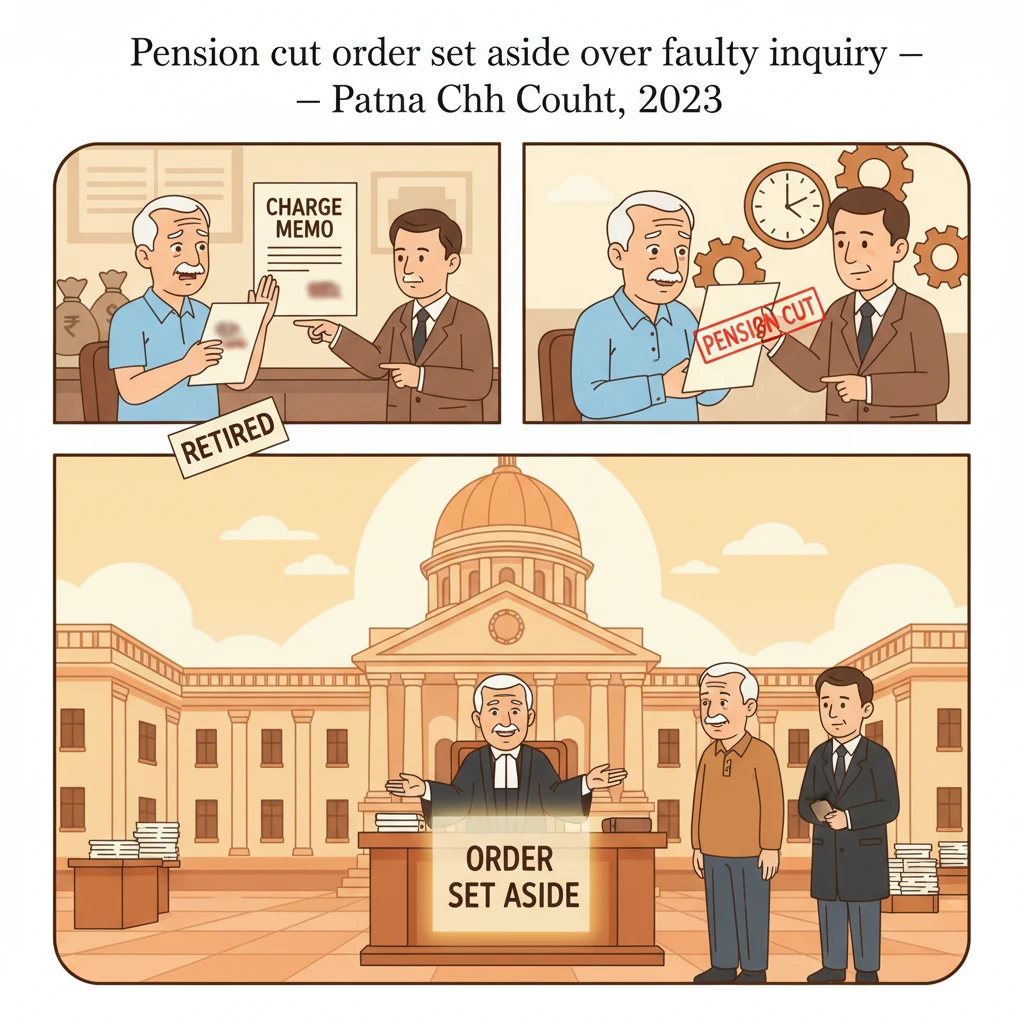
Case Background
The appellant was working as a Junior Engineer in the Road Construction Department of the State of Bihar. On 28.05.2006, a departmental proceeding was initiated against him by framing articles of charge. The core allegation related to misappropriation of Rs. 93,00,000/- (ninety three lakhs) from the State exchequer.
The appellant submitted his explanation to the charge memo, denying the allegations. The disciplinary authority was not satisfied with this explanation and decided to hold a formal inquiry. An Inquiry Officer and a Presenting Officer were appointed to conduct the proceedings.
On 06.02.2007, the Inquiry Officer submitted his report, holding that the charges against the appellant were proved. Based on this report, the disciplinary authority issued a second show cause notice on 08.03.2007, enclosing the inquiry report. The appellant replied to this second show cause notice and the inquiry report on 08.04.2007.
Meanwhile, the appellant reached the age of superannuation and retired from service on 30.09.2007. Because he had retired while the departmental proceedings were pending, the State converted the pending proceedings into a proceeding under Rule 43(b) of the Bihar Pension Rules on 25.03.2008. This provision allows the State to proceed against retired employees in relation to pension and gratuity.
Thereafter, a show cause notice dated 11.03.2010 was issued to the appellant proposing deduction of pension and withholding of gratuity. The appellant submitted his reply on 09.04.2010.
On 02.07.2010, the competent authority passed an order imposing the penalty of deduction of pension and withholding of gratuity. Feeling aggrieved, the appellant submitted a representation or memorial on 16.04.2010. This representation was rejected on 10.08.2010.
The appellant then approached the Patna High Court by filing Civil Writ Jurisdiction Case No. 14330 of 2010, challenging the punishment order and related actions. The learned Single Judge dismissed the writ petition by order dated 16.08.2018.
Against that dismissal, the appellant filed the present Letters Patent Appeal (L.P.A. No. 1347 of 2018) before a Division Bench of the Patna High Court.
What the Court Examined and Decided
In the Letters Patent Appeal, the appellant mainly attacked the validity of the departmental inquiry and the competence of the authority who communicated the punishment. The Division Bench, comprising Hon’ble Mr. Justice P. B. Bajanthri and Hon’ble Mr. Justice Arun Kumar Jha, heard both sides and examined the records.
First, the appellant argued that the penalty order was passed by an incompetent authority, namely the Chief Engineer, and therefore it was invalid. The Bench noted that this point had already been considered earlier along with the official records.
From those records, it emerged that the decision to impose punishment of deduction of pension and withholding gratuity had been taken by the State Government itself. The Chief Engineer had only communicated this decision. Therefore, the Court held that the contention about incompetence of the authority could not be accepted. On this limited issue, the appellant failed.
The second and more substantial argument of the appellant related to the way the departmental inquiry was conducted under Rule 17 of the Bihar CCA Rules, 2005. The appellant pointed out that:
(1) Along with the charge memo, only one document was cited as evidence. No list of witnesses was supplied.
(2) During the inquiry, the Presenting Officer relied only on that single document to prove the charge.
(3) No witness, particularly the author of the document, was examined or offered for cross-examination.
The appellant therefore claimed that the inquiry did not comply with the procedure prescribed in various sub-rules of Rule 17 of the Bihar CCA Rules, 2005 and related provisions. In simple terms, the complaint was that the charge was never properly proved in the legal manner required.
On the other hand, counsel for the respondents (the State and departmental authorities) argued that the inquiry was conducted in accordance with the CCA Rules. They maintained that the single document cited was sufficient to prove the charge and that the Inquiry Officer had rightly held the charge proved. Therefore, according to them, there was no defect either in the punishment order or in the order of the learned Single Judge.
The Division Bench identified the “core question” in the appeal as whether the departmental inquiry against the appellant had been held in accordance with Rule 17 and other related provisions of the Bihar CCA Rules, 2005.
The Bench noted some undisputed facts:
(i) Along with the charge memo, only one document was cited.
(ii) No list of witnesses was provided to the appellant.
(iii) The Presenting Officer relied solely on that document during the inquiry.
The Court held that such a procedure was contrary to the various sub-rules of Rule 17 of the CCA Rules, 2005. The Disciplinary Authority and the Inquiry Officer had failed to follow those mandatory provisions.
In support of this, the Court relied on the Supreme Court judgment in Roop Singh Negi vs. Punjab National Bank and Ors., (2009) 2 SCC 570. In that case, the Supreme Court had held that where the Presenting Officer relies on a document to prove a charge in a departmental inquiry, the author of that document must be examined, and the delinquent employee must have the opportunity to cross-examine that author.
Since, in this case, no such witness was examined, and only the document itself was placed, the Court found that there was a violation of the settled legal requirement. On this basis, the Division Bench held that the appellant had made out a prima facie case for interference with the penalty order and the learned Single Judge’s order upholding it.
Accordingly, the Court set aside:
(a) The penalty order communicated on 10.08.2010 in relation to pension deduction and withholding of gratuity; and
(b) The order of the learned Single Judge dated 16.08.2018 in C.W.J.C. No. 14330 of 2010.
However, the Court did not give a clean slate to the appellant. It observed that the allegations involved alleged misappropriation of a large public amount of Rs. 93,00,000/-. Given this seriousness, the Court held that it was a fit case for remand, relying on Supreme Court decisions in:
(i) Managing Director, ECIL v. B. Karunakar, (1993) 4 SCC 727; and
(ii) Chairman-cum-Managing Director, Coal India Limited & Ors. v. Ananta Saha and Others, (2011) 5 SCC 142 (paras 46 to 50).
Quoting extensively from Ananta Saha, the Bench underlined the principle that where a punishment is quashed on technical grounds in a disciplinary matter, the proper course is generally to allow the employer to conduct a fresh inquiry from the stage vitiated by the defect.
The Supreme Court had also clarified that in such cases:
– The result of the fresh inquiry relates back to the date of earlier termination or punishment.
– The delinquent can be reinstated and placed under suspension for the fresh inquiry, and paid subsistence allowance, but entitlement to back wages is not automatic.
– Back wages and other consequential benefits are discretionary and are to be decided by the disciplinary authority after the fresh inquiry, considering justice, equity, and good conscience.
Applying these principles, the Patna High Court remanded the departmental inquiry back to the disciplinary authority with directions:
(1) The disciplinary authority must commence a fresh inquiry in accordance with law.
(2) The fresh inquiry must be completed within four months from the date of receipt of the High Court’s order.
(3) The appellant must cooperate in the inquiry.
Regarding pension and gratuity, the Court held that the withheld pension amount and gratuity amount will be decided by the disciplinary authority/State Government only after the final order is passed in the remanded departmental inquiry.
The Court further directed that:
– Once the final order in the departmental inquiry is passed, within four weeks from that date, the disciplinary authority/State Government must regulate the pension and other pensionary benefits which were due to the appellant.
– A speaking order (reasoned order) must be passed in this regard and communicated to the appellant.
– If the appellant is found entitled to any monetary benefits, those shall be calculated and disbursed within two months from the date of the final order in the departmental inquiry.
With these observations and directions, the Letters Patent Appeal was allowed.
Why This Judgment Matters
This judgment is important for government employees and pensioners facing departmental proceedings, especially in Bihar. The Patna High Court clearly held that an employee cannot be punished, or have pension and gratuity cut, on the basis of a bare document without examining its author in the inquiry.
For employees, this means that if the department wants to use a document against them, it must also produce a witness who can speak about that document and face cross-examination. If this is not done, the inquiry can be struck down for violating the Bihar CCA Rules, 2005, and the principles laid down by the Supreme Court.
At the same time, the Court balanced this by not closing the door on the employer where serious allegations, such as large-scale misappropriation, are involved. Instead, it allowed the State to redo the inquiry properly, while keeping final decision on pension and gratuity pending until that process is completed.
For retired employees, the judgment clarifies that departmental proceedings can continue under Rule 43(b) of the Bihar Pension Rules even after retirement. But such proceedings must strictly follow the law, and any final decision regarding pension and gratuity must be reasoned, time-bound, and communicated.
Legal Issues and Answers
- Issue: Was the departmental inquiry against the appellant conducted in accordance with Rule 17 of the Bihar CCA Rules, 2005?
Answer: No. The Court found that only one document was relied on, no list of witnesses was provided, and the author of the document was not examined, which was contrary to Rule 17 and the law laid down in Roop Singh Negi. - Issue: Was the punishment of deduction of pension and withholding of gratuity sustainable in law?
Answer: No. Because the inquiry itself was defective, the penalty order and the Single Judge’s order upholding it were set aside, and the matter was remanded for a fresh inquiry. - Issue: What is the proper course when a punishment is set aside on technical grounds in a disciplinary proceeding, particularly after retirement?
Answer: Following ECIL v. B. Karunakar and Ananta Saha, the proper course is to allow a fresh inquiry from the stage vitiated, with the employee reinstated (or treated accordingly) and placed under suspension if necessary, and with back wages and pensionary benefits to be decided after the fresh inquiry.
Cases Cited by the Court
- Roop Singh Negi vs. Punjab National Bank and Ors., (2009) 2 SCC 570.
- Managing Director, ECIL v. B. Karunakar, (1993) 4 SCC 727.
- Chairman-cum-Managing Director, Coal India Limited & Ors. v. Ananta Saha and Others, (2011) 5 SCC 142.
- R. Thiruvirkolam v. Presiding Officer, (1997) 1 SCC 9.
- Punjab Dairy Development Corpn. Ltd. v. Kala Singh, (1997) 6 SCC 159.
- Graphite India Ltd. v. Durgapur Projects Ltd., (1999) 7 SCC 645.
- Union of India v. Y.S. Sadhu, (2008) 12 SCC 30.
- U.P. SRTC v. Mitthu Singh, (2006) 7 SCC 180.
- Akola Taluka Education Society v. Shivaji, (2007) 9 SCC 564.
- Balasaheb Desai Sahakari S.K. Ltd. v. Kashinath Ganapati Kambale, (2009) 2 SCC 288.
Case Details
Case Number: Letters Patent Appeal No. 1347 of 2018 in Civil Writ Jurisdiction Case No. 14330 of 2010
Case Title: Mahendra Prasad Singh vs. The State of Bihar and Ors.
Citation: 2023 (1) PLJR 711
Coram: Hon’ble Mr. Justice P. B. Bajanthri and Hon’ble Mr. Justice Arun Kumar Jha
Date of Judgment: 09.01.2023
Advocates:
- For the Appellant: Mr. P.N. Shahi, Sr. Advocate; Mr. Arun Kumar Pandey, Advocate; Mr. Amresh Kumar, Advocate
- For the Respondents: Mr. S.D. Yadav, AAG-9
Nature of the Case: Letters Patent Appeal against dismissal of writ petition challenging departmental punishment under Rule 43(b) of Bihar Pension Rules relating to deduction of pension and withholding of gratuity, arising out of disciplinary proceedings against a government employee.
Link to Judgment: https://patnahighcourt.gov.in/viewjudgment/MyMxMzQ3IzIwMTgjMSNO-pcOE1aLSmOs=
If you found this explanation helpful and wish to stay informed about
how legal developments may affect your rights in Bihar,
you may consider following Samvida Law Associates for more updates.







