

Case Background
The petitioner served as Director of the Forensic Science Laboratory at Patna. He held this post from 31.3.2003 until his retirement on 31.1.2018.
While he was still in service, the State authorities initiated departmental action against him. A show cause notice was issued to him on 27.3.2017. He was asked to explain his conduct.
The petitioner submitted his reply. However, according to the State authorities, his reply was not satisfactory. Thereafter, by letter dated 14.6.2017, the authorities sent him a memo of charge in Prapatra ‘ka’. He was again asked to submit a reply within 15 days, failing which action would be taken under the Bihar Government Servant (Classification, Control and Appeal) Rules, 2005, commonly called the CCA Rules.
The petitioner sent his reply on 10.7.2017. After considering this reply, the Home (Police) Department issued a resolution dated 9.10.2017, signed by the Deputy Secretary, deciding to start a regular departmental proceeding against him under the CCA Rules.
Before this proceeding could conclude, the petitioner superannuated on 31.1.2018. After his retirement, by order dated 6.3.2018, the pending departmental proceeding was converted into a proceeding under Rule 43 of the Bihar Pension Rules.
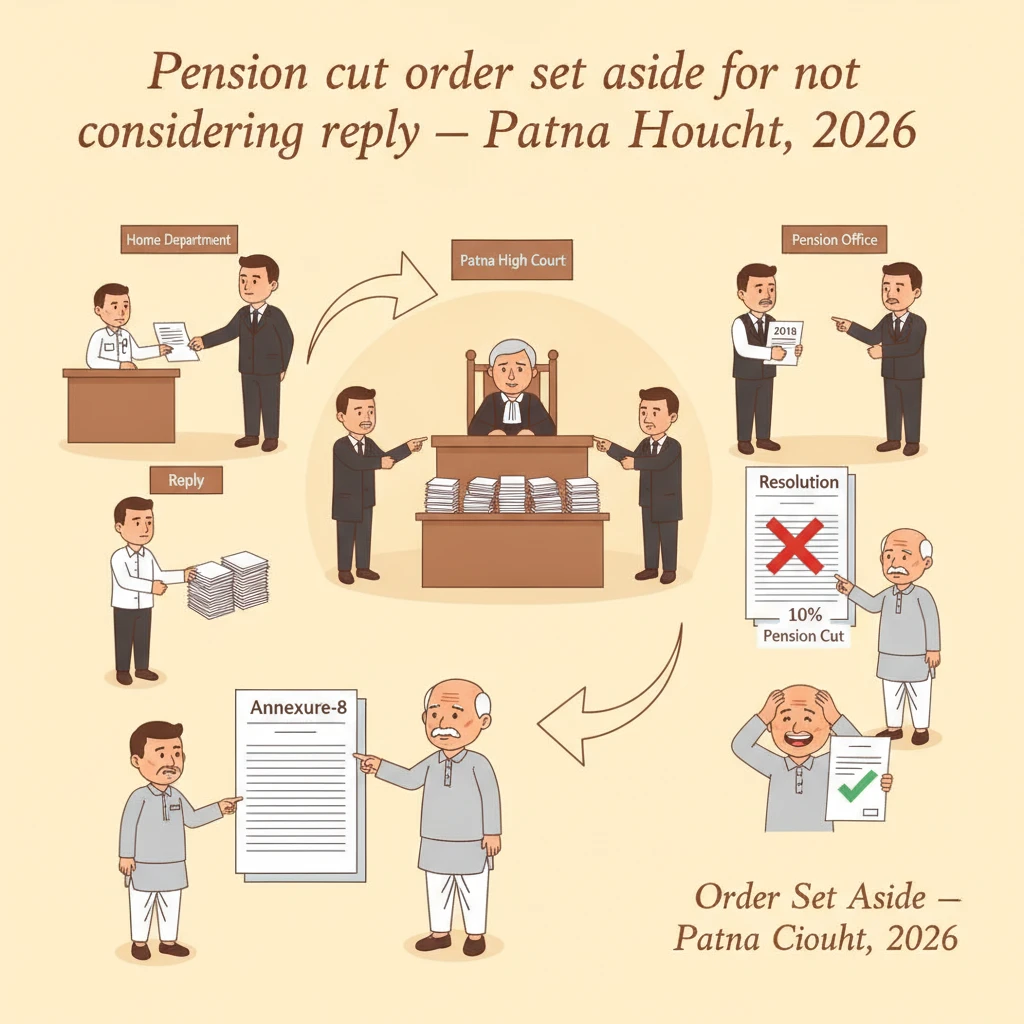
On 4.5.2018, the petitioner was asked to submit his final reply. In response, he filed a detailed explanation dated 15.5.2018 before the Special Secretary, Home Department, Bihar, Patna. This reply, as recorded by the Court, ran into several pages and was brought on record as Annexure-8 to the writ petition.
Despite this, the Joint Secretary, Home (Police) Department, Government of Bihar, subsequently issued resolution contained in memo no. 3333 dated 24.4.2019. In this resolution, the State imposed the punishment of deduction of 10% of the petitioner’s pension for a period of five years. The order also stated that this punishment had the approval of the Bihar Public Service Commission.
Feeling aggrieved, the petitioner approached the Patna High Court in Civil Writ Jurisdiction Case No. 19888 of 2019, challenging the punishment order.
What the Court Examined and Decided
The writ petition was heard by Hon’ble Mr. Justice Partha Sarthy. The Court heard counsel for the petitioner and Government Pleader for the State of Bihar and examined the documents placed on record.
The core grievance of the petitioner was that the punishment order dated 24.4.2019 was illegal. He argued that the Inquiry Officer had wrongly held the charges proved. He also contended that there was no pecuniary loss to the State Government, and therefore no punishment under Rule 43(b) or even Rule 43(a) of the Bihar Pension Rules could be imposed.
Most importantly, the petitioner pointed out that he had submitted a detailed reply to the second show cause notice on 15.5.2018. According to him, the authorities passed the punishment order dated 24.4.2019 without considering this reply at all.
To support his argument, the petitioner relied on the judgment of the Hon’ble Supreme Court in Raj Kumar Mehrotra vs. State of Bihar, (2005) 12 SCC 256. He submitted that as per this judgment, an authority imposing punishment must consider the representation submitted in response to the show cause notice. Non-consideration of his detailed reply, therefore, was a serious legal defect and the order deserved to be set aside.
The State of Bihar, through its counsel, opposed the writ petition. The State argued that there were no procedural irregularities in the departmental proceedings. According to the State, the petitioner had been given opportunity at all stages and the charge of grave misconduct had been found proved in the departmental enquiry.
The State further submitted that, after the petitioner’s retirement, it was proper to pass the punishment order under Rule 43 of the Bihar Pension Rules, directing deduction of 10% of his pension for five years. On this basis, the State contended that the writ petition had no merit and should be dismissed.
The Court, after hearing both sides, focused on the core question of whether the petitioner’s final explanation dated 15.5.2018 had been considered by the authorities before passing the punishment order.
The Court noted the sequence of events in some detail. A departmental proceeding under Rule 17 of the CCA Rules was initiated on 9.10.2017. Upon the petitioner’s retirement on 31.1.2018, this proceeding was converted into one under Rule 43(b) of the Bihar Pension Rules.
After the Conducting Officer submitted the inquiry report, finding the charges proved, a notice dated 4.5.2018 was issued to the petitioner. He was asked to submit his final explanation. The petitioner responded with a detailed explanation on 15.5.2018, running into several pages, which was annexed to the writ petition.
The Court then carefully examined the punishment order dated 24.4.2019. It observed that the order did not even mention the detailed explanation furnished by the petitioner. Nor did it discuss any of the grounds, defences, or explanations raised by him in that reply.
This omission was central to the Court’s reasoning. The Court referred to the decision of the Supreme Court in Raj Kumar Mehrotra. In that case, the Supreme Court had examined an order of punishment passed after a show cause notice.
The Supreme Court had held that, even where minor penalties are imposed under Rule 55-A, the rule requires that the representation made in response to the show cause notice must be taken into consideration before the punishment is passed. The Court there found that the impugned order did not show that any of the issues raised by the delinquent officer in his reply had been considered. No reasons had been given by the authority for holding the charges proved. Therefore, the Supreme Court held that the punishment order could not be sustained.
Quoting from the Supreme Court judgment, the Patna High Court highlighted that a punishment order which does not reflect consideration of the employee’s reply is flawed. The Supreme Court had further directed that any amount already deducted from the appellant’s pension in that case should be refunded, with interest if not repaid within six weeks.
Applying this legal position to the present case, the Patna High Court held that the punishment order dated 24.4.2019 suffered from the same defect. The respondent authorities had passed the order without taking into consideration the petitioner’s reply to the last notice and without dealing with the explanation furnished by him.
In the opinion of the Court, this failure by the authorities to deal with the petitioner’s final reply was sufficient, in itself, to invalidate the punishment order. The Court specifically observed that the order of punishment was fit to be set aside on this ground alone.
However, the Court did not finally decide on the correctness of the charges or the merits of the findings recorded in the departmental enquiry. Instead, it adopted a balanced approach.
The Court set aside the impugned order contained in memo no. 3333 dated 24.4.2019, issued under the signature of the Joint Secretary, Home (Police) Department, Government of Bihar. It then remanded the matter back to respondent no. 7 (the Joint Secretary, Home Department) for passing a fresh order in accordance with law.
While remanding, the Court directed that the new order must take into consideration the explanation furnished by the petitioner in his reply dated 15.5.2018. In other words, the authority is required to re-examine the matter, apply its mind afresh to the reply, and then decide whether any punishment is warranted and, if so, what punishment should be imposed.
With these observations and directions, the writ application was allowed.
Why This Judgment Matters
This judgment is important for all government servants, especially those facing departmental enquiries near or after retirement. It makes clear that the government cannot mechanically impose punishment without properly reading and considering the employee’s reply.
Even when an officer has retired and proceedings continue under the Bihar Pension Rules, the basic principles of fairness still apply. If the authority ignores the explanation given in response to a show cause notice, the punishment order can be struck down by the Court.
The decision also reassures pensioners that their pension cannot be cut merely because the department has made allegations. The department must show, on record, that it has examined the person’s defence and has given reasons for disagreeing with it.
For departments and officers who conduct departmental proceedings, the case is a clear reminder. Any punishment order—whether for serving employees or retirees—should mention that the reply has been considered and should briefly deal with the main points raised. Otherwise, the order may not survive judicial review.
Legal Issues and Answers
-
Issue: Can the State deduct a portion of a retired employee’s pension under Rule 43 of the Bihar Pension Rules without considering his detailed reply to the final show cause notice?
Answer: No. The Patna High Court held that a punishment order passed without considering and dealing with the employee’s final explanation is unsustainable and must be set aside. -
Issue: What is the effect of non-consideration of a reply to show cause in disciplinary proceedings, in light of Raj Kumar Mehrotra vs. State of Bihar?
Answer: Following the Supreme Court’s ruling in Raj Kumar Mehrotra, the Court held that such non-consideration violates the requirement that representations must be examined before imposing punishment, and therefore invalidates the punishment order.
Cases Cited by the Court
- Raj Kumar Mehrotra vs. State of Bihar; (2005) 12 SCC 256.
Case Details
Case Number: Civil Writ Jurisdiction Case No. 19888 of 2019
Case Title: Umesh Kumar Sinha vs. The State of Bihar & Ors.
Citation: 2026(3) PLJR 460
Coram: Hon’ble Mr. Justice Partha Sarthy
Advocates:
- For the petitioner: Mr. Prabhakar Singh, Advocate
- For the respondents: Mr. Nadim Seraj, GP5
Nature of the Case: Writ petition (civil) challenging a departmental punishment order under Rule 43 of the Bihar Pension Rules, arising from a departmental proceeding originally initiated under the Bihar Government Servant (Classification, Control and Appeal) Rules, 2005.
Key Statutory Provisions Referred:
- Rule 17 of the Bihar Government Servant (Classification, Control and Appeal) Rules, 2005
- Rule 43(b) of the Bihar Pension Rules
Link to Full Judgment: Patna High Court Judgment in CWJC No. 19888 of 2019
If you found this explanation helpful and wish to stay informed about how legal developments may affect your rights in Bihar, you may consider following Samvida Law Associates for more updates.







