

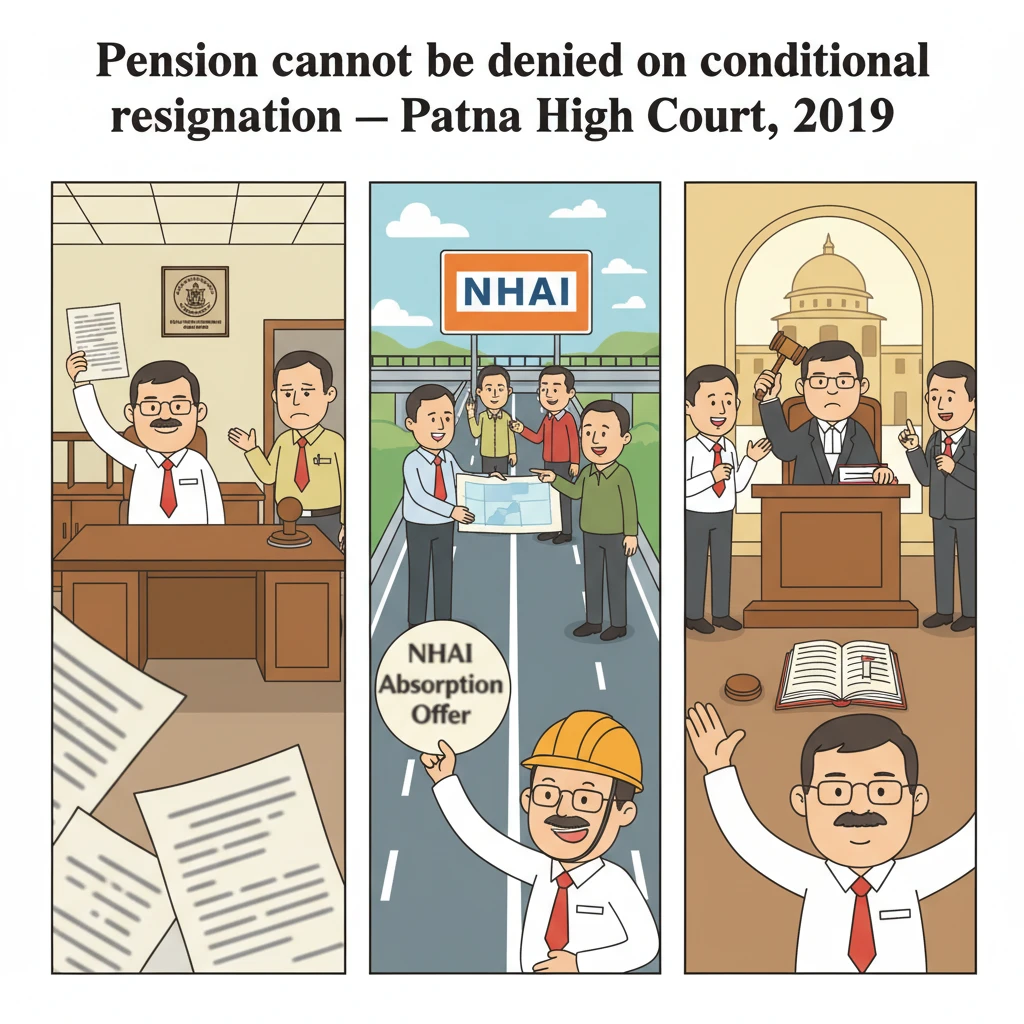
Case Background
The petitioner was a civil engineer in the Road Construction Department of the Government of Bihar. He was appointed as an Assistant Engineer on 16.06.1987, confirmed with effect from 03.07.2004, and promoted to Executive Engineer (Civil) by notification dated 01.11.2006.
While he was working as Executive Engineer (Monitoring) in the office of the Chief Engineer (Monitoring), a public advertisement dated 10.11.2007 was issued by the National Highways Authority of India (NHAI) for various posts on deputation. The Road Construction Department forwarded applications, including that of the petitioner, to NHAI with no objection on 08.02.2008.
By letter dated 17.01.2008, NHAI called the petitioner for interview. He was selected and, by Memo No. 5406(S) dated 18.04.2008, his services were placed on deputation to NHAI for four years. Consequent upon his release, NHAI appointed him as Deputy General Manager (Technical) on deputation for four years.
On 01.11.2012, NHAI issued a circular inviting applications from Deputy General Managers willing to be considered for permanent absorption in NHAI. The petitioner, by letter dated 07.11.2012, informed the Secretary, Road Construction Department, and sought forwarding of his application for absorption.
Instead of processing absorption, the Road Construction Department issued Memo No. 155(S) dated 08.01.2013 to NHAI asking that the petitioner be sent back, as his four-year deputation had expired on 13.04.2012. NHAI, by letter dated 28.01.2013, requested an extension of deputation for one year because the petitioner was in the Vigilance Division handling critical investigations. This letter was not answered by the Department.
On 01.04.2013, NHAI made a formal offer of appointment to the petitioner on absorption basis as Deputy General Manager (Technical). Clause 2 of this offer said that absorption was subject to submission and verification of certain documents, including the consent of the Cadre Controlling Authority in the parent department. It further stated that this consent condition could be waived if the parent department accepted the officer’s resignation or voluntary retirement.
Relying on this clause, the petitioner submitted a letter dated 09.04.2013 to the Secretary, Road Construction Department. In this letter he sought “technical resignation” so that he could be absorbed in NHAI, and specifically requested that, since he had completed more than 25 years of service with the Government of Bihar, his resignation be accepted with grant of pension and all other post-retiral benefits.
Having received no response, the petitioner sent reminders on 24.05.2013 and 08.08.2013. NHAI also wrote to the Secretary, Road Construction Department on 05.06.2013, enclosing a list of six officers, including the petitioner, seeking their absorption, followed by a reminder on 25.02.2014.
Eventually, the State Government acted. By Memo No. 12011(S) dated 12.12.2014, the Additional Secretary, Road Construction Department, accepted the petitioner’s resignation for absorption in NHAI. However, the memo explicitly denied pension and other post-retiral benefits and treated his past service as forfeited. This memo became the impugned order challenged before the Patna High Court in CWJC No. 2267 of 2018.
What the Court Examined and Decided
The core dispute before the Patna High Court was whether the petitioner’s departure from Bihar service to join NHAI amounted to a simple, unconditional resignation, attracting forfeiture of past service and loss of pension under Rule 101(a) of the Bihar Pension Rules, 1950, or whether it was a conditional “technical resignation” that could not be accepted without also granting pensionary benefits.
The petitioner argued that his letter dated 09.04.2013 was not a normal resignation from service. It was a conditional technical resignation, clearly linked to his absorption in NHAI and subject to the grant of pension and other post-retiral benefits. He had completed about 27 years of satisfactory service with the State and therefore fulfilled the qualifying service requirement for pension and for voluntary retirement under Finance Department Memo No. 190(F) dated 27.04.1979, which envisaged voluntary retirement with pension for those who had completed at least 20 years of service.
According to the petitioner, by accepting only a part of his request—his resignation—while denying pension, the State effectively imposed a major penalty equivalent to removal or dismissal from service, which results in forfeiture of past service. Such a penalty, he argued, cannot be imposed without a regular departmental proceeding, which was never held in his case.
He further submitted that pension is not a bounty but a right accruing from long service. Since his absorption in NHAI was not a fresh appointment by direct recruitment but followed deputation initiated with the State’s consent, the State was bound to protect his pension. He also alleged discrimination: in similar cases, other officers of the Road Construction Department who joined NHAI as Managers (Technical) were allowed pension and other retiral dues upon their resignation and absorption, as shown by Memo No. 1107(S) dated 10.02.2014.
On the other hand, the State’s counsel relied heavily on Rule 101(a) of the Bihar Pension Rules, 1950, which provides that resignation, or dismissal or removal for misconduct, insolvency, inefficiency or failure to pass examinations, entails forfeiture of past service. The State argued that once the petitioner resigned and got absorbed in NHAI, he ceased to be a government servant of Bihar, and his service stood forfeited under this Rule.
The State also said that the Finance Department had declined concurrence for payment of pension and other retiral benefits in light of Rule 101(a). Moreover, it claimed that the petitioner did not return to the parent department after the expiry of his deputation period on 13.04.2012 despite a letter dated 08.01.2013 asking NHAI to send him back. According to the State, he instead chose to get absorbed in NHAI without obtaining a no-objection certificate or consent from the department, so his case could not be treated as voluntary retirement.
Justice Nilu Agrawal first examined Rule 101(a). The Rule, the Court noted, contemplates two distinct situations: (i) resignation; and (ii) dismissal or removal for specified misconduct-related reasons. In either situation, past service is forfeited. Therefore, if the petitioner’s act was truly a “resignation” within the meaning of this Rule, his past service would stand forfeited.
The question, then, was whether the petitioner’s letter dated 09.04.2013 could in law be treated as a “resignation” falling under Rule 101(a).
The Court referred to two Supreme Court decisions cited by the petitioner: Dr. Prabha Atri v. State of U.P. (2003) 1 SCC 701 and Sheel Kumar Jain v. New India Assurance Co. Ltd. (2011) 12 SCC 197. In Prabha Atri, the Supreme Court held that to constitute a resignation, there must be a clear, unconditional intention to give up the office, and the letter must not merely be a threatened offer written in frustration. The Court emphasised that a resignation must be “unconditional and with an intention to operate as such.”
In Sheel Kumar Jain, the Supreme Court discussed how, depending on the statutory scheme, exit from service may be treated as resignation or voluntary retirement, and that pension schemes should generally be read to advance, not defeat, the right of employees who have completed qualifying service.
Applying these principles, the Patna High Court analysed the text and context of the petitioner’s letter dated 09.04.2013. The letter was written in response to NHAI’s offer dated 01.04.2013, which itself made absorption conditional on either consent of the parent department or acceptance of resignation/voluntary retirement by the parent department. In his letter, the petitioner asked for “technical resignation” to enable his absorption in NHAI but very clearly added that his resignation be accepted with pension and all other post-retiral benefits, considering that he had put in more than 25 years of service.
The Court held that such a letter could not be called an unconditional resignation. It was a conditional proposition: the petitioner sought acceptance of his resignation only together with protection of his pension and retiral rights. If the Government was unable or unwilling to grant those benefits, its proper course was to decline his request for technical resignation and leave him free to decide his future course of action.
By accepting his resignation but refusing pension, the Department effectively ignored the condition attached to the resignation. Justice Agrawal observed that the parent department, “without applying its mind to the relevant rule,” accepted the resignation for absorption in NHAI without pension and pensionary benefits. This had the effect of forfeiting his long past service and amounted to imposing a major punishment without any departmental proceeding.
The Court also took note of the petitioner’s allegation that similarly situated officers absorbed in NHAI had received pensionary benefits. The State’s counter affidavit did not specifically deny this; it only repeated that the Finance Department had not given concurrence in this case under Rule 101(a). The Court found this insufficient, and treated the difference in treatment as unjustified.
On the State’s argument that the petitioner overstayed in NHAI after his deputation period, the Court held that this could not be used as a shield to deny pension. The acceptance of resignation for absorption came later, on 12.12.2014. Once the respondents decided to accept his resignation for absorption, they could not both rely on his alleged overstay and simultaneously forfeit his pension; they could not “approbate and reprobate at one and the same time.”
Ultimately, the Court concluded that the petitioner’s letter was not a resignation simpliciter. It was a conditional technical resignation. Since the State accepted the resignation without fulfilling the condition of granting pensionary benefits, the impugned order to that extent was illegal.
Accordingly, the writ petition was allowed. The Court set aside the order dated 12.12.2014 (Annexure-20) to the extent it forfeited pension and other post-retiral benefits. The Court directed that the petitioner be granted pension and post-retiral dues in the same manner as other similarly situated Road Construction Department employees who were absorbed in NHAI.
Why This Judgment Matters
This decision is significant for government employees who move from a State department to another organisation, such as NHAI, on deputation and later get absorbed there. Many such officers fear losing their pension from the original government service.
The Patna High Court makes it clear that if an officer submits a conditional or technical resignation, clearly asking that pension and retiral benefits be protected, the Government cannot simply accept the resignation and ignore the condition. If it cannot give the benefits, it must refuse the resignation altogether, not selectively accept only the part that suits it.
The judgment also underlines that long years of service and qualifying service rules for voluntary retirement cannot be bypassed indirectly. Denying pension in such circumstances is treated almost like a major punishment, which normally requires a departmental enquiry. This provides a measure of security for officers contemplating absorption in central agencies or authorities.
Finally, by noting that similarly situated officers were given pensionary benefits, the Court signals that State authorities must act consistently and avoid discriminatory “pick and choose” methods when dealing with the rights of employees.
Legal Issues and Answers
-
Issue: Whether the petitioner’s letter dated 09.04.2013 amounted to a simple, unconditional resignation under Rule 101(a) of the Bihar Pension Rules, 1950, leading to forfeiture of past service and denial of pension.
Answer: No. The Court held that the letter was a conditional technical resignation, not a resignation simpliciter, and therefore could not be used to forfeit his pensionary benefits. -
Issue: Whether the State could accept the petitioner’s resignation for absorption in NHAI while refusing his request for pension and other post-retiral benefits.
Answer: No. The Court held that if the State was not prepared to grant the benefits demanded in the conditional resignation letter, it should have refused to accept the resignation; selectively accepting it while denying benefits was illegal. -
Issue: Whether the petitioner was entitled to pension and post-retiral benefits from the Government of Bihar after his absorption in NHAI.
Answer: Yes. The Court held that the impugned order forfeiting his pensionary rights was unsustainable and that he is entitled to pension and other post-retiral benefits like other similarly situated Road Construction Department employees absorbed in NHAI.
Cases Cited by the Court
- Dr. Prabha Atri v. State of U.P. & others, (2003) 1 SCC 701
- Sheel Kumar Jain v. New India Assurance Co. Ltd. & others, (2011) 12 SCC 197
- Division Bench judgment of Patna High Court in LPA No. 688 of 2009 (dated 10.11.2014)
Case Details
Case Number: Civil Writ Jurisdiction Case No. 2267 of 2018
Case Title: Binay Kumar Thakur v. The State of Bihar & others
Coram: Hon’ble Justice Smt. Nilu Agrawal
Date of Judgment: 14.03.2019
Citation: 2019(2) PLJR 885
Advocates:
For the petitioner: Mr. Sanjay Kumar Singh, Advocate
For the respondents (State of Bihar): Mr. Chittranjan Sinha, PAAG-2
Nature of the Case: Writ petition (civil) under Article 226 of the Constitution challenging denial of pension and other post-retiral benefits on acceptance of technical resignation.
Link to Full Judgment: Click here to read the full judgment of the Patna High Court
If you found this explanation helpful and wish to stay informed about
how legal developments may affect your rights in Bihar,
you may consider following Samvida Law Associates for more updates.







