
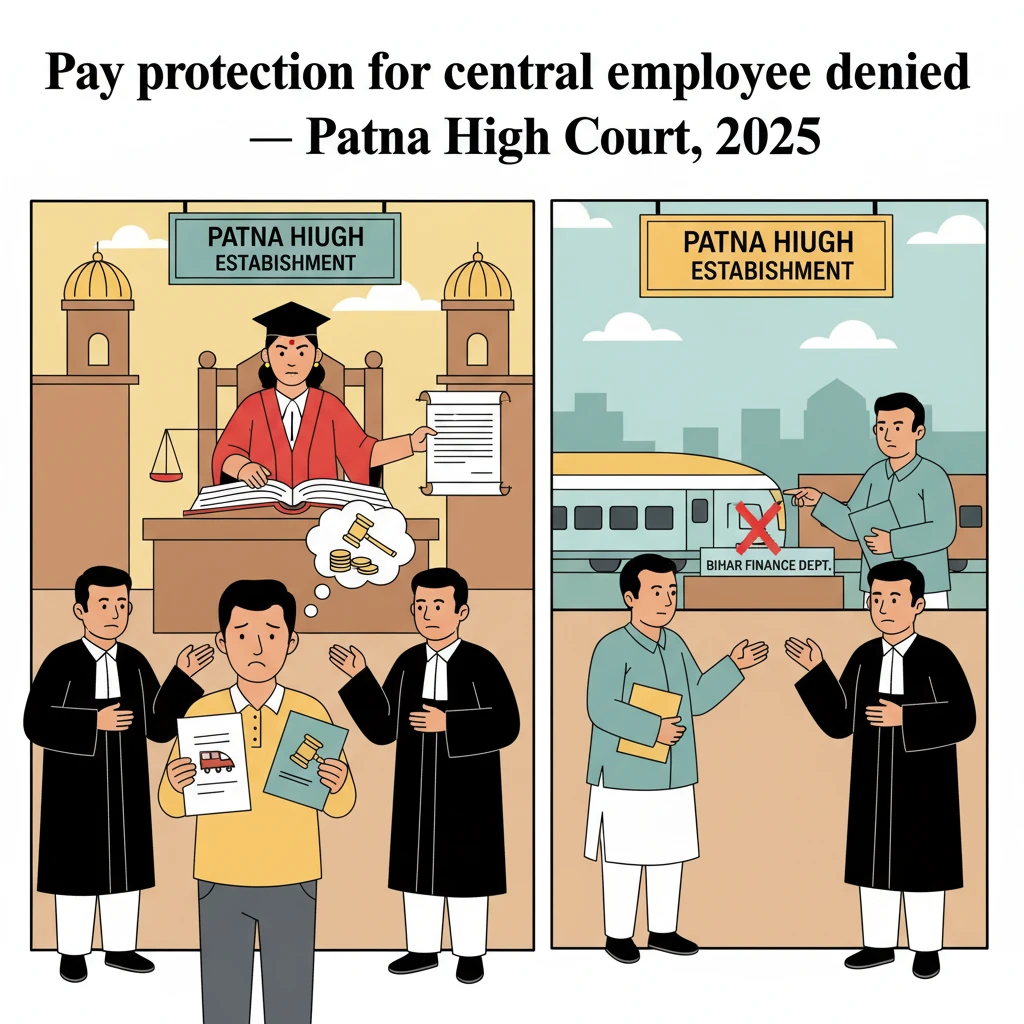
Case Background
The petitioner first worked in the Indian Railways. After undergoing a regular selection process, he was appointed as Chemical & Metallurgical Assistant-II in East Central Railway, in the pay scale of Rs.5000-8000/-, by office order dated 12.12.2001.
During his railway service, he was posted at the Workshop Project under East Central Railway at Patna. While working there, Advertisement No.1/2010 was issued by the establishment of the Patna High Court for the post of Assistant.
The petitioner obtained a No Objection Certificate from the Railway authorities and applied for the post. He participated in the selection, was found successful, and was informed of his selection by letter dated 08.08.2011. The letter stated that the appointment as Assistant in the Patna High Court establishment would be in the revised Pay Band-2 of Rs.9300-34800/- with Grade Pay of Rs.4600/-.
After being relieved from Indian Railways, the petitioner joined as Assistant in Patna High Court on 17.11.2011. His basic salary as Assistant was fixed at Rs.12,540/- plus Grade Pay of Rs.4600/-. In comparison, while serving as Chemical & Metallurgical Assistant-II in East Central Railway up to October 2011, his basic pay had been Rs.14,920/-.
For a few years after joining the High Court establishment, the petitioner did not raise any formal dispute regarding his pay. On 14.01.2016, about four years and two months after joining, he submitted a representation to the State authorities. He requested pay protection so that his pay as Assistant would not be lower than what he was drawing in Railways, and also requested transfer of his Provident Fund account from Railways.
The Law Department referred his claim to the Finance Department. The petitioner’s service history, service book and appointment letter were called for. After deliberation, the Finance Department opined that Rule 78 of the Bihar Service Code could not be used to grant pay protection to him because he had been a Central Government employee.
On that basis, the Law Department issued Letter No.423 dated 23.01.2017 to the Registrar (Establishment), Patna High Court, clearly stating that pay protection under Rule 78 was available only to State Government employees, not to Central Government employees. Later, despite a fresh detailed representation dated 27.09.2018 by the petitioner, the Law Department again rejected his claim through letter dated 26.03.2019.
These two letters dated 23.01.2017 and 26.03.2019, by which the State refused pay protection, were challenged by the petitioner before the Patna High Court in Civil Writ Jurisdiction Case No.18238 of 2019.
What the Court Examined and Decided
Justice Harish Kumar of the Patna High Court heard arguments from both sides. The main question framed was whether a person who had been serving in East Central Railway, and then was selected as Assistant in the Patna High Court establishment through an open advertisement, was entitled to pay protection under Rule 78 of the Bihar Service Code.
On behalf of the petitioner, it was argued that Rule 78 permits protection of initial pay when a government servant moves to another post on a time scale of pay. His counsel pointed to Annexure-B to Appendix-6 of the Bihar Service Code, where “Government Servant” is defined as service under the Government of Bihar and includes service under the Government of India and other Provincial Governments of India.
Based on this definition, the petitioner contended that his past service in Indian Railways should be treated as service of a “Government Servant” under the Code. Therefore, when he joined as Assistant in Patna High Court, his initial pay should have been fixed above or at least equal to the substantive pay he had been drawing in Railways, in terms of Rule 78.
He further argued that the Finance Department had misinterpreted Rule 2 and Rule 45 of the Bihar Service Code. According to the petitioner, Rule 2 only states to whom the Code applies, and includes the staff attached to the Patna High Court. Rule 45 explains the meaning of the term “State Government” or “Government” as the State Government of Bihar, but does not define “Government Servant”. Thus, the petitioner claimed that these Rules did not bar him from getting pay protection.
The petitioner also brought to the Court’s notice that, during the pendency of his writ petition, the Finance Department agreed to count his past Central Government service from 12.12.2001 to 16.11.2011 for pensionary benefits. In furtherance of this, Memo No.16435-16448 dated 23.03.2022 was issued, stating that his service in Indian Railways would be clubbed with his service in the High Court establishment for pension. He argued that if the State could count his earlier service for pension, it should also consider it for pay protection.
Another limb of his argument was based on parity. He relied on an Office Order dated 02.12.2008 issued by Rajendra Agricultural University, Bihar, Pusa. In that case, pay protection had been given to an Assistant Professor-cum-Junior Scientist who had earlier served under Birsa Agricultural University, Kanke (under the State of Jharkhand), by relying on Rule 78(A)(II). The petitioner said that denial of similar benefit to him amounted to discrimination.
The State, through its counsel, opposed the petition on multiple grounds. First, it pointed out that the petitioner joined as Assistant in 2011 without any protest about pay, and only after about five years, in November 2016, did he first raise the issue through a representation. The State argued that such delay and laches was fatal to his claim in writ jurisdiction.
On the merit of pay protection, the State relied on Rule 2 of the Bihar Service Code, which states that the Rules apply to all government servants under the rule-making control of the State Government, as well as staff attached to the Patna High Court and the secretarial staff of the Assembly and Council. According to the State, Rule 78’s benefit is confined to those employees. It cannot be extended to Central Government or other State Government employees who come into Bihar service through fresh recruitment.
The State stressed that the petitioner had been a Central Government employee and was never under the rule-making control of the Bihar Government before his appointment as Assistant. When he applied pursuant to Advertisement No.1/2010, he entered an open competition. His appointment was a fresh recruitment, and he was granted the pay scale applicable to a newly appointed Assistant. Therefore, he could not claim pay protection.
The State also referred to Note-3 of Rule 78(2), which indicates that Appendix-6 is concerned with pay fixation of gazetted government servants on promotion to higher posts or promotion from non-gazetted to gazetted posts. It argued that these provisions are about internal promotions, not about fresh appointees coming from Central or other State services.
To support its stand, the State cited a Division Bench judgment of the Patna High Court in The State of Bihar & Ors. v. Rajendra Rai and analogous cases (L.P.A. No.374 of 2019). In that case, teachers appointed as Headmasters through a fresh State recruitment process were denied pay protection despite their earlier service, because their appointment was not a promotion but a new appointment.
The State also pointed out two Single Judge decisions: Dr. Sunita Kumari v. The State of Bihar and analogous cases (C.W.J.C. No.5152 of 2016) and Praveen Kumar Mishra v. The State of Bihar & Ors. (C.W.J.C. No.368 of 2017), where similar views were taken against granting pay protection on fresh recruitment.
The Court first examined the objection regarding delay. Referring to Supreme Court decisions in Karnataka Power Corporation Ltd. v. K. Thangappan [(2006) 4 SCC 322], P.S. Sadasivaswamy v. State of Tamil Nadu [(1975) 1 SCC 152], and Tukaram Kana Joshi v. Maharashtra Industrial Development Corporation [(2013) 1 SCC 353], the Court noted that delay and laches are important when exercising writ jurisdiction. Service-related disputes should ordinarily be brought within six months to one year.
Here, the petitioner had waited around five years after joining in November 2011 to seek pay protection. The Court held that this delay by itself was sufficient ground to decline relief. However, to give final quietus to the controversy, the Court also examined the case on merits.
The Court then considered Rule 2 and Rule 45 of the Bihar Service Code. It held that these provisions clearly show that the Code applies to government servants under the rule-making control of the State of Bihar, and also to staff attached to the Patna High Court and the secretarial staff of the Assembly and Council. Rule 45 clarifies that the terms “State Government” or “Government” in the Code mean the Government of Bihar.
Thus, there was no ambiguity: Bihar Service Code is applicable only to employees of the Bihar State Government and specified staff attached to its institutions, not to Central Government employees as such.
The Court then examined Rule 78. It noted that Rule 78 gives pay protection where a government servant, who holds a lien on a permanent post, is appointed substantively to another post on a time scale and certain conditions are met. All three contingencies in Rule 78(a)(i), (ii) and (iii) are premised on the employee already holding a lien on an earlier permanent post under the same rule framework.
The Court further observed that under Rule 68 of the Bihar Service Code, once a government servant is substantively appointed to a permanent post, he ceases to hold his earlier lien, unless otherwise provided. Therefore, Rule 78 is about movement and promotion within the same government service, not about a person leaving Central Government service and joining Bihar service through a fresh recruitment.
In the petitioner’s case, he applied “with open eyes” under Advertisement No.1/2010, which did not promise pay protection. He accepted the offer and joined as Assistant without any objection to pay. There was no provision in the Bihar Service Code that an employee coming from Central Government or another State would automatically receive pay protection of his previous post.
Relying on the Division Bench’s decision in Rajendra Rai, the Court reiterated that when recruitment is open to all, including Central Government and other State employees, those who are selected are fresh recruits. For such fresh recruits, claim of pay protection cannot be entertained simply because they were earning higher pay earlier.
On the petitioner’s reliance on “exception” to Rule 78 and on Appendix-6, the Court held that the exception is limited to cases of temporary posts with identical time scales as permanent posts under different governments or departments and has no application to the petitioner’s situation. Note-3 of Rule 78 and Appendix-6, in the Court’s view, only govern pay fixation on promotion of gazetted government servants or movement from non-gazetted to gazetted posts, again within government service, not fresh appointments from outside.
Regarding the State’s subsequent decision to count the petitioner’s previous Railway service for pension, the Court clarified that this flowed from Resolution No.665 dated 15.07.2019, which allows addition of past Central Government service for death-cum-gratuity under the New Pension Scheme in specific circumstances. This pension-related provision had no material bearing on the question of pay protection under Rule 78.
On the parity argument based on the Rajendra Agricultural University order granting pay protection to one Pallav Shekhar, the Court noted that the full facts of that case were neither placed before the Court nor clearly disclosed. Further, it was admitted by the respondent that this was a wrong decision. Relying on the Supreme Court’s ruling in State of Bihar v. Upendra Narayan Singh [(2009) 5 SCC 65], the Court held that equality before law is a positive concept. An illegality or irregularity in favour of one person cannot be used to claim repetition of the same illegality for others.
In the final analysis, the Court concluded that Rule 78 of the Bihar Service Code restricts the privilege of pay protection to employees of the Bihar State Government (including specified attached staff) and that it cannot be extended to Central Government or other State Government employees who enter Bihar service as fresh recruits through an open recruitment process, unless a specific rule provides otherwise.
Finding both delay and lack of legal entitlement, the Patna High Court dismissed the writ petition, upholding the State’s rejection of the petitioner’s claim for pay protection.
Why This Judgment Matters
This judgment is important for all Central Government and other State Government employees who think of joining the Bihar Government or Patna High Court through open recruitment.
The Court has made it clear that if such persons come into Bihar service as fresh recruits, they cannot assume they will get higher pay or pay protection just because they were drawing more salary earlier. Their pay will be fixed as per the rules and scale of the new post, unless a specific rule or advertisement promises otherwise.
The judgment also highlights that employees should raise pay-related disputes without long delay. Waiting for several years after joining and then seeking higher pay through writ petitions is likely to be treated as belated and may be rejected on grounds of delay and laches.
Further, the decision draws a clear line between two different benefits: counting past service for pension (governed by specific resolutions like Resolution No.665 dated 15.07.2019) and granting pay protection under Rule 78. Getting one benefit does not automatically mean getting the other.
Lastly, the Court has reaffirmed that a wrong benefit given to someone else cannot form the basis for claiming equal treatment. Illegality cannot be repeated in the name of equality.
Legal Issues and Answers
- Issue: Can a former Central Government employee, who joins as Assistant in the Patna High Court establishment through fresh recruitment, claim pay protection under Rule 78 of the Bihar Service Code based on his higher earlier pay in Indian Railways?
Answer: No. The Court held that Rule 78 pay protection applies only to Bihar State Government employees (including specified attached staff) who already fall under the Bihar Service Code and move within that service. It does not extend to Central or other State Government employees appointed as fresh recruits through open recruitment. - Issue: Does delay of about five years in seeking pay protection after joining the new post bar relief in writ jurisdiction?
Answer: Yes. The Court held that the petitioner’s unexplained delay of five years in raising the claim amounted to laches. This was sufficient ground to refuse relief, although the Court also rejected the claim on merits. - Issue: Can a petitioner rely on a wrongly granted pay protection benefit to another person in a different institution to claim parity under Article 14?
Answer: No. Relying on Supreme Court precedent, the Court held that equality before law cannot be used to replicate an illegality. A wrong order in favour of someone else does not create a right to the same wrong benefit.
Cases Cited by the Court
- Karnataka Power Corporation Ltd. through its Chairman and Managing Director and Another v. K. Thangappan and Another, (2006) 4 SCC 322.
- P.S. Sadasivaswamy v. State of Tamil Nadu, (1975) 1 SCC 152.
- Tukaram Kana Joshi and Others v. Maharashtra Industrial Development Corporation Limited and Others, (2013) 1 SCC 353.
- The State of Bihar & Ors. v. Rajendra Rai and other analogous cases, L.P.A. No.374 of 2019.
- Dr. Sunita Kumari v. The State of Bihar and other analogous cases, C.W.J.C. No.5152 of 2016.
- Praveen Kumar Mishra v. The State of Bihar & Ors., C.W.J.C. No.368 of 2017.
- State of Bihar v. Upendra Narayan Singh, (2009) 5 SCC 65.
Case Details
Case Number: Civil Writ Jurisdiction Case No.18238 of 2019
Case Title: Rakesh Kumar Mishra v. The State of Bihar & Ors.
Coram: Hon’ble Mr. Justice Harish Kumar
Citation: 2025(3) PLJR 800
Advocates:
- For the Petitioner: Mr. Abhinav Srivastava, Senior Advocate; Mr. Pushkar Bhardwaj, Advocate
- For the Respondents (State): Mr. Gopal Krishna, AC to GP-2
Nature of the case: Writ petition under Article 226 of the Constitution challenging rejection of claim for pay protection and related benefits.
Date of Judgment: 21-07-2025
Link to Judgment: Click here to view the Patna High Court judgment
If you found this explanation helpful and wish to stay informed about
how legal developments may affect your rights in Bihar,
you may consider following Samvida Law Associates for more updates.







