
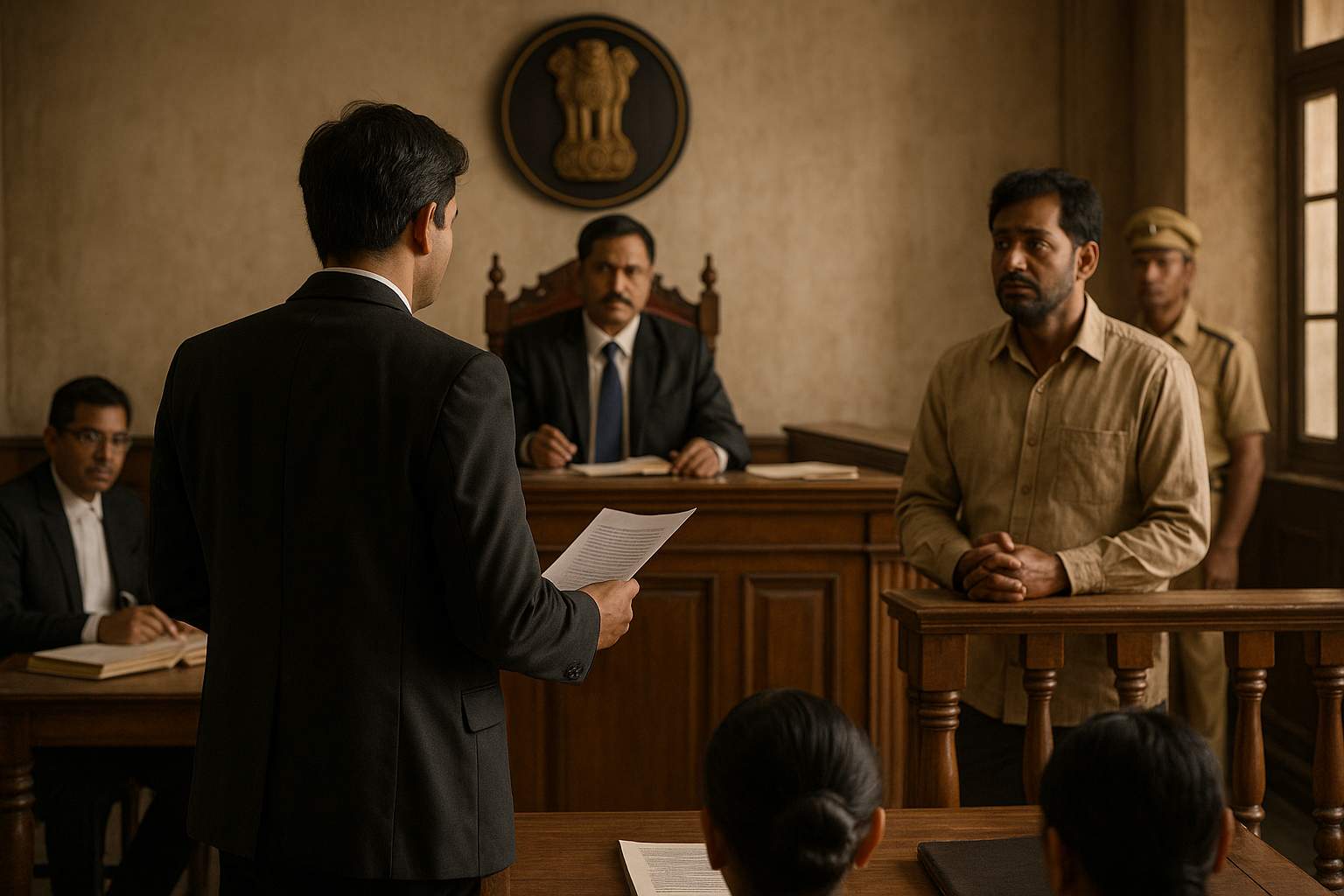
The Patna High Court delivered a significant judgment in 2022 clarifying the scope of Section 311 of the Code of Criminal Procedure (CrPC). The decision came in a case where the trial court had allowed the prosecution to recall its witnesses even after the prosecution had failed for several years to produce any evidence. The High Court set aside that order, emphasizing that Section 311 cannot be used to fill the gaps left by prosecutorial negligence.
This case originated from a police investigation registered in 2010. A charge-sheet was filed on 27 July 2011, and the trial court took cognizance on 6 August 2012. Charges were framed on 25 February 2013. After this, the prosecution was repeatedly directed to present its witnesses for examination, but no witness ever appeared before the court. Despite repeated adjournments, the prosecution failed to produce any evidence.
Over the years, the trial court issued several summons and warrants, but the prosecution still did not act diligently. Finally, the trial court fixed 28 November 2019 as the “last opportunity” for the prosecution to produce its witnesses. When no witness appeared, the court closed the prosecution evidence on 7 December 2019. The trial then proceeded to the stage of examining the accused under Section 313 CrPC, which was completed on 20 January 2020.
On that very day, the prosecution filed an application under Section 311 CrPC, requesting permission to examine its witnesses. The trial court accepted the application on 2 March 2020 and allowed the prosecution to reopen its evidence. The accused challenged this order before the Patna High Court.
The petitioners contended that the prosecution had been given more than sufficient time—from 2013 to 2019—to present its evidence, but had shown no seriousness. Allowing the prosecution to revive its evidence after closure of trial and completion of Section 313 examination would unfairly prejudice the accused and prolong the case indefinitely. The petitioners further argued that Section 311 CrPC is not a tool to repair defects in the prosecution’s case or to compensate for its repeated lapses.
Section 311 of the CrPC empowers a criminal court to summon, recall, or re-examine any witness if the court considers the evidence necessary for a just decision. However, this power is not unlimited. It must be exercised judiciously, and only when the additional evidence is truly essential for the just determination of the case. The courts have repeatedly held that this provision cannot be used merely to fill lacunae in the prosecution’s case or to harass the accused by prolonging the trial.
The petitioners relied on earlier rulings, including Keshav Choudhary & Ors. v. State of Bihar, 2000 (3) PLJR 220, where the Patna High Court had held that Section 311 is not intended to give the prosecution a “long rope” to undo its own negligence. The purpose of the provision is to assist the court in reaching a just decision—not to reopen a case that the prosecution has failed to pursue with diligence. The petitioners also referred to Rajendra Prasad Singh @ Khiru Singh v. Ramuchit Singh @ Chhotak Singh, 1984 BBCJ 657, and Bindeshwari Prasad Singh v. Kali Singh, which laid down similar principles.
The State opposed the petition, arguing that the prosecution should be granted one more opportunity in the interest of justice. It was contended that the court’s power under Section 311 is broad and should be used liberally whenever the court deems the additional evidence necessary. The opposite party also claimed that the prosecution’s witnesses could not attend earlier due to unavoidable circumstances and that recalling them would aid the court in reaching the truth.
After hearing both sides, the Patna High Court observed that the prosecution had been given ample opportunity over the course of seven years to produce its witnesses. The court noted that despite several adjournments and the issuance of summons and warrants, no witness appeared. The trial had already reached an advanced stage—the prosecution evidence was closed, and the accused had been examined under Section 313 CrPC.
The High Court held that reopening the prosecution’s evidence after such a long delay would amount to giving the prosecution another chance to make up for its own inaction. Such an approach would undermine the accused’s right to a fair and speedy trial. The Court emphasized that while Section 311 gives wide powers to the trial court, those powers must be exercised in the interest of justice, which includes fairness to both sides. Justice cannot be one-sided—it must protect the accused from unnecessary harassment as much as it allows the prosecution to present its case fully.
The Court concluded that in this “petty case,” where the prosecution had already enjoyed multiple opportunities, there was no justification for reopening the evidence under Section 311 CrPC. Accordingly, the High Court set aside the trial court’s order dated 2 March 2020 and directed the trial court to proceed with the case and conclude the trial within two months of receiving the High Court’s order.
This judgment thus serves as an important precedent regarding the limits of Section 311 CrPC. It reinforces that courts must strike a balance between ensuring a fair trial and preventing abuse of process by either side. The provision cannot be misused to prolong proceedings indefinitely or to fix lapses arising from prosecutorial negligence.
Significance or Implication of the Judgment
This ruling holds practical importance for both the general public and prosecuting agencies. It reminds government prosecutors and police departments that criminal trials must be handled with responsibility and promptness. Courts will not permit endless adjournments or recall of witnesses after closure of evidence simply because the prosecution failed to act earlier.
For citizens, this decision strengthens the principle of a speedy trial—a key aspect of the right to life and liberty under Article 21 of the Constitution of India. By denying repeated adjournments and rejecting the misuse of Section 311, the High Court has reaffirmed that justice delayed is justice denied. The ruling discourages procedural laxity and compels government departments to coordinate effectively with witnesses and ensure their attendance on scheduled dates.
For the State, the decision signals the need for stronger coordination between investigating officers, prosecutors, and witnesses. Courts are unlikely to entertain last-minute pleas to reopen evidence once it is closed, particularly when the delay is attributable to official inaction.
Legal Issues Decided and the Court’s Reasoning
- Whether the trial court rightly exercised its power under Section 311 CrPC to allow the prosecution to examine witnesses after closure of evidence and completion of Section 313 CrPC examination.
Held: No. The High Court ruled that Section 311 cannot be invoked to compensate for the prosecution’s own failure over several years to produce evidence. - Whether the use of Section 311 CrPC is permissible when it causes prejudice to the accused and delays the conclusion of trial.
Held: No. The High Court clarified that the power under Section 311 must serve the ends of justice and not frustrate them by prolonging proceedings unfairly. - Whether reopening of prosecution evidence was justified after seven years of adjournments.
Held: No. Since adequate opportunity had already been granted, the High Court set aside the order permitting recall of witnesses.
Judgments Referred by Parties
- Keshav Choudhary & Ors. v. State of Bihar, 2000 (3) PLJR 220 — cited by petitioners to highlight that Section 311 CrPC should not be used to fill gaps in the prosecution case or to harass accused persons.
Judgments Relied Upon or Cited by the Court
- Keshav Choudhary & Ors. v. State of Bihar, 2000 (3) PLJR 220 — relied upon by the High Court to reaffirm that the power under Section 311 is meant to ensure justice, not to cure prosecutorial negligence.
- Rajendra Prasad Singh @ Khiru Singh v. Ramuchit Singh @ Chhotak Singh, 1984 BBCJ 657 — cited for the principle that Section 311 cannot be used to fill gaps in the prosecution’s evidence.
- Bindeshwari Prasad Singh v. Kali Singh — referred for the rule that a subordinate criminal court cannot recall its own order closing prosecution evidence.
Case Title
Petitioners v. State of Bihar & Anr. (Names withheld)
Case Number
Criminal Miscellaneous No. 12417 of 2021; arising out of Sahiyara P.S. Case No. 80 of 2010 (District: Sitamarhi)
Citation(s)
2023 (1) PLJR 266
Coram and Names of Judges
Hon’ble Mr. Justice Dr. Anshuman (Oral Judgment dated 30 November 2022)
Names of Advocates and Representation
- For the petitioners: Mr. Kumar Praveen, Advocate
- For the State: Mr. Jagdhar Prasad, APP
- For Opposite Party No. 2: Mr. Ashok Kumar Jha, Advocate
Link to Judgment
NiMxMjQxNyMyMDIxIzEjTg==-kRP7O0qnTIA=
If you found this explanation helpful and wish to stay informed about how legal developments may affect your rights in Bihar, you may consider following Samvida Law Associates for more updates.







