
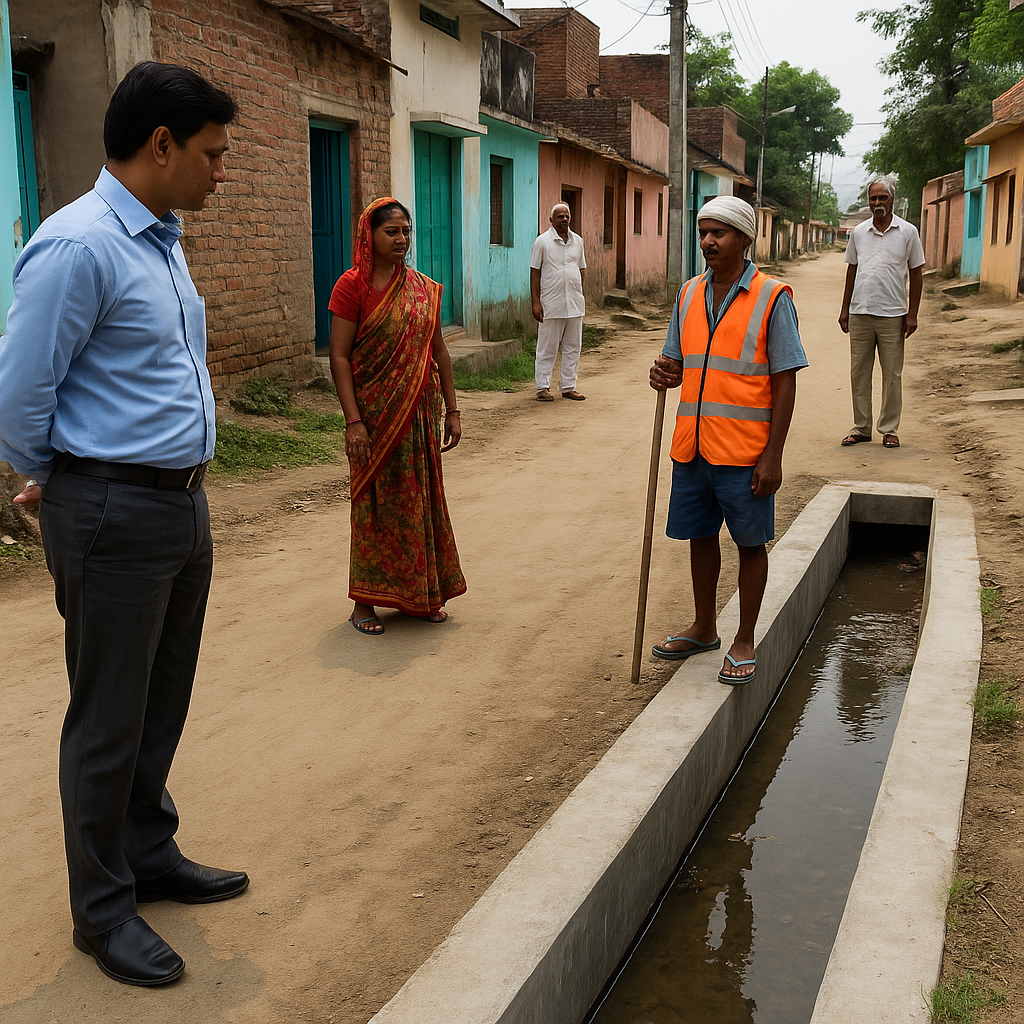
The Patna High Court in 2022 dismissed a writ petition filed by a landowner from Muzaffarpur who had approached the Court complaining that the local municipal authorities had constructed a road and drainage (nala) on her private raiyati land without her consent. The Court held that such a dispute, which involves complex questions of fact and determination of easementary rights of the local public, cannot be decided in writ jurisdiction under Article 226 of the Constitution of India. Instead, the aggrieved person has to take recourse to the proper civil forum.
In this matter, the petitioner (a private landholder) had claimed that her late husband had constructed a house on plot no. 139, khata no. 26, in village Harpur Lahori (now known as Sri Ram Nagar) under Ward No. 12, P.S. Ahiyapur, District Muzaffarpur. Around the house, some vacant land was allegedly left for convenience. According to the petitioner, in or around 2011, the municipal authorities forcibly constructed a road and a drain on this private land. She claimed that this was done without acquisition, without consent, and without any lawful authority. She therefore asked the Court to direct the authorities to remove the road and nala and to restore possession to her.
The petitioner stated that the land was originally purchased in 1983 in her name through a registered sale deed and was later gifted in 1989 to her husband, who was the original petitioner in this case. After his death, the present petitioner pursued the matter. She also claimed to have earlier complained before the District Magistrate, Muzaffarpur, but no remedial action was taken, which is why she invoked the writ jurisdiction of the High Court.
On the other hand, the State authorities and the Municipal Corporation took a very different stand. They filed a counter affidavit based on a factual enquiry conducted at the instance of the District Magistrate. The District Magistrate, Muzaffarpur, had called for a report from the Circle Officer, Kanti, on 16.08.2022. After conducting spot verification and examining revenue and sale records, the Circle Officer submitted his report on 20.08.2022. This report became crucial in the case.
As per the enquiry report, the road and drainage in question were not some arbitrary encroachment by the Municipality. Instead, they existed on the eastern part of the plotted land and formed the only access route for the local residents of that area. The report further noted that a large chunk of land in that locality had been plotted and sold to different persons, and at the time of such plotting an internal road of about 8 feet width had been carved out. This was also corroborated by a sale deed produced by a neighbour dated 17.04.1987, which specifically showed an 8 feet wide road within the boundary. In other words, according to the official enquiry, the road was part of the plotted layout and had been in public use as the common passage for several people.
It was also pointed out on behalf of the respondents that all persons in the locality had left some land for road and drainage purposes, and that the road was being used not only by the petitioner but by all other residents. The authorities therefore took the stand that the petitioner was now trying to block or obstruct the right of passage (right of easement) of other inhabitants by claiming that the land under the road belonged exclusively to her.
After hearing both sides, Hon’ble Mr. Justice Mohit Kumar Shah of the Patna High Court examined the material and came to the conclusion that the dispute was not a simple one. It was not a pure question of law. It involved (a) rival factual assertions about title and extent of land, (b) existence and alignment of an internal road carved out at the time of plotting, (c) longstanding public use and easementary rights of the local residents, and (d) whether the petitioner was now seeking to close a public passage. All these questions, the Court observed, required oral as well as documentary evidence, spot inspection, and perhaps cross-examination of witnesses.
In such a situation, the High Court reiterated the settled principle that writ jurisdiction is not the appropriate remedy when the core of the case is a disputed question of fact or when private rights and easementary claims are to be adjudicated. The Court specifically relied on authoritative Supreme Court decisions which have repeatedly held that when facts are contested and adjudication requires evidence, the writ court should decline interference and the parties should be relegated to the civil court. On this reasoning, the High Court held that the writ petition was not maintainable and dismissed it.
Thus, the outcome of the case is that the petitioner did not get the relief of removal of road and nala. However, the dismissal was not on the ground that she had no right at all, but on the ground that the High Court, sitting in writ jurisdiction, could not determine such disputed factual and easementary issues. The appropriate remedy for the petitioner would be to approach the competent civil court for declaration of title, for removal of alleged encroachment, or for any other consequential relief, where evidence can be properly led and appreciated.
Significance or Implication of the Judgment
This judgment is significant for landowners, municipal bodies, and residents of plotted colonies in Bihar:
- It clarifies that if a person alleges that the Municipality or local authorities have laid a road or drain over private land, but the authorities say that the land was part of a plotted scheme and has been in public use, then such a dispute cannot be casually resolved in writ jurisdiction.
- It protects the collective right of passage of local residents. Where a passage has emerged over time as the only ingress and egress for a locality, courts will be slow to allow an individual to block it through a writ, especially without a full trial.
- It reiterates the consistent position of the Supreme Court that Article 226 is not meant for fact-heavy, evidence-dependent civil disputes. Such matters belong in the civil court.
- For Municipal Corporations, the judgment is a reminder to maintain proper records of layout plans, plotted roads, and public passages, because those records become vital in defending such cases.
- For citizens, the message is: if you genuinely believe your private land has been taken over as a public road without due process, you must be prepared to prove your title and possession through a regular civil suit, and not rely only on a writ.
Legal Issue(s) Decided and the Court’s Decision
- Whether the writ petition under Article 226 of the Constitution is maintainable when the petitioner claims that a road and drain have been constructed over her private raiyati land, but the authorities assert that the road is part of a plotted layout and is the only public access for local residents.
- Court’s reasoning: The case involves disputed questions of fact regarding title, extent of land, existence of an 8-feet internal road in prior sale deeds, and the easementary rights of local residents. Such issues require oral and documentary evidence. Therefore, they cannot be decided in writ proceedings.
- Whether the High Court should interfere to order removal of the road and nala.
- Court’s reasoning: Since the road is shown, on enquiry, to be the common passage for the locality, and since other landholders in the area have also left land for road and drainage, the petitioner’s attempt to block the passage would affect the right of easement of others. Such competing claims must be adjudicated in an appropriate forum, not in writ jurisdiction.
- Outcome:
- The writ petition was dismissed as not maintainable.
Judgments Referred by Parties
- (Not specifically recorded in the judgment.)
Judgments Relied Upon or Cited by Court
- Smt. Gunwant Kaur & Others vs. Municipal Committee, Bhatinda & Others, (1969) 3 SCC 769 – cited to underline that writ jurisdiction is not the proper forum where facts are seriously disputed and evidence is required.
- Thansingh Nathmal & Others vs. The Superintendent of Taxes, Dhubri & Others, AIR 1964 SC 1419 – cited for the principle that when the dispute requires investigation into facts, the High Court should decline to exercise writ jurisdiction.
- Punjab National Bank & Others vs. Atmanand Singh & Others, (2020) 6 SCC 256 – relied upon for reinforcing the rule that writ court will not entertain matters involving complex factual disputes that require evidence.
Case Title
- Petitioner vs. Muzaffarpur Municipal Corporation & Ors.
Case Number
- Civil Writ Jurisdiction Case No. 4129 of 2018
Citation(s)
2023 (1) PLJR 70
Coram and Names of Judges
- Hon’ble Mr. Justice Mohit Kumar Shah
Names of Advocates and who they appeared for
- For the petitioner: Mr. Naresh Chandra Verma, Advocate; Mr. Natraj Verma, Advocate
- For the State: Mr. Rajsh Kumar Sinha, AC to AAG-7
- For the Corporation: Mr. Anurag Saurav, Advocate
Link to Judgment
MTUjNDEyOSMyMDE4IzEjTg==-dD7m2Uw70Dc=
If you found this explanation helpful and wish to stay informed about how legal developments may affect your rights in Bihar, you may consider following Samvida Law Associates for more updates.







