
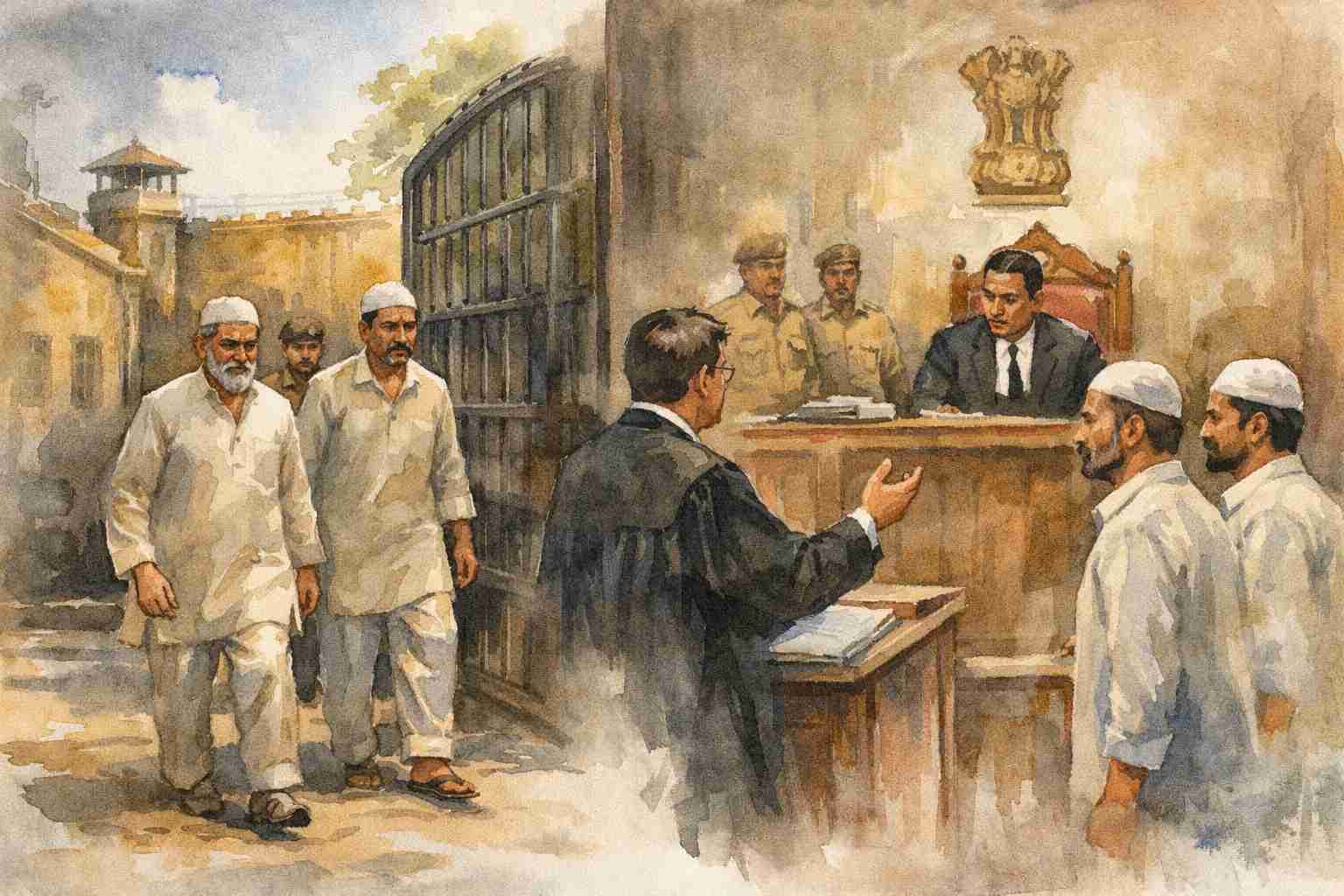
The Patna High Court has set aside decisions of the Bihar State Sentence Remission Board that had rejected pre-mature release of life convicts, and has directed the Board to reconsider the cases under the appropriate policy framework. The order—passed by Hon’ble Mr. Justice Rajeev Ranjan Prasad on 22 December 2022 in two connected criminal writ petitions—clarifies how remission policies must be applied consistently and fairly, especially for convicts whose cases fell during a period when the 2002 remission framework had not yet been implemented in practice.
Simplified Explanation of the Judgment
In two connected criminal writ petitions, the petitioner(s) challenged the Bihar State Sentence Remission Board’s decisions that had turned down their pleas for pre-mature release. The Board had relied on Clause IV of the State’s 10 December 2002 notification (popularly referred to as the “2002 remission policy”) to reject the proposals, citing an “adverse” view from the police and the presiding officer of the trial court. The petitioner(s) argued that this approach was flawed for two key reasons: (i) as a matter of fact, the 2002 policy was not implemented until 25 September 2007, and convicts similarly situated during the interim were considered under the 1984 policy; and (ii) even if the 2002 policy applied, there was no trial-court finding that the crime was an “organized,” pre-planned murder so as to trigger the stricter exclusion in Clause IV.
On hearing both sides, the Court noted that the convictions in question were dated 30 June 2006—squarely within the period when, in practice, remission matters were still being processed under the 1984 framework by jail authorities because the State Remission Board was not yet fully operational. The State itself admitted that the Board’s functional set-up and consideration of cases commenced only from 25 September 2007. Prior to that date, even some convicts sentenced after the 2002 notification had been released by applying the earlier 1984 policy. In view of this admitted administrative reality, the Court followed earlier binding decisions to hold that similarly situated convicts could not be treated differently merely because of the subsequent implementation of the 2002 framework.
The Court then addressed the “planned/organized murder” ground used to deny pre-mature release. It underscored that there was no finding in the trial judgment that the offense was committed in an organized, pre-meditated manner—an essential factual foundation if Clause IV of the 2002 policy is to be invoked to exclude consideration for pre-mature release. The State’s attempt to invoke dictionary meanings of “planned murder” could not substitute for what the trial court had actually found. Administrative authorities cannot read into a trial judgment words that are not there.
Another important aspect was the quality of the adverse reports relied upon. The Superintendent of Police’s report, the Court found, was vague and speculative—merely suggesting that some untoward incident “might” occur if the petitioner(s) were released. In contrast, the Probation Officer’s report spoke to the petitioner(s)’s good conduct in custody, which the Court considered more reliable because the Probation Officer regularly observes the behavior of convicts inside prison. The Court held that such conjectural police inputs cannot outweigh grounded, conduct-based assessments in remission matters, particularly when the prisoner has already spent about two decades in actual custody.
Ultimately, the Court set aside the Board’s rejection orders and directed the Board to convene a meeting within one month of receiving the order, and to reconsider the petitioner(s)’s cases for pre-mature release in line with the legal discussion and applicable policy position recognized by the Court. In short, the judgment ensures that (a) remission policies be applied uniformly and not arbitrarily, and (b) exclusions like “planned/organized murder” be invoked only where the trial record explicitly supports such categorization.
Significance or Implication of the Judgment
This decision is significant for both the public and the administration:
- It reaffirms that remission is a matter of legal right to fair consideration under the correct policy—not a discretionary boon that can be withheld on vague or inconsistent grounds. It ensures that similarly placed prisoners are treated alike, preventing “reverse discrimination.”
- For government and prison authorities, it clarifies that transitional administrative gaps (like the period before a Board becomes functional) cannot produce unequal treatment. If a cohort was considered under an older policy due to practical realities, later authorities must avoid arbitrarily applying a newer, stricter policy to others from the same period.
- It guides Remission Boards to rely on concrete, record-based findings (such as explicit trial-court conclusions) rather than on generalized police apprehensions, and to give due weight to probation-based conduct assessments developed inside prison.
Legal Issue(s) Decided and the Court’s Decision (with reasoning)
- Whether the 2002 remission policy could be applied to convicts whose cases fell during the period before the Remission Board became functional (until 25.09.2007):
— Decision: No; such cases must be treated consistently with others from that period who were considered under the 1984 policy, as recognized by prior binding judgments. Reason: The State admitted that, in practice, cases were considered under the 1984 policy until the Board’s first meeting on 25.09.2007. Consistency and equality demand similar treatment to similarly situated convicts. - Whether an exclusion for “planned/organized murder” under Clause IV of the 2002 policy can bar consideration without a specific trial-court finding:
— Decision: No; the exclusion cannot be invoked absent a clear finding in the trial judgment. Reason: Authorities cannot rely on dictionary meanings or post-hoc inferences to add to what the trial court actually held. - Whether vague apprehensions in a police report can outweigh a positive conduct-based assessment for remission:
— Decision: No; speculative remarks by police cannot defeat the purpose of remission policy, especially after long incarceration, where the Probation Officer’s conduct-based report favors release. Reason: The Probation Officer’s on-ground assessment of behavior carries more probative value than conjecture.
Judgments Referred by Parties (with citations)
- Petitioner(s) relied on:
— Division Bench decision in Cr.W.J.C. No. 748 of 2017 (regarding similar treatment for similarly situated convicts during the transition period).
— Single-Judge decision: Surendra Mahto v. State of Bihar, 2021 (4) PLJR 393 (application of policy consistent with cohort treatment).
— Supreme Court: Dr. G. Sadasivan Nair v. Cochin University of Science & Technology, (2022) 4 SCC 404 (principle against selective application of restrictive provisos; equality).
— Supreme Court: Ram Chander v. State of Chhattisgarh, 2022 SCC OnLine SC 500.
Judgments Relied Upon or Cited by Court (with citations)
- Division Bench: Cr.W.J.C. No. 748 of 2017 (Chandra Kant Kumar v. State of Bihar & Ors.) — noted to establish that the Remission Board was first constituted in 2007 and similarly situated convicts (post-2002, pre-Board) were considered under the 1984 policy.
- Single Bench: Surendra Mahto v. State of Bihar, 2021 (4) PLJR 393 — followed to direct consideration for pre-mature release where the 2002 policy could not be applied against the cohort.
- Supreme Court: Dr. G. Sadasivan Nair v. Cochin University of Science & Technology, (2022) 4 SCC 404 — applied by analogy to disapprove selective application of a restrictive proviso/policy to one individual while exempting others.
Case Title
Criminal Writ Jurisdiction Case No. 861 of 2021 (with) Criminal Writ Jurisdiction Case No. 1310 of 2022 — petitioner(s) v. State of Bihar & Ors. (names withheld) — Patna High Court.
Case Number
Criminal Writ Jurisdiction Case No. 861 of 2021; Criminal Writ Jurisdiction Case No. 1310 of 2022.
Citation(s)
2023 (1) PLJR 384
Coram and Names of Judges
Hon’ble Mr. Justice Rajeev Ranjan Prasad.
Names of Advocates and who they appeared for
- For the petitioner(s): Mr. Vijay Kumar Singh, Advocate.
- For the respondent-State: Mr. Prabhu Narayan Sharma, AC to AG.
Link to Judgment
MTYjODYxIzIwMjEjNCNO-VaoFI4yRvpI=
If you found this explanation helpful and wish to stay informed about how legal developments may affect your rights in Bihar, you may consider following Samvida Law Associates for more updates.







