
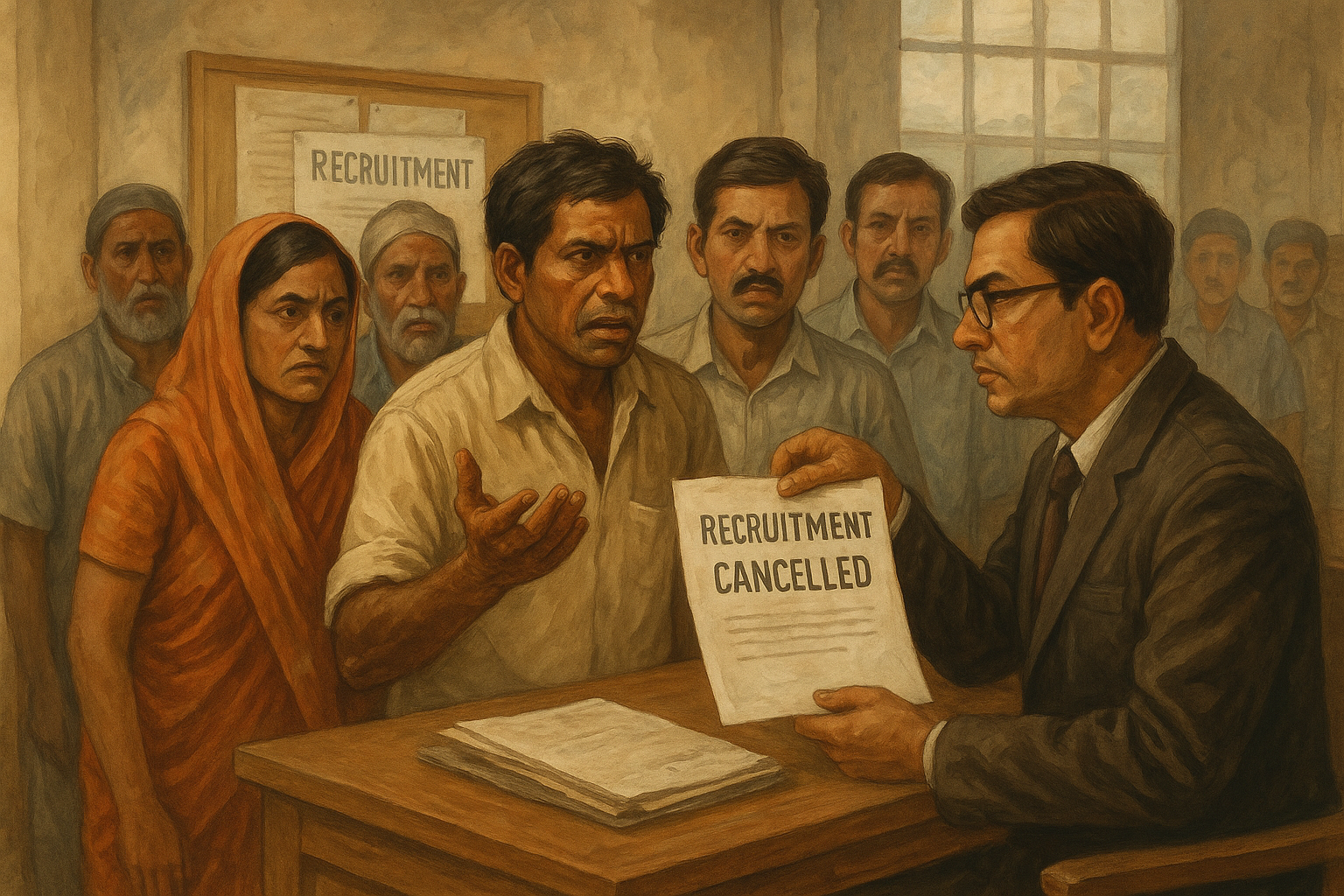
The Patna High Court’s Division Bench delivered an important ruling on 14 November 2022 in a Letters Patent Appeal arising from a long-delayed recruitment of unskilled labourers by the erstwhile Bihar State Electricity Board (now Bihar State Power Holding Company Ltd.). The appeal challenged a Single Judge’s 2018 decision that had directed the authorities to complete the 2007 selection and not alter the eligibility criteria mid-process. The Division Bench modified the relief: instead of compelling recruitment under the old criteria, it awarded compensation to the affected candidates, while underscoring principles of fairness, non-arbitrariness, and legitimate expectation in public employment processes.
The case began with Advertisement No. 01/2007 (dated 13 March 2007) for Junior Lineman and Unskilled Labourer on contract. For Unskilled Labourer, the qualification prescribed was Class 8 pass. Applications were submitted in March 2007, but the process stalled amid a sectoral restructuring: in 2012, the Board was unbundled into multiple companies under the Bihar State Electricity Reforms Transfer Scheme, 2012. Later, in 2015, the new holding company decided to (i) cancel the pending process and (ii) raise the minimum qualification for the Class-IV/Unskilled post from Class 8 to Class 10.
Aggrieved candidates first secured an order in May 2014 directing the authorities to take a final decision on the 2007 recruitment within six months. When that was not honored, a contempt petition followed. During the contempt proceedings, the holding company disclosed two communications dated 16.04.2015 and 05.05.2015 announcing cancellation of the process and enhancement of the qualification to Matriculation. The candidates were permitted to withdraw the contempt and challenge those communications through a fresh writ petition (CWJC No. 6229/2016).
On 6 August 2018, the Single Judge held that the employer could not change the “rules of the game” mid-way by altering the qualification from Class 8 to Class 10 for the very posts that had been advertised in 2007. The Single Judge directed completion of the process as per the original advertisement within three months.
In the Letters Patent Appeal (LPA No. 1264 of 2018), the appellants argued there is no indefeasible right to appointment and placed reliance on Shankarsan Dash v. Union of India. They also contended that after restructuring under the 2012 scheme, the power companies had administrative authority to revisit eligibility criteria and cancel an outdated process. The respondents countered that once recruitment had begun, qualifications could not be elevated mid-stream; doing so would unlawfully change the rules.
The Division Bench (Hon’ble Mr. Justice P. B. Bajanthri and Hon’ble Mr. Justice Purnendu Singh) acknowledged the tension between two settled propositions: candidates do not have a vested right to appointment merely because vacancies and a selection process exist; yet State action must be fair, non-arbitrary, and respectful of legitimate expectations. The Bench discussed the Supreme Court’s jurisprudence on “rules of the game,” including Tej Prakash Pathak (2013) and earlier authorities, and noted that the contours of when and how selection procedures can be changed mid-course have been referred to a larger Bench.
Crucially, the Bench observed that raising the minimum educational qualification from Class 8 to Class 10 offered little functional relevance to the actual duties of an unskilled labourer, and that the prolonged pendency (about seven years) had created a legitimate expectation that the 2007 process would be taken to its logical end. The company’s late decision to cancel—surfaced only in the contempt proceedings—was found to have caused prejudice and defeat legitimate expectation.
Balancing all factors, the Division Bench did not compel recruitment under the old advertisement. Instead, it modified the Single Judge’s order and directed payment of compensation: ₹1.5 lakh to each of the petitioners within four weeks, failing which interest at 9% per annum would apply until actual payment. Costs were not imposed. This relief recognized the harm caused by delay and arbitrary shift in criteria, without mandating appointments in a process initiated over a decade earlier.
Simplified Explanation of the Judgment
This case is about fairness in government recruitment and what happens when authorities delay and later change the eligibility rules. In 2007, an electricity sector employer in Bihar advertised posts for unskilled labourers, requiring only Class 8 qualification. Many candidates applied. Years passed without a final decision. In 2012, the sector was restructured into new companies. Then in 2015, the new authority cancelled the old process and raised the educational qualification to Class 10.
The candidates had already approached the High Court in 2014 and obtained an order requiring the authorities to take a final decision within six months. When the order was not followed, they filed a contempt case. Only then did the authority reveal two letters from April and May 2015 announcing cancellation and enhanced qualification. The candidates then filed a fresh writ to challenge those letters.
In 2018, a Single Judge agreed with the candidates and said the employer could not change the “rules of the game” after the process had started. The Judge directed completion of recruitment under the original 2007 terms. The authority appealed.
On appeal, the Division Bench carefully balanced two legal ideas:
- No candidate has an automatic right to be appointed just because there was an advertisement and they applied. Government can decide not to fill posts for valid reasons. This principle comes from Supreme Court cases like Shankarsan Dash.
- But at the same time, the government must act fairly and cannot act arbitrarily. If candidates are made to wait for years and the authority quietly cancels the process or raises eligibility without a strong reason, the court may intervene to protect legitimate expectations.
The Bench noted that changing the qualification from Class 8 to Class 10 for an unskilled post did not have a clear functional justification given the nature of the job. The long delay and the way the cancellation surfaced—during contempt proceedings—suggested unfairness. The court emphasized that public bodies cannot “play fast and loose” with recruitment processes; they must follow principles of reason, relevance, and non-arbitrariness.
However, the Bench also recognized that forcing appointments under an advertisement issued many years earlier might not be appropriate. Rather than order recruitment under the old criteria, the court opted for a practical remedy that acknowledged the candidates’ legitimate expectation and the prejudice caused: monetary compensation. It directed payment of ₹1.5 lakh to each affected candidate within four weeks, with 9% annual interest if delayed. This approach balanced the lack of a vested right to appointment against the duty of the State and its instrumentalities to act fairly.
In short, the judgment is a reminder that while no one can demand a government job as a matter of right, the government also cannot keep a selection pending for years and then change the eligibility mid-course without compelling public interest. When such unfairness occurs, courts can fashion relief—here, compensation—to do justice.
Significance or Implication of the Judgment
- For the general public and job-seekers: This decision reassures candidates that courts will check arbitrary State actions in recruitment, especially when processes are delayed and expectations are built. Even when appointments cannot be compelled, compensation can be awarded to address unfairness.
- For government departments and public sector entities: The ruling underscores that changes to eligibility criteria during an ongoing recruitment must be backed by compelling reasons and followed transparently. Prolonged inaction and last-minute alterations can invite judicial scrutiny and financial liability.
- For administrators handling legacy advertisements: If restructuring or policy changes make earlier criteria obsolete, the authorities should close processes promptly with reasons, communicate decisions directly to candidates, and consider transition measures, instead of letting matters linger.
Legal Issue(s) Decided and the Court’s Decision with reasoning
- Can an employer change eligibility criteria mid-process?
The court reiterated that changing “rules of the game” after the process has begun is generally impermissible unless justified by compelling public interest. Here, raising the qualification for an unskilled post from Class 8 to Class 10 lacked sufficient functional justification. - Do candidates have a right to be appointed?
No indefeasible right to appointment exists merely because a process started. However, State action must remain non-arbitrary and fair; the doctrine of legitimate expectation applies where candidates are led to reasonably expect completion of an announced process. - What is an appropriate remedy when unfairness is established?
Instead of mandating appointments under a long-stalled advertisement, the court awarded compensation (₹1.5 lakh per candidate, with 9% interest if delayed), recognizing both the absence of a vested right and the prejudice caused by protracted delay and abrupt cancellation.
Judgments Referred by Parties (with citations)
- Appellants (employer side):
- Shankarsan Dash v. Union of India, (1991) 3 SCC 47 — no indefeasible right to appointment; State may decline to fill vacancies for valid reasons.
- Respondents (candidates):
- Relied on the “rules of the game” principle, asserting that eligibility cannot be altered mid-selection (as recognized in multiple Supreme Court precedents later discussed by the court).
Judgments Relied Upon or Cited by Court (with citations)
- Tej Prakash Pathak v. Rajasthan High Court, (2013) 4 SCC 540 — discussion on changing “rules of the game” and need for larger Bench clarity.
- State of Haryana v. Subash Chander Marwaha, (1974) 3 SCC 220 — no right to appointment despite qualifying marks; high standards may justify not filling posts.
- K. Manjusree v. State of A.P., (2008) 3 SCC 512; P.K. Ramachandra Iyer v. Union of India, (1984) 2 SCC 141; Umesh Chandra Shukla v. Union of India, (1985) 3 SCC 721; Durgacharan Misra v. State of Orissa, (1987) 4 SCC 646 — discussed in context of selection standards and mid-course changes.
- Asha Kaul v. State of J&K, (1993) 2 SCC 573 — State must act fairly; cannot reduce recruitment to a farce after initiating the process.
- NOIDA Entrepreneurs Assn. v. NOIDA — principles of non-arbitrariness and legitimate expectation in State action.
- State of Jharkhand v. Brahmputra Metallics Ltd., Ranchi, 2020 SCC OnLine SC 968 — substantive legitimate expectation and abuse of power.
- State of Bihar v. Shyama Nandan Mishra, 2022 LiveLaw (SC) 449 — upsetting a substantive legitimate expectation without compelling public interest amounts to abuse of power.
Case Title
Bihar State Electricity Board (now Bihar State Power Holding Company Ltd.) & Ors. v. State of Bihar & Ors. (anonymised; individual names not used)
Case Number
Letters Patent Appeal No. 1264 of 2018 (arising out of CWJC No. 6229 of 2016)
Citation(s)
2023 (1) PLJR 141
Coram and Names of Judges
Hon’ble Mr. Justice P. B. Bajanthri; Hon’ble Mr. Justice Purnendu Singh — Oral Judgment dated 14.11.2022.
Names of Advocates and who they appeared for
- Mr. Anand Kumar Ojha — for the appellants (employer side).
- Mr. Yogendra Prasad Sinha, AAG-7 — for the respondents (State side).
Link to Judgment
MyMxMjY0IzIwMTgjMSNO-8zi6suRQBVM=
If you found this explanation helpful and wish to stay informed about how legal developments may affect your rights in Bihar, you may consider following Samvida Law Associates for more updates.







