
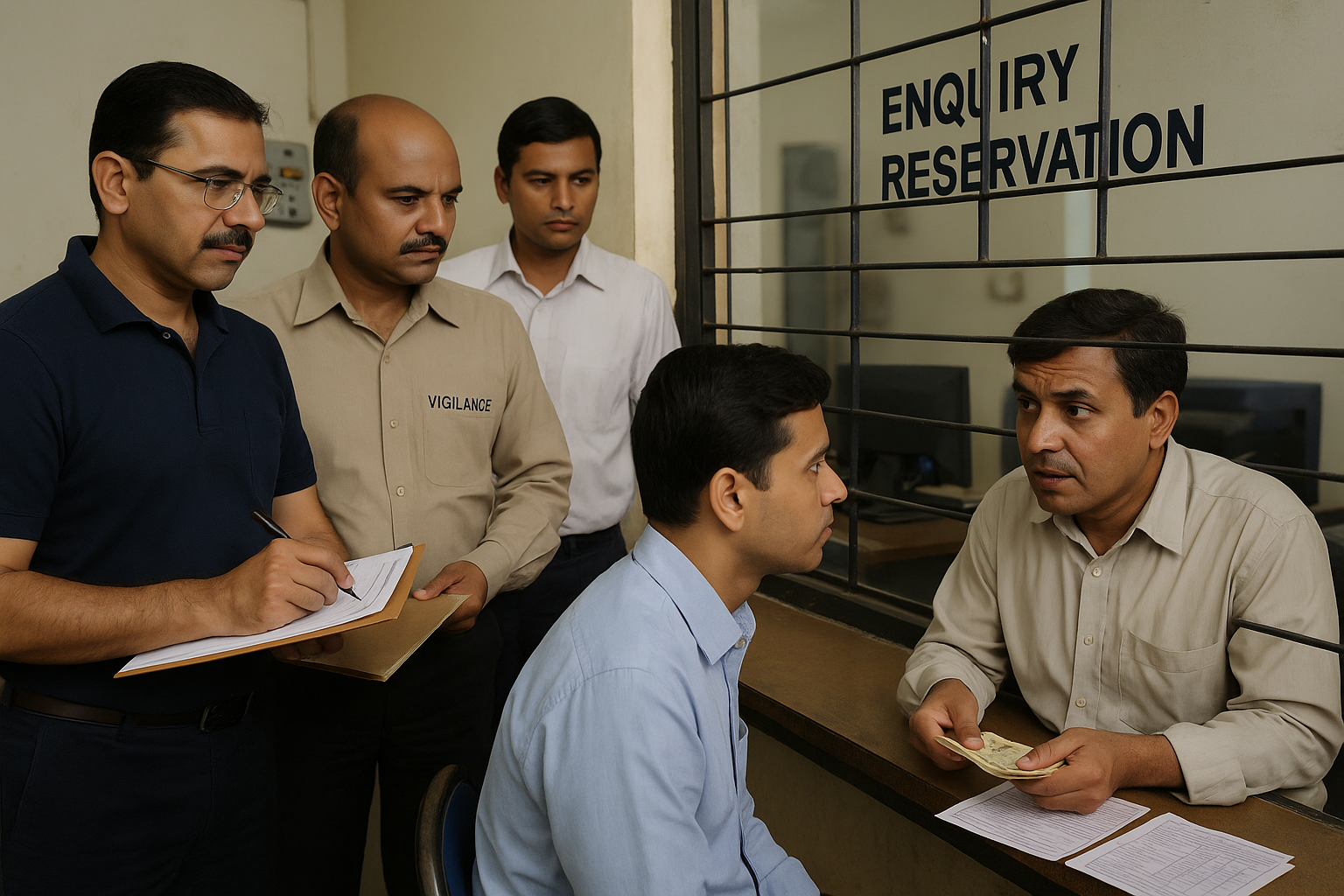
The Patna High Court has set aside a disciplinary punishment imposed on a railway employee after finding that the vigilance inspection and the subsequent departmental proceedings suffered from serious procedural defects. The Court held that when a surprise cash/checking operation is conducted without independent witnesses and when there is inconsistency between the original charge and the final findings of the disciplinary and appellate authorities, such proceedings cannot be sustained in law. The Court, therefore, allowed the writ petition and directed restoration of the employee’s pay, along with payment of consequential dues, within three months.
In this case, the petitioner was working as an Enquiry-cum-Reservation Clerk in the East Central Railway. A vigilance team conducted a sudden inspection on 12.09.2011 and prepared what is called a “Joint Inspection Memo.” During this check, the officials claimed that the petitioner’s government cash was short by ₹632. The team also found three Tatkal requisition forms at the counter without claimants and noticed that some reservation slips were not properly endorsed. On this basis, a departmental proceeding was initiated and three articles of charge were framed, the main allegation being that the petitioner had misappropriated ₹632 from government cash and thereby violated Rule 3(1)(i)–(iii) of the Railway Services (Conduct) Rules, 1966.
An inquiry officer was appointed. He submitted his report; thereafter, the disciplinary authority imposed the penalty of reduction of pay to a lower stage for three years with cumulative effect. The appellate authority confirmed this order on 10.03.2014. The petitioner then approached the Central Administrative Tribunal (CAT), Patna Bench, by filing O.A. No. 17 of 2016. The Tribunal, however, upheld the disciplinary action on 01.08.2019. Aggrieved, the petitioner invoked the writ jurisdiction of the Patna High Court.
When the matter reached the High Court, the petitioner attacked the very foundation of the vigilance check and the inquiry. It was strongly contended that: (i) the vigilance team did not associate any independent witness, which is mandatory in view of the Supreme Court ruling in Moni Shankar v. Union of India, (2008) 3 SCC 484; (ii) the inquiry officer himself was from the vigilance side and therefore should not have inquired into a vigilance-based charge, in light of Union of India v. Prakash Kumar Tondon, (2009) 2 SCC 541; and (iii) there was a serious mismatch between the article of charge (alleging shortage of ₹632) and the final finding recorded by the disciplinary and appellate authorities (treating the case as if there was excess of ₹76). The petitioner also relied on M.V. Bijlani v. Union of India, (2006) 5 SCC 88, to urge that the authority cannot travel beyond the charge. The High Court found considerable force in these submissions.
Most crucially, the Court examined the “Joint Inspection Memo.” It noted that the memo was a cyclostyled (pre-printed) format in which the vigilance team had not even clearly indicated whether the difference in cash was a shortage or an excess. This, the Court said, showed non-application of mind. Once the charge memo itself specifically alleged shortage of ₹632, the disciplinary authority could not later proceed on the premise that there was “excess” cash of ₹76. Such a shift in the very nature of allegation went to the root of the matter and vitiated the entire proceeding. The Tribunal, according to the High Court, failed to appreciate this fundamental inconsistency.
Accordingly, the Patna High Court, by oral judgment dated 10.11.2022 in CWJC No. 11663 of 2021, set aside:
(a) the order of the Central Administrative Tribunal dated 01.08.2019 in O.A. No. 17 of 2016;
(b) the disciplinary authority’s order dated 23.07.2013; and
(c) the appellate authority’s order dated 10.03.2014.
It further directed the railway authorities to restore the employee’s pay and release the consequential monetary benefits within three months of receiving the order.
Significance or Implication of the Judgment
This judgment is significant for government and public sector employees, especially those in revenue-handling posts such as booking clerks, ticket reservation clerks, and commercial staff in the Railways.
- Reaffirmation of procedural safeguards in vigilance checks: The Court reiterated that where an employee is checked in a surprise operation and financial irregularity is alleged, the inspection report must be supported by independent witnesses. Absence of such witnesses can cast doubt on the entire proceeding, particularly when the employee disputes the facts. This gives employees protection against arbitrary or one-sided vigilance reports.
- Authorities cannot change the nature of the charge midway: The case shows that if an employee is initially charged with “shortage of cash,” the disciplinary authority cannot punish him on the ground of “excess cash” or some other variant of the same incident. The final punishment must be for the charge that was actually framed and proved. This principle ensures fairness, as the delinquent employee must know the exact allegation he has to defend.
- Appointment of impartial inquiry officer: The Court disapproved of appointing a vigilance officer to inquire into a vigilance-based case, unless the department can clearly show that the officer was not part of vigilance at the relevant time. This protects the neutrality of departmental inquiries and reduces the perception of bias.
- Tribunal orders are open to judicial review: Even though the Central Administrative Tribunal had upheld the punishment, the High Court stepped in because material aspects — like the absence of independent witnesses and the inconsistency in charges — had been ignored. This underscores that High Courts will interfere when there is perversity or non-consideration of relevant law and precedents.
- Financial restoration within a time frame: By directing the authority to restore pay and release the differential amount within three months, the Court ensured real relief to the petitioner and not merely a technical victory. For serving or retired employees, this aspect is practical and valuable.
Legal Issue(s) Decided and the Court’s Decision with Reasoning
- Whether a vigilance/preventive check conducted without independent witnesses is valid?
The Court held that, in the absence of material showing that independent witnesses were not required for such a check, the principle laid down in Moni Shankar v. Union of India applies, and independent witnesses ought to have been associated. Since the Railway failed to distinguish its procedure from what the Supreme Court had considered, the memo stood weakened. - Whether a vigilance inspector can act as an inquiry officer in a vigilance-based disciplinary proceeding?
The Court found that the petitioner had specifically shown, through annexures, that the inquiry officer was a vigilance inspector. The Railways did not produce any record to rebut this. Relying on the Supreme Court’s view in Union of India v. Prakash Kumar Tondon, the Court accepted the objection and treated the inquiry as suffering from a procedural defect. - Whether disciplinary and appellate authorities can punish an employee for something different from the original charge?
No. The original article of charge alleged shortage of ₹632. But the authorities later treated the case as if the petitioner had excess of ₹76. This was held to be a clear case of non-application of mind and of travelling beyond the charge, contrary to the principle in M.V. Bijlani v. Union of India, (2006) 5 SCC 88. Hence, the orders could not be sustained. - Whether the Tribunal was justified in affirming the punishment?
The Court held that the Tribunal failed to notice these vital infirmities and therefore its order was liable to be set aside.
Judgments Referred by Parties (with citations)
- Moni Shankar v. Union of India, (2008) 3 SCC 484 — cited to argue that vigilance checks, particularly in railway matters, must be supported by independent witnesses and proper procedure.
- Union of India & Others v. Prakash Kumar Tondon, (2009) 2 SCC 541 — relied on to argue that a vigilance officer should not sit in inquiry over a vigilance case.
- M.V. Bijlani v. Union of India, (2006) 5 SCC 88 — cited to show that the disciplinary authority cannot go beyond the charge and punish on a different foundation.
Judgments Relied Upon or Cited by Court (with citations)
- The High Court specifically took note of the principles in Moni Shankar v. Union of India, (2008) 3 SCC 484, on the need for independent witnesses in railway vigilance checks.
- The Court also accepted the reliance placed on Union of India v. Prakash Kumar Tondon, (2009) 2 SCC 541, regarding impartiality of inquiry officers in vigilance matters.
- The ratio in M.V. Bijlani v. Union of India, (2006) 5 SCC 88, was accepted to hold that findings inconsistent with the charge cannot stand.
Case Title
- Petitioner vs. Union of India through the General Manager, East Central Railway & Ors. (actual party names withheld for publication purposes)
Case Number
- Civil Writ Jurisdiction Case No. 11663 of 2021
- Arising out of order dated 01.08.2019 in O.A. No. 17 of 2016 of the Central Administrative Tribunal, Patna Bench
Citation(s)
2023 (1) PLJR 11
Coram and Names of Judges
- Hon’ble Mr. Justice P. B. Bajanthri
- Hon’ble Mr. Justice Purnendu Singh
(Oral Judgment dated 10.11.2022)
Names of Advocates and Who They Appeared For
- For the petitioner: Mr. Gautam Saha, Advocate
- For the respondents (Union of India / East Central Railway): Mr. Praveen Kumar Sinha, Advocate with Mr. Rakesh Kumar Sinha, C.G.C.
Link to Judgment
MTUjMTE2NjMjMjAyMSMxI04=-0mbacbFCrG8=
If you found this explanation helpful and wish to stay informed about how legal developments may affect your rights in Bihar, you may consider following Samvida Law Associates for more updates.








Very helpful article for me on my case
We are glad we could help.