
Case Background
This case arose from a dispute over the election of office bearers of the District Bar Association, Lakhisarai.
According to the petitioners, the last election of the District Bar Association was held on 16.10.2023. After coming into office, the elected committee allegedly started acting contrary to the by-laws and rules of the association.
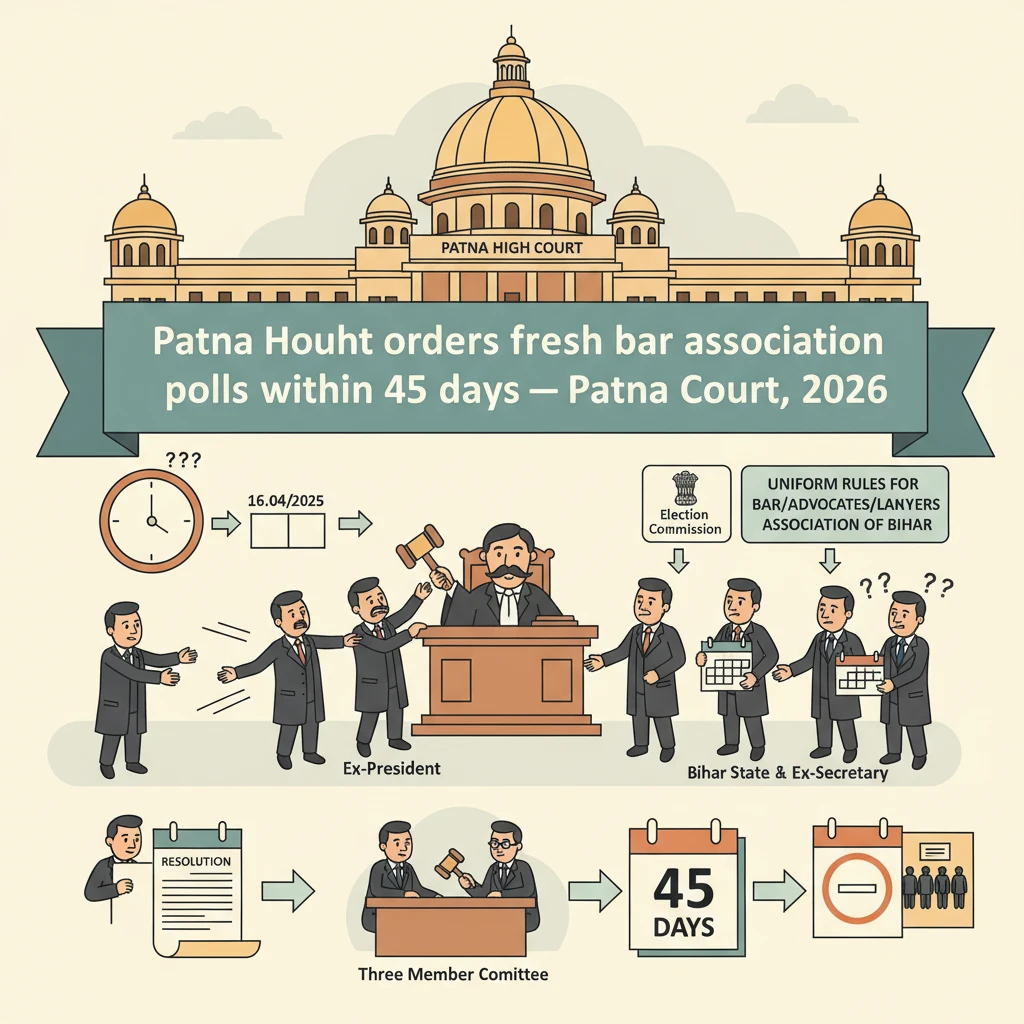
The petitioners pointed out that under Rule 15 of the “Uniform Rules For Bar/Advocates/Lawyers Association of Bihar”, the term of office bearers and members of the executive committee is for two years. The term is to be counted from 16th April of the year of election.
As per their case, the term of the previously elected committee came to an end on 16.04.2025. After expiry of this term, the executive committee was required to cease to function. The Election Commission of the Bihar State Bar Council was then expected to take steps to hold a fresh election within three months.
The petitioners alleged that, despite this rule, no fresh election of the District Bar Association, Lakhisarai, was held even after the term ended. This, they said, created serious resentment among the members of the bar.
Due to the delay, some members, including the petitioners, constituted what they described as an “ad hoc committee” and started the process for conducting elections themselves.
Meanwhile, on 12.11.2025, the Bihar State Bar Council itself deliberated on the situation of the Lakhisarai Bar Association. As recorded in the writ petition and referred to in the judgment, the Bar Council considered the continuing disputes in the association to be “very unfortunate”. As a last chance, it resolved to grant 30 days’ time to the association for calling a General Body Meeting to elect a Returning Officer and a Three Men Committee for holding the election.
Despite this resolution of 12.11.2025, the petitioners claimed that members of the Bar Council, for one reason or another, were not allowing the election to be conducted. The General Body of the Lakhisarai Bar Association then fixed 24.01.2026 as the date of election, based on a general notice dated 18.12.2025.
Before that election could be held, the Bihar State Bar Council passed an order dated 04.01.2026, reference no. 18 to 24/2026. By this order, it resolved to restrain, with immediate effect, the commencement of the election process of the District Bar Association, Lakhisarai, which had been initiated in pursuance of the General Body Meeting dated 11.12.2025.
In addition, a show-cause notice dated 09.12.2025 was issued to the petitioners, asking them to submit their explanation within a fortnight. Later, by order dated 15.12.2025, a Three Member Committee of the respondents was directed to resolve the ongoing stalemate and hindrance in the Lakhisarai Bar Association.
Feeling aggrieved by these actions of the Bihar State Bar Council, the petitioners approached the Patna High Court under its civil writ jurisdiction in CWJC No. 1062 of 2026.
What the Court Examined and Decided
The matter was heard by Hon’ble Mr. Justice Harish Kumar on 22.01.2026. The Court heard the learned Senior Advocate for the petitioners, the counsel for the Bihar State Bar Council, and the counsel for the State.
The petitioners’ side argued that the central problem was the inaction of the Bihar State Bar Council in not allowing the election of the District Bar Association, Lakhisarai, to proceed. They challenged three main actions:
First, the order dated 04.01.2026 (Ref: 18 to 24/2026), by which the Bar Council restrained the initiation of the election process that had started after the General Body Meeting dated 11.12.2025.
Second, the show-cause notice dated 09.12.2025 directing them to explain their conduct within fifteen days.
Third, the order dated 15.12.2025 directing a Three Member Committee to resolve the stalemate and hindrance in the affairs of the Lakhisarai Bar Association.
On the legal side, the petitioners relied heavily on Rule 15 of the Uniform Rules For Bar/Advocates/Lawyers Association of Bihar. This rule states that the term of office bearers and executive members is two years from the date of election, counted from 16th April of that year. After this period, the executive committee must stop functioning, and the Election Commission of the Bihar State Bar Council must hold elections within three months.
They pointed out that the term of the earlier committee had ended on 16.04.2025, yet no fresh election had taken place. According to them, this left the association without a validly elected body and compelled them to form an ad hoc committee to initiate the election process. Their intention, they said, was only to secure a fresh, properly elected committee.
On the other hand, the Bihar State Bar Council, represented by its counsel, strongly opposed the writ petition. It was argued that the petitioners themselves had acted illegally by forming an ad hoc committee. According to the Bar Council, this ad hoc body had no legal status and the petitioners had effectively taken the law into their own hands.
The Bar Council relied on Rule 32 of the same Uniform Rules. This rule provides that the decision of the Bar Council is binding on all bar associations and lawyers in the State of Bihar. Further, referring to Rule 32-A, the Bar Council explained that its Executive Committee acts as the Election Commission. It has full powers to get elections conducted in all affiliated bar associations, including the power to change a Returning Officer, stay counting or declaration of results, annul elections and cancel results.
According to the Bar Council, there had been irregularities and “high handedness” on the part of the so-called General Body members of the Lakhisarai Bar Association. In view of this, and after proper deliberation, a Three Member Committee was constituted to look into the matter. The plan was that, after this committee examined and apprised the situation, the process of election of the association would then be taken up.
The Three Member Committee reported that there was a “sorry state of affairs” in the District Bar Association, Lakhisarai. It further informed that the petitioners, by constituting an illegal ad hoc committee, had started the election process beyond their powers and contrary to the model rules. This report led to the impugned order dated 04.01.2026 by which the Bar Council stopped the election process initiated by the petitioners’ side.
After hearing both sides, the Patna High Court focused on one key point: both groups actually wanted an election to be held. The real dispute was about who would control and conduct that election and whether the ad hoc committee formed by some members had any role.
The Court noted that, because of interference by the “self created ad-hoc Committee” of the District Bar Association, Lakhisarai, some obstruction had arisen in conducting the election.
However, during the hearing, the petitioners made an important statement. They submitted unanimously that they would not cause any impediment if the Bihar State Bar Council was genuinely interested in holding the election. They emphasised that holding elections was the dire need of the situation.
The Court then examined the factual position and the model rules. It took note of the admitted fact that the term of office bearers had already come to an end (the judgment records the date as 16.10.2025 at this stage, though earlier the end of term is stated as 16.04.2025 in the narration given on behalf of the petitioners).
Crucially, the Court referred to the mandate of the Model Rules, which clearly require that the Executive Committee of the Bihar State Bar Council acts as the Election Commission. Under these rules, the Executive Committee has all the powers to get elections conducted in all affiliated Bar/Advocates/Lawyers Associations.
In light of these rules, the Court found it appropriate to direct the Bihar State Bar Council to take charge of the election process rather than allow the self-constituted ad hoc committee to proceed.
Therefore, instead of quashing the Bar Council’s actions or endorsing the ad hoc election process, the Court issued a clear, time-bound direction. It ordered the Bihar State Bar Council to conduct the election of the District Bar Association, Lakhisarai, by following due process of law within 45 days from the date of pronouncement of the order.
With this direction, the writ petition was disposed of. No further relief was granted in favour of the petitioners, and the Court did not interfere with the Bar Council’s authority under the Uniform Rules.
Why This Judgment Matters
This judgment is significant for lawyers and bar associations across Bihar.
First, it confirms that under the Uniform Rules for Bar/Advocates/Lawyers Associations of Bihar, it is the Executive Committee of the Bihar State Bar Council that functions as the Election Commission for bar association elections.
This means that, even where the term of a bar association’s committee has expired and elections are delayed, members cannot unilaterally form ad hoc committees and start their own election process. Any such move can be treated as beyond their powers and contrary to the model rules.
Second, the decision also shows that the Patna High Court is willing to step in when there is a deadlock in bar association affairs. Here, the Court did not side with either group fully. Instead, it looked at the larger interest of the institution and directed that proper elections must be held within a fixed time.
For ordinary advocates, especially those practising in district courts, this judgment reinforces that the proper route is to press the Bar Council to act under the rules, rather than trying to bypass it.
For the Bihar State Bar Council, the order is a reminder of its duty to ensure regular, timely, and fair elections in all affiliated associations, especially once the term of existing office bearers ends.
Legal Issues and Answers
- Issue: Can members of a district bar association form an ad hoc committee and conduct elections themselves when the term of the existing committee has expired and the Bar Council has intervened?
Answer: The Court did not approve of the self-created ad hoc committee and instead directed that, as per the Model Rules, the Bihar State Bar Council’s Executive Committee must act as the Election Commission and conduct the election. - Issue: What is the responsibility of the Bihar State Bar Council regarding bar association elections when terms of office bearers have ended?
Answer: The Court held that under the Model Rules, the Executive Committee of the Bihar State Bar Council is required to act as the Election Commission and has all powers to conduct elections in affiliated associations; it was directed to conduct the Lakhisarai Bar Association election within 45 days.
Cases Cited by the Court
- The judgment does not mention or rely on any prior decided cases. No case law is cited.
Case Details
Case Number: Civil Writ Jurisdiction Case No. 1062 of 2026
Case Title: Rajesh Kumar & Ors. v. The State of Bihar & Ors.
Coram: Hon’ble Mr. Justice Harish Kumar
Citation: 2024(2) PLJR 562
Advocates:
- For the petitioners: Mr. Amit Srivastava, Senior Advocate; Mr. Onkar Nath, Advocate; Mr. Ram Vinay Pd. Singh, Advocate.
- For the Bihar State Bar Council: Mr. Bipin Kumar, Advocate; Mr. Ravi, Advocate.
- For the State: Mr. Sita Ram Yadav, GP-16.
Nature of the case: Writ petition under civil writ jurisdiction seeking directions regarding conduct of election to the District Bar Association, Lakhisarai, and challenging orders and notices issued by the Bihar State Bar Council.
Link to the Judgment: Patna High Court Judgment in CWJC No. 1062 of 2026
If you found this explanation helpful and wish to stay informed about
how legal developments may affect your rights in Bihar,
you may consider following Samvida Law Associates for more updates.







