

Case Background
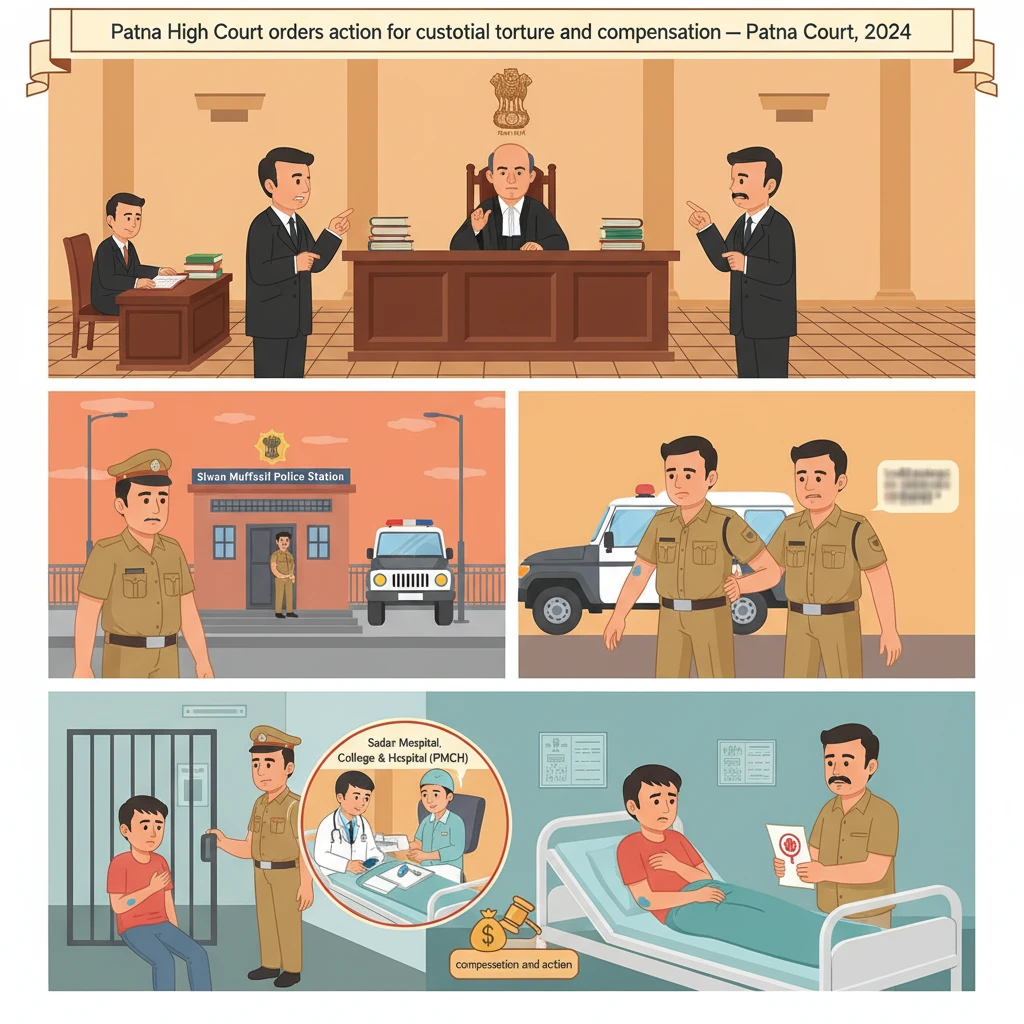
The case started with a criminal writ petition filed by Dinesh Kumar Singh, a resident of Siwan. He approached the Patna High Court as the father of an accused person, Yogesh Kumar Singh @ Techchu Singh.
According to the petition, on 4 July 2017 at about 2:30 p.m., the son was picked up by police from the court premises in Siwan. The arrest was said to be in connection with Siwan Muffasil P.S. Case No. 185 of 2017, registered under Sections 326, 307 and 34 of the Indian Penal Code and Section 27 of the Arms Act.
The petitioner alleged that after arrest, his son was illegally detained, brutally beaten with lathis, kicked and punched, and seriously injured while in police custody. He claimed that the arresting officers did not follow the mandatory safeguards in Sections 50, 56 and 57 of the Code of Criminal Procedure, 1973.
The writ petition, filed in 2017, sought directions for action against specific police officers (respondent numbers 6 to 8) and against the authorities generally for illegal arrest, delay in production before the Magistrate, custodial assault, and non-compliance with Cr.P.C. provisions. It also requested any other appropriate reliefs.
Over time, the victim was tried in Sessions Trial No. 622 of 2018 arising out of the same police station case. The High Court noted that he was ultimately acquitted by judgment dated 29 February 2020 in that sessions trial.
What the Court Examined and Decided
The Patna High Court, through Hon’ble Mr. Justice Bibek Chaudhuri, began by recalling a strong observation of the Supreme Court in State of M.P. v. Shyamsunder Trivedi & Ors., (1995) 4 SCC 262. The Supreme Court had described death in police custody and torture in custody as among the worst crimes in a civilised society, an affront to human dignity and a threat to the rule of law.
Against that backdrop, the Court examined the facts of this case. Certain facts were undisputed and admitted in the counter affidavits filed by senior police officers (respondent numbers 5 and 7).
First, it was undisputed that on 4 July 2017 at about 2:30 p.m., the petitioner’s son was arrested from the Siwan court premises in connection with Siwan Muffasil P.S. Case No. 185 of 2017. The arrest was based on some confessional statements of co-accused persons in that case. The Court pointed out that a statement of one accused implicating another is not admissible in evidence and cannot, by itself, be treated as a proper basis for arrest in the absence of other material.
Secondly, after the arrest, the victim was taken to Siwan Muffasil Police Station and kept in police custody. This was recorded in G.D. Entry No. 111 dated 4 July 2017. Respondent No. 7 was the Officer-in-Charge of that police station at the relevant time.
According to the Officer-in-Charge, while in the police lock-up the arrested person complained of breathing problems and was then taken to the local hospital. At about 5:00 p.m. the Medical Officer at Sadar Hospital, Siwan examined him and recorded multiple injuries:
1. Pain and swelling of the left thigh.
2. Bruise on the left scapular region.
3. Pain in chest.
4. Bruise on the left flank region.
5. Large bruise on the left thigh.
6. Bruise on the left leg.
7. Bruise on the right thigh.
8. Pain in both lower limbs.
The Medical Officer opined that the injuries were simple and caused by a hard and blunt substance. However, the Court emphasised that there was no allegation from the police side that the arrested person had already been injured before his arrest. It was not their case that he was brought in injured condition.
The arrested person was admitted to Sadar Hospital and, considering the nature of the injuries, referred to Patna Medical College & Hospital (PMCH). He was discharged from PMCH on 7 July 2017. The Court noted that, on the materials, the injuries were received while he was in police custody.
The petitioner produced photographs showing severe bruises, haematoma and swelling on the upper portions of both legs of his son. These supported the allegation of heavy beating.
The Court then considered contemporaneous complaints made by the victim himself. On 5 July 2017, an application was filed on his behalf before the Chief Judicial Magistrate, Siwan. In this application, he stated that he had been arrested by Siwan Police in connection with some unknown case and, with intention to kill him, was severely assaulted at Siwan Town Police Station. He mentioned his hospitalisation at Sadar Hospital and subsequent referral to PMCH.
The High Court observed that, despite receiving such a serious complaint, the Chief Judicial Magistrate did not direct any preliminary inquiry under Section 202 Cr.P.C. Later, the petitioner father also sent detailed information about the incident to the Inspector General of Police, Muzaffarpur and the Director General of Police, Patna, but no action was taken.
Meanwhile, another application (D.R. No. 2677 of 2017) dated 5 July 2017 reached the Chief Judicial Magistrate on 6 July 2017. It recorded that the accused had complained of breathlessness in lock-up and was admitted to Sadar Hospital and then referred to PMCH. However, the first medical report from Sadar Hospital did not note any complaint or finding of breathlessness.
The PMCH discharge certificate, in the column for clinical history, recorded that the patient was a case of multiple injuries, including at the back of the right leg and left palm, with an “alleged history of police lathi charge on 04.07.2017 (1 PM) at Siwan” and complaint of breathlessness and pain in legs. The Court treated this as further support that the injuries were linked to police action on the date of arrest.
On 8 July 2017, after discharge from PMCH, the victim was produced before the Chief Judicial Magistrate. He told the Magistrate that he had chest and leg pain, lack of strength in his legs, and haematoma with swelling on his left thigh. He was remanded to judicial custody, and the jail doctor was directed to provide treatment.
The High Court noted another important fact: the victim was later acquitted in Sessions Trial No. 622 of 2018 arising from the same police case. This highlighted that, despite such serious injury, no case had been lodged against the police personnel responsible for custodial violence.
Respondent No. 7, the then Officer-in-Charge of Siwan Muffasil Police Station, claimed he had no knowledge of injuries caused in custody. However, the Court recorded that a departmental proceeding had been initiated against him and that he had been punished departmentally. Respondent No. 8 (the in-charge of Town Police Station, Siwan) stated he had no role in the arrest, lock-up custody or the alleged custodial violence, since the case was of Muffasil Police Station.
Respondent No. 5, the Superintendent of Police, Siwan, in his counter affidavit, stated that departmental inquiries were still going on to identify which officers had assaulted the petitioner’s son and that criminal cases would be initiated after the culprits were identified. The Court expressed surprise that, despite the incident having occurred in 2017, the Superintendent of Police had still not been able to identify the culprits by March 2024.
The Court then turned back to the Supreme Court’s discussion in Shyamsunder Trivedi and the Law Commission’s 113th Report. The Supreme Court had recommended legislative changes to the Evidence Act to allow courts to presume that injuries caused during police custody were inflicted by police, unless they proved otherwise. The High Court noted that, although Parliament had not yet enacted such a presumption, Section 106 of the Indian Evidence Act already allowed courts to draw inferences when facts were especially within the knowledge of a person.
Applying Section 106, the Court held that respondent No. 7 and all other police officers and personnel who were on duty in Siwan Muffasil Police Station on 4 July 2017 from 2:00 p.m. to 5:00 p.m. had “special knowledge” of how and by whom the petitioner’s son was assaulted in the lock-up. It was their duty to explain the injuries.
The Court reasoned that, because the arrested person was in their exclusive custody and had no opportunity to come into contact with other assailants, the law placed a burden on those officers to disclose what had happened. If they failed to discharge this burden, an adverse presumption could be drawn against them.
On this basis, the Court concluded that the Officer-in-Charge, the lock-up in-charge and all police personnel on duty in that time period were answerable and, on their failure to give a satisfactory explanation, were liable to prosecution for custodial violence and atrocities.
The Court then issued specific directions. Respondent No. 5, the Superintendent of Police, Siwan, was directed to lodge a criminal complaint against the Officer-in-Charge and all police officers, including the lock-up in-charge, of Siwan Muffasil Police Station who were on duty between 2:00 p.m. and 5:00 p.m. on 4 July 2017. The complaint would be under appropriate penal provisions for custodial violence inflicted on the petitioner’s son.
The Court also directed that, because of the custodial violence and police atrocity, the Department of Police under the Home Department must pay compensation of Rs. 2 lakh to the victim within four weeks from the date of the order. The Principal Secretary, Department of Home, Government of Bihar, was tasked with executing this compensation order.
Further, the Superintendent of Police, Siwan, was designated as the official informant in the criminal complaint to be lodged. The Court instructed that the investigation of the proposed criminal case must be completed within the statutory period specified in Section 167(5) Cr.P.C., so that an immediate trial of the offenders could be ensured.
With these findings and directions, the Patna High Court disposed of the writ petition on contest.
Why This Judgment Matters
This judgment is important for anyone facing or fearing police brutality in Bihar, especially during arrest or in police lock-up.
First, the Patna High Court clearly held that when a person suffers injuries while in exclusive police custody, the burden is on the police officers on duty to explain how those injuries occurred. If they do not, the court can presume that the injuries were caused by those very officers.
Second, the Court did not accept long delays or “ongoing inquiries” as an excuse for not registering a criminal case against erring officers. Even after many years, it directed that a fresh criminal complaint must be filed and the investigation completed within the legal time limit.
Third, the Court recognised the right of a victim of custodial violence to monetary compensation from the State, over and above any criminal action. Here, it ordered payment of Rs. 2 lakh from the Police Department under the Home Department.
For ordinary citizens, this judgment signals that the Patna High Court is willing to step in when the police and even magistrates fail to act on complaints of custodial torture. It also reinforces that written complaints to authorities, medical records, and hospital discharge summaries can play a vital role in proving custodial violence.
Legal Issues and Answers
- Issue: Whether the injuries suffered by the petitioner’s son were caused during police custody at Siwan Muffasil Police Station and, if so, who bore responsibility.
Answer: The Court held that the injuries were sustained while the victim was in exclusive police custody and, applying Section 106 of the Evidence Act, concluded that the Officer-in-Charge, lock-up in-charge and all police personnel on duty from 2:00 p.m. to 5:00 p.m. on 4 July 2017 had special knowledge of the assault and were liable to be prosecuted if they failed to explain the injuries. - Issue: What remedial and punitive steps should follow established custodial violence in this case.
Answer: The Court directed the Superintendent of Police, Siwan, to lodge a criminal complaint against the concerned officers under appropriate penal provisions, mandated completion of investigation within the period under Section 167(5) Cr.P.C., and ordered payment of Rs. 2 lakh compensation to the victim by the Police Department under the Home Department, to be executed by the Principal Secretary, Home.
Cases Cited by the Court
- State of M.P. v. Shyamsunder Trivedi & Ors., (1995) 4 SCC 262.
Case Details
Case Number: Criminal Writ Jurisdiction Case No. 2525 of 2017 (arising out of P.S. Case No. – Year-1111)
Case Title: Dinesh Kumar Singh v. The State of Bihar & Ors.
Citation: 2024 (2) PLJR 614
Court: High Court of Judicature at Patna
Coram: Hon’ble Mr. Justice Bibek Chaudhuri
Date of Judgment: 23-04-2024
Advocates for Petitioner: Ms. Shama Sinha, Advocate; Ms. Asmita, Advocate; Ms. Shreya, Advocate
Advocate for Respondents: Mr. Prabhat Kumar Verma, Advocate
Parties: Petitioner – father of the victim of alleged custodial violence; Respondents – State of Bihar through senior police and Home Department officers and two local police officers.
Nature of the Case: Criminal writ petition alleging custodial violence, illegal arrest and violation of Cr.P.C. safeguards, seeking action against police officers and appropriate reliefs.
Link to Judgment: Full text of Patna High Court judgment
If you found this explanation helpful and wish to stay informed about
how legal developments may affect your rights in Bihar,
you may consider following Samvida Law Associates for more updates.







