
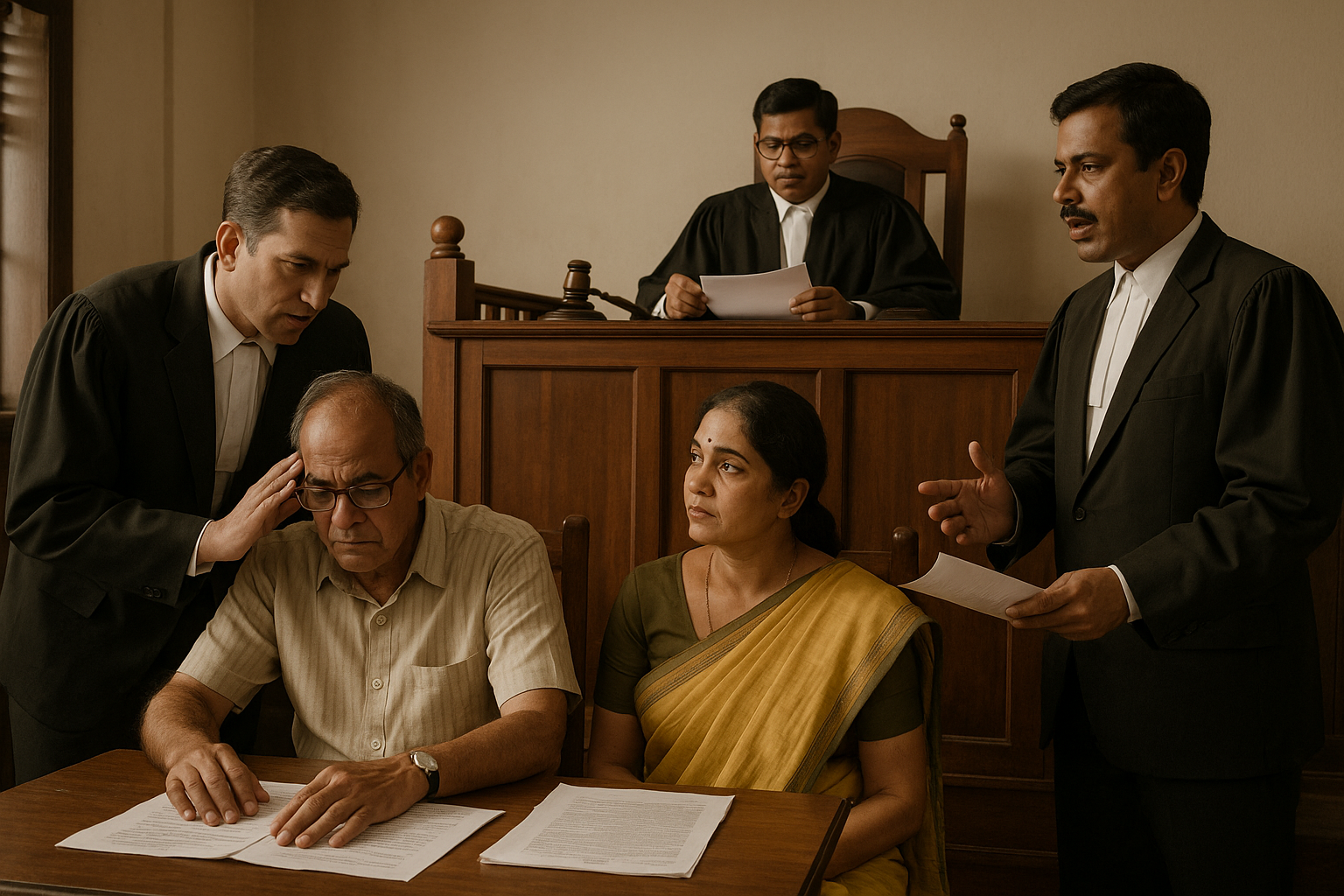
Simplified Explanation of the Judgment
The Patna High Court, in August 2022, dealt with a very old civil dispute that had been pending since 1990. The original case was a title suit for specific performance of an agreement to sell. In simple terms, the plaintiff (hereafter “the petitioner”) had filed a civil suit in 1990 asking the civil court at Bihar Sharif to enforce an agreement for sale allegedly executed in 1989 by the original defendant (now deceased). The plaintiff wanted the court to compel the other side to honour that contract.
However, the defendant had consistently said that he never signed that agreement for sale dated 05.08.1989. This denial was not made at a late stage — it was made long back, even when he was examined as a witness. In fact, the trial court’s record showed that the original defendant was examined as a defence witness on 05.08.2000 and he clearly stated in his cross-examination that he had not executed the agreement for sale.
Because signature was in dispute, the trial court had, way back in 2002, taken the defendant’s admitted signatures before the court staff (Sheristadar) so that they could be sent for expert comparison. But after that, no step was taken for almost 15 years by the plaintiff to pursue that exercise. This long silence was very important for the court.
Then suddenly, after all those years, on 08.11.2017, the plaintiff filed an application before the trial court asking that the disputed signature on the 1989 agreement for sale be sent to a handwriting expert for comparison with the admitted signatures of the original defendant.
By that time, the suit was almost at the stage of conclusion. The matter had already been remanded once by the appellate court, witnesses had been re-examined, documents had been marked as exhibits, and even the arguments of the defendant had been heard partly. At such a late stage, the trial court felt that the plaintiff’s request to send the signature to an expert was not bona fide but was only to delay the disposal of the suit.
Therefore, the trial court (Munsif, Bihar Sharif) rejected the plaintiff’s application for examination of the signature through an expert by order dated 19.02.2018. Instead of accepting this and proceeding with the case, the plaintiff again filed another, similar petition on 13.03.2018 asking for the same relief. The trial court dismissed this second application too on 09.04.2018, holding that when one such application had already been rejected, a successive and repetitive application for the same purpose could not be entertained, especially at the stage of final hearing.
Aggrieved by these two orders of the trial court, the plaintiff approached the Patna High Court in Civil Miscellaneous Jurisdiction No. 1152 of 2018 under the High Court’s supervisory jurisdiction. The petitioner’s basic grievance was: “I should have been allowed to get the signature of the original defendant examined by a handwriting expert; the trial court wrongly refused it.”
The Patna High Court, speaking through Hon’ble Mr. Justice Anil Kumar Sinha, upheld the trial court’s orders and dismissed the civil miscellaneous application. The High Court carefully looked at the timeline and said:
- The suit is of 1990.
- The defendant had denied the execution of the agreement way back in 2000.
- The trial court took signature specimens in 2002 to facilitate expert examination.
- Yet the plaintiff did nothing for 15 years.
- Only in 2017, when the suit had reached the final stage, did the plaintiff move an application for expert examination.
- Then, after that application was refused, he filed another similar application.
In these circumstances, the High Court found no infirmity in the trial court’s view that the application was filed only to prolong the litigation and stall the final disposal of a very old suit. The Court emphasised that expert opinion is not to be sought mechanically or at the whims of a party. Courts are empowered to refuse such requests if they are clearly aimed at delaying proceedings.
The High Court also noted that the trial court had considered the “totality of circumstances” — the age of the suit, the fact that the defendant had already been examined, the fact that the plaintiff had slept over the matter for years, and the fact that the suit was now at the verge of judgment. When a court gives a reasoned order on such facts, the High Court normally does not interfere in supervisory jurisdiction.
Thus, the Patna High Court dismissed the petitioner’s challenge and let the trial court’s orders dated 19.02.2018 and 09.04.2018 stand. As a result, the civil suit was to proceed without any further expert examination of the disputed signature.
Significance or Implication of the Judgment
This judgment is important for three reasons:
- Delay tactics will not be encouraged: Where a civil suit is very old and has almost reached the final stage, the court is entitled to refuse applications that are clearly intended to delay the hearing or reopen old issues.
- Expert opinion is not an absolute right: A party cannot insist, as a matter of right, that every disputed signature must be sent to an expert. The court will see when the request is made, why it is made, and whether it will actually assist in deciding the real dispute.
- Supervisory jurisdiction is limited: The High Court will not interfere with well-reasoned procedural orders of the trial court unless there is a clear illegality or perversity. Here, the trial court had applied its mind, so the High Court did not disturb it.
For litigants and lawyers in Bihar, the decision sends a clear message: do not wait for 10–15 years to raise a technical plea about handwriting; do it promptly. Otherwise, the court may treat it as an afterthought and reject it.
Legal Issue(s) Decided and the Court’s Decision (with Reasoning)
- Whether a civil court can refuse an application for handwriting/signature examination through an expert when the suit is at the final stage?
✔️ Yes. The trial court can refuse such a request if it appears to be belated, unnecessary, or intended to delay the disposal of the suit. The High Court affirmed this view. - Whether a party can file successive applications for the same relief (expert examination) after the first one is rejected?
✔️ No. Successive petitions for the same purpose are not maintainable, especially when the first rejection was on merits and when the case is about to conclude. The trial court rightly dismissed the second application dated 13.03.2018. - Whether the High Court should interfere under civil miscellaneous/supervisory jurisdiction with such interlocutory orders?
✔️ No, not in the facts of this case. The High Court found no infirmity in the trial court’s reasoning and therefore refused to interfere. - Whether a 15-year inaction by the plaintiff in pursuing expert comparison can be treated as a ground to reject the later request?
✔️ Yes. The court considered the long inaction as a relevant factor showing lack of bona fides. The petition appeared to be filed only to delay the suit.
Case Title
Petitioner (plaintiff in Title Suit No. 68 of 1990) vs. Respondents (legal heirs and subsequent parties) — names withheld for privacy
Case Number
- Civil Miscellaneous Jurisdiction No. 1152 of 2018
- Arising out of Title Suit No. 68 of 1990 (Court of Munsif, Bihar Sharif)
Citation(s)
2023 (1) PLJR 68
Coram and Names of Judges
- Hon’ble Mr. Justice Anil Kumar Sinha
Names of Advocates and who they appeared for
- For the petitioner: Mr. Bhupendra Kumar Verma
- For the respondents: Not clearly recorded in the available extract / to be verified from certified copy.
Link to Judgment
NDQjMTE1MiMyMDE4IzMjTg==-h7NjMfSi6e0=
If you found this explanation helpful and wish to stay informed about how legal developments may affect your rights in Bihar, you may consider following Samvida Law Associates for more updates.







