
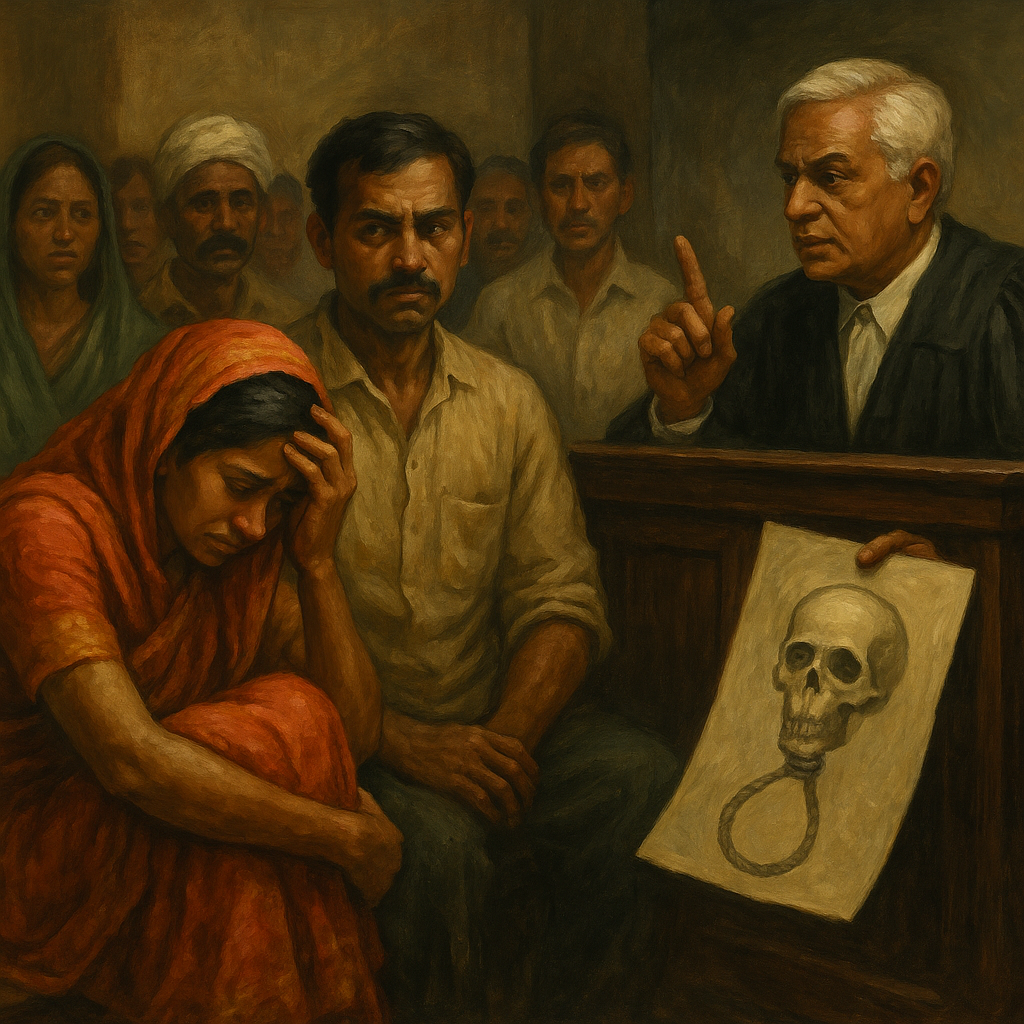
Simplified Explanation of the Judgment
The Patna High Court delivered an important judgment concerning a dowry death case under Section 304B of the Indian Penal Code. The appellant, a young man from Vaishali district, was convicted by the Sessions Judge in 2017 for the dowry death of his wife and for causing disappearance of evidence (Sections 304B and 201 IPC). He was sentenced to 10 years’ rigorous imprisonment under Section 304B and 2 years under Section 201, to run concurrently.
The marriage took place in November 2012. According to the prosecution, within a few months the husband and his family started demanding a colour television and a gold chain as dowry. The woman’s parents stated that she had informed them telephonically about torture and physical assault for non-fulfilment of these demands. On 1 June 2013, about six months after marriage, her dead body was discovered near a village school inside a plastic bag. There were ligature marks on her neck and medical evidence confirmed death due to strangulation.
The trial court convicted the husband. On appeal, the Patna High Court examined both the factual matrix and legal principles.
Defence Arguments
- Demand of dowry was not mentioned before the death; it was an afterthought.
- No independent witnesses supported the allegation; only family members testified.
- Both families were poor, hence demand of costly items like gold chain and TV was unlikely.
- Reliance was placed on Gurdeep Singh v. State of Punjab (2011) 12 SCC 408, where conviction was set aside due to lack of proximity between alleged demand and death.
Prosecution Arguments
- Law does not require independent witnesses; family members are competent witnesses.
- The victim died within months of marriage under unnatural circumstances.
- Consistent testimony established harassment and dowry demand.
- Under Section 113B of the Evidence Act, there is a presumption of dowry death when cruelty and harassment soon before death is proved.
Court’s Findings
The Court emphasized four ingredients for dowry death under Section 304B IPC:
- Death otherwise than under normal circumstances.
- Within 7 years of marriage.
- Soon before death, subjected to cruelty/harassment.
- Such cruelty/harassment related to dowry demand.
Applying these, the Court found:
- The victim died of strangulation within 6 months of marriage.
- Evidence from her family consistently showed harassment for TV and gold chain.
- The time gap between demand and death was short; proximity test was satisfied.
- Poverty of the families did not negate possibility of dowry demand.
- The defence claim that she went out selling clothes and did not return was unsupported.
Thus, the conviction was upheld.
Sentence Modification
However, the Court noted the appellant had been in custody since 30 September 2013 and had already served more than 7 years. Considering his young age, absence of aggravating circumstances, and justice being served by time already undergone, the Court reduced his sentence to the period already served.
Accordingly, the appeal was dismissed with modification of sentence. The appellant was directed to be released forthwith.
Significance or Implication of the Judgment
For society:
- Reaffirms strict approach of courts towards dowry-related deaths, ensuring accountability of husbands and in-laws.
- Confirms that even post-marriage demands (not only at marriage) qualify as dowry under law.
For legal system:
- Clarifies that family members’ testimony is sufficient to prove dowry demand; lack of independent witnesses is not fatal.
- Reinforces application of Section 113B Evidence Act, which shifts the burden of proof once dowry demand and harassment are shown.
- Illustrates judicial balancing: while conviction for dowry death was maintained, sentencing considered custody period and mitigating factors.
For young couples:
- The judgment underscores the gravity of dowry demands, even in modest-income families, and the potential for severe legal consequences.
Legal Issue(s) Decided and the Court’s Decision
- Was the prosecution able to prove dowry death under Section 304B IPC?
• Yes. Death occurred within 6 months of marriage, by strangulation, with evidence of cruelty and dowry demand. - Is independent witness testimony required in dowry cases?
• No. Family members’ testimony is sufficient if credible. - Does poverty rule out dowry demand?
• No. Dowry demand can occur regardless of financial status. - Should the sentence be reduced?
• Yes. Since the appellant had already served more than 7 years, sentence was reduced to period undergone.
Judgments Relied Upon or Cited by Court
- Gurdeep Singh v. State of Punjab, (2011) 12 SCC 408 (distinguished)
Case Title
Jitendra Tiwary v. The State of Bihar
Case Number
Criminal Appeal (SJ) No. 3415 of 2017
(Arising out of Lalganj P.S. Case No. 87 of 2013, District Vaishali)
Citation(s)
2021(2) PLJR 104
Coram and Names of Judges
Hon’ble Mr. Justice Birendra Kumar (Judgment dated 22-02-2021)
Names of Advocates and who they appeared for
- For the appellant: Mrs. Bela Singh, Advocate
- For the State: Mr. Zeyaul Hoda, APP
Link to Judgment
https://patnahighcourt.gov.in/viewjudgment/MjQjMzQxNSMyMDE3IzEjTg==-PZTf4v8mQlk=
If you found this explanation helpful and wish to stay informed about how legal developments may affect your rights in Bihar, you may consider following Samvida Law Associates for more updates.







