
Case Background
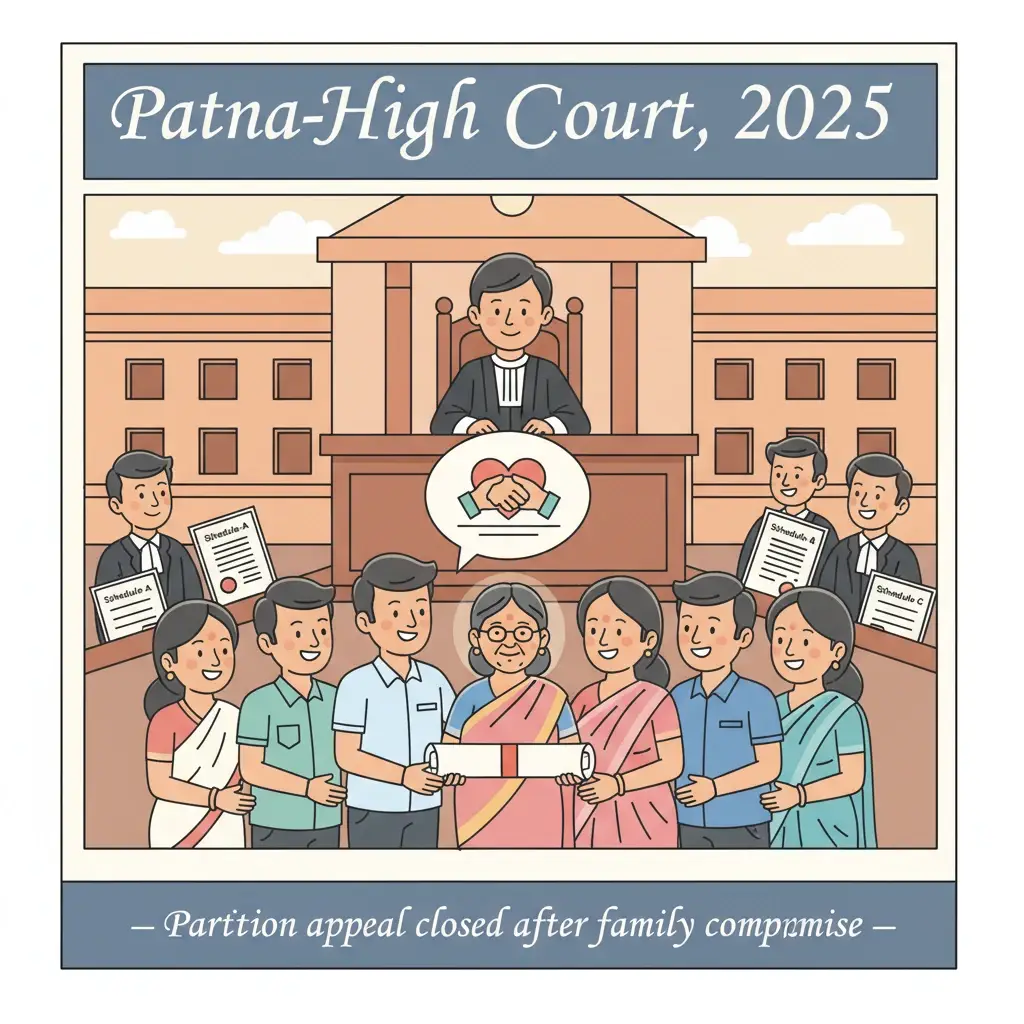
This case arose out of a family dispute over partition of ancestral property in village Chenari, District Rohtas, Bihar. The original civil case was Title Suit No. 435 of 2001, filed for partition of the suit property because there was disagreement over the shares claimed by different family members.
In that title suit, a judgment and decree had been passed by the trial court regarding partition. One of the sons, Manoj Kumar Agrawal, was not satisfied with the decision and filed First Appeal No. 183 of 2009 before the Patna High Court challenging that judgment and decree.
The parties to the appeal were all close family members. The appellant Manoj Kumar Agrawal and respondents Uma Shanker Prasad Agrawal (also called Uma Shanker Agrawal) and Saroj Kumar Agrawal are full brothers. Respondent Uma Rani Agrawal is the wife of respondent Uma Shanker. The original respondent no. 1, Most. Shanti Kuer, was the mother of the three brothers.
During the pendency of the appeal, the original respondent no. 1, Most. Shanti Kuer, died on 28.09.2024. After her death, her daughter-in-law, Gayatri Devi (also described as Gayatri Agrawal or Gayatree Agrawal), the wife of the appellant Manoj Kumar Agrawal, was substituted in her place as one of her legal heirs.
While the appeal remained pending, the family decided to settle the partition dispute amicably outside court. They reduced this settlement into a written compromise deed and moved an interlocutory application before the High Court, seeking a compromise decree in terms of that settlement.
What the Court Examined and Decided
The interlocutory application was registered as I.A. No. 04 of 2025 in the first appeal. It was filed under Order XXIII Rule 3 read with Section 151 of the Code of Civil Procedure, 1908. The relief sought was clear: the parties requested the Court to pass a compromise decree between them and to finally end the civil litigation.
On 24.03.2025, Hon’ble Mr. Justice Shailendra Singh heard learned counsel for all sides: counsel for the appellant, counsel for respondent no. 1 (substituted), and counsel for respondents 2 to 4. All counsel jointly supported the compromise and requested that it be recorded.
The Court first noted the family relationship between the parties. The appellant and respondents 2 and 3 are real brothers. Respondent no. 4 is the wife of respondent no. 2. The deceased original respondent no. 1, Most. Shanti Kuer, was the mother of these three brothers. After her death, the appellant’s wife, Gayatri Devi @ Gayatri Agrawal @ Gayatree Agrawal, was substituted in her place as a legal heir.
It was jointly submitted that Most. Shanti Kuer had expressed, during her lifetime and before her death on 28.09.2024, a desire that her three sons should maintain cordial relations and resolve the dispute amicably. Respecting this wish, the parties settled the partition dispute outside the court.
According to the submissions recorded in the judgment, all parties reached a compromise regarding the disputed properties described in the original partition suit. The dispute in Title Suit No. 435 of 2001 was over the extent of shares claimed by each shareholder in the suit property. After discussions, the family decided to divide the properties by preparing three separate schedules.
These schedules are described as Schedule-A, Schedule-B and Schedule-C of the compromise deed, which was filed as Annexure-1 to the interlocutory application. The property distribution under the compromise was as follows:
First, the properties mentioned in Schedule-A were allotted to respondent no. 2, Uma Shanker Prasad Agrawal @ Uma Shanker Agrawal.
Second, the properties mentioned in Schedule-B were allotted jointly to the appellant, Manoj Kumar Agrawal, and to Gayatri Devi @ Gayatri Agrawal @ Gayatree Agrawal, the substituted respondent no. 1. These properties were jointly allotted to both of them together.
Third, the properties mentioned in Schedule-C were allotted to respondent no. 3, Saroj Kumar Agrawal @ Saroj Kumar.
Respondent no. 4, Uma Rani Agrawal, the wife of respondent no. 2, was not allotted any separate share in the properties. However, the Court records that both she and Gayatri Devi @ Gayatri Agrawal @ Gayatree Agrawal declared that they would not make any separate claim and that they were fully satisfied with the partition and all terms and conditions of the compromise.
A key point noted by the Court is that all schedules relating to allotment of shares were signed by all the parties. Further, the appellant, the substituted respondent no. 1, respondents 2 and 3, and respondent no. 4 each swore their own affidavits. In those affidavits, they confirmed their support for the compromise terms and admitted that they had signed the compromise deed with full knowledge of its contents.
On this basis, both sides jointly requested the Patna High Court to pass a compromise decree and to set aside the earlier judgment and decree in Title Suit No. 435 of 2001 so that the compromise could be given full effect. They also submitted that there was no need for any preliminary decree because the properties had already been partitioned by metes and bounds under the compromise.
The Court then considered the legal requirement under Order XXIII Rule 3 CPC. This rule allows the Court to pass a decree in accordance with a lawful compromise that has been duly recorded, provided that the compromise is voluntary and not caused by fraud, misrepresentation, or undue influence.
To satisfy itself, the Court carefully examined:
1. The averments made in the interlocutory application.
2. The contents of the compromise deed (Annexure-1).
3. The statements made by all parties in their respective affidavits supporting the compromise.
After this scrutiny, the Court found that both parties had reached a lawful compromise. It specifically recorded that there was no material to suggest any fraud, misrepresentation, undue influence, or similar defect affecting any party while resolving the partition issue.
The Court also noted that the compromise deed had been signed by all parties and that they had each affirmed the compromise on oath. This satisfied the Court that the settlement was genuine, voluntary, and binding.
In light of these findings, the Patna High Court decided to accept the compromise and pass a decree accordingly. It allowed I.A. No. 04 of 2025 and set aside the judgment and decree passed in Title Suit No. 435 of 2001, but clearly stated that this was done on the ground of compromise and not on the merits of the original dispute.
The Court then decreed the suit filed by the appellant, Manoj Kumar Agrawal, in the light of Order XXIII Rule 3 CPC and the settlement reached between the parties. Since the properties had already been partitioned by metes and bounds in the compromise itself, the Court held that there was no need to prepare a preliminary decree.
Instead, the Court directed that a final decree be prepared in accordance with the terms of the compromise deed (Annexure-1). The compromise deed was ordered to form part of the decree. The Court further directed that the final decree be prepared within the prescribed limitation period and that a certified copy of the order and the decree be sent to the trial court for needful action.
With these directions, the interlocutory application was allowed, and the first appeal was disposed of, bringing the long-running partition litigation between the parties to an end through their own compromise.
Why This Judgment Matters
This judgment shows how the Patna High Court supports amicable settlement of family property disputes, especially in partition matters. Instead of pushing the parties to fight on, the Court respected their decision to follow the late mother’s wish for peace among her sons.
For ordinary families facing similar disputes, this order highlights that even long-pending cases, like a partition suit and appeal from 2001 and 2009, can be resolved quickly if all sides agree on clear terms in writing and confirm them through affidavits.
The Court’s decision also clarifies that when a lawful compromise fully divides property by metes and bounds, the Court can directly direct preparation of a final decree. There is then no need for a separate preliminary decree, saving time and avoiding more litigation.
Finally, the judgment underlines that the Court will examine whether a compromise is genuine and free from fraud or undue influence. Once satisfied, the Court can set aside the earlier judgment and decree purely on the basis of the compromise, without going into who was right or wrong in the original dispute.
Legal Issues and Answers
- Issue: Whether the Patna High Court could set aside the earlier partition judgment and decree and pass a new decree on the basis of a compromise reached during the pending first appeal under Order XXIII Rule 3 CPC.
Answer: Yes. The Court held that the parties had entered into a lawful, voluntary compromise without fraud or undue influence, and accordingly set aside the earlier judgment and decree, decreed the suit in terms of the compromise, and directed preparation of a final decree based on the compromise deed. - Issue: Whether a preliminary decree was necessary when the compromise deed itself partitioned the properties by metes and bounds.
Answer: No. The Court held that, in view of the compromise already effecting partition by metes and bounds, there was no need to pass a preliminary decree and directly ordered preparation of a final decree in terms of the compromise.
Cases Cited by the Court
- No prior judgments or case law have been cited or relied upon in this order.
Case Details
Case Number: First Appeal No. 183 of 2009; I.A. No. 04 of 2025 (in the appeal)
Case Title: Manoj Kumar Agrawal v. Gayatri Devi & Ors.
Coram: Hon’ble Mr. Justice Shailendra Singh
Citation: 2025 (2) PLJR 819
Advocates:
- For the appellant: Mr. Dineshwar Pandey, Advocate
- For respondent no. 1: Mr. Rahul Singh, Advocate
- For respondent nos. 2 to 4: Mr. Siddharth Harsh, Advocate
Nature of the Case: First appeal arising from a partition title suit (Title Suit No. 435 of 2001), disposed of on the basis of a compromise under Order XXIII Rule 3 CPC.
Link to Judgment: https://patnahighcourt.gov.in/viewjudgment/MSMxODMjMjAwOSMxI04=-ot3aNgrXGk4=
If you found this explanation helpful and wish to stay informed about
how legal developments may affect your rights in Bihar,
you may consider following Samvida Law Associates for more updates.







