
Case Background
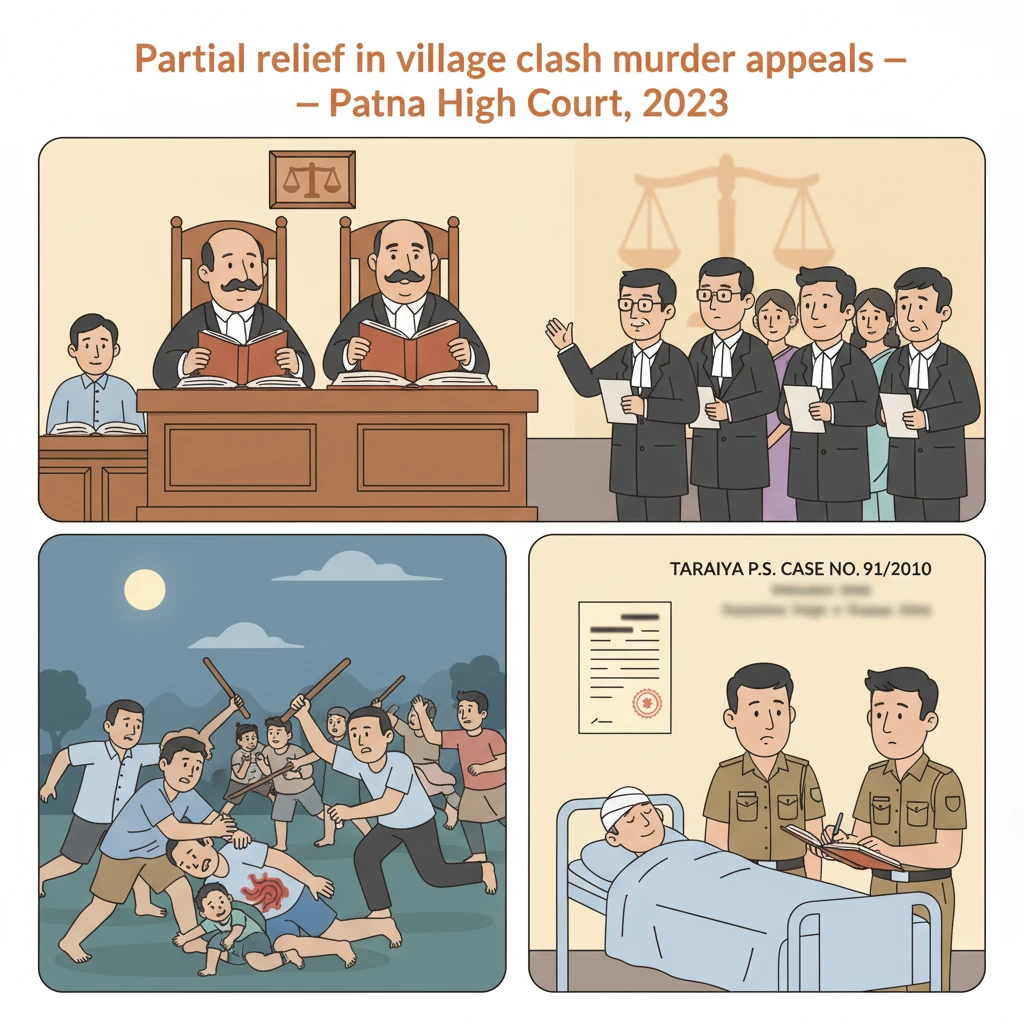
The case arose from Taraiya P.S. Case No. 91 of 2010, District Saran. The incident took place on 31.08.2010 at about 7:45 p.m. in village Rajwara, according to the prosecution.
As per the fardbeyan of the informant (P.W. 11) recorded at 10:00 a.m. on 01.09.2010 at Pirbahore Police Station Camp, P.M.C.H., Patna, a minor boy, aged about eight years, was singing in front of his house when several accused, including the appellants, allegedly came and started assaulting him.
On seeing this, two villagers, later examined as P.W. 2 and P.W. 5, rushed to save the boy. According to the informant, one of the accused, later appellant in these appeals, exhorted others to kill these rescuers. The mob then allegedly attacked them with lathis and dandas, injuring them seriously.
Hearing the commotion, more villagers arrived, including Sanaullah and Nurul Hoda. They too were allegedly assaulted. The allegation against one appellant, Md. Inayatullah, was that he struck Sanaullah on the stomach with a bhujali, causing his intestines to come out. Another appellant, Md. Ashif Ali @ Munna, was alleged to have attacked Nurul Hoda with a sword on his right hand.
Other villagers like Sakil (P.W. 6), Maqsud Ahmad (P.W. 3), and Parvej (not examined) were also said to have been beaten. All injured were shifted for treatment; some to P.M.C.H., Patna, and others to private hospitals in Patna and to Taraiya Hospital.
Sanaullah died during treatment at P.M.C.H. soon after the incident, while Nurul Hoda succumbed to his injuries in the morning of 01.09.2010. On the basis of the fardbeyan, Taraiya P.S. Case No. 91 of 2010 was registered later that night under Sections 147, 148, 149, 323, 324, 325, 326, 307 and 302 IPC against 13 accused persons, including the present appellants.
Investigation led to two sets of charge-sheets. Initially, charge-sheet was filed against appellants Md. Inayatullah, Nasim Akhtar, Ashif Ali @ Munna and a juvenile, Nawajish Raza, with further investigation continuing against others. A subsequent charge-sheet was filed against Late Master Md. Shafiullah, appellants Alauddin, Nasim Akhtar (again shown), Muzibullah, Samsul Zoha and Salauddin. Allegations against some named persons were found false and they were not sent up for trial.
The cases of juveniles, including Nawajish Raja and Samsul Zoha and Md. Safiullah, were separated and sent to the Juvenile Justice Board.
Ultimately, seven adult accused faced Sessions Trial No. 716/738 of 2011 before the VIth Additional Sessions Judge, Saran at Chapra. The Trial Court convicted all of them under Sections 148, 307, 302/149 IPC and sentenced each to life imprisonment under Section 302/149 IPC, seven years under Section 307/149 IPC, and two years under Section 148 IPC, with fine and concurrent running of sentences.
During pendency of the appeals before the Patna High Court, one appellant, Master Md. Shafiullah, died. On confirmation of his death, his appeal was held to have abated under Section 394 of the Code of Criminal Procedure.
What the Court Examined and Decided
The Division Bench (Hon’ble Mr. Justice Ashutosh Kumar and Hon’ble Mr. Justice Shailendra Singh) heard all four appeals together and delivered a common CAV judgment on 07.10.2023.
The main questions before the Patna High Court were whether the Trial Court correctly appreciated the evidence, including the timing of the FIR, the place of occurrence, the injuries on both sides, and the extent of criminal liability of each appellant under Sections 148, 307, 302/149 IPC.
On behalf of the appellants, it was argued that the earliest version of the occurrence, allegedly received by the Investigating Officer (P.W. 12) on the night of 31.08.2010, had been suppressed. It was also contended that a counter case lodged by appellant Md. Inayatullah (Taraiya P.S. Case No. 92 of 2010) was not properly considered.
The defence emphasised that the place of occurrence had not been conclusively proved, because no blood or objectionable material was recovered from the site named by the informant, and that some key witnesses (including the child singer and his father) were not examined without explanation. They also attacked the prosecution for not explaining injuries suffered by members of the accused side, and argued this omission showed suppression of the true origin of the incident.
Further, the defence case was that there was a clash between two groups of the same community over local issues, in which both sides suffered injuries and, unfortunately, two persons from one group died. In such a scenario, they submitted, conviction of all appellants for murder with the aid of Section 149 IPC could not be sustained.
The State and the informant opposed these submissions, relying heavily on the eye-witness account of injured prosecution witnesses. They argued that the FIR was promptly recorded at P.M.C.H., then rightly forwarded to Taraiya Police Station as the place of occurrence fell in its jurisdiction. Endorsement of the Additional Chief Judicial Magistrate on 02.09.2010 showed no undue delay in despatch.
The prosecution further submitted that even if motive was not fully established, the direct eyewitness testimony and medical evidence were sufficient. Minor contradictions were said to be natural, considering the large number of persons involved and the time gap between occurrence and deposition. They also highlighted that the accused-side injuries were simple and that two people had been killed and several others injured from the prosecution side.
The High Court first examined the issue of delay and place of FIR. It noted that the incident occurred on 31.08.2010 night. Some injured were treated at Taraiya Hospital and discharged, but the two most critically injured, Sanaullah and Nurul Hoda, were immediately taken to P.M.C.H., where one died soon and the other next morning.
The Court held that though the Investigating Officer could have registered an FIR at Taraiya Police Station on the night of 31.08.2010, his failure to do so did not automatically render the later FIR recorded at P.M.C.H. suspicious. The Court referred to decisions such as King Emperor v. Khwaja Najir Ahmad, Ram Jag v. State of U.P., and State of M.P. v. Ratan Singh to reiterate that FIR is not a substantive piece of evidence and that reasonable delay, explained by the circumstances of taking care of the critically injured, does not by itself demolish the prosecution case.
On the question of defective or colourable investigation, the Bench cited Arvind Kumar @ Nemichand v. State of Rajasthan. It drew a distinction between a defective investigation and one conducted in a deliberately biased manner. A merely defective investigation does not automatically benefit the accused unless it goes to the root of the prosecution case. The task of the Court is to winnow the reliable parts of the evidence and discover the truth.
Next, the Court turned to the non-explanation of injuries on the accused side. It noted that the same doctor (P.W. 8 / D.W. 5), Dr. Alok Bihari Sharan, had examined simple injuries on both prosecution witnesses and accused persons, including juveniles and women. Another doctor (P.W. 7) had similarly found only simple injuries on one injured prosecution witness.
The prosecution had exhibited the fardbeyan and charge-sheet of the counter case (Taraiya P.S. Case No. 92 of 2010) and injury reports of several accused persons as Exhibits B to B/4. The Court found no attempt to suppress the existence of the counter case or the fact of injuries on the accused side. However, it did question why the fardbeyan and prosecution witnesses were silent about these injuries.
Referring to Laxmi Singh v. State of Bihar and again to Arvind Kumar @ Nemichand, the Bench observed that failure to explain accused-side injuries can suggest that the prosecution has not presented the complete genesis of the occurrence, especially where there is evidence of a clash between two groups.
From the Investigating Officer’s testimony and other evidence, the Court found indications of a broader village dispute between two groups of the same religious community, possibly over control of the local mosque or issues relating to offering namaz. The explanation in the FIR that the incident erupted simply because a child was singing at his doorstep did not appear fully convincing.
The Investigating Officer had found blood not at the door of the boy’s house (as claimed in the FIR), but beneath the wall of a person named Tasaduq. He had also heard that two groups of villagers had fought. This supported the view that the story of the child’s song being the sole trigger was unlikely and that a group clash had occurred.
However, the Court made it clear that this omission and partial distortion did not make the entire prosecution story false. Many of the prosecution witnesses were injured themselves, and most injuries on both sides were simple. The High Court therefore accepted that a clash took place, but not as one planned with a pre-formed common object to kill.
Crucially, the Bench noted that only two appellants, Md. Inayatullah and Md. Ashif Ali, were alleged to have used deadly weapons (bhujali and sword). There was no evidence that all accused came with a pre-concerted plan to commit murder. One of the deceased, Nurul Hoda, was an outsider from another locality, further suggesting the absence of a specific pre-planned target.
Given this context, the Court held that the common object of the unlawful assembly to commit murder, as required under Section 149 IPC, was not proved. Therefore, conviction of all appellants under Sections 302/149 and 307/149 IPC was not sustainable. Instead, each accused had to be held liable according to his specific role.
Turning to individual liability, the Court considered the medical evidence. Dr. Arbind Kumar (P.W. 9), who conducted post-mortem examinations, confirmed that Sanaullah had an incised wound on the abdomen below the navel, with part of the gut protruding and blood and clots inside the abdominal cavity. This directly matched the ocular version that Md. Inayatullah delivered a bhujali blow causing the intestines to come out. The doctor opined that death was due to this abdominal injury.
For Nurul Hoda, the doctor found a stitched wound involving the right elbow, forearm, wrist, and palm, with complete cutting of radius and ulna and bones of the wrist, along with deep soft tissue damage and blood clots. He stated that death was due to haemorrhage and shock, likely connected with this injury, which the prosecution attributed to the sword blow by Md. Ashif Ali.
The Court held that the injury inflicted by Md. Inayatullah was sufficient in the ordinary course of nature to cause death and squarely fell within Section 300 “thirdly”, making him liable for murder under Section 302 IPC. His conviction and life sentence were therefore confirmed.
For Md. Ashif Ali, the Bench took a different view. It accepted that he had assaulted Nurul Hoda with a sword, causing the fatal arm injury, but observed that he may not have intended to cause such an injury as would, in the ordinary course of nature, necessarily result in death. His act, however, clearly amounted to an attempt to commit murder, bringing it under Section 307 IPC. His conviction was accordingly altered from Section 302/149 IPC to Section 307 IPC, and he was sentenced to ten years’ rigorous imprisonment.
As for the remaining appellants — Md. Alauddin, Nasim Akhtar, Md. Muzibullah (Cr. App (DB) No. 761 of 2017) and Wasim Akhtar @ Tunna (Cr. App (DB) No. 827 of 2017) — the Court found no reliable evidence of any specific grievous or fatal blows by them. In view of the absence of a common object to kill, they could not be pinned with murder liability via Section 149. The Court, however, held them guilty of rioting with deadly weapons and causing hurt and therefore converted their convictions to Sections 148 and 324 IPC.
Considering that these appellants had already spent considerable time in custody after conviction and that most injuries were simple, the Court held that the period already undergone by them was sufficient punishment for offences under Sections 148 and 324 IPC. They were ordered to be released forthwith, if not wanted in any other case.
Md. Ashif Ali was stated to be in custody since 26.05.2017. The Court directed that he be released after he completes ten years in custody under his modified sentence.
Criminal Appeal (DB) Nos. 761, 827 and 901 of 2017 were thus partially allowed, while Criminal Appeal (DB) No. 900 of 2017 filed by Md. Inayatullah was dismissed.
Why This Judgment Matters
This judgment is important for villagers and families caught in group clashes that turn serious.
First, the Patna High Court shows that even when an FIR may not tell the full background, the entire prosecution case is not automatically thrown out. The Court carefully checked medical reports, injuries and witness statements to separate truth from exaggeration.
Second, the judgment makes it clear that in a sudden village fight, all participants cannot be convicted for murder unless there is clear proof that they shared a common plan to kill. Each person’s role must be separately assessed.
Third, the Court still held individuals personally responsible where evidence was strong. The person who gave the fatal bhujali blow was kept convicted for murder and will remain in prison for life. The one who caused a life-threatening sword injury was punished for attempt to murder.
For people in Bihar, this decision underlines that participating in a violent mob, even without using a deadly weapon, can still lead to conviction for rioting and causing hurt. At the same time, it offers some protection against being wrongly branded a murderer when there is only a general village clash and no clear murder plan.
Legal Issues and Answers
- Issue: Did delay in registering the FIR at Taraiya Police Station and the earlier movements of the Investigating Officer make the prosecution story unreliable?
Answer: No. The Court held that, given the urgent need to take critically injured persons to P.M.C.H., the timing and place of the fardbeyan were reasonable, and there was no suspicious delay. - Issue: Did non-explanation of injuries on the accused side and existence of a counter case completely destroy the prosecution case?
Answer: No. The Court accepted that a two-sided clash had occurred and that the FIR motive was incomplete, but held that this did not make the entire case false. Instead, it affected the finding on common object under Section 149 IPC. - Issue: Could all appellants be held guilty of murder with the aid of Section 149 IPC, or should liability be fixed individually?
Answer: The Court held that the common object to kill was not proved. Only Md. Inayatullah’s act amounted to murder under Section 302 IPC, Md. Ashif Ali’s act amounted to attempt to murder under Section 307 IPC, and the remaining appellants were liable only under Sections 148 and 324 IPC.
Cases Cited by the Court
- King Emperor v. Khwaja Najir Ahmad, AIR 1945 PC 18
- Ram Jag and Others v. State of Uttar Pradesh, (1974) 4 SCC 201
- State of M.P. v. Ratan Singh and Others, (2020) 12 SCC 630
- Arvind Kumar @ Nemichand and Others v. State of Rajasthan, 2021 SCC OnLine SC 1099
- Laxmi Singh v. State of Bihar, (1976) 4 SCC 394
Case Details
Case Numbers: Criminal Appeal (DB) No. 900 of 2017; Criminal Appeal (DB) No. 761 of 2017; Criminal Appeal (DB) No. 827 of 2017; Criminal Appeal (DB) No. 901 of 2017, all arising out of Taraiya P.S. Case No. 91 of 2010, District Saran.
Case Title: Md. Inayatullah @ Sonu @ Md. Enayatullaha v. The State of Bihar; Master Md. Shafiullah and Others v. The State of Bihar; Wasim Akhtar @ Tunna v. The State of Bihar; Md. Ashif Ali @ Munna v. The State of Bihar.
Coram: Hon’ble Mr. Justice Ashutosh Kumar and Hon’ble Mr. Justice Shailendra Singh.
Date of Judgment: 07.10.2023.
Citation: 2024 (1) PLJR 416.
Advocates for Appellants (all appeals): Mr. Ajay Kumar Thakur, Advocate; Ms. Kiran Kumari, Advocate; Mr. Md. Imteyaz Ahmad, Advocate; Mr. Ritwik Thakur, Advocate; Ms. Vaishnavi Singh, Advocate; Mr. Anuj Kumar, Advocate.
Advocate for the State (Respondent): Mr. Ajay Mishra, APP.
Advocates for the Informant: Mr. Vishwanath Prasad Singh, Senior Advocate; Mr. Sanjay Kumar Singh, Advocate; Mr. Rajesh Kumar, Advocate.
Nature of the Case: Criminal appeals (Division Bench) challenging conviction and sentence passed by the VIth Additional Sessions Judge, Saran at Chapra in Sessions Trial No. 716/738 of 2011 for offences under Sections 148, 307, 302/149 IPC.
Link to Judgment: Click here to read the full Patna High Court judgment
If you found this explanation helpful and wish to stay informed about how legal developments may affect your rights in Bihar, you may consider following Samvida Law Associates for more updates.







