

Case Background
The case arose from a long-running dispute between a village worker and the Public Health Engineering Department (PHED) of Bihar over employment in exchange for land.
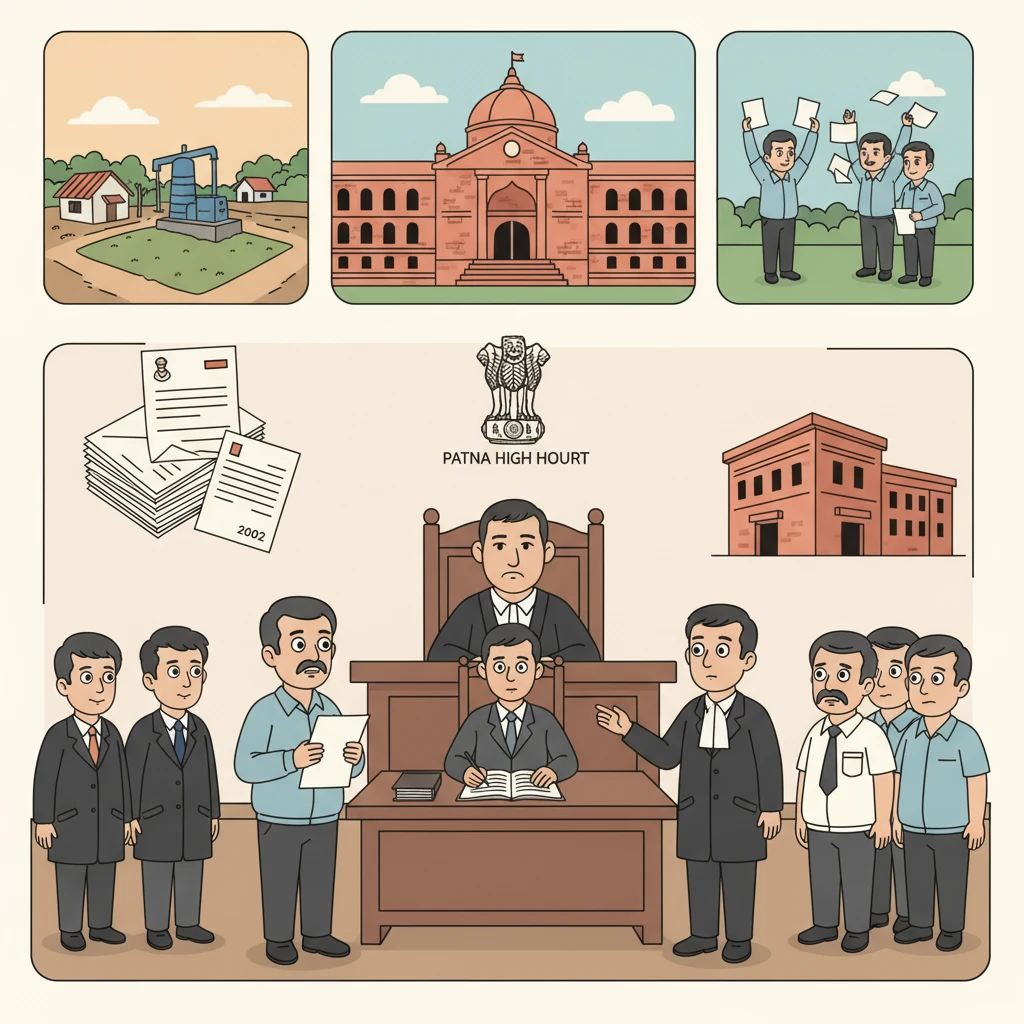
The petitioner’s father donated ancestral land, described as Khata No. 1015, Khesra No. 5079 and Touzi No. 86/440, to the PHED. The land was used for constructing a pump chamber in Village Maranchi, District Patna, under the State’s Rural Water Supply Scheme.
According to the petitioner, the Superintending Engineer, Public Health Engineering Circle, Patna, issued an appointment letter on 20.09.1985. This was done after the land was acquired, after obtaining a certificate from the village Mukhiya and a recommendation from the then Minister of the State. The petitioner was engaged as a daily wage Pump Khalasi (a Group D post) with an assurance that his services would later be absorbed in the permanent establishment.
He claims to have worked continuously from 20.09.1985. However, by letter no. 2306 dated 13.04.2002, he was retrenched as a daily wager along with others. A batch of writ petitions, including CWJC No. 7359 of 2002 (Ram Tapeshwar Sah and others vs State of Bihar and others), led to directions from the Patna High Court for regularisation of daily wage employees who came within the Government’s cut-off date.
Following those directions and a Government circular (Letter No. 639 dated 16.03.2006 issued by the General Administration Department, Bihar), the services of the petitioner and 19 others were absorbed by letter dated 30.11.2006. GPF accounts were opened and salaries were paid, based on a merit list prepared by date of entry into service.
However, by order dated 26.10.2007 (Memo No. 787, annexed as Annexure 13), a Three Men Committee decision led to his reversion from permanent employee back to daily wage status, and a fresh merit list was now based on date of birth. The petitioner again worked as a daily wager, while making repeated representations claiming that similarly situated persons had been regularised.
In April 2018, he filed the present writ petition (CWJC No. 6624 of 2018) seeking regularisation of his services on the post of Nalkoop/Pump Khalasi, Group D, in compliance with the earlier undertaking to give permanent employment in lieu of the donated land.
During pendency of the writ, the Executive Engineer, Public Health Division, Patna East, issued Memo No. 1079 dated 15.05.2018 retrenching the petitioner from service. The petitioner challenged this order by filing Interlocutory Application No. 4473 of 2018, which was heard along with the main writ petition.
What the Court Examined and Decided
Justice Dr. Anshuman of the Patna High Court heard both sides on 20.08.2024.
The petitioner’s counsel argued that the PHED had taken the family’s land on the clear assurance of providing a permanent job to the petitioner. He pointed to the 1985 appointment letter issued by the Superintending Engineer, following certification by the Mukhiya and recommendation by the Minister. According to him, the petitioner had worked continuously as a Pump Khalasi since 20.09.1985.
Counsel stressed that after the 2002 retrenchment, the petitioner was brought back under the regularisation scheme pursuant to CWJC No. 7359 of 2002 and the Government circular dated 16.03.2006. By letter dated 30.11.2006, the petitioner’s services were regularised along with 19 others, GPF accounts were opened and deductions started.
Later, by Memo No. 787 dated 26.10.2007, a Three Men Committee changed the basis of the merit list from date of entry to date of birth, and the petitioner was again treated as a daily wage employee. Despite that, he continued working, and his counsel emphasized that many other similarly situated workers had ultimately been absorbed permanently, whereas the petitioner had been discriminated against.
He relied on the judgment of the Patna High Court in CWJC No. 20170 of 2016 (Umesh Mandal vs State of Bihar and others and analogous cases), where on 16.03.2018 the Court directed regularisation of the petitioners there with all consequential benefits including continued back wages. According to him, the petitioner’s case was squarely covered by Umesh Mandal.
The State opposed the writ mainly on the ground of delay and legal bars on regularisation. The State’s counsel argued that the real cause of action arose in 2007 when Memo No. 787 reverted the petitioner to daily wage status. Yet, he approached the High Court only in 2018, after about 11 years, without any reasonable explanation.
For this proposition, the State referred to several decisions. It cited a Patna High Court ruling in CWJC No. 16171 of 2017 (Shanichar Bind vs State of Bihar and others), where the Court declined to entertain a writ filed after an unexplained delay of about seven years. That judgment had itself relied on Supreme Court precedents, including:
Chennai Metropolitan Water Supply and Sewerage Board and others vs T. T. Murali Babu, (2014) 4 SCC 108, where the Supreme Court held that a belated challenge to an order of dismissal after four years does not deserve indulgence, and the writ petition should be rejected at the threshold for delay alone.
The State also referred to State of Uttaranchal and another vs Shiv Charan Singh Bhandari and others, 2013 AIR SCW 6627; C. Jacob vs Director of Geology and Mining and another, AIR 2009 SC 264; State of Jammu and Kashmir vs R. K. Zalpuri and others, AIR 2016 SC 3006; and State of Tamil Nadu vs Seshachalam, (2007) 10 SCC 137, all emphasizing the importance of approaching the court within a reasonable time.
The State further distinguished the petitioner’s reliance on Umesh Mandal. It submitted that in Umesh Mandal there were available sanctioned Group D posts, whereas in the present case the petitioner’s initial appointment was not against any vacant sanctioned post. Therefore, he could not claim regularisation or parity with those petitioners.
On the factual side, the State did not dispute that the petitioner’s father had donated land to the PHED, nor that the petitioner was engaged as Pump Khalasi after the land was taken, on the basis of the Mukhiya’s certificate and the Minister’s recommendation. It also accepted that the petitioner had earlier been retrenched in 2002, later brought under regularisation, and again affected by the Three Men Committee’s decision in 2007.
The Court first identified the main grievance. It noted that the petitioner was “primarily aggrieved” by Memo No. 787 dated 26.10.2007 (Annexure 13), which recorded the Three Men Committee’s decision and was only communicated by the Chief Engineer (Mechanical). That decision had already considered his case for regularisation once.
Relying on Secretary, State of Karnataka vs Uma Devi, (2006) 4 SCC 1, the Court held that once such a committee had decided the petitioner’s case, the matter could not be referred again for a second round of consideration for regularisation. The petitioner was therefore “not entitled to regularization by virtue of the length of his service.”
On this basis, the Court rejected his claim for permanent absorption, also keeping in view the significant delay and laches in challenging the 2007 decision.
However, the Court then turned to a different and important aspect: the land donation and the promise of employment. It recorded that the land had been provided to the State of Bihar for construction of a water tank and that the Superintending Engineer and the Minister of State had assured to engage the petitioner in lieu of the land.
From the pleadings on record, it appeared to the Court that the petitioner or his family had not received “a single penny” as consideration for the land. The only quid pro quo was the employment given to him as a daily wage Pump Khalasi.
The Court observed that the petitioner had indeed been working as a daily wage Pump Khalasi, and it was this engagement that was terminated by Memo No. 1079 dated 15.05.2018, leading to his retrenchment from service. That order was specifically under challenge through Interlocutory Application No. 4473 of 2018.
Justice Dr. Anshuman took a strong equitable view. He held that where land has been taken on the assurance of employment, and employment has actually been given as a daily wage engagement, such assurance by officials and by the Minister of State “not only creates the doctrine of estoppel on paper but also it is a estoppel in action and conduct.”
In simple terms, the State could not now, after benefiting from the land without paying any money, deny even the daily wage engagement that was given in return. Equity demanded that the retrenchment order dated 15.05.2018 should be set aside.
Accordingly, the Court directed that the petitioner be engaged again as a daily wage Pump Khalasi, on the same basis as he had been working prior to 15.05.2018. This engagement was to continue till completion of his age of retirement. The Court also granted back wages from 15.05.2018, the date of retrenchment, till the date on which he had actually been retrenched.
Thus, the writ petition was allowed in part: regularisation was denied, but reinstatement as daily wager with back wages was granted.
Why This Judgment Matters
This decision is significant for workers and families who have given land to the government on the promise of a job, especially in rural Bihar.
The Patna High Court made it clear that long delay in challenging an adverse order and lack of a sanctioned post can block any claim for regularisation. The case of Uma Devi continues to limit the power of courts to order permanent absorption of daily wagers.
At the same time, the judgment recognises that when the State takes land without paying compensation and instead offers a job, it cannot later remove that job lightly. The Court invoked the principle of estoppel in conduct to protect the petitioner’s daily wage engagement.
Practically, this means that while such workers may not easily get permanent status, they can still seek protection against arbitrary termination, especially where their land has been taken purely on the strength of a promise of employment.
Legal Issues and Answers
- Issue: Was the petitioner entitled to regularisation/absorption as a permanent Group D employee (Pump/Nalkoop Khalasi) in the PHED on the basis of long service and the earlier assurances linked to land donation?
Answer: No. The Court held that, in view of the Three Men Committee’s earlier decision, the law laid down in Secretary, State of Karnataka vs Uma Devi (2006) 4 SCC 1, absence of a sanctioned post, and long delay in approaching the Court, the petitioner could not claim regularisation. - Issue: Could the PHED validly retrench the petitioner from his daily wage engagement by Memo No. 1079 dated 15.05.2018 despite the land having been taken on assurance of employment?
Answer: No. The Court held that the assurance of employment in lieu of land created an estoppel in action and conduct against the State. Equity required that the retrenchment order be set aside and the petitioner be re-engaged as a daily wage Pump Khalasi with back wages from 15.05.2018 till the date of retrenchment, to continue till his age of retirement.
Cases Cited by the Court
- Secretary, State of Karnataka vs Uma Devi, (2006) 4 SCC 1.
- Chennai Metropolitan Water Supply and Sewerage Board and others vs T. T. Murali Babu, (2014) 4 SCC 108.
- State of Uttaranchal and another vs Shiv Charan Singh Bhandari and others, 2013 AIR SCW 6627.
- C. Jacob vs Director of Geology and Mining and another, AIR 2009 SC 264.
- State of Jammu and Kashmir vs R. K. Zalpuri and others, AIR 2016 SC 3006.
- State of Tamil Nadu vs Seshachalam, (2007) 10 SCC 137.
- Ram Tapeshwar Sah and others vs State of Bihar and others (CWJC No. 7359 of 2002 and batch cases).
- Umesh Mandal vs State of Bihar and others, CWJC No. 20170 of 2016 and analogous cases.
- Sushil Kumar Pandey and others vs State of Bihar and others, MJC No. 1030 of 2006.
- Shanichar Bind vs State of Bihar and others, CWJC No. 16171 of 2017.
Case Details
Case Number: Civil Writ Jurisdiction Case No. 6624 of 2018
Case Title: Bipin Kumar vs The State of Bihar and others
Court: High Court of Judicature at Patna
Coram: Hon’ble Mr. Justice Dr. Anshuman
Date of Judgment: 20.08.2024
Citation: 2024(4) PLJR 595
Advocates: Mr. Siyaram Pandey, Advocate for the petitioner; Mr. Arvind Ujjwal, SC-4 for the State/respondents.
Nature of the Case: Writ petition (civil) seeking regularisation/absorption and challenging retrenchment from daily wage post, arising out of alleged land-for-employment arrangement with the Public Health Engineering Department, Government of Bihar.
Link to the Judgment: Full text of judgment on Patna High Court website
If you found this explanation helpful and wish to stay informed about how legal developments may affect your rights in Bihar, you may consider following Samvida Law Associates for more updates.







