

Case Background
This case arises from a long-running dispute over a single Panchayat Shiksha Mitra post in Murukiya Gram Panchayat, Andhrathari Block, Madhubani district.
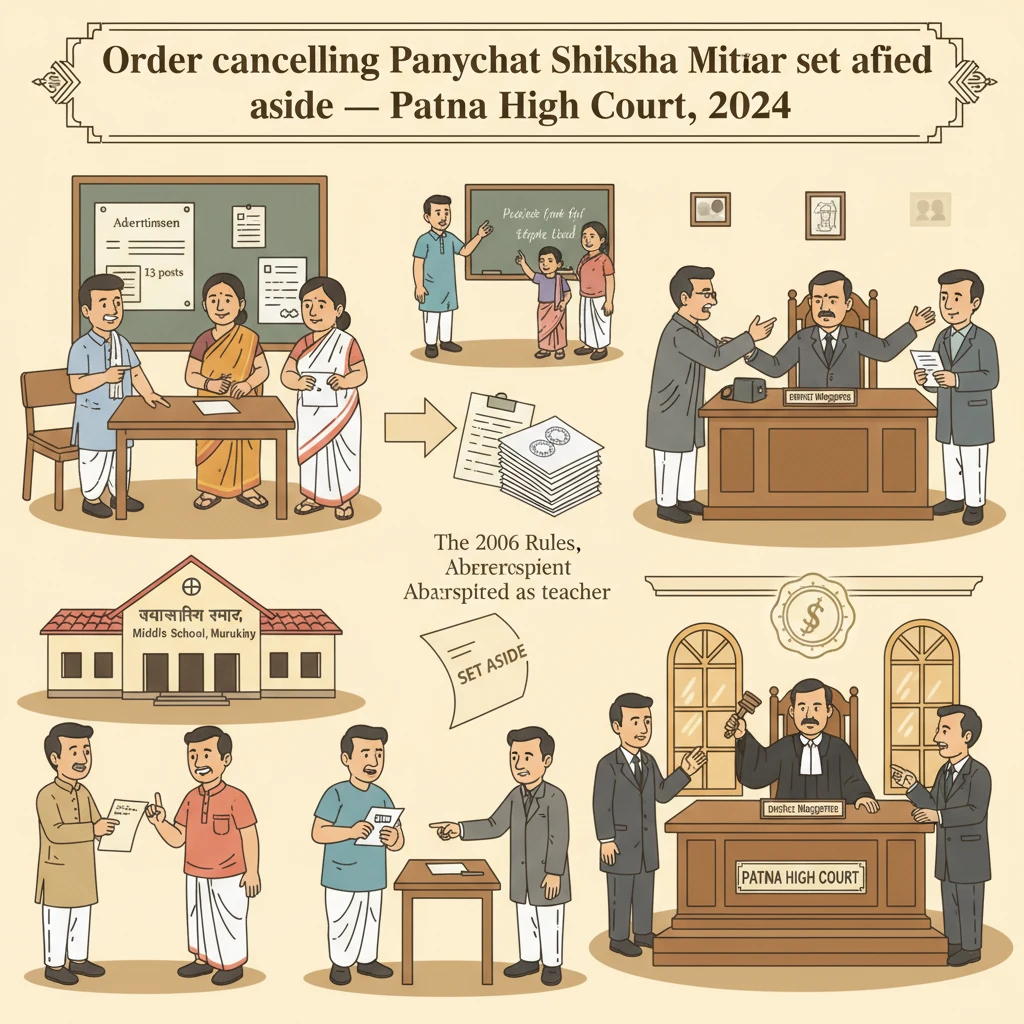
In 2005, 13 posts of Panchayat Shiksha Mitra were advertised in Murukiya Gram Panchayat. As per the roster, six posts were reserved for male candidates, including one for Extremely Backward Class (EBC) male candidates. The dispute relates only to this one EBC male post.
The writ petitioner and respondent no. 11 both applied for this EBC post. A Sukh Suvidha Samiti prepared the merit list for EBC candidates on 24.05.2005. The petitioner was placed at serial no. 8 and respondent no. 11 at serial no. 9. Both secured the same weightage of 15 marks.
On the basis of this merit list, the petitioner was selected as Panchayat Shiksha Mitra by letter dated 24.05.2005 and joined on 25.05.2005 at the Upgraded Middle School, Murukiya. His contract was renewed after eleven months by letter dated 11.05.2006. After the Bihar Panchayat Teachers (Appointment and Service Conditions) Rules, 2006 came into force with effect from 01.07.2006, he was absorbed as a Panchayat Teacher.
Respondent no. 11 objected to the petitioner’s selection, complaining before the Block Development Officer, Andhrathari, and also before the District Magistrate, Madhubani, through the Janata Darbar. He alleged malicious conduct by the Mukhiya and Panchayat Secretary in appointing the petitioner despite his lower marks.
On the District Magistrate’s direction, the Sub Divisional Magistrate, Jhanjharpur, conducted an enquiry into irregularities in appointments of Panchayat Shiksha Mitras in various Gram Panchayats, including Murukiya. In his report, sent to the District Magistrate on 28.06.2005, the Sub Divisional Magistrate concluded that respondent no. 11’s claim was correct and that the petitioner, having lesser marks, was illegally appointed.
Following this, the Block Education Extension Officer, Andhrathari, by letter dated 09.09.2005, directed the Panchayat Secretary of Murukiya Gram Panchayat to cancel the petitioner’s appointment and appoint respondent no. 11 within a week. This direction was not implemented, and instead the petitioner’s contract was renewed on 11.05.2006.
Later, on 11.09.2006, the District Superintendent of Education, Madhubani, again directed the Mukhiya and Panchayat Secretary to act on respondent no. 11’s complaint within a week. Acting on this, the Mukhiya and Panchayat Secretary, by letter dated 16.10.2006, asked the Headmaster of the Upgraded Middle School, Murukiya, to cancel the petitioner’s appointment and appoint respondent no. 11. According to respondent no. 11, he joined the school on 19.10.2006.
The petitioner then approached the District Superintendent of Education seeking an enquiry and necessary action.
On 05.06.2007, the Block Education Extension Officer issued another letter to the Headmaster stating that, in view of departmental notification dated 01.07.2006 and departmental letter no. 1899 dated 10.11.2006, no person could be appointed as Panchayat Shiksha Mitra after 01.07.2006. Since respondent no. 11 was appointed on 16.10.2006, his appointment was contrary to these departmental directions and his services should be dispensed with immediately.
Respondent no. 11 was accordingly removed by letter dated 08.06.2007. He challenged this removal before the Patna High Court in CWJC No. 7795 of 2007. That writ petition was disposed of on 25.11.2009 with liberty to him to approach the District Appellate Authority.
Respondent no. 11 then filed Appeal Case No. 112/05/2010 before the District Appellate Authority, Madhubani. By order dated 08.09.2010, the District Appellate Authority allowed the appeal, quashed the order dated 05.06.2007 and directed reinstatement of respondent no. 11. The writ petitioner was not made a party to this appeal.
Aggrieved by this appellate order, the petitioner approached the Patna High Court through the present Civil Writ Jurisdiction Case No. 338 of 2011.
What the Court Examined and Decided
The Patna High Court examined the competing claims of the petitioner and respondent no. 11, the sequence of departmental letters and enquiries, and the effect of the 2006 Rules which converted the scheme of Panchayat Shiksha Mitras into Panchayat Teachers.
On behalf of the petitioner, it was argued that since both he and respondent no. 11 had equal weightage marks, his higher educational qualification of B.A. Part II justified his selection as per the rules. It was also argued that once the 2006 Rules came into force with effect from 01.07.2006, no appointment as Panchayat Shiksha Mitra could legally be made. Therefore, the letter dated 16.10.2006 issued by the Mukhiya and Panchayat Secretary asking for cancellation of his appointment and for engagement of respondent no. 11 was wholly illegal.
The petitioner further contended that the District Appellate Authority’s order dated 08.09.2010 was passed behind his back. He was directly affected because reinstatement of respondent no. 11 was ordered in his place, but he was not impleaded in the appeal. This, it was argued, was a clear violation of the principles of natural justice.
The State, on the other hand, supported the enquiry findings that the petitioner’s original appointment as Panchayat Shiksha Mitra was invalid and illegal as he had lower marks than respondent no. 11. It was pointed out that the Block Education Extension Officer’s letter dated 09.09.2005 had already directed cancellation of the petitioner’s appointment and appointment of respondent no. 11. However, due to delay at the Gram Panchayat level, respondent no. 11’s appointment was made only on 16.10.2006. Because this was after 01.07.2006, the Block Education Extension Officer later directed cancellation of respondent no. 11’s appointment as well.
Respondent no. 11 argued that he belonged to the Extremely Backward Class category, supported by certificate issued by the District Magistrate, Madhubani, and that his appointment ought to relate back to the 2005 letter directing his engagement. He also contended that the petitioner was not a necessary party to the appeal before the District Appellate Authority.
The Court first noted the undisputed facts. The petitioner was selected and appointed as Panchayat Shiksha Mitra on 24.05.2005 and joined on 25.05.2005. He worked, received honorarium, and his contract was renewed on 11.05.2006. After the 2006 Rules came into force on 01.07.2006, he was absorbed as Panchayat Teacher.
The Court recorded that although the Block Education Extension Officer had, by letter dated 09.09.2005, directed cancellation of the petitioner’s appointment and appointment of respondent no. 11 within a week, this letter was never acted upon. Instead, the petitioner’s service was formally renewed in May 2006.
The Court then examined the legal position regarding appointments of Panchayat Shiksha Mitras after 01.07.2006. It relied on the Division Bench decision in Smt. Renu Kumari Pandey and Others v. The State of Bihar and Others, reported in 2011 (4) PLJR 297 (DB), which held that the post of Panchayat Shiksha Mitra stood abolished once the 2006 Rules came into force and that no appointment, claim for appointment, or deemed appointment as Panchayat Shiksha Mitra could be made retrospectively thereafter.
This Division Bench ruling had later been affirmed by a Full Bench of the Patna High Court in Kalpana Rani v. The State of Bihar, reported in 2014 (2) PLJR 665. The Full Bench, in paragraph 118, categorically held that after 01.07.2006 no person could be appointed on the basis of his or her name appearing in a panel of Panchayat Shiksha Mitra, because the post itself had been abolished. Empanelment alone did not give a right to appointment or to absorption as Panchayat Teacher.
Applying these decisions, the Single Judge held that the contention of respondent no. 11 could not be accepted. Admittedly, respondent no. 11 was not appointed or working as Panchayat Shiksha Mitra on 01.07.2006, the date when the post was converted into Panchayat Teacher. He was shown as appointed only on 16.10.2006, after abolition of the post. Therefore, despite any earlier recommendations or higher marks, he could not claim appointment or deemed appointment as Panchayat Shiksha Mitra, nor could he seek absorption as Panchayat Teacher under Rule 20(iii) of the 2006 Rules.
The Court emphasized that merely securing higher marks in the intermediate examination or being an aspirant did not create a right to be appointed as Panchayat Teacher after the cut-off date, when the scheme changed. The Full Bench reasoning in Kalpana Rani squarely applied: after 01.07.2006, a person whose name figured in the panel of Panchayat Shiksha Mitra but who had not actually been appointed and working on that date could not derive any benefit from such empanelment.
On the other hand, the petitioner had been duly appointed in 2005, had worked, had his contract renewed before 01.07.2006, and had been absorbed as Panchayat Teacher under the 2006 Rules. His service, therefore, could not be displaced on the basis of a claim which the law itself did not recognise.
The Court then turned to the manner in which the District Appellate Authority had passed its order dated 08.09.2010. The appellate authority had ordered reinstatement of respondent no. 11 in place of the petitioner, yet the petitioner had not been impleaded as a party in that appeal. The High Court found that the order was passed behind the back of the petitioner and in blatant violation of the principles of natural justice.
Because the appellate decision was both legally unsustainable in view of the 2006 Rules and binding precedents, and procedurally defective for want of hearing to the affected party, the High Court set it aside.
In the result, the Court allowed the writ petition. The order dated 08.09.2010 in Appeal Case No. 112/05/2010 passed by the District Appellate Authority, Madhubani, was quashed. No order was made as to costs.
Why This Judgment Matters
This judgment is important for Panchayat Shiksha Mitra and Panchayat Teacher disputes across Bihar, especially for candidates in rural areas who feel they were wrongly left out.
The Patna High Court has clearly reiterated that once the Bihar Panchayat Teachers (Appointment and Service Conditions) Rules, 2006 came into effect on 01.07.2006, the post of Panchayat Shiksha Mitra ceased to exist. Anyone who was only in a panel or had a recommendation but was not actually appointed and working by that date cannot later claim appointment or absorption as Panchayat Teacher.
For existing Panchayat Teachers who were validly appointed before 01.07.2006 and absorbed under the 2006 Rules, this decision offers security. Their appointments cannot be disturbed years later on the basis of rival candidates’ higher marks or earlier enquiry reports, if those rivals were not in service when the scheme changed.
The judgment also highlights that authorities and appellate bodies must hear all affected persons before passing orders. Replacing one teacher with another without hearing the existing teacher violates natural justice and will not stand in court.
Legal Issues and Answers
- Issue: Can a person who was only recommended or empanelled as Panchayat Shiksha Mitra, but not actually appointed and working on 01.07.2006, claim appointment or absorption as Panchayat Teacher after the 2006 Rules came into force?
Answer: No. Following the Division Bench decision in Smt. Renu Kumari Pandey and the Full Bench decision in Kalpana Rani, the post of Panchayat Shiksha Mitra stood abolished with effect from 01.07.2006, and no appointment or deemed appointment can be claimed thereafter on the basis of earlier empanelment or higher marks. - Issue: Was the District Appellate Authority’s order directing reinstatement of respondent no. 11 valid when the existing Panchayat Teacher (the petitioner) was not made a party to the appeal?
Answer: No. The order was passed in violation of principles of natural justice, as it adversely affected the petitioner’s service without giving him an opportunity of hearing. The Patna High Court set aside the appellate order on this ground as well. - Issue: Could the 2006 Rules and departmental notifications be used to justify cancellation of respondent no. 11’s appointment made on 16.10.2006?
Answer: Yes. The Court accepted that, in view of the departmental notification dated 01.07.2006 and letter no. 1899 dated 10.11.2006, no appointment as Panchayat Shiksha Mitra could be made after 01.07.2006, rendering respondent no. 11’s later appointment unsustainable.
Cases Cited by the Court
- Smt. Renu Kumari Pandey and Others v. The State of Bihar and Others, 2011 (4) PLJR 297 (Division Bench).
- Kalpana Rani v. The State of Bihar, 2014 (2) PLJR 665 (Full Bench).
- Alok Kumar and Others v. The State of Bihar and Others, 2009 (2) PLJR 929 (cited by petitioner’s counsel).
Case Details
Case Number: Civil Writ Jurisdiction Case No. 338 of 2011
Case Title: Ram Udgar Chaudhary v. The State of Bihar & Others
Citation: 2024 (2) PLJR 441
Court: High Court of Judicature at Patna
Coram: Hon’ble Mr. Justice Anil Kumar Sinha
Date of Judgment: 02.04.2024
Advocates:
- For the Petitioner: Mr. Satish Chandra Jha No. 3
- For the State: Mr. Shiv Kumar, AC to GA 3
- For Respondent No. 11: Mr. Sanjeev Kumar Jha, Mr. Jayant Anand
Nature of the Case: Writ petition under civil writ jurisdiction challenging order of District Appellate Authority in teacher employment dispute.
Impugned Order: Order dated 08.09.2010 passed by the District Appellate Authority, Madhubani, in Appeal Case No. 112/05/2010, directing reinstatement of respondent no. 11.
Final Outcome: Writ application allowed; appellate order dated 08.09.2010 set aside; no order as to costs.
Link to Judgment: Full text of judgment on Patna High Court website
If you found this explanation helpful and wish to stay informed about
how legal developments may affect your rights in Bihar,
you may consider following Samvida Law Associates for more updates.







