

Case Background
The writ petition arose after the death of a Canara Bank officer, late Brajesh Mishra, who was working as Chief Manager at the Kolkata Circle Office from 28.04.2020. He died in service on 20.01.2021.
During his service, before marriage, he had nominated his mother (petitioner no.1) and his brother (petitioner no.2) as joint nominees in the Bank records.
After his death, petitioner no.1 applied to Canara Bank on 21.03.2021 for settlement of death and terminal claims of her son, and asked that the settlement be made jointly with the deceased officer’s wife, who later became respondent no.4.
Subsequently, petitioner no.1 revoked her earlier authorisation given in favour of respondent no.4 for settlement of retiral and terminal dues by an email dated 10.05.2021 and a letter dated 13.05.2021.
The Bank processed the claim and released some settlement amounts, but adjusted them towards an unsecured loan taken by the deceased employee. The petitioners were informed of this adjustment by letter dated 22.11.2021.
Meanwhile, on 22.07.2021, the petitioners applied on behalf of late Brajesh Mishra for “exit” from the National Pension System due to his death, so that the NPS amount lying with the Pension Fund Regulatory and Development Authority (PFRDA) could be released.
By letter no. KC:HRM:807:2021 dated 29.07.2021, Canara Bank rejected this NPS claim. It relied on Regulation 31(V) of the PFRDA (Exits and Withdrawals) Regulations, 2015, and said that since the deceased had made the nomination before marriage and made no fresh nomination after marriage, the previous nomination had become invalid. The Bank directed the petitioners to produce a legal heir certificate for settlement of the NPS amount.
Feeling aggrieved, the mother and brother approached the Patna High Court in Civil Writ Jurisdiction Case No. 2846 of 2022, mainly challenging this letter dated 29.07.2021 and seeking release of NPS and other pensionary benefits to clear the housing loan of the deceased.
Initially, the deceased officer’s wife was not a party to the writ. On 09.02.2023, the Court directed that she be impleaded as respondent no.4. After service of notice, she entered appearance and filed her response.
What the Court Examined and Decided
The Court heard three sets of lawyers: counsel for the petitioners (mother and brother), counsel for Canara Bank, and counsel for respondent no.4 (widow).
On behalf of the petitioners, it was argued that the Bank’s reliance on the 2015 PFRDA Regulation was misplaced because the Regulation was amended in 2017. The amendment clarified that at the time of exit on account of death, the nomination existing in the employer’s records for other terminal benefits would be treated as the nomination for NPS benefits as well.
The petitioners produced the amended rule as Annexure-5/1 and contended that, despite this change, the Bank had illegally refused their claim, insisting on a legal heir certificate. They also highlighted that petitioner no.1 is a widowed mother, with old age ailments, without independent income, and struggling to repay the housing loan taken by her late son.
According to the petitioners, the Bank was repeatedly threatening petitioner no.1 that, unless the housing loan was cleared, the Bank would auction the flat purchased through that loan. Since the NPS amount was not being released, the outstanding loan amount could not be adjusted, and interest and penal interest continued to pile up. The petitioners asserted that the housing loan liability could be fully or substantially cleared from the NPS corpus.
On the other hand, Canara Bank defended its order. The Bank argued that the impugned decision of 29.07.2021 was based on the 2015 PFRDA Regulations published in the Gazette of India on 11.05.2015. Under Regulation 31(V), any nomination made before marriage becomes invalid upon marriage unless a fresh nomination is made.
The Bank submitted that, after the impugned order, the widow (respondent no.4) had also applied on 29.07.2021 for exit from NPS as claimant. She was informed that her claim as a nominee could not be accepted because she had never been nominated after marriage.
According to the Bank, under the amended PFRDA Regulations, NPS claims can only be settled in favour of legal claimants if their entitlement has already been settled in other terminal benefit accounts. Here, gratuity and other accounts had been settled in favour of petitioner no.1 and the widow jointly, following Government of India guidelines.
The Bank also said that serious disputes between the mother, brother, and widow had arisen. Therefore, as per Government guidelines, a joint legal heir certificate was required to resolve the dispute and to enable proper settlement. The Bank further informed the Court that liabilities of the deceased were still outstanding: about Rs. 31,96,787.69 in home loan, and Rs. 5,63,267.03 in overdraft, as shown in Annexure-2 to its counter affidavit.
Counsel for respondent no.4 (widow) contested the petitioners’ stance and the Bank’s attempt to shut her out. He argued that as the deceased’s wife, she is entitled to all terminal benefits under NPS and to the death claim settlement. He pointed out that petitioner no.2, being her elder brother-in-law, was capable of maintaining himself and their mother, whereas she had no income and was in great hardship after her husband’s death.
Referring to the Bank’s own application form for settlement of balances in accounts, lockers and safe custody, counsel for the widow submitted that she had been treated as legal heir of late Brajesh Mishra. Therefore she was entitled to NPS benefits.
He also argued that the Bank’s impugned communication was consistent with the regulations because any nomination before marriage becomes invalid, and a fresh nomination after marriage is mandatory. He relied on paragraph 32(V) of the relevant Regulation. Further, he cited the Supreme Court’s decision in Shakti Yezdani & Anr. v. Jayanand Jayant Salgonkar & Ors. (Civil Appeal No. 7107 of 2017) to say that nomination does not confer absolute ownership, nor does it oust legal heirs; the usual inheritance rules continue to apply.
The High Court then examined the broader legal position regarding nomination. It referred to the Supreme Court judgment in Shipra Sengupta v. Mridul Sengupta & Ors., (2009) 10 SCC 680, which, following Sarbati Devi & Anr. v. Usha Devi, (1984) 1 SCC 424, held that nomination only authorises a person to receive the amount or manage property. It does not make the nominee the beneficial owner. After the death of the person concerned, the heirs can claim the money or property as per the law of succession.
The Court also relied on Division Bench judgments of the Patna High Court itself. In Ati Razia Devi v. State of Bihar & Ors., 2016(1) PLJR 835, concerning family pension, it was held that the purpose of nomination is to allow the State to pay and obtain a valid discharge; the nominee then holds the money in trust for the lawful beneficiary who can assert their rights in civil court.
In Shiv Shankar Arya v. Union of India & Ors., 2016(2) PLJR 477, the Division Bench reiterated that nomination is only an authority to receive payments and give discharge; the nominee does not become absolute owner but is a trustee for the heirs.
The Court further referred to Khushboo Gupta v. Life Insurance Corporation of India, 2019(4) PLJR 885. There, despite the deceased having nominated his mother, the Court held that both wife and mother, being Class I heirs under the Hindu Succession Act, 1956, were each entitled to 50% of the insurance proceeds.
Coming to the specific clause relied on by the Bank, the Court examined sub-clause (v) of point no. 31 of the PFRDA Regulations, which states that a fresh nomination shall be made on marriage and any nomination before marriage shall be deemed invalid. The Court held that the Bank’s reading was “wholly misconceived.”
According to the Court, this clause deals with a situation where, after marriage, the subscriber actually makes a fresh nomination. In such a case, the earlier nomination is displaced by the new one. The clause does not support automatic invalidation of the earlier nomination merely because the subscriber got married but did not file a new nomination.
It was an admitted fact that late Brajesh Mishra did not file any fresh nomination after marriage. It was also undisputed, in fact and law, that respondent no.4 is his widow and petitioner no.1 is his mother, and both are Class I heirs under the Hindu Succession Act, 1956. Petitioner no.1 herself had initially sought settlement of her son’s death claim jointly with the widow.
The Court reiterated that, in law, nomination does not grant exclusive beneficial interest; it merely designates who can receive the money from the institution. The amount so received must still be distributed as per succession law. Once rights have vested in the mother and the widow as Class I heirs, such rights cannot be taken away merely because of family disputes.
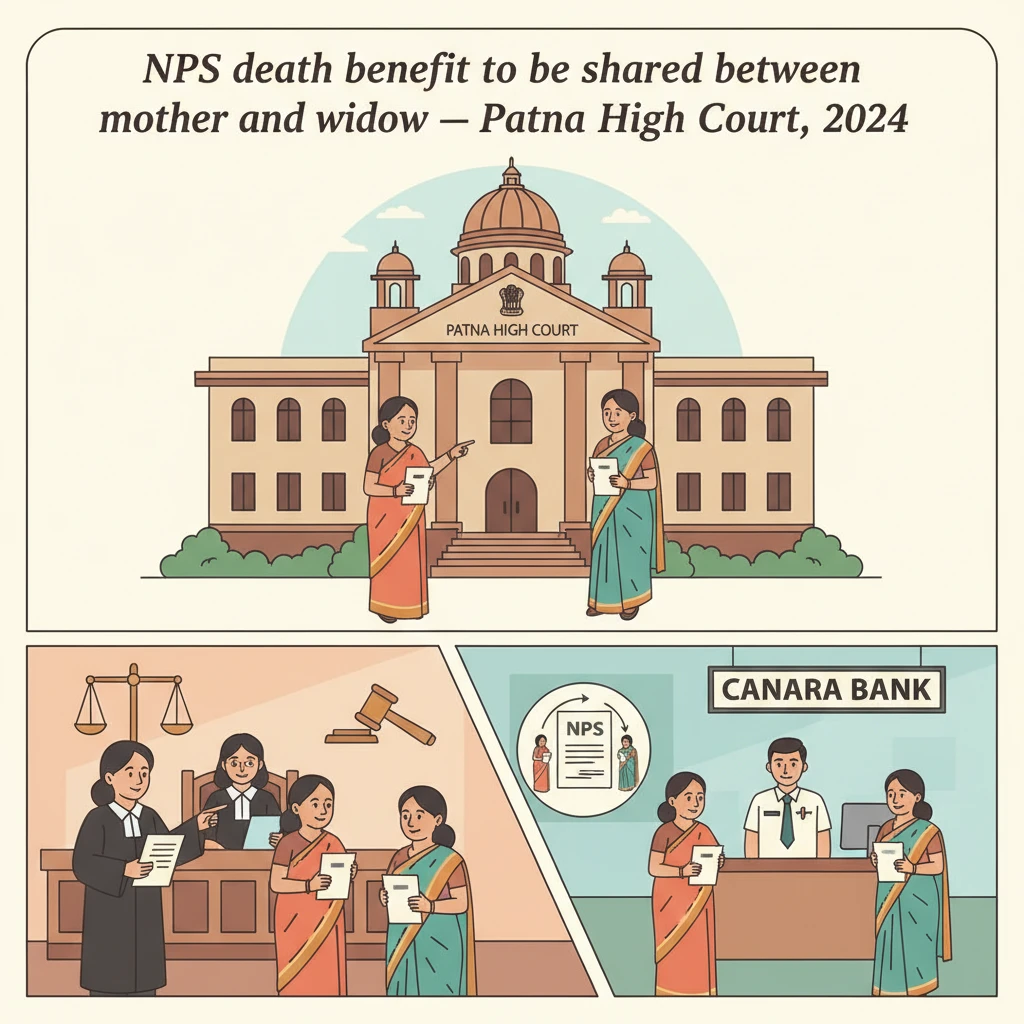
On this reasoning, the Court ordered Canara Bank to release half of the NPS amount, or any other terminal benefits, to petitioner no.1 and the other half to respondent no.4, dividing it equally between them. This exercise is to be completed preferably within four weeks of receipt or production of the Court’s order.
Regarding the outstanding home loan and overdraft, the Court noted that these liabilities are to be settled from the assets of the deceased’s legal heirs in accordance with law. If, after receiving the NPS and other amounts, petitioner no.1 and respondent no.4 agree to repay the loan, the Bank shall appropriate the amounts towards the home loan. If they do not agree, the Bank is free to proceed under the Securitisation and Reconstruction of Financial Assets and Enforcement of Security Interest Act, 2002 (SARFAESI Act).
On this basis, the writ petition was partly allowed, mainly by setting aside the Bank’s stand that the old nomination was void and directing equal disbursal of NPS and other dues to the mother and widow.
Why This Judgment Matters
This judgment is important for families of deceased employees who are covered under the National Pension System or similar schemes.
It clarifies that banks and employers cannot automatically treat pre-marriage nominations as invalid simply because the subscriber got married and did not update the nomination.
More importantly, the Patna High Court has reaffirmed that nomination is only a method for banks and institutions to know to whom to release money. It does not decide who is the real owner of the money after death.
In simple terms, even if a mother, father, spouse, or any other person is the nominee, the final right to the money is shared by all legal heirs according to succession law. Institutions like banks get a good discharge by paying the nominee, but that does not close the door for other legal heirs.
For widows, parents, and children of deceased employees, this means they can ask for a fair share in death benefits even if their name is not on the nomination form, so long as they are legal heirs.
The judgment also balances the rights of family members with the recovery rights of banks. It allows the Bank to use SARFAESI if family members do not cooperate in clearing housing loan dues, while still ensuring that the NPS money reaches the lawful heirs.
Legal Issues and Answers
- Issue: Does marriage of an NPS subscriber automatically invalidate a nomination made before marriage, so that the Bank can deny NPS benefits to pre-marriage nominees?
Answer: No. The Patna High Court held that Regulation 31(v) does not provide for automatic invalidation; it only applies where a fresh nomination is made after marriage. - Issue: Does a nominee get absolute ownership of NPS or other terminal benefits on the death of the subscriber, excluding other legal heirs?
Answer: No. The Court held that nomination merely authorises receipt; the money must still be distributed among legal heirs as per the Hindu Succession Act, 1956. - Issue: How should NPS and other terminal benefits of the deceased officer be divided between his mother and widow?
Answer: The Court directed Canara Bank to release half of the NPS and other terminal benefits to the mother (petitioner no.1) and half to the widow (respondent no.4), both being Class I legal heirs.
Cases Cited by the Court
- Shipra Sengupta v. Mridul Sengupta & Ors., (2009) 10 SCC 680
- Sarbati Devi & Anr. v. Usha Devi, (1984) 1 SCC 424
- Ati Razia Devi v. State of Bihar & Ors., 2016(1) PLJR 835
- Shiv Shankar Arya v. Union of India & Ors., 2016(2) PLJR 477
- Khushboo Gupta v. Life Insurance Corporation of India Through Executive Director & Ors., 2019(4) PLJR 885
- Shakti Yezdani & Anr. v. Jayanand Jayant Salgonkar & Ors., Civil Appeal No. 7107 of 2017
Case Details
Case Number: Civil Writ Jurisdiction Case No. 2846 of 2022
Case Title: Smt. Raj Lakshmi Mishra & Anr. v. The Chairman-cum-Managing Director, Canara Bank & Ors.
Coram: Hon’ble Mr. Justice Harish Kumar
Date of Judgment: 03.09.2024
Citation: 2024(4) PLJR 449
Advocates:
- For the petitioners: Mr. Gyanendra Kumar Shukla, Advocate
- For Canara Bank (respondent nos. 1 to 3): Mr. Jitendra Kumar, Advocate
- For respondent no.4 (widow): Mr. Shekhar Singh, Advocate
Nature of the case: Writ petition under Article 226 of the Constitution of India challenging denial of NPS and terminal benefits and seeking directions for their release and adjustment towards loan liabilities.
Link to the Judgment: Click here to read the full Patna High Court judgment
If you found this explanation helpful and wish to stay informed about
how legal developments may affect your rights in Bihar,
you may consider following Samvida Law Associates for more updates.







