
Case Background
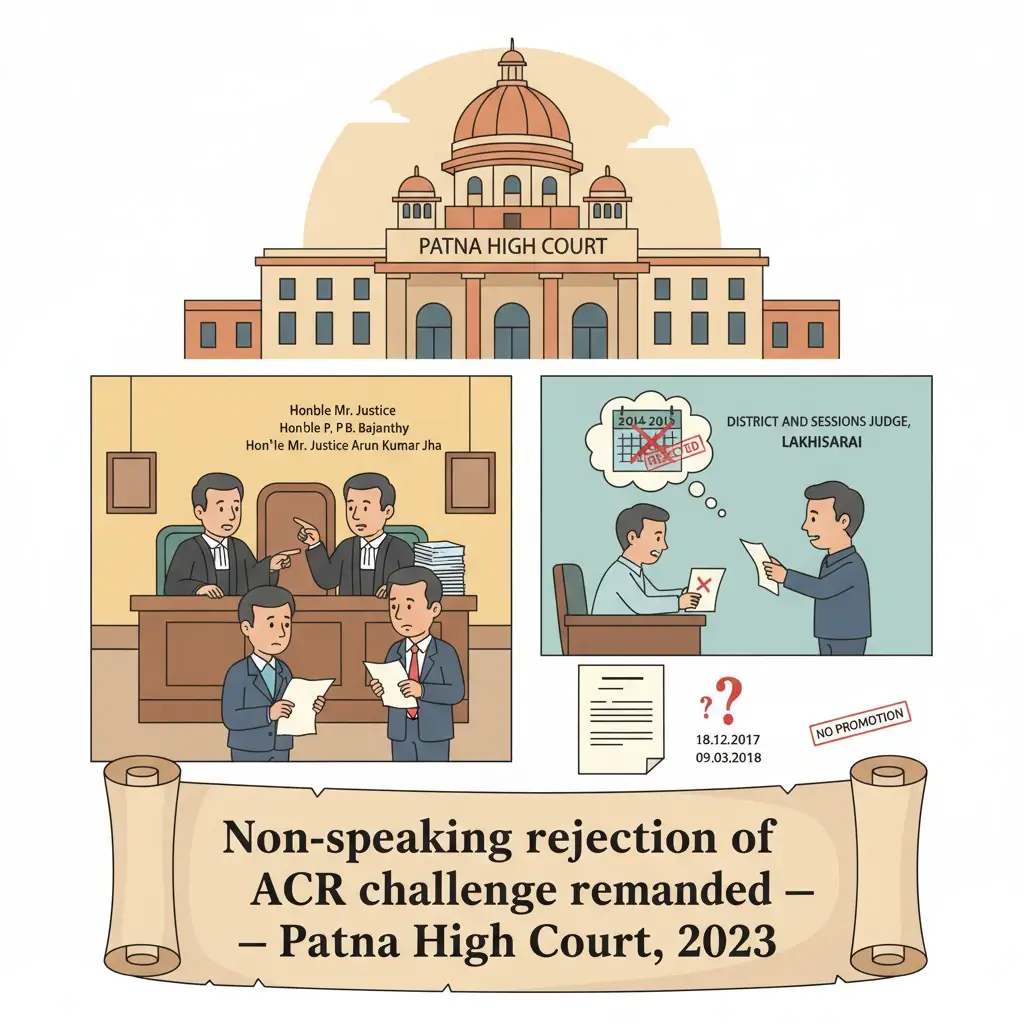
The petitioner filed a civil writ petition before the Patna High Court in Civil Writ Jurisdiction Case No.17336 of 2018. He questioned how his annual confidential report for the year 2014–2015 had been dealt with by the authorities.
The grievance related to remarks in his confidential report which indicated that he was not ready for higher or additional duties and responsibilities. According to him, this assessment affected his chances of further promotion and operated as a punishment without proper basis.
The petitioner stated that the confidential report for the year 2014–2015 was communicated to him after more than two years. He also claimed that this was done without issuing any show cause notice and without hearing him, even though there was a contradiction between the view of his controlling authority and the communication made to him.
He further alleged that the adverse remarks were used to deprive him of promotion, and that his representation or appeal against these remarks was rejected without reasons by the High Court on 18.12.2017. He also questioned a later order dated 09.03.2018, again alleging that it was passed without any proper basis and without giving reasons.
On these grounds, he approached the Patna High Court seeking a writ of certiorari to quash the communications and orders, and for appropriate consequential reliefs.
What the Court Examined and Decided
The Patna High Court, through a Division Bench comprising Hon’ble Mr. Justice P. B. Bajanthri and Hon’ble Mr. Justice Arun Kumar Jha, heard the matter. The oral judgment was delivered by Hon’ble Mr. Justice P. B. Bajanthri on 02.01.2023.
The core issue framed by the Court was narrow and focused. The Court described it as a “short question”: whether the petitioner’s representation against his annual confidential report for the year 2014–2015 had been properly considered by the competent authority, with reference to each of the contentions raised in his representation, or not.
The Court first looked at how the decision rejecting his representation had been communicated. The decision of the authority was communicated to the petitioner through the District and Sessions Judge, Lakhisarai. The communication merely stated that the representation against the adverse remarks for the year 2014–2015 had been rejected.
The Court noted that, in this communication, no reasons were provided. It observed that, even if the authority had any reasons for rejecting the representation, those reasons were not made available to the petitioner. It was essentially a bare rejection without explanation.
The Court then turned to the counter affidavit filed on behalf of the first respondent, namely the High Court of Judicature at Patna through the Registrar General. The Court specifically referred to paragraph 7 of this counter affidavit.
On examining this paragraph, the Court found that the counter affidavit merely reiterated what had already been stated in the communication made through the District and Sessions Judge. It did not disclose any detailed reasoning or examination of the petitioner’s specific grounds raised in his representation.
In other words, even the stand taken in court by the respondent did not show that a reasoned, speaking order had been passed on the petitioner’s representation. On this basis, the Court concluded that “prima facie there is no speaking order on the petitioner’s representation.”
Having reached this conclusion, the Court held that the petitioner had made out a case warranting interference with the decision rejecting his representation.
The Court then referred to a recent judgment of the Supreme Court. It cited the case of Ram Chander vs. State of Chhattisgarh, reported in AIR 2022 SC 2017. In that case, the Apex Court had held that mechanical reasons are not considered adequate.
The Patna High Court stated that the principle laid down in Ram Chander’s case was “aptly applicable” to the facts before it. The central idea drawn from the Supreme Court judgment was that orders rejecting such representations must not be mechanical or vague. They must contain proper reasons.
The Bench further observed that rejection of a representation against an annual confidential report is amenable to judicial review. This means that courts can examine whether the process and reasoning behind such a rejection meet legal standards.
The Court emphasized that, since such rejection is subject to judicial review, it “must be supported by material information or reasons.” A non-speaking order that offers no real explanation will not meet this requirement.
In clear terms, the Court summed up its finding by stating that the impugned actions were “non-speaking.” Therefore, they could not stand in law.
On this basis, the Court set aside the impugned actions of the respondents relating to the rejection of the petitioner’s representation against his annual confidential report for the year 2014–2015. This included the non-speaking rejection communicated through the District and Sessions Judge and the orders of 18.12.2017 and 09.03.2018, to the extent they related to rejection of his representation without reasons.
The matter was not finally decided on merits of the confidential report itself. Instead, the Court directed the competent authority to reconsider the petitioner’s representation afresh. This direction required the authority to pass a “speaking order,” meaning an order that clearly records reasons.
Specifically, the Court directed the concerned or competent authority to decide the petitioner’s representation afresh and to pass a reasoned order after due consideration of each of the contentions stated in the representation against the annual confidential report for the years 2014–2015.
The Court fixed a timeline for this exercise. It directed that such decision be taken within four months from the date of receipt of the High Court’s order. It also directed that the decision be communicated to the petitioner at the earliest.
Thus, the immediate outcome of the writ petition was that the non-speaking rejection orders were set aside, and the petitioner obtained a fresh chance to have his objections to the adverse entries in his confidential report examined in a proper, reasoned manner.
Why This Judgment Matters
This judgment is important for government servants and court staff whose careers depend on annual confidential reports. The Patna High Court has reiterated that authorities cannot simply reject representations against adverse remarks with one-line, mechanical orders.
The Court has underlined that whenever a representation against an ACR is rejected, the authority must record reasons and deal with the specific points raised. Such orders must be “speaking orders,” not empty formalities.
The judgment also confirms that rejection of representations against ACRs is open to judicial review. If an order is non-speaking or mechanical, a court can set it aside and direct fresh consideration.
For employees, this provides some protection against arbitrary or unexplained adverse remarks that may affect promotions or career progression. For authorities, it serves as a reminder that transparency and reasoned decision-making are legal requirements, not optional practices.
Legal Issues and Answers
- Issue: Whether the petitioner’s representation against the adverse remarks in his annual confidential report for 2014–2015 was properly considered and decided by a speaking, reasoned order.
Answer: No. The Patna High Court held that the rejection of the representation was communicated without reasons, the counter affidavit merely repeated this, and there was no speaking order. The impugned actions were set aside and the authority was directed to decide the representation afresh by a reasoned order within four months. - Issue: Whether mechanical or non-speaking rejection of a representation against an ACR can withstand judicial scrutiny.
Answer: No. Relying on Ram Chander vs. State of Chhattisgarh (AIR 2022 SC 2017), the Court held that mechanical reasons are not adequate and that rejection of representation against an ACR must be supported by material information or reasons, being amenable to judicial review.
Cases Cited by the Court
- Ram Chander vs. State of Chhattisgarh, AIR 2022 SC 2017
Case Details
Case Number: Civil Writ Jurisdiction Case No.17336 of 2018
Case Title: Narayan Das Sharma vs. The High Court of Judicature at Patna & Anr.
Coram: Hon’ble Mr. Justice P. B. Bajanthri and Hon’ble Mr. Justice Arun Kumar Jha
Citation: 2023 (1) PLJR 757
Advocates:
- For the petitioner: Mr. Shiv Kumar, Advocate; Mr. Sahjanand Sharma, Advocate
- For the respondents: Mr. Piyush Lall, Advocate
Nature of the case: Writ petition (civil) challenging rejection of representation against adverse remarks in annual confidential report and related orders
Link of the judgement; https://patnahighcourt.gov.in/viewjudgment/MTUjMTczMzYjMjAxOCMxI04=—ak1–hlhEtKSZk8=
If you found this explanation helpful and wish to stay informed about
how legal developments may affect your rights in Bihar,
you may consider following Samvida Law Associates for more updates.







