
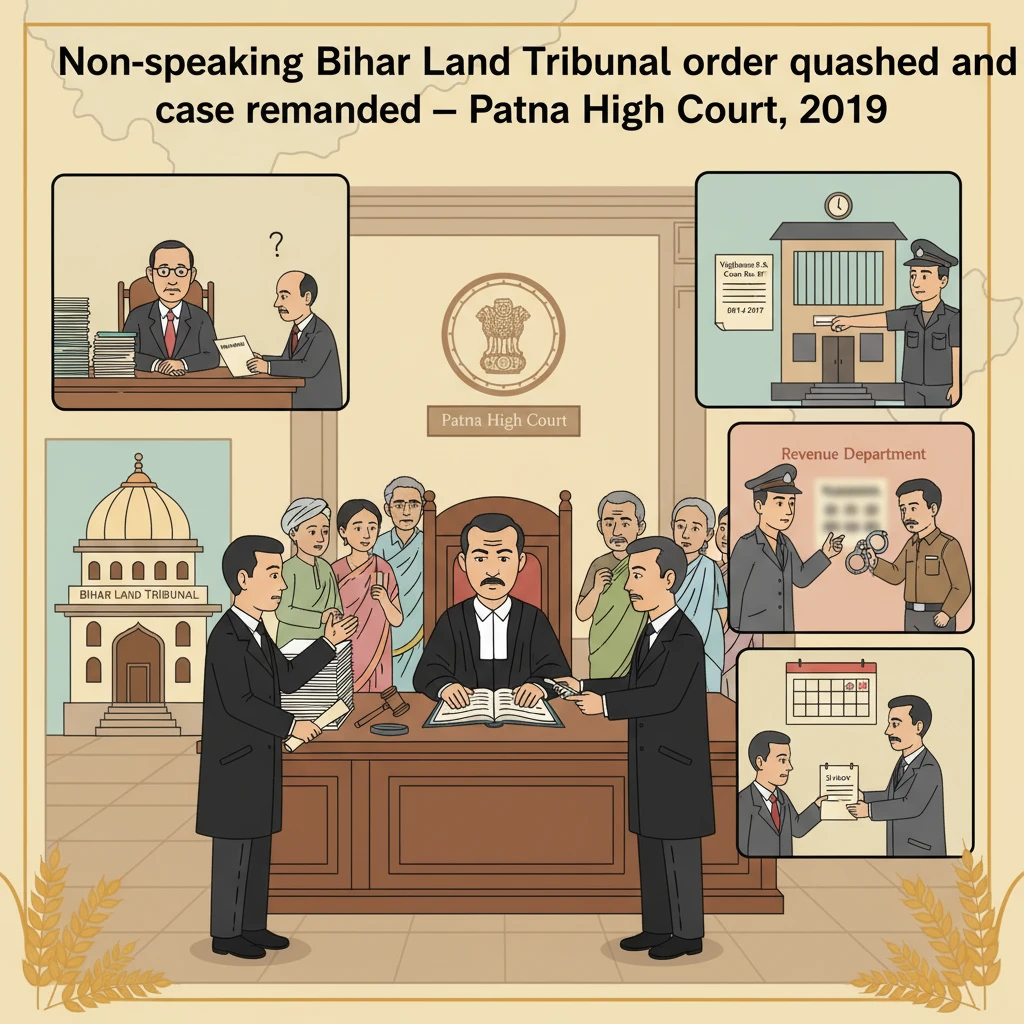
Case Background
The writ petition, Civil Writ Jurisdiction Case No. 7250 of 2015, was filed by a landholder from Madhubani district. He challenged an order dated 24 February 2015 passed by the Bihar Land Tribunal, Patna, in B.L.T. Case No. 389 of 2013.
The Tribunal’s order had interfered with an earlier order of the Collector, Madhubani dated 02 February 2002 in Bataidari Appeal No. 33 of 1999-2000. The Tribunal allowed the claim of certain private respondents and set aside the Collector’s decision. The writ petitioner approached the Patna High Court saying this Tribunal order was illegal.
The writ petition was heard by a learned Single Judge who, by orders dated 31 January 2019 and 08 February 2019, recorded serious concern over the manner in which the Tribunal’s order had been passed and over the conduct of the Tribunal’s Member (Administrative), Dr. K.P. Ramaiah, who had authored that order.
During the writ proceedings, it emerged from a counter affidavit filed for the Chief Secretary, Bihar, that a vigilance case had been registered against Dr. Ramaiah and that since 31 October 2017 he had not been functioning as Member (Administrative). An office order of the Bihar Land Tribunal, dated 26 December 2017, stated that no case would be placed before him because of his involvement in the criminal case.
In view of these facts, the learned Single Judge directed that Dr. Ramaiah be impleaded by name as respondent no. 21 in the writ petition and called upon the State to explain why he had not yet been removed from his post. The private respondents (no. 4 to 20) were also issued notice.
Meanwhile, Dr. Ramaiah filed two Letters Patent Appeals (L.P.A. No. 438 of 2019 and L.P.A. No. 439 of 2019) questioning the Single Judge’s orders dated 31 January 2019 and 08 February 2019. Those appeals came before a Division Bench headed by the Hon’ble Chief Justice. Because both the writ petition and the appeals were closely connected, the Division Bench summoned the writ records and heard everything together.
What the Court Examined and Decided
The Division Bench first focused on the core writ issue: whether the Bihar Land Tribunal’s order dated 24 February 2015 in B.L.T. Case No. 389 of 2013 could stand in law.
The Court noted that the learned Single Judge had already made a “prima facie” observation that this Tribunal order was a non-speaking one, meaning it did not give reasons. The Division Bench examined the Tribunal order itself, especially paragraph 24, which contained the operative decision.
Paragraph 24 of the Tribunal’s order simply stated that, after hearing the parties, going through the documents and perusing the impugned Collector’s order, the Member found reason to interfere. It then quashed the Collector’s order dated 02 February 2002 in Bataidari Appeal No. 33 of 1999-2000 and allowed the application.
The High Court observed that, before this single sentence, the Tribunal order merely set out 23 paragraphs of facts and the parties’ submissions “in an almost ex parte manner.” However, the order did not record any findings, did not discuss how the law applied to the facts, and did not explain why the Collector’s decision was wrong.
For the Division Bench, this created a clear gap: there was no link between what the parties had argued and the conclusion reached. The Tribunal had, in effect, only announced a result without disclosing the reasoning process behind it.
The Patna High Court held that such an order cannot be sustained. Courts and tribunals must not only decide, they must show why they are deciding in a particular way. Reasons are part of natural justice. Without them, affected parties cannot understand or challenge the decision properly, and higher courts cannot review it effectively.
The Court also considered the wider background regarding the conduct and status of Dr. K.P. Ramaiah. From the counter affidavit of the Chief Secretary, affirmed through the Assistant Director, Land Acquisition (Revenue), it appeared that:
- A Vigilance P.S. Case No. 081 of 2017 had been registered against Dr. Ramaiah on 23 October 2017 for serious offences under Sections 406, 409, 420, 468, 471, 477A, 120B of the Indian Penal Code and Section 13(2) read with Section 13(1)(A) of the Prevention of Corruption Act.
- The Superintendent of Police, Vigilance, had written to the Chairman of the Bihar Land Tribunal on 26 December 2017 about this FIR.
- On the same date, the Tribunal had issued an office order that no case should be placed before Dr. Ramaiah for hearing or disposal, with immediate effect.
- Dr. Ramaiah had remained largely absent from his duties and was not functioning as Member (Administrative) from 31 October 2017.
- For deciding whether he should be removed from his post, an inquiry had been initiated, charges framed, and a show-cause notice issued to him. That process was stated to be underway.
The Division Bench said it was mentioning these facts “to indicate that a person who did not deserve to occupy the said office was continuing” and that the Tribunal itself had already decided that no new case would be placed before him.
Taking this background together with the nature of the Tribunal’s order, the Court held that the impugned order was not only a non-speaking order but also suffered from “malice in law” and violated the principles of natural justice. The Court explicitly described the order as arbitrary and as a mala fide exercise of power in the background of the conduct of respondent no. 21.
The Bench fully agreed with the concerns and tentative view earlier expressed by the learned Single Judge in his orders dated 31 January 2019 and 08 February 2019. It recorded that the impugned Tribunal order was “writ large” with non-recording of reasons and mere conclusions.
On this basis, the High Court allowed the writ petition. It set aside the Bihar Land Tribunal’s order dated 24 February 2015 in B.L.T. Case No. 389 of 2013.
However, the Court did not finally decide the underlying land rights. Instead, it remanded the matter back to the Bihar Land Tribunal. The Tribunal was directed to decide the case afresh on merits, in accordance with law, after issuing notice to all concerned. The Court clarified that it would be open to the private respondents to pursue their case before the Tribunal.
The High Court stressed that the earlier Tribunal order had been quashed solely on two grounds: failure to record reasons and the mala fide character of the order in the circumstances mentioned. This meant that parties would still get a full opportunity before the Tribunal to argue their land dispute on merits.
After disposing of the writ petition, the Division Bench then turned to the two Letters Patent Appeals filed by Dr. Ramaiah, which were mainly about the Single Judge’s critical observations on his conduct, and the directions to the State to consider his removal from the Tribunal.
During the appellate proceedings, several procedural developments occurred:
- The Court summoned Dr. Ramaiah’s personal presence, but he did not appear, leading the Bench to view his conduct as defiance. A bailable warrant was issued under the signature of the Registrar General, to be executed by the Inspector General of Police (Headquarters).
- The Court also considered whether criminal contempt proceedings should be drawn against him for obstructing the course of justice and lowering the authority of the Court by ignoring its order to appear.
- Dr. Ramaiah approached the Supreme Court through Special Leave Petitions against the Division Bench’s interim orders. The Supreme Court recorded a statement by his senior counsel that he would appear before the High Court and directed him to file an affidavit of compliance.
- After this, Dr. Ramaiah appeared before the Division Bench, filed an affidavit, and expressed willingness to withdraw both the Special Leave Petitions and the Letters Patent Appeals. He also undertook to resign from the post of Member (Administrative), Bihar Land Tribunal.
- He subsequently tendered his resignation to the State Government with effect from 11 July 2018 (the period till which he was on leave) and moved for withdrawal of the appeals, offering unconditional apology and stating that he never intended to defy the Court.
In light of this affidavit and the fact that the writ petition had already been decided, the Division Bench permitted withdrawal of L.P.A. Nos. 438 and 439 of 2019. It dropped the criminal contempt proceedings, accepted the apology, and discharged the bailable warrant and surety.
At the same time, it imposed conditions and directions: the resignation would be subject to any order of the State Government, and the State remained free to proceed in accordance with law, including any inquiry into his removal as a Tribunal member. The Court also noted that a charge-sheet had been filed in Vigilance P.S. Case No. 081 of 2017 and granted liberty to the appellant to seek regular bail from the trial court, with a timeline for disposal of such bail application.
Before closing the matter, the Bench made strong observations on the duty of courts to protect the rule of law, the necessity of recording reasons in judicial orders, and the need to ensure that litigants cannot misuse legal remedies to evade accountability. The Court emphasised that while individuals have a right to approach courts, this must not result in miscarriage of justice or erode public faith in the judicial system.
Why This Judgment Matters
This judgment has practical importance for ordinary land litigants in Bihar, especially those whose cases go before the Bihar Land Tribunal.
First, the Patna High Court made it clear that any Tribunal order which simply narrates facts and arguments but gives no reasons cannot survive. People affected by such orders can challenge them on this ground. Courts will insist that Tribunals explain why they are allowing or rejecting a claim.
Second, the High Court showed that where there are serious questions about the conduct of a judicial or quasi-judicial officer, higher courts will take them seriously. Here, despite an FIR and long absence from duties, the officer continued to hold a high post. The Court’s orders pushed the State to start an inquiry, frame charges, and examine his removal.
Third, the decision protects the writ petitioner, whom the Court described as a “victim of gross injustice.” By quashing the non-speaking Tribunal order and remanding the matter, the Court ensured he would get a fair hearing based on reasons, not just conclusions.
Finally, the Court balanced strictness with fairness. It called out the appellant’s earlier non-appearance and even initiated contempt proceedings, but later accepted his unconditional apology when he appeared, resigned, and expressed willingness to cooperate in the legal process. This shows that while the Patna High Court will firmly enforce its authority, it will also close matters once respect for the law is restored.
Legal Issues and Answers
- Issue: Can a Bihar Land Tribunal order which only sets out facts and arguments but gives no reasons for its conclusion be sustained in law?
Answer: No. The Patna High Court held that such a non-speaking order violates principles of natural justice, is arbitrary, and cannot stand. The Tribunal must record its reasons, not just its conclusions. - Issue: What should happen when a Tribunal’s order is found to be non-speaking and tainted by malice in law, but the underlying land dispute remains unresolved?
Answer: The proper course is to set aside the defective order and remit the case back to the Tribunal for a fresh decision on merits after notice to all concerned, as directed by the Patna High Court. - Issue: How should the Court respond when a litigant disobeys an order to appear and seems to be evading the process of law?
Answer: The Division Bench held that such conduct may amount to obstruction of justice and justify drawing criminal contempt proceedings and issuing a bailable warrant. However, if the litigant later appears, apologises unconditionally, and complies with the Court’s directions, the Court may drop contempt while still allowing the State to proceed according to law.
Cases Cited by the Court
- The judgment primarily reproduces and relies on earlier orders of the learned Single Judge in C.W.J.C. No. 7250 of 2015 and an order dated 23 March 2018 in Cr. Misc. Case No. 4117 of 2018 (rejection of anticipatory bail in Vigilance P.S. Case No. 081 of 2017). No external Supreme Court or High Court precedents are cited by name.
Case Details
Case Number: Civil Writ Jurisdiction Case No. 7250 of 2015; Letters Patent Appeal No. 438 of 2019; Letters Patent Appeal No. 439 of 2019
Case Title (Writ): Bimal Chandra Mishra v. The State of Bihar & Ors.
Case Title (LPA 438/2019 and 439/2019): Karra Parasuramaiah v. The State of Bihar & Ors.
Citation: 2019 (3) PLJR 364
Coram: Hon’ble the Chief Justice Amreshwar Pratap Sahi; Hon’ble Mr. Justice Rajeev Ranjan Prasad
Advocates (as recorded in the Division Bench judgment):
- For the Appellant(s) in LPAs: Mr. Y.V. Giri, Senior Advocate; Mr. Sumit Kumar Jha, Advocate
- For the Respondent(s): Mr. Lalit Kishore, Advocate General
- For the writ petitioner before the Division Bench: Shri Subodh Kumar Jha, learned counsel
Nature of the Case: Writ petition under civil writ jurisdiction challenging an order of the Bihar Land Tribunal in a land/bataidari matter; connected Letters Patent Appeals against interim and related orders of a Single Judge concerning the conduct and continuance of a Tribunal Member.
Date of Judgment (Division Bench): 02 May 2019
Court: High Court of Judicature at Patna
Link to Judgment: Patna High Court Judgment in CWJC No. 7250 of 2015 & LPAs 438/2019, 439/2019
If you found this explanation helpful and wish to stay informed about how legal developments may affect your rights in Bihar, you may consider following Samvida Law Associates for more updates.







