
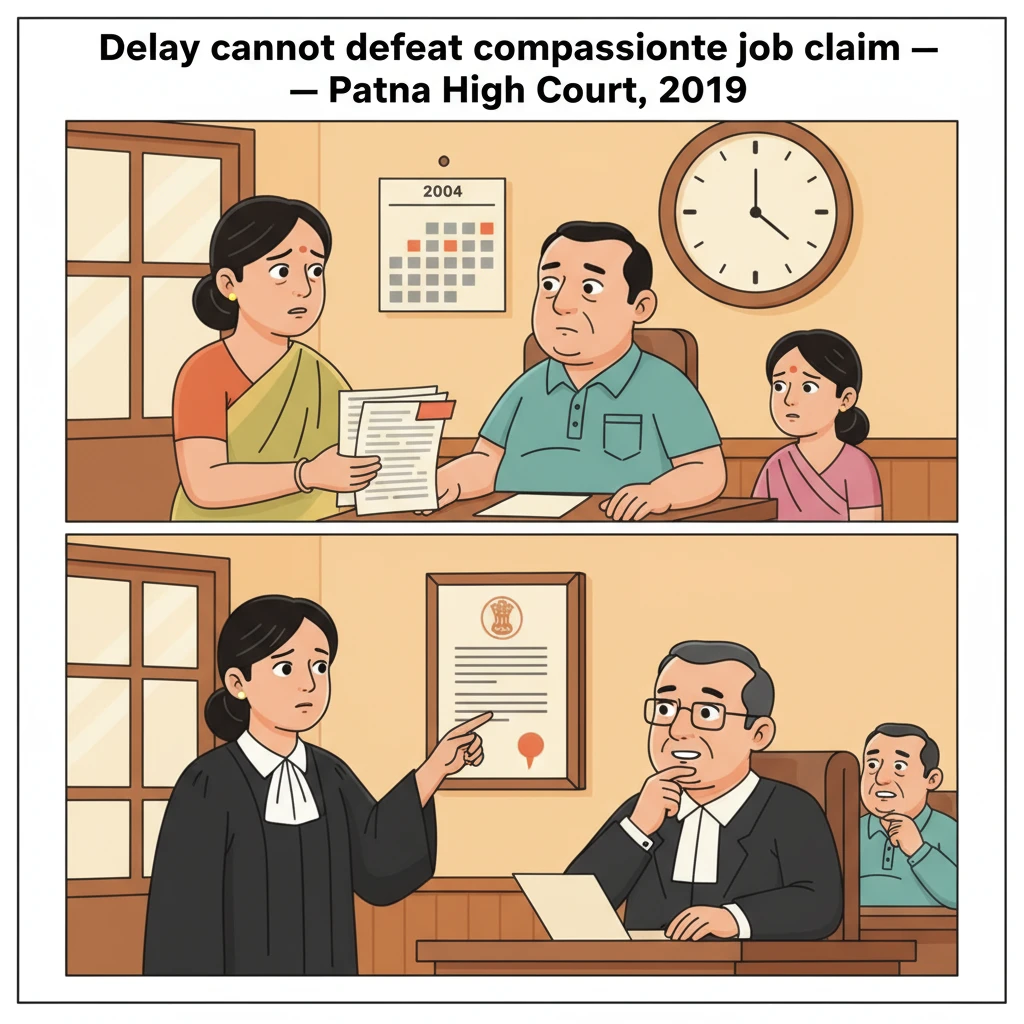
The Patna High Court quashed the rejection, blaming delay by government officers.
The Court ordered the District Magistrate to reconsider the daughter’s case within six weeks.
The family’s right to timely relief was protected.
Case Background
The writ petition was filed in the Patna High Court against an order dated 26.11.2018 passed by the District Programme Officer (Establishment), Darbhanga. By this order, the officer rejected the request for compassionate appointment of the petitioner, the eldest daughter of a deceased government employee.
The petitioner’s father, a government employee, died in harness on 03.06.2003. After his death, his widow applied for appointment on compassionate ground on 04.09.2004 in the prescribed format. At that time, she was about 39 years old. Her date of birth, as disclosed in her petition, was 02.04.1965, so she was within the maximum age limit of 40 years for such appointment.
However, the authorities did not take any timely decision on her application. The file remained pending with them for more than six years. Ultimately, her claim was rejected only in 2010 by letter dated 25.03.2010 issued by the Deputy Collector (Establishment), Darbhanga, on the ground that she had crossed the maximum age of 40 years.
After this rejection, the widow applied in 2010 itself for compassionate appointment in favour of her eldest daughter, i.e. the present petitioner. An application dated 05.06.2010 was filed when the petitioner had already attained majority. Her date of birth, as per her educational certificates, is 05.02.1992, so she was about 18 years old on the date of application and thus eligible for consideration.
Despite this, the authorities again sat over the matter. The petitioner’s application remained pending for more than eight years. Finally, by the impugned order dated 26.11.2018, the District Programme Officer rejected her claim on the ground that the application had been filed after fourteen years of the death of the employee, while the prescribed time limit was five years.
Aggrieved by this decision, the petitioner approached the Patna High Court under its civil writ jurisdiction, seeking quashing of the order dated 26.11.2018 and a direction to appoint her on compassionate ground.
What the Court Examined and Decided
Hon’ble Mr. Justice Mohit Kumar Shah heard the matter. The Court examined the factual timeline and the legal principles governing compassionate appointments.
The petitioner’s main argument was that neither she nor her mother was at fault for the delay. The mother applied well within time and age limits, but the authorities kept the file pending until she crossed the prescribed age and then rejected her. Once that happened in March 2010, the mother promptly applied in June 2010 for appointment of the petitioner, who had by then become a major. Therefore, any delay was entirely due to the authorities, and the family should not be punished for that.
To support this, the petitioner relied on several earlier decisions:
First, in 2018 (2) PLJR 785 (Sanjay Kumar vs. The State of Bihar & Ors.), the Court had held that where entitlement to compassionate appointment arises only after correction of the employee’s date of birth, the bar of five years from the date of death cannot apply rigidly. The application made soon after the correction was held not time-barred.
Second, in 2018 (3) PLJR 829 (Baban Rai vs. The State of Bihar & Ors.), the Court held that where the applicant applies within one year of the employee’s death but the authorities delay consideration for years, allowing the applicant to become overage, the applicant cannot be made to suffer. The delay by the authorities cannot prejudice the petitioner.
Third, in 2015 (3) PLJR SC 197 (Canara Bank & Anr. vs. M. Mahesh Kumar Santha & Anr.), the Supreme Court stressed that claims for compassionate appointment must be decided without delay because their purpose is to mitigate hardship caused by the death of the breadwinner. That decision also dealt with which scheme applies — the one in force on the date of death or on the date of consideration.
Fourth, in 1997 (1) PLJR 626 (Chandra Bhushan Singh vs. The State of Bihar & Ors.), this Court had held that where there is inordinate delay in deciding a compassionate appointment application and that delay is due to circumstances beyond the applicant’s control, the right of the applicant cannot be defeated on the ground of such delay.
Fifth, in 1991 (1) PLJR SC 1 :: (1989) 4 SCC 468 (Smt. Sushma Gosain & Others vs. Union of India & Others), the Supreme Court had laid down that appointments on compassionate grounds should be made expeditiously and without delay because their purpose is to soften the hardship felt by the family on the sudden death of the bread-earner.
The Court observed that these propositions of law were well settled and not in dispute.
On the other side, the State argued that the claim was made after about fourteen years from the date of death and, therefore, compassionate appointment could not be granted. It was also claimed that there was no laches on the part of the State authorities.
The Court then carefully looked at the undisputed facts. It found that the employee died on 03.06.2003. The widow applied for compassionate appointment on 04.09.2004, i.e. within about fifteen months of the death. On that date she was less than 40 years of age and fully eligible. The authorities, however, kept the application pending and rejected it in March 2010 on the ground that she had become overage.
The Court noted that only after her own rejection in 2010 did the mother apply, the same year, for appointment of her eldest daughter. Before that rejection, she had no occasion or reason to seek appointment for her daughter, because she reasonably expected her own application to be considered.
On the date of the petitioner’s application (05.06.2010), she had already attained 18 years of age and was major. There was no legal impediment to considering her for compassionate appointment. Yet the authorities kept her case pending for more than eight years, and only in 2018 rejected it as time-barred, counting fourteen years from the employee’s death.
The Court held that the impugned order dated 26.11.2018 “suffers from various fallacies.” First, it was wrong to say that the application was filed after fourteen years. The first application was filed by the widow within fifteen months of death. The second application on behalf of the daughter was filed immediately after the widow’s claim was rejected in 2010. At best, the daughter’s application could be said to have been filed seven years after the death. Even then, the Court emphasised that the right occasion for her application arose only when the mother’s claim was turned down.
The Court clearly stated that there was no delay on the part of the petitioner or her mother. Rather, the delay was entirely due to the respondent authorities, who neither decided the widow’s application promptly nor acted quickly on the petitioner’s claim.
The Court then examined a related question: what would have happened had the authorities decided the widow’s application promptly, say in 2004 or 2005? The Court noted that if they had done so, the widow would have been within age and eligible. The adverse situation — her becoming overage — arose only due to the negligence and laches of the authorities. No explanation for this delay was offered in the counter affidavit.
Reiterating settled law, the Court observed that compassionate appointment is meant to mitigate the hardship faced by the family due to the sudden death of the bread-earner. Such cases should not be kept pending for years. The Supreme Court has even held that if no suitable post is available, a supernumerary post may be created to accommodate eligible candidates.
It also noted that delay beyond the control of the applicant cannot be used to deny compassionate appointment. Where authorities themselves cause the delay, they cannot later rely on it to reject the claim.
The Court referred to the celebrated Supreme Court decision in Umesh Kumar Nagpal vs. State of Haryana & Others, (1994) 4 SCC 138, particularly paragraph 2. The extracted passage explains that regular public employment must be based on open competition and merit. Compassionate appointment is an exception, justified on humanitarian grounds where a government employee dies in harness leaving the family in penury. The purpose is to help the family tide over a sudden financial crisis by offering one eligible dependent a job, usually in Class III or IV, after assessing the family’s financial condition.
Finally, the Court looked at the specific circumstances of this family. It noted that the deceased’s family did not appear to be financially sound. He had left behind his widow and three daughters, with the petitioner being the eldest. The mother was left to fend for herself and her three daughters alone. The Court held that the family had been “traumatized beyond a limit” due to laches, delay and inaction by the respondent authorities.
In this situation, the Court concluded that the petitioner’s case must be considered immediately for compassionate appointment, provided there was no other legal impediment. Accordingly, it directed the District Magistrate, Darbhanga (Respondent No. 4), to take necessary steps within six weeks from the date of receipt or production of a copy of the order.
The writ petition was allowed, and the impugned order dated 26.11.2018 bearing letter no. 3633 issued by the District Programme Officer (Establishment), Darbhanga, was quashed.
Why This Judgment Matters
This judgment is important for families of deceased government employees in Bihar who seek compassionate appointments. It confirms that delay caused by authorities cannot be used as a ground to deny such appointments.
The Patna High Court made it clear that when a widow applies within time and the department keeps her case pending until she becomes overage, the family’s right does not vanish. A timely second application for a major child must be considered, and the clock cannot be unfairly stretched to make the claim appear time-barred.
The decision also sends a strong message to administrative officers. Files relating to compassionate appointments must be processed quickly. Sitting on them for years, without explanation, is not acceptable and can be corrected by the Court.
For ordinary citizens, especially widows and children of deceased employees, this ruling offers hope. It shows that the Patna High Court is willing to protect families from bureaucratic delay and ensure that the humanitarian purpose of compassionate appointment is not defeated.
Legal Issues and Answers
- Issue: Can a claim for compassionate appointment be rejected as time-barred when the family applied within time, but the authorities delayed the decision and later rejected the second application of the major daughter on the ground of late filing?
Answer: No. The Court held that there was no delay on the part of the family. The delay was due to laches of the authorities, and the impugned rejection order was quashed. The petitioner’s case must be considered for compassionate appointment. - Issue: Does delay caused by government authorities in processing a compassionate appointment application defeat the right of the applicant or his/her dependent?
Answer: No. The Court reaffirmed that delay beyond the control of the applicant cannot be used to deny compassionate appointment. Authorities must process such cases promptly, and their own inaction cannot prejudice the claimant.
Cases Cited by the Court
- 2018 (2) PLJR 785 – Sanjay Kumar vs. The State of Bihar & Ors.
- 2018 (3) PLJR 829 – Baban Rai vs. The State of Bihar & Ors.
- 2015 (3) PLJR SC 197 – Canara Bank & Anr. vs. M. Mahesh Kumar Santha & Anr.
- 1997 (1) PLJR 626 – Chandra Bhushan Singh vs. The State of Bihar & Ors.
- 1991 (1) PLJR SC 1 :: (1989) 4 SCC 468 – Smt. Sushma Gosain & Others vs. Union of India & Others.
- (1994) 4 SCC 138 – Umesh Kumar Nagpal vs. State of Haryana & Others.
Case Details
Case Number: Civil Writ Jurisdiction Case No. 4725 of 2019
Case Title: Lakshmi Kumari vs. The State of Bihar & Ors.
Coram: Hon’ble Mr. Justice Mohit Kumar Shah
Citation: 2019 (3) PLJR 379
Advocates: Mr. Gopal Jha for the petitioner; Mr. Jitendra Kr. Roy 1 (SC13) for the respondents
Nature of the Case: Writ petition (civil) challenging rejection of claim for compassionate appointment
Link to Judgment: Click here to access the full judgment of the Patna High Court
If you found this explanation helpful and wish to stay informed about
how legal developments may affect your rights in Bihar,
you may consider following Samvida Law Associates for more updates.







