

Case Background
This case arose from a writ petition filed before the Patna High Court under its civil writ jurisdiction. The petitioner had been working as a driver for the State authorities.
According to the judgment, he had been appointed on an ad hoc basis on 21.03.2013. His engagement was on daily wages, not on a regular, sanctioned post.
Feeling aggrieved after several years of service as a daily-wage driver, he approached the High Court. He sought directions in the nature of mandamus against the State of Bihar and its officers.
In the writ petition, the petitioner prayed for multiple reliefs. First, he asked the Court to direct the State to absorb him on a regular driver post in the Departments of the Government of Bihar.
Second, he requested that the State be directed to publish an advertisement for selection of vehicle drivers in different departments and to give him priority in such selection. For this priority, he sought relaxation in age and educational qualifications.
Third, he demanded costs against the authority which had taken his services on daily wages from 21.03.2013 onwards. Fourth, he prayed for equal pay for equal work from 21.02.2015 till the date of the petition.
Fifth, he asked for litigation costs on the ground that he had been compelled to approach the Court. Finally, he sought any other relief to which he might be found entitled.
Thus, the grievance had two main parts: regularisation of his service as a driver, and payment of wages or salary equal to that of a regular driver for the period of his ad hoc service.
What the Court Examined and Decided
The matter was heard by Hon’ble Mr. Justice P. B. Bajanthri. The Court heard the learned counsel for the petitioner and the learned Advocate General representing the State of Bihar and its officers.
The Court first noted the nature of the engagement. It recorded that the petitioner was “undisputedly” appointed on an ad hoc basis on 21.03.2013. This meant his appointment was temporary, not through regular recruitment, and not against a regular sanctioned post following proper procedure.
On the issue of regularisation, the Court looked for any legal or policy basis that could support the petitioner’s claim. The learned counsel for the petitioner could not point out any policy decision of the State Government for regularisation of daily wage or temporary employees appointed as on 21.03.2013.
There was also no statutory provision shown which could give such a right of regularisation to the petitioner. In simple terms, there was no law, rule, government resolution, or policy specifically stating that a daily-wage driver like the petitioner, appointed in 2013, must be regularised.
In the absence of such a legal foundation, the Court held that the petitioner had no legal or statutory right to seek regularisation. A writ of mandamus can be issued only when there is a clear legal right and a corresponding legal duty on the part of the State or authority.
The Court then referred to binding Supreme Court precedent. It cited the landmark decision of the Constitution Bench in Secretary, State of Karnataka and Others v. Uma Devi, reported in 2006 (4) SCC 1.
In Uma Devi, the Supreme Court had strongly disapproved regularisation of ad hoc or casual employees who had entered service without following the constitutional scheme of public employment. The judgment held that regularisation cannot be used to bypass open, fair and competitive recruitment, and that public posts must generally be filled through proper selection.
The Patna High Court also referred to its own Full Bench decision in Ram Sevak Yadav and Another v. The State of Bihar and Others in CWJC Nos. 267 and 472, reported in 2013 (1) PLJR 964. This Full Bench judgment, following Uma Devi, had similarly discouraged regularisation of irregularly appointed employees where there was no legal right and no regular selection process.
On the strength of these authorities, the High Court reiterated that courts should not direct regularisation merely because a person has worked for some years on an ad hoc or daily-wage basis. Without a statutory right or policy and without proper recruitment, no enforceable right to be regularised arises.
Therefore, the petitioner’s claim for absorption on a regular driver post and for directions to advertise posts with special preference for him was not accepted. Implicitly, the request for costs against the authorities for using his services on daily wages, and for litigation costs on that ground, also did not find favour on the issue of regularisation.
Having rejected the claim to regularisation, the Court turned to the second limb of grievance: payment of wages and arrears.
The petitioner had asked for equal pay for equal work from 21.02.2015 onwards. The Court examined what relief could be granted in this area within the legal framework.
The Court directed the concerned authority to examine the petitioner’s service particulars. It asked the competent authority to take a decision on whether the petitioner was entitled to arrears of salary.
While giving this direction, the Court relied on the judgment of the Supreme Court in State of Haryana v. Charanjit Singh, reported in (2006) 9 SCC 321. In that decision, the Supreme Court had held that an ad hoc employee is entitled to the basic pay of the regular post, even if he is not a regular appointee.
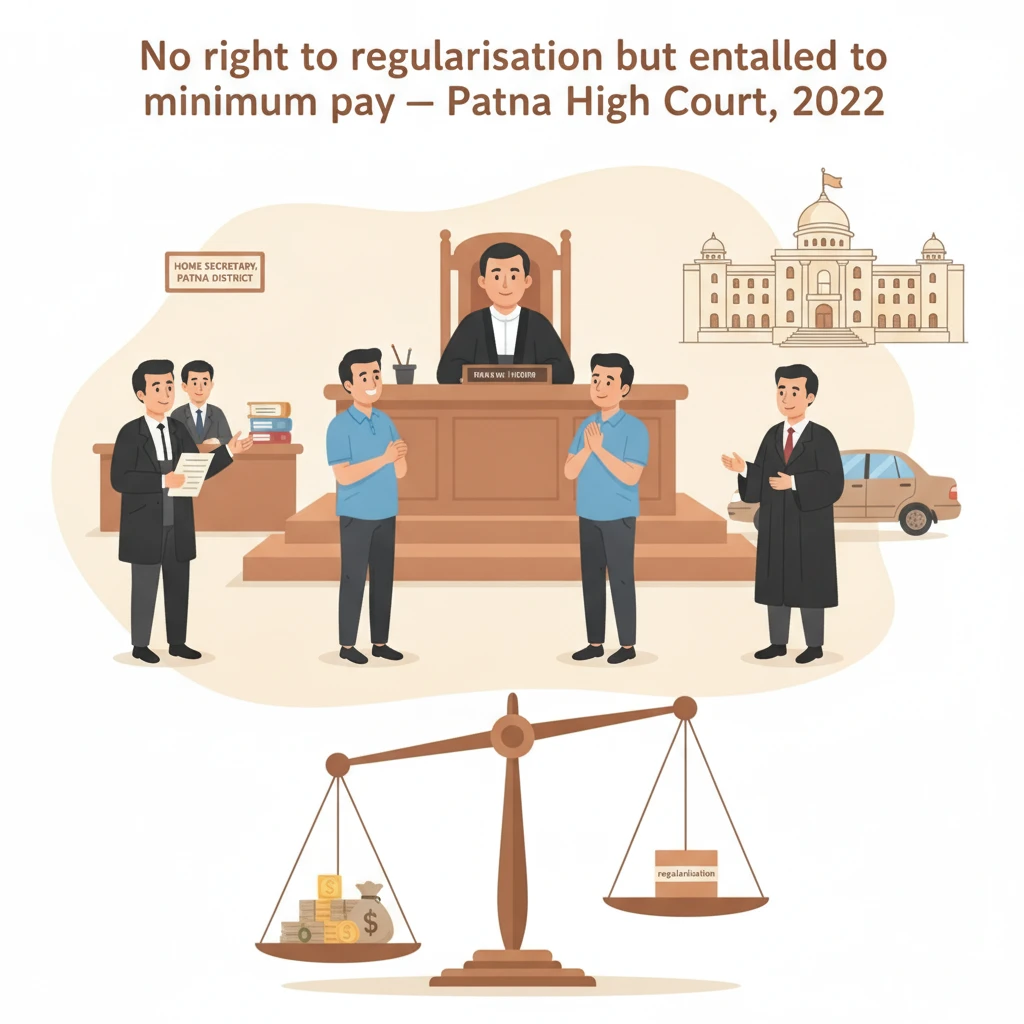
Drawing from this principle, the Patna High Court held that since the petitioner had been appointed as a driver on an ad hoc basis, he was entitled to at least the minimum pay attached to the post of driver.
The Court ordered that the minimum pay attached to the post of driver should be calculated and disbursed to the petitioner. It fixed a timeline of three months from the date of receipt of the Court’s order for this calculation and payment.
The Court also attached a consequence for delay. It directed that if the arrears of salary or wages were not paid within the three-month period, the concerned respondent would have to pay interest on the arrears at the rate of 8% per annum.
This part of the judgment is significant because, although the Court refused regularisation, it recognised the petitioner’s right to fair monetary treatment for the work actually done. The Court balanced the bar on regularisation with the principle that ad hoc employees should not be exploited by paying them much less than the basic pay of a regular post.
Ultimately, with these observations and directions, the Court disposed of the writ petition. No further directions on regularisation or preference in recruitment were issued.
Why This Judgment Matters
This judgment is important for daily-wage and ad hoc workers in government offices, especially those working as drivers and similar staff in Bihar.
First, it clearly states that long service as a daily-wage worker, by itself, does not create a right to be made permanent. Unless there is a specific government policy or law, the Patna High Court will not force the State to regularise such employees.
This follows the Supreme Court’s ruling in Uma Devi and the Patna High Court Full Bench in Ram Sevak Yadav. Government jobs must normally go through proper recruitment, not through regularisation of temporary workers.
At the same time, the judgment offers some protection to ad hoc workers. It recognises that even if they are not regular employees, they are entitled to at least the basic minimum pay for the post they are performing, based on Charanjit Singh.
For workers, this means that if they have been doing the work of a particular post for years, they can at least demand payment of basic pay attached to that post, even if they cannot demand permanent status.
For government departments, the judgment is a reminder that keeping people for long periods on daily wages, without proper pay, can lead to financial liability in the form of arrears and even interest if payment is delayed.
Legal Issues and Answers
Issue: Does a daily-wage/ad hoc driver appointed on 21.03.2013 have a legal right to be regularised in government service or to get preference in future recruitment?
Answer: No. In the absence of any statutory provision or State policy for such regularisation, and in light of Uma Devi and Ram Sevak Yadav, the petitioner had no enforceable right to regularisation or preference.
Issue: Is an ad hoc driver entitled to receive wages equal to the minimum basic pay of a regular driver for the period of his engagement?
Answer: Yes. Relying on State of Haryana v. Charanjit Singh, the Court held that an ad hoc employee is entitled to the basic pay of the regular post and directed calculation and payment of minimum pay attached to the driver post, with 8% interest if delayed beyond three months.
Cases Cited by the Court
- Secretary, State of Karnataka and Others v. Uma Devi, 2006 (4) SCC 1.
- Ram Sevak Yadav and Another v. The State of Bihar and Others, CWJC Nos. 267 and 472, 2013 (1) PLJR 964 (Full Bench, Patna High Court).
- State of Haryana v. Charanjit Singh, (2006) 9 SCC 321.
Case Details
Case Number: Civil Writ Jurisdiction Case No. 5287 of 2021
Case Title: Chhotu Kumar Saw v. The State of Bihar and Others
Citation: 2022 (2) PLJR 427
Coram: Hon’ble Mr. Justice P. B. Bajanthri
Date of Judgment: 06.04.2022
Advocates:
- For the Petitioner: Mr. Binod Pd. Singh
- For the Respondents: Mr. Lalit Kishore, Advocate General
Respondents: The State of Bihar through the Home Secretary, the District Magistrate, Patna, and the Circle Officer, Belchhi, District Patna
Nature of the Case: Writ petition seeking mandamus for regularisation, priority in recruitment, equal pay for equal work, arrears and costs, relating to a daily-wage/ad hoc driver in State service.
Link to Judgment: Click here to read the full judgment of the Patna High Court
If you found this explanation helpful and wish to stay informed about how legal developments may affect your rights in Bihar, you may consider following Samvida Law Associates for more updates.







