

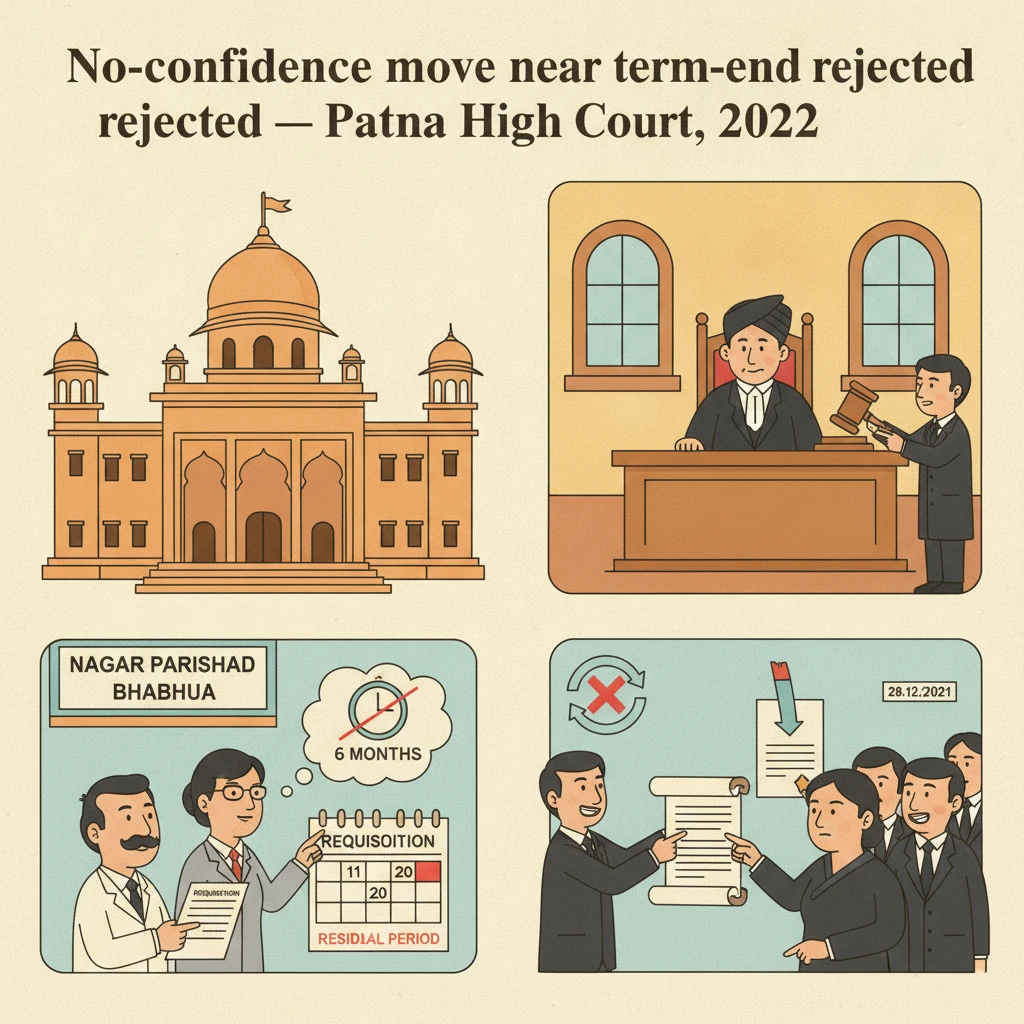
Case Background
The petitioner is a Ward Councillor of Ward No. 22, Nagar Parishad, Bhabhua in District Kaimur. Respondent No. 10 is the Deputy Chief Councillor of the same Nagar Parishad.
On 15.12.2021, the Executive Officer of Nagar Parishad, Bhabhua wrote a letter to the Urban Development and Housing Department, Government of Bihar, Patna. In that letter, he sought guidelines regarding a requisition received for calling a no-confidence motion against the Deputy Chief Councillor, that is, Respondent No. 10.
The Executive Officer pointed out that the term of the Nagar Parishad was going to expire within six months from the date of the requisition for the no-confidence motion. Because of this, he wanted clarity from the Department on how to proceed.
Responding to this query, on 28.12.2021, the Urban Development and Housing Department issued a letter to the Chief Executive Officer, Nagar Parishad, Bhabhua, Kaimur. Through this letter, the Chief Executive Officer was asked to proceed in accordance with sub-section (4) of Section 25 of the Bihar Municipal Act, 2007 in the matter of bringing the no-confidence motion against the Deputy Chief Councillor.
The Ward Councillor (petitioner) then approached the Patna High Court by filing Civil Writ Jurisdiction Case No. 923 of 2022. She sought quashing of the Department’s letter dated 28.12.2021 on the ground that it did not contain clear guidelines in light of the municipal body’s term nearing its end.
What the Court Examined and Decided
The Division Bench of the Patna High Court, comprising Hon’ble Mr Justice Chakradhari Sharan Singh and Hon’ble Mr Justice Madhuresh Prasad, heard the matter. The oral judgment was delivered by Hon’ble Mr Justice Chakradhari Sharan Singh on 08.03.2022.
The core grievance raised by the petitioner was that the State Government’s communication dated 28.12.2021, which referred to Section 25(4) of the Bihar Municipal Act, 2007, did not provide a “clear guideline” on how to deal with the no-confidence motion when the term of the Nagar Parishad was about to end within six months.
The Court first noted the sequence of communications. The Executive Officer’s letter dated 15.12.2021 had sought guidance because the no-confidence motion against the Deputy Chief Councillor had been requisitioned at a time when the Nagar Parishad’s term was close to expiry. Based on this query, the Urban Development and Housing Department issued the impugned letter dated 28.12.2021 instructing the Chief Executive Officer to proceed as per Section 25(4) of the Bihar Municipal Act, 2007.
The petitioner’s lawyer argued that this reply letter of 28.12.2021 did not give a specific and clear answer. According to the petitioner, in the absence of a detailed guideline, there was confusion about whether a no-confidence motion could be processed when less than six months were left in the term of the municipality.
The Court, however, did not accept this view. It held that the writ petition itself was misconceived because Section 25(4) of the Bihar Municipal Act, 2007 contains an express and clear provision governing this situation.
To support its conclusion, the Bench reproduced Section 25 of the Act, which deals with the “Removal of Chief Councillor/Deputy Chief Councillor.” Sub-section (4) sets out how a Chief Councillor or Deputy Chief Councillor may be removed by a no-confidence resolution passed at a special meeting, with the required majority of councillors and on a requisition made in writing by not less than one-third of the total number of councillors.
Importantly, the Court highlighted the third proviso to Section 25(4), which specifically states:
“Provided further also that no confidence motion shall not be brought within the residual period of six months of the Municipality.”
The Bench underlined this part for emphasis. This proviso clearly bars bringing a no-confidence motion within the last six months of the term of the municipality. In other words, once the municipality has only six months of its term left, no new no-confidence motion against the Chief Councillor or Deputy Chief Councillor can be initiated.
The petitioner’s counsel attempted to argue that an attempt to bring a no-confidence motion against Respondent No. 10 had already been made in 2021 and that the present requisition was part of a “continuing process.”
However, the Court was not persuaded by this submission. The judgment records that, “Be that as it may,” there is an express and unambiguous provision in Section 25(4) of the Act, as discussed above, that a no-confidence motion cannot be brought within the residual period of six months of the municipality’s term.
On this basis, the Court took the view that there was no need for any further “clarification” or “guideline” beyond what the statute itself already clearly provides. The Department’s letter asking the authorities to proceed in accordance with Section 25(4) was therefore in line with the law.
The Bench concluded that, since the law directly prohibits any no-confidence motion within the last six months of the municipality’s term, there was no ground for the High Court to interfere through a writ petition. The existence of such a clear statutory bar meant that no further judicial intervention was necessary.
Accordingly, the Court declined to entertain the relief sought by the petitioner. It held that the writ application had no merit and dismissed it. No further directions were considered necessary.
In simple terms, the Patna High Court said that when the law itself clearly stops a no-confidence motion in the last six months of the municipality’s term, councillors or others cannot use the Court to demand extra instructions or to get around that bar. The government’s letter that referred to this legal rule was found to be proper, and the challenge to it failed.
Why This Judgment Matters
This judgment is important for councillors and officials in all municipalities in Bihar. It clarifies that the bar under Section 25(4) of the Bihar Municipal Act, 2007 is absolute: no-confidence motions against a Chief Councillor or Deputy Chief Councillor cannot be brought during the last six months of the municipality’s term.
For elected representatives, this means that attempts to change the leadership through no-confidence motions near the end of the term are not allowed. They cannot claim confusion or seek special instructions when the law is already clear.
For municipal officials, like Executive Officers and Chief Executive Officers, the decision confirms that they must strictly follow Section 25(4). If the municipality is within its last six months, they should not proceed with any new no-confidence requisition against the Chief Councillor or Deputy Chief Councillor.
For ordinary residents, the judgment explains why political attempts to unseat municipal leaders at the very end of their term may not legally succeed. The law aims to provide stability in municipal governance during this final period.
Legal Issues and Answers
-
Issue: Can a writ petition be used to challenge a government letter directing municipal authorities to act in accordance with Section 25(4) of the Bihar Municipal Act, 2007 when a no-confidence motion is sought within the last six months of the municipality’s term?
Answer: No. The Patna High Court held that Section 25(4), particularly its third proviso, expressly prohibits bringing a no-confidence motion within the residual period of six months of the municipality’s term. The writ petition seeking quashing of the government’s letter was held to be misconceived and was dismissed.
Cases Cited by the Court
- No earlier judgments or case law have been cited or relied upon in this decision.
Case Details
Case Number: Civil Writ Jurisdiction Case No. 923 of 2022
Case Title: Farah Naaz v. The State of Bihar & Ors.
Coram: Hon’ble Mr Justice Chakradhari Sharan Singh; Hon’ble Mr Justice Madhuresh Prasad
Date of Judgment: 08.03.2022
Citation: 2022(2) PLJR 183
Nature of the Case: Writ petition (civil) under the civil writ jurisdiction challenging a government letter regarding a no-confidence motion in a municipality
Advocates:
- For the petitioner: Mr Rajeev Ranjan, Advocate
- For the State of Bihar: Mr Shankar Kumar, AC to AAG VII
- For the State Election Commission: Mr Sanjeev Nikesh, Advocate
Link to the Judgment: View full judgment on Patna High Court website
If you found this explanation helpful and wish to stay informed about
how legal developments may affect your rights in Bihar,
you may consider following Samvida Law Associates for more updates.







