

Case Background
The criminal appeal arose from Sessions Trial No. 19 of 1991 / 436 of 1991, based on Amas P.S. Case No. 5 of 1988 from district Gaya. The appellant had been tried for the offence of murder under Section 302 of the Indian Penal Code.
On 29 April 1994, the learned Additional Sessions Judge-V, Gaya convicted the appellant for murder and sentenced him to rigorous imprisonment for life. The appellant then filed Criminal Appeal (DB) No. 464 of 1994 before the Patna High Court challenging both the conviction and the sentence.
The appeal was heard by a Division Bench of Hon’ble Mr. Justice A. M. Badar and Hon’ble Mr. Justice Sunil Kumar Panwar. The judgment of the High Court was delivered on 9 December 2021, with Hon’ble Mr. Justice Sunil Kumar Panwar speaking for the Bench.
What the Court Examined and Decided
The prosecution case started with the fardbeyan of the informant, Razia Devi (P.W. 3), recorded by A.S.I. Akloo Kunwar (P.W. 8) on 15 January 1988 at about 7:30 p.m. On the basis of this statement, a formal FIR, Amas P.S. Case No. 5 of 1988 (Ext. 1), was registered against the accused.
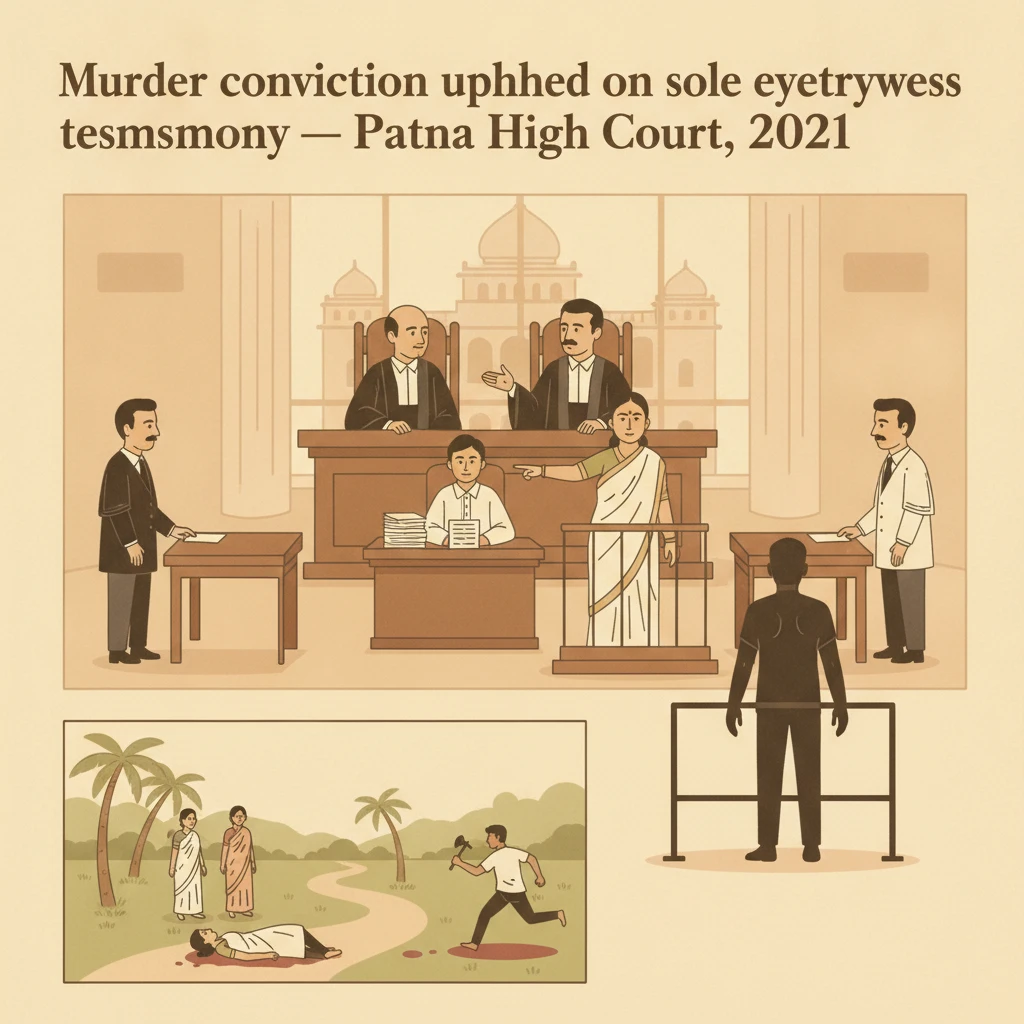
According to the informant, on Friday, 15 January 1988, which was the occasion of Til Sankranti, she and the deceased, Saraswatia Devi, wife of Nanhak Mallah, went to village Harbaria to purchase cow-dung cakes. After purchasing the cow-dung cakes, both women were returning to their village carrying baskets filled with the purchase.
At about 4 p.m., when they reached near village Tarbana Khandha, close to the field of Ram Kumar Singh, the accused, armed with a farsa (a sharp, heavy cutting weapon), suddenly appeared from behind a palm tree where he had been hiding. He first delivered a blow with the farsa to the leg of the deceased. The deceased fell down and cried out, asking why he was assaulting her.
The informant stated that the accused did not stop after the first blow. He kept assaulting the deceased, brutally attacking her with the farsa on vital parts of her body, particularly her head and neck. Due to these repeated blows, the deceased succumbed to her injuries on the spot.
The informant, out of fear, tried to run away from the place of occurrence. The accused then told her that he would not assault her but threatened her not to disclose the incident to the villagers. The accused fled towards the north, leaving the farsa at the place of occurrence. The informant returned home and narrated the incident to her husband and others.
On receiving information about a woman being murdered, P.W. 8, the Investigating Officer, rushed to the spot at around 7:30 p.m. that evening. He found the dead body of the deceased on the ground and recorded the fardbeyan of the informant at the place of occurrence. Due to darkness, he stayed at the village and, the next morning, prepared the inquest report (Ext. 5).
During investigation, P.W. 8 seized the farsa and blood-stained cloth from the scene, preparing a seizure list (Ext. 7) in the presence of two witnesses, Sahab Singh and Naresh Singh. Blood was found at the place of occurrence, and the farsa was located to the south of the dead body. P.W. 8 also described the surrounding area and noted the presence of two or three palm trees to the west of the spot.
The dead body was sent for postmortem, which was conducted by P.W. 7, Dr. Arjun Singh, on 16 January 1988 at 1:30 p.m. The doctor found several incised wounds:
There was an incised wound on the dorsum of the left hand, 3 inches by 3 inches, cutting the metacarpal bones of the little, ring and middle fingers. Another incised wound of 2 inches by 1 inch and bone-deep was present on the right dorsum of the hand, cutting the metacarpal bone of the index finger.
A 4 inch by 1 inch bone-deep incised wound was found over the parotid and auxiliary area on the right side of the face. A major incised wound of 6 inches by 1½ inches and bone-deep was located on the right side of the neck, cutting all soft tissues and blood vessels on the right side, the esophagus, trachea and the third cervical vertebra. There was also an incised wound of 3 inches by 1½ inches on the lateral side of the left knee joint.
The doctor opined that the injuries were caused by a sharp, heavy cutting weapon like a farsa. Injuries (i), (ii) and (iv) were grievous; the rest were simple. Importantly, he stated that except injury (iv), no other injury was individually sufficient to cause death. However, injury (iv) to the neck was sufficient in the ordinary course of nature to cause death, and a person suffering such an injury would die within an hour and would not be able to speak or walk afterwards.
During trial, the prosecution examined nine witnesses. P.W. 1, P.W. 5, P.W. 6 and P.W. 9 were largely formal witnesses dealing with the FIR, fardbeyan, chargesheet and production of material exhibits like the blood-stained earth and farsa. P.W. 2 stated that he came to know about the involvement of the accused when the police examined the informant. P.W. 4 claimed to be a hearsay witness but turned hostile.
Thus, the core of the prosecution case rested on the testimony of P.W. 3, Razia Devi, the sole eyewitness and informant. In her deposition before the trial court, she clearly repeated the prosecution story: her visit with the deceased to buy cow-dung cakes, their return journey, the accused hiding behind a palm tree with farsa, the first blow on the leg, subsequent repeated blows and the accused’s threat to her.
In cross-examination, she stated that she had watched the accused assaulting the deceased with her own eyes. She accepted that the occurrence took place in a lonely area. She denied the defence suggestion that the accused was away in Kolkata at the time of occurrence and asserted that he was the brother of the deceased’s husband.
Before the High Court, the main argument raised on behalf of the appellant was that the conviction was unsafe because it was based solely on the testimony of P.W. 3 without corroboration from other witnesses. It was also argued that the Investigating Officer did not seize cow-dung cakes or baskets from the spot, though the prosecution story mentioned them scattering during the assault.
The Patna High Court carefully examined the testimony of P.W. 3. The Bench noted that her evidence was cogent, reliable and trustworthy and that it proved the charge beyond reasonable doubt. The Court held that a conviction can legally rest on the solitary testimony of an eyewitness if the Court finds it credible, and it is not necessary to seek further corroboration.
The Court referred to Section 134 of the Indian Evidence Act, which states that no particular number of witnesses is required to prove a fact. Crime is not always committed in front of many eyewitnesses; sometimes there is only one witness or none. If courts insisted on multiple eyewitnesses in every case, many offenders would escape punishment. Thus, the testimony of a single eyewitness, if found worthy of reliance, is sufficient.
The Bench observed that although P.W. 3 was a rustic woman, she had stood firm during cross-examination. Any minor discrepancies in her evidence were considered natural, especially as she was narrating events that had occurred four years earlier. No material contradiction emerged to discredit her version. Importantly, the defence could not show any reason why she would falsely implicate the accused.
The Court also noted that the medical evidence of P.W. 7 fully supported the eyewitness account and was consistent with the fardbeyan (Ext. 2). The nature and position of injuries, especially the deep neck wound, matched the type of attack described by P.W. 3 and the weapon used, namely a farsa.
On the argument regarding non-seizure of cow-dung cakes and baskets, the High Court relied on the settled position that reliable and credible prosecution evidence cannot be brushed aside merely because investigation was imperfect or perfunctory in some respects. Non-collection of every possible material from the scene cannot by itself be a ground to acquit an accused when there is strong direct and medical evidence.
After considering all the evidence, the Division Bench held that the prosecution had successfully established the murder of the deceased and the involvement of the appellant. The testimony of P.W. 3, supported by the medical and investigative record, inspired full confidence. There was no basis to interfere with the well-reasoned judgment of the trial court.
Accordingly, the High Court dismissed the criminal appeal and confirmed the conviction under Section 302 IPC and the life sentence imposed on the appellant. The Court also recorded appreciation for the assistance rendered by the amicus curiae, Ms. Surya Nilambari, Advocate, and directed the Patna High Court Legal Services Committee to pay her Rs. 5,000 as remuneration.
Why This Judgment Matters
This decision of the Patna High Court is significant for families of victims and witnesses in murder cases, especially from rural backgrounds. It makes clear that courts can and will rely on the evidence of a single eyewitness if that person is truthful and consistent.
The judgment also reassures witnesses who may be poor, less educated or “rustic” that their testimony is not considered weak merely for that reason. What matters is whether they saw the incident themselves and whether their story stands firm under questioning.
For accused persons and defence lawyers, the judgment is a reminder that minor lapses in police investigation, such as not seizing every object mentioned in the story, will not automatically lead to acquittal if credible direct evidence and medical proof support the prosecution case.
Overall, the case reinforces the principle that the justice system can convict even on solitary eyewitness testimony when it is trustworthy, ensuring that serious crimes like murder do not go unpunished simply because there were not many people around when the crime was committed.
Legal Issues and Answers
-
Issue: Can a conviction for murder under Section 302 IPC be upheld solely on the basis of the testimony of a single eyewitness, who is a rustic village woman, without further corroboration?
Answer: Yes. The Patna High Court held that under Section 134 of the Evidence Act, there is no requirement for multiple witnesses. The reliable, cogent and trustworthy testimony of P.W. 3, supported by medical evidence, was sufficient to sustain the conviction. -
Issue: Does failure by the Investigating Officer to seize certain material objects mentioned in the prosecution story, such as cow-dung cakes and baskets, vitiate the prosecution case?
Answer: No. The Court held that reliable and credible prosecution evidence cannot be discarded merely because the investigation was perfunctory in some respects. Non-collection of such material from the scene was not a ground for acquittal in the face of strong eyewitness and medical evidence.
Cases Cited by the Court
- No specific earlier cases are cited or relied upon by name in the reported judgment.
Case Details
Case Number: Criminal Appeal (DB) No. 464 of 1994
Case Title: Manger Mallah v. State of Bihar
Coram: Hon’ble Mr. Justice A. M. Badar and Hon’ble Mr. Justice Sunil Kumar Panwar
Citation: 2022(1) PLJR 595
Judgment Date (High Court): 09-12-2021
Trial Court Judgment and Sentence: 29-04-1994, learned Additional Sessions Judge-V, Gaya, in Sessions Trial No. 19 of 1991 / 436 of 1991, arising out of Amas P.S. Case No. 5 of 1988
Offence: Section 302 of the Indian Penal Code
Sentence: Rigorous imprisonment for life (confirmed in appeal)
Advocates: Ms. Surya Nilambari, Advocate for the appellant; Mr. Dilip Kumar Sinha, Additional Public Prosecutor (APP) for the State
Nature of Case: Criminal appeal (Division Bench) against conviction and sentence for murder under Section 302 IPC
Link to Judgment: https://patnahighcourt.gov.in/viewjudgment/NSM0NjQjMTk5NCMxI04=-XiadsuRUq90=
If you found this explanation helpful and wish to stay informed about
how legal developments may affect your rights in Bihar,
you may consider following Samvida Law Associates for more updates.







