

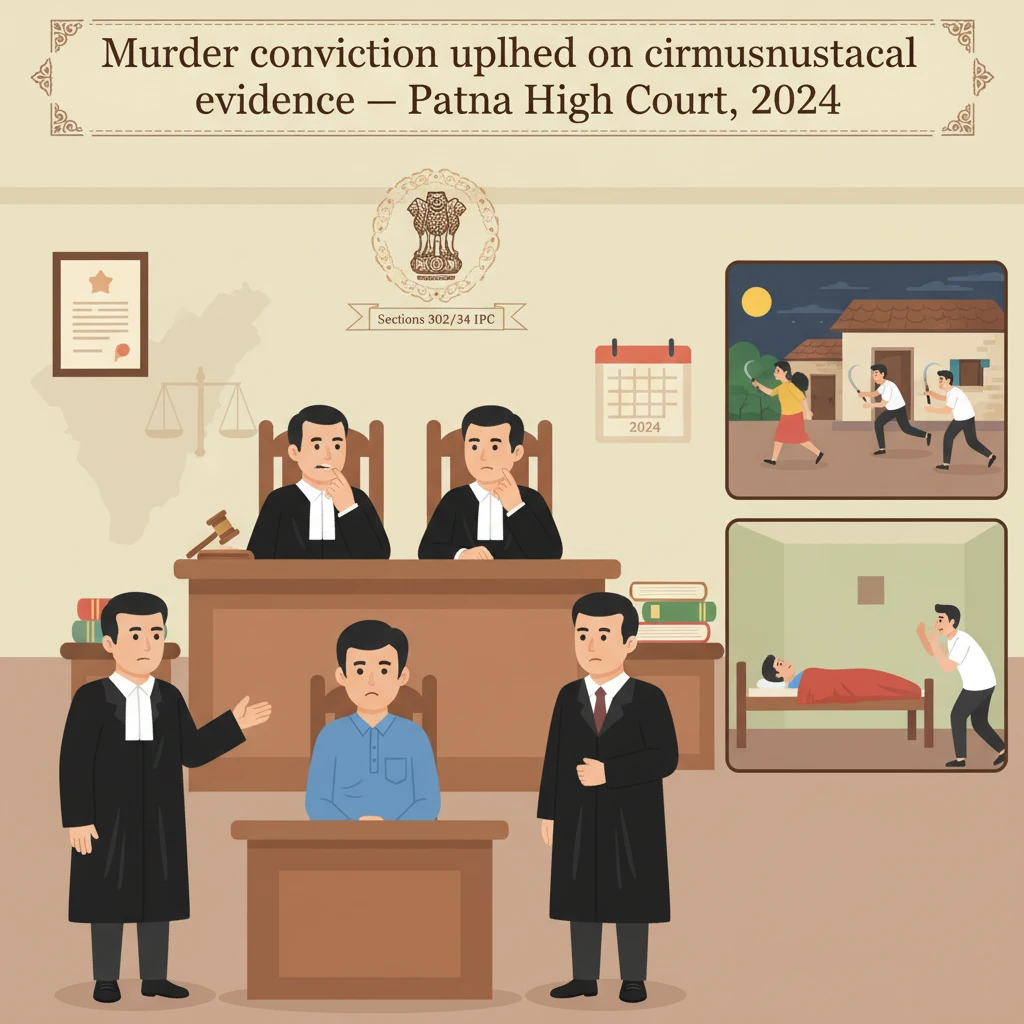
Case Background
The case arises from Vaishali P.S. Case No. 111 of 2015. The informant, Gajendra Thakur (PW-8), stated that on the night of 19.04.2015 he and his wife Sushila Devi (PW-7) slept in the verandah of their house, while their son Subodh Kumar slept alone in a room (referred to as the ‘kothari’).
At about 01:45 a.m. on 20.04.2015, they heard sounds of restlessness coming from the room where Subodh was sleeping. When they rushed there, they saw two young men, including the present appellant Md. Alauddin, running away from the room with “chapar” (a sharp cutting implement) in their hands. Inside the room they found Subodh lying on the bed, soaked in blood, with a deep cut on the right side of his neck. He had died on the bed.
According to the written report, the motive alleged was that the appellant’s sister, Soni Khatoon, used to talk to Subodh on the phone. The informant and his wife had objected to this and had even gone to speak to Soni’s parents and brother, but the communication continued. The informant alleged that the appellant, along with Md. Yunus and Soni Khatoon, conspired to kill Subodh by cutting his neck with a chapar.
On this written report, Vaishali P.S. Case No. 111 of 2015 was registered on 20.04.2015 under Sections 302/34/120B IPC against the three named accused. After investigation, a chargesheet was filed on 16.07.2015 under the same sections.
At the stage of cognizance on 26.10.2015, the Magistrate noted that the records of co-accused Soni Khatoon and Md. Yunus had already been sent to the Juvenile Justice Board by earlier orders dated 21.04.2015 and 06.05.2015. The case of the adult accused, Md. Alauddin, was committed to the Court of Session on 30.11.2015. Sessions Trial No. 446 of 2015 was registered.
On 05.01.2016, charges under Sections 302/34 and 120B IPC were framed against the appellant and explained to him. The prosecution examined 12 witnesses, including family members, neighbours, the doctor, and investigating officers, and produced documentary evidence such as the post-mortem report and inquest. The defence examined two witnesses.
The Additional Sessions Judge-I, Vaishali at Hajipur, by judgment dated 10.05.2018, convicted the appellant under Section 302/34 IPC and sentenced him on 17.05.2018 to life imprisonment and a fine of Rs. 50,000/-. Aggrieved, the appellant filed Criminal Appeal (DB) No. 788 of 2018 before the Patna High Court, which was decided on 23.09.2024.
What the Court Examined and Decided
The Patna High Court, speaking through Hon’ble Mr. Justice Rajeev Ranjan Prasad (for the Bench also comprising Hon’ble Mr. Justice Shailendra Singh), carefully reviewed the entire trial record, evidence of all witnesses, and the grounds of appeal.
First, the Court noted that this was a case of circumstantial evidence. Nobody claimed to have seen the actual act of cutting Subodh’s neck. However, the parents, PW-7 Sushila Devi and PW-8 Gajendra Thakur, claimed they saw the appellant and Md. Yunus fleeing from the room with blood-stained chapars immediately after the groaning sound from their son’s room.
The trial court had earlier found almost all key witnesses consistent that when they woke up after hearing the groaning sound, they rushed to the room and saw the appellant and Yunus running away with chapars. The High Court re-examined this aspect.
The appellant’s counsel argued that apart from PW-7 and PW-8, the neighbours (PW-1 Yogendra, PW-2 Rajendra, PW-3 Krishnandan, PW-5 Suresh, PW-9 Ashok) only reached the spot after hearing the cries of the informant, and could not have seen the assailants fleeing. The Court accepted that, on a careful reading, it may not be fully established that these neighbours actually saw the appellant running away. But the Court pointed out that even if their version on this limited point is put aside, the testimony of the parents PW-7 and PW-8 stands firm.
The Court emphasised that PW-7 and PW-8 were sleeping in the verandah, with the room of Subodh situated to the north. They heard the groaning of their son, immediately went to the room, and saw the appellant leaving the room with blood-stained chapar. Their presence was natural because the incident occurred inside their house at night.
The defence tried to question the place of occurrence by relying on the inquest report prepared at the “deceased’s door” and by pointing to the investigating officer’s statement that he did not find blood at the place of occurrence. The High Court rejected this challenge for two reasons.
First, relying on Section 138 of the Evidence Act and the Supreme Court decision in Gian Chand v. State of Haryana, the Court held that if the defence wanted to challenge the correctness of a witness’s statement on a particular point, such as place of occurrence, it had to cross-examine the witness on that point. Here, the defence did not put any such question to PW-7 and PW-8 about where the incident occurred or where they were sleeping. Therefore their evidence on these points remained unchallenged and had to be accepted.
Second, regarding the absence of blood at the scene, the Court carefully read the deposition of the investigating officer (PW-12). In paragraph 9 he said that the dead body was lying on the cot, and he did not remember whether there was a bedsheet or whether blood had fallen down. In paragraph 10 he said he did not find blood at the place of occurrence and had not seized blood-stained clothes. The Court found these statements inconsistent, and also noted that the officer was deposing about two years and four months after the incident and admitted he did not remember certain details. In this background, his later statement that there was no blood on the floor was not given much weight and was held insufficient to doubt the place of occurrence.
On motive, the Court noted that all prosecution witnesses were consistent that Subodh and the appellant’s sister Soni Khatoon were talking to each other through mobile phone. PW-7 stated that both studied in the same school and went to the same tuition. She said that Subodh was telling Soni not to talk with him. PW-8 stated that Subodh had been talking to Soni for about six months before the incident, and that about 7–8 days before the occurrence, his wife had gone to the appellant’s house to reprimand them. The defence did not seriously challenge these statements in cross-examination.
The appellant’s counsel argued that the accused had no annoyance over this relationship and that it was actually the deceased’s family who were upset. However, the Court held that from the consistent oral testimony, the relationship between Subodh and Soni Khatoon clearly emerged as the cause of occurrence and motive behind the killing. The Court found that the prosecution had proved motive beyond reasonable doubt.
On medical evidence, PW-10, the doctor, conducted the post-mortem and reported a deep incised wound on the right upper neck of the deceased. He opined that death was due to bleeding and shock from this injury, and that the weapon used was hard and sharp-edged. This matched the prosecution’s case of a neck injury inflicted with a chapar.
The defence argued that because there was only one external injury, the story that two accused attacked Subodh with chapars was doubtful. The Court did not treat this as sufficient to break the chain of circumstances. The presence of a single fatal injury on a vital part of the body was fully compatible with the prosecution version that a sharp cutting weapon like a chapar was used.
The appellant also argued that his statement under Section 313 CrPC was not properly recorded, and that not all incriminating circumstances were put to him, relying on Supreme Court decisions like Raj Kumar @ Suman, Naresh Kumar, and Sujit Biswas. The High Court examined the Section 313 statement and found that the appellant had been told that the witnesses had deposed that he cut the neck of the informant’s son in the night when he was sleeping in the room by a sharp cutting weapon. Thus, both the place of occurrence and the alleged act had been clearly put to him. The appellant gave no explanation and simply answered “No”.
Since no specific incriminating fact was shown to have been used against the appellant without putting it to him, the Court held that there was no prejudice and that the law laid down in Raj Kumar @ Suman did not help the appellant in this case.
On the issue of delay in lodging the FIR, the defence said that PW-7 stated she informed the police in the night itself, but the written report by PW-8 was given only in the morning, meaning a delay of 4–5 hours and suppression of the first version. The Court noted that the occurrence took place at about 01:45 a.m., the police station was 12 kilometres away, and the written report was given when the police arrived in the morning. The FIR was registered and the inquest and post-mortem were done thereafter, with the dead body reaching the hospital at 4:15 p.m. on 20.04.2015. Relying on Supreme Court precedent including Tara Singh and Hariprasad @ Kishan Sahu, the Court held that such a short delay in rural conditions, when the family had just suffered a death in their house, could not by itself cast doubt on the prosecution case, especially when neither PW-7 nor PW-12 was cross-examined on this point.
The defence also produced two witnesses. DW-1, Wasiran Khatoon, admitted in cross-examination that she was deposing on the basis of what the appellant’s father (DW-2 Md. Jabbar) had told her. DW-2 came to the witness box as the appellant’s father. The High Court found that both defence witnesses were not reliable or independent, and their evidence did not shake the prosecution case.
After reviewing all evidence and the law on circumstantial evidence, including the Supreme Court decisions in Sharad Birdhichand Sarda and Rukia Begum, the Court concluded that the chain of circumstances was complete. Motive was proved; the appellant was seen fleeing the room immediately after the incident with a blood-stained chapar; the deceased was found dead on the bed with a matching neck injury; and the defence version of an “unknown criminal” had no supporting material.
The Court held that there was no other reasonable conclusion except that the appellant had committed the murder along with his associate. It found no error in the trial court’s appreciation of evidence and upheld both the conviction under Section 302/34 IPC and the life sentence with fine.
Why This Judgment Matters
This Patna High Court judgment is important for families of victims, investigating agencies, and defence lawyers dealing with night-time murders inside homes where there may be no direct eye-witness to the act of killing.
The Court showed that in such cases, consistent evidence of close family members, if not shaken in cross-examination, can be treated as reliable even if they only see the accused escaping immediately after the crime. The Court also clarified that small delays in lodging FIRs in rural areas, especially at odd hours, will not automatically weaken a genuine case when the basic story is supported by medical and other evidence.
The judgment underlines that if the defence wants to dispute basic facts like place of occurrence or identity of the accused, they must clearly confront prosecution witnesses during cross-examination. Raising such doubts later, without confronting witnesses when they are in the witness box, will not succeed.
For lay readers, the decision shows that courts give serious weight to the first-hand account of grieving parents when they are consistent and not contradicted, and that attempts to blame “unknown criminals” without any backing are unlikely to succeed in appeal.
Legal Issues and Answers
- Issue: Whether the conviction of the appellant for murder under Section 302/34 IPC could stand when the case rested mainly on circumstantial evidence and the parents only saw him fleeing with a weapon.
Answer: Yes. The Patna High Court held that the parents were natural and wholly reliable witnesses, the motive was proved, medical evidence matched the prosecution case, and the chain of circumstances left no reasonable doubt about the appellant’s guilt. - Issue: Whether alleged lapses such as delay in FIR, doubts over place of occurrence, and incomplete Section 313 CrPC questioning vitiated the trial.
Answer: No. The Court held that the FIR was lodged within a reasonable time given the circumstances, the place of occurrence remained unchallenged in cross-examination and was therefore accepted, and the appellant was sufficiently confronted with incriminating circumstances under Section 313 CrPC without showing any prejudice.
Cases Cited by the Court
- Hariprasad @ Kishan Sahu v. State of Chhattisgarh, (2024) 2 SCC 557
- Tara Singh v. State of Punjab, 1991 Supp (1) SCC 536
- Sharad Birdhichand Sarda v. State of Maharashtra, (1984) 4 SCC 116
- Rukia Begum and Others v. State of Karnataka, (2011) 4 SCC 779
- Gian Chand v. State of Haryana, (2013) 14 SCC 420
- Laxmibai (Dead) through LRs. and Another v. Bhagwantbuva (Dead) through LRs. and Others, (2013) 4 SCC 97
- Raj Kumar @ Suman v. State (NCT of Delhi), AIR 2023 SC 3113
- Naresh Kumar v. State of Delhi, AIR 2024 SC 3233
- Sujit Biswas v. State of Assam, (2013) 12 SCC 406
- Asraf Ali v. State of Assam, (2008) 16 SCC 328
- S. Harnam Singh v. State (Delhi Administration), (1976) 2 SCC 819
Case Details
Case Number: Criminal Appeal (DB) No. 788 of 2018; arising out of Vaishali P.S. Case No. 111 of 2015; Sessions Trial No. 446 of 2015
Case Title: Md. Alauddin v. State of Bihar
Citation: 2024(4) PLJR 343
Court: High Court of Judicature at Patna
Coram: Hon’ble Mr. Justice Rajeev Ranjan Prasad; Hon’ble Mr. Justice Shailendra Singh
Date of Judgment: 23.09.2024
Advocates:
- For the Appellant: Mr. Ajay Kumar Thakur, Advocate; Mr. Arvind Kumar Sinha, Advocate
- For the State: Mr. Ajay Mishra, Additional Public Prosecutor
- For the Informant: Mr. Raja Ram Rai, Advocate
Offences Alleged: Sections 302/34/120B IPC (trial court finally convicted under Section 302/34 IPC)
Trial Court Result: Conviction under Section 302/34 IPC; life imprisonment with fine of Rs. 50,000/-
Nature of the Case: Criminal appeal (Division Bench) against conviction and sentence for murder passed by the Sessions Court
Final High Court Outcome: Appeal dismissed; conviction and sentence affirmed
Link to Judgment: Patna High Court Judgment
If you found this explanation helpful and wish to stay informed about
how legal developments may affect your rights in Bihar,
you may consider following Samvida Law Associates for more updates.







