

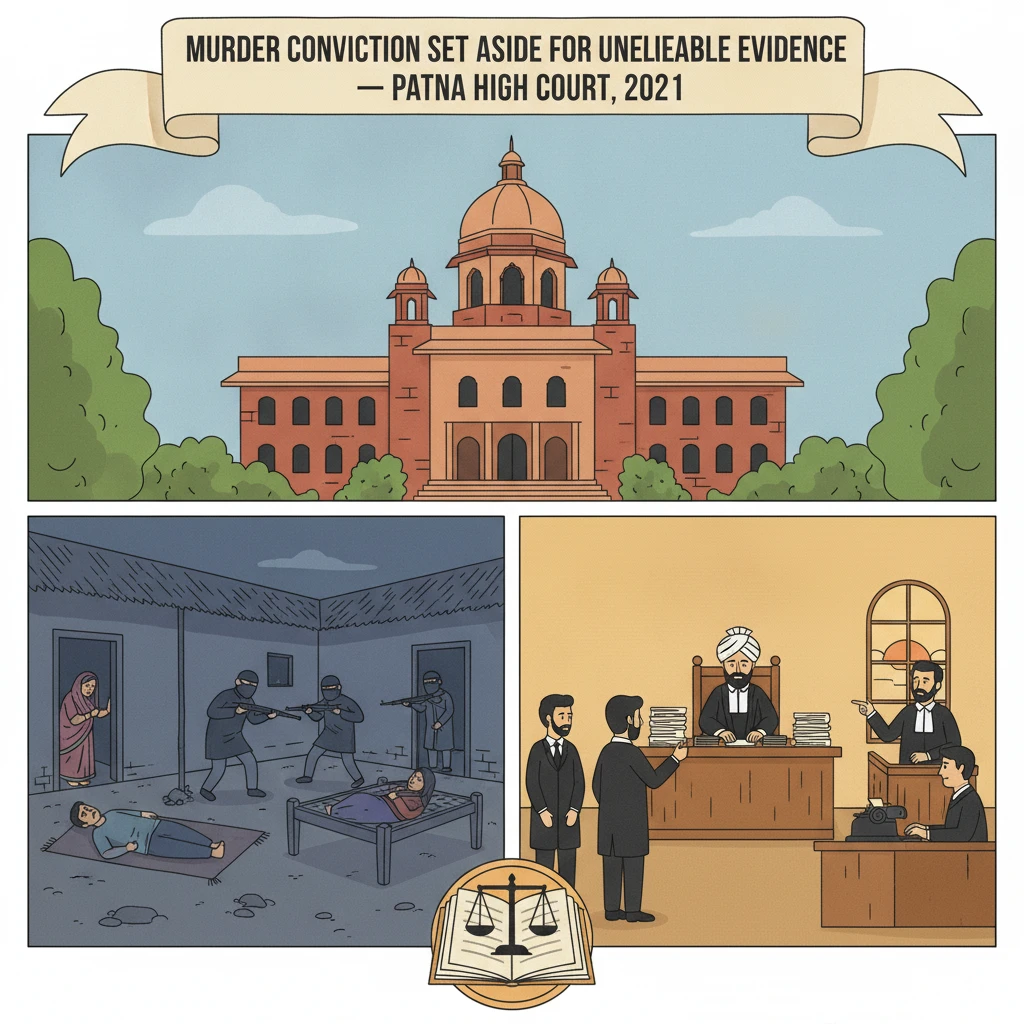
Case Background
This case arises from a brutal double murder in a village in Bhagalpur district in 1995. The allegation was that late at night on 4 July 1995, several armed men entered the courtyard of a house and opened fire, killing a husband and wife.
On 5 July 1995 at about 9:30 a.m., the son of the deceased couple (later examined as PW‑2) gave his fardbeyan in village Nadiyawa under Sabour Police Station. On that basis, Sabour P.S. Case No. 154 of 1995 was registered. He named a co-villager (later the appellant in this appeal) and several others as assailants and attributed clear roles to each.
After investigation, the police submitted charge-sheet No. 151/1995. Some accused, including four co-villagers, were shown in judicial custody. Others, including this appellant, were shown as absconding. Cognizance was taken on 7 December 1995 under Sections 449 and 302/34 of the Indian Penal Code and Section 27 of the Arms Act. Records of the absconding accused, including the present appellant, were separated.
The available accused were tried first in Sessions Trial No. 632 of 1996. They were ultimately acquitted, and PW‑2 (the informant) was declared hostile in that trial. Many years later, in another case (Sabour Goradih P.S. Case No. 25 of 2005 giving rise to Sessions Trial No. 1283 of 2006), the present appellant was convicted and sentenced to life imprisonment. While he was in custody in that later case, the Magistrate issued a production warrant in the old 1995 case, and the appellant was brought into Sessions Trial No. 1155 of 2010 arising from Sabour P.S. Case No. 154 of 1995.
In Sessions Trial No. 1155 of 2010 before the Ad hoc Additional District & Sessions Judge‑4, Bhagalpur, charges were framed against the appellant under Sections 302 and 449 IPC and Section 27 of the Arms Act. On 10 January 2014, the trial court convicted him on all counts. On 15 January 2014, the court sentenced him to life imprisonment under Section 302 IPC with fine, five years’ rigorous imprisonment under Section 449 IPC with fine, and three years’ rigorous imprisonment under Section 27 of the Arms Act with fine. Sentences were to run concurrently.
The appellant challenged both conviction and sentence by filing Criminal Appeal (DB) No. 230 of 2014 before the Patna High Court. By the time the appeal was heard, almost 26 years had passed since the original occurrence. The Division Bench (Hon’ble Mr. Justice Ashwani Kumar Singh and Hon’ble Mr. Justice Rajeev Ranjan Prasad) delivered the C.A.V. judgment on 23 December 2021.
What the Court Examined and Decided
The Patna High Court began by noting that the entire prosecution case rested on the fardbeyan (Ext. 1) of PW‑2 and the depositions of PW‑1 (the daughter of the deceased couple) and PW‑2. These were the only eye witnesses relied upon by the State in the appeal.
During the trial against the appellant, the prosecution examined only five witnesses: PW‑1 (daughter), PW‑2 (informant/son), two seizure/inquest witnesses (PWs 3 and 4), and the doctor (PW‑5) who conducted the post-mortems. The investigating officer (I.O.), who could have clarified many points about the investigation and recovery of evidence, was not examined. Instead, the prosecution produced a certified copy of his deposition from the earlier Sessions Trial No. 632 of 1996 as a “public document”.
The defence did not examine any witness. In his statement under Section 313 CrPC, the appellant denied the allegations and claimed innocence. The core defence argument before the High Court was that the conviction was based entirely on unreliable, inconsistent, and at times self-contradictory testimony of PW‑1 and PW‑2, who were close relatives of the deceased and admittedly had hostile feelings towards the appellant. It was also pointed out that the I.O., a material witness, had been withheld, and no independent neighbours or police personnel who were allegedly present at the spot were examined.
Defence counsel took the Court carefully through portions of PW‑1 and PW‑2’s evidence, both in the present trial and in Sessions Trial No. 632 of 1996. It was highlighted that:
- PW‑1 and PW‑2 were full sister and brother of the deceased family and had long-standing enmity with the appellant’s family.
- In the earlier Sessions Trial No. 632 of 1996, PW‑2 had changed his stand, disowned parts of his fardbeyan, and was declared hostile, leading to acquittal of four co-accused.
- In the present trial also, PW‑2 gave a different version from his fardbeyan, changing the role of various assailants and contradicting himself on crucial points.
- PW‑1 claimed to have heard 100 rounds of firing and different kinds of bullets, while PW‑2 said he heard only seven shots. PW‑1 suggested that the killings were part of a larger “gang war” involving criminal antecedents of her family members and other incidents in which police had killed or arrested her relatives.
- PW‑1 stated that she and PW‑2 had concealed themselves and discussed the incident later, raising doubt about whether either of them had actually seen who fired on whom.
- Medical evidence (post-mortem reports) showed no food in the stomachs of the deceased, though PW‑1 claimed they had eaten late that night, creating contradiction between ocular and medical evidence.
The High Court next examined the law on appreciation of witness testimony. It referred to the Supreme Court decision in Govindaraju @ Govinda v. State, which in turn had followed Lallu Manjhi v. State of Jharkhand. These cases lay down that oral testimony can be classified as wholly reliable, wholly unreliable, or partly reliable. Where a witness falls into the third category, his evidence must be corroborated by independent evidence before conviction can be based on it. The Court stressed that the presence of a sole or limited number of witnesses is not itself a problem if their evidence is cogent, reliable, and fits the overall chain of events—but here the problem was the opposite: the main witnesses themselves were not reliable.
The Court also relied on Nallabothu Ramulu @ Seetharamaiah & Ors. v. State of Andhra Pradesh, where the Supreme Court emphasised that miscarriage of justice includes both wrongful conviction of the innocent and wrongful acquittal of the guilty. There, the trial and High Court had overlooked serious gaps such as absence of any mention of light in the FIR or inquest report despite a night-time mass attack. In the present case, the Patna High Court noted, neither the FIR nor trial evidence clearly explained how the witnesses identified the assailants or saw the firing in darkness; they did not even disclose the source of light.
The High Court then dissected PW‑2’s role. In his fardbeyan, he said the co-accused Suresh Mandal fired at his father on the direction of Bulla Mandal, while the appellant fired at his mother. Yet in his later deposition, he shifted, saying that the appellant and Anil Singh and Karpuri Tanti fired at his father, and again changed the account regarding who fired on his mother. This, the Court held, showed that PW‑2 had “improved and deviated” from his fardbeyan and materially contradicted himself. His later version, if believed, would completely alter the case theory against the appellant.
Similarly, PW‑1’s testimony was riddled with improbabilities and contradictions. She claimed to have been sleeping inside a straw-walled room, with no door, during the incident and did not state that she saw the appellant jump into the courtyard or fire. She admitted hearing about other criminal cases involving her family and a long list of killings and arrests, suggesting that her family, including her father and brothers, were themselves involved in crime. The Court held that such a witness was “related, inimical and interested” and her evidence could not be safely relied upon without independent corroboration.
The Court also emphasised the non-examination of the I.O., whose evidence could have helped test the prosecution case—whether cartridges, bloodstains, or other physical signs were found at the place of occurrence, whether there was a police camp in the village, and what neighbours or police personnel saw and heard. Because the I.O. was not produced, the defence was deprived of the chance to confront him with contradictions and omissions. His earlier deposition from Sessions Trial No. 632 of 1996 was mechanically marked as a public document and even used against the appellant, which the High Court found legally questionable.
The Bench referred to Mohan Lal & Ors. v. State of Rajasthan, where the Supreme Court had treated a key eyewitness as “tainted” because of major discrepancies from his earliest version and contradictions with other evidence. Applying the same standard, the High Court held that PW‑2’s evidence in the present case was also tainted and unsafe to rely upon for a conviction.
After carefully evaluating all material, the High Court concluded that if the testimonies of PW‑1 and PW‑2 were excluded as unreliable, there remained no solid evidence to prove the appellant’s guilt for the double murder. No independent neighbour or police witness had been examined; material investigation evidence through the I.O. was absent; and the medical evidence alone could not connect the appellant beyond reasonable doubt. In such a situation, the legal test of proof in a criminal trial—proof “beyond all reasonable doubts”—was not satisfied.
Accordingly, the Court held that the prosecution had failed to establish the charge of murder, house-trespass and illegal use of arms against the appellant beyond reasonable doubt. The conviction and sentence imposed by the trial court were set aside, and the appellant was acquitted of all charges. As he was already in custody in connection with this case, the Bench directed that he be released forthwith.
Why This Judgment Matters
This decision is important for both accused persons and victims’ families in serious criminal cases. It shows that a conviction cannot legally rest on doubtful, changing or hostile testimony, even if the witnesses are closely related to the victim or have strong feelings against the accused.
The Patna High Court has made it clear that:
- Courts must examine whether key witnesses are reliable and whether their earlier statements match their evidence in court.
- Where witnesses contradict themselves on crucial points, or admit that they did not actually see what they first told the police, their evidence may be treated as unsafe.
- If the main witnesses’ evidence is excluded, and no other independent material remains, an accused cannot be convicted of a serious charge like murder.
For ordinary people, the case underlines that:
- If the police or prosecution build a case mainly on statements of interested family members, such convictions can later be overturned if those statements turn out to be exaggerated or false.
- Victims’ relatives who give shifting versions may not automatically guarantee conviction of the accused; courts will check their reliability.
- Non-examination of key officials like the investigating officer can weaken the prosecution and help the accused, as happened here.
For lawyers, this judgment is a reminder of the duty to carefully scrutinise prosecution evidence, particularly where a conviction depends largely on the testimony of a few related or hostile witnesses. It highlights the importance of cross-examining such witnesses and of insisting that I.O.s and independent witnesses be produced.
For persons accused in older cases, especially where they are brought on production warrant from another case, the decision shows that higher courts can and do overturn convictions where the legal standard of proof is not met. It also signals that withholding material witnesses or relying solely on the word of inimical family members can result in acquittal on appeal.
Legal Issues and Answers
Issue: Whether the appellant’s conviction for murder, house-trespass and use of arms could be sustained when the main eyewitnesses were related, hostile and self-contradictory, and when the investigating officer and independent witnesses were not examined.
Answer: No. The Patna High Court held that the evidence of PW‑1 and PW‑2 was unreliable, tainted by contradictions and hostility, and without their testimonies there was insufficient material to prove guilt beyond reasonable doubt. The conviction and sentence were therefore set aside and the appellant was acquitted.
Issue: What is the impact of non-examination of the investigating officer and of using his earlier deposition as a “public document” against the accused?
Answer: The Court noted that the I.O. was a material witness whose non-examination created serious gaps in the prosecution case and prejudiced the defence. Marking his earlier testimony as a public document and using it against the appellant, without producing him for cross-examination, was legally improper and contributed to miscarriage of justice at the trial level.
Cases Cited by the Court
- Arjun Marik & Others v. State of Bihar, (1994) Supp (2) SCC 372
- Mohan Lal & Others v. State of Rajasthan, 2000 Cri LJ 2982
- Nallabothu Ramulu @ Seetharamaiah & Ors. v. State of Andhra Pradesh, (2014) 12 SCC 261
- Amar Nath Jha v. Nand Kishore Singh & Others, AIR 2018 SC 3597
- Govindaraju @ Govinda v. State by Sriramapuram Police Station & Another, (2012) 4 SCC 722
- Lallu Manjhi v. State of Jharkhand, (2003) 2 SCC 401 (referred through Govindaraju)
Case Details
Case Number: Criminal Appeal (DB) No. 230 of 2014
Case Title: Nawal Singh v. State of Bihar
Originating Case: Sabour P.S. Case No. 154 of 1995; Sessions Trial No. 1155 of 2010; judgment of Ad hoc Additional District & Sessions Judge‑4, Bhagalpur dated 10.01.2014 and sentence dated 15.01.2014
Citation: 2022 (1) PLJR 496
Coram: Hon’ble Mr. Justice Ashwani Kumar Singh; Hon’ble Mr. Justice Rajeev Ranjan Prasad
Advocates:
- For the Appellant: Mr. Ajay Kumar Thakur, Advocate; Mr. Md. Imteyaz Ahmad, Advocate; Mr. Malay Kumar Choudhary, Advocate; Mr. Shivam, Advocate; Ms. Vaishnavi Singh, Advocate
- For the State (Respondent): Mr. Abhimanyu Sharma, Additional Public Prosecutor
- For the Informant: Mr. Manohar Prasad Singh, Advocate; Mr. Nagendra Kumar, Advocate; Mr. Samir Kumar Sinha, Advocate
Nature of the Case: Criminal appeal (Division Bench) against conviction and sentence for offences under Sections 302 and 449 of the Indian Penal Code and Section 27 of the Arms Act.
Date of High Court Judgment: 23 December 2021
Result: Appeal allowed; conviction and sentences set aside; appellant acquitted of all charges and directed to be released forthwith.
Link to Judgment: Patna High Court Judgment – Criminal Appeal (DB) No. 230 of 2014
If you found this explanation helpful and wish to stay informed about
how legal developments may affect your rights in Bihar,
you may consider following Samvida Law Associates for more updates.







