

Case Background
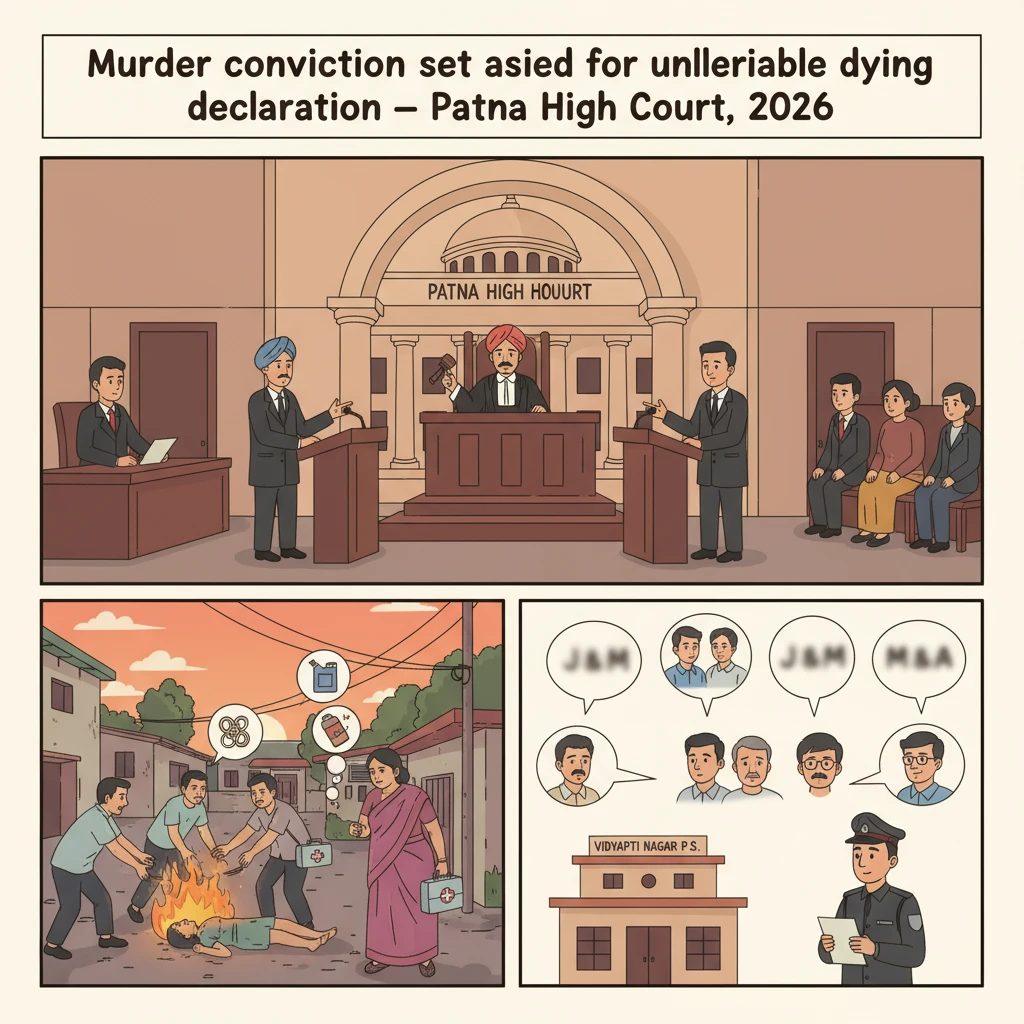
This case arises from a tragic incident on 13.06.2017 in Vidyapati Nagar, District Samastipur. A 15‑year‑old girl, Anshu Kumari @ Akanksha Kumari, daughter of informant Sunil Kumar Rai (PW‑14), suffered severe burn injuries and later died.
According to the fardbayan (Ext.3) of PW‑14, recorded on 14.06.2017 at 7:00 AM, he was at his medicine shop around 12:00 noon on 13.06.2017 when he heard a commotion from his village home. On reaching there, he found his daughter lying in the courtyard of his uncle Ashok Rai’s house, with her hands and mouth tied and her body on fire. Neighbours helped to extinguish the fire and she was taken to hospital.
The girl was first admitted to Paramount Care Hospital, Patna, where she was treated in the ICU. She died during treatment in the intervening night of 13.06.2017 and 14.06.2017.
On the basis of PW‑14’s statement, Vidyapati Nagar P.S. Case No.72 of 2017 was registered under Sections 341, 342, 307, 302 and 34 of the Indian Penal Code. After investigation, police submitted charge‑sheet against five persons, including the present appellant Amit Kumar, under Sections 448, 342, 302 and 120B IPC.
The alleged motive, as narrated by PW‑14, was an earlier incident involving elopement/kidnapping of Juhi Kumari, daughter of neighbour Sanjay Rai. The appellant and his family were suspected in that matter, and the informant had supported Sanjay Rai, leading to alleged enmity and threats.
The case was committed to the Court of Session and tried as Sessions Trial No.826 of 2017 before the Fast Track Court‑I, Samastipur. By judgment dated 10.01.2019, the trial court convicted Amit Kumar under Section 302 IPC and sentenced him on 15.01.2019 to rigorous imprisonment for life with fine of Rs.10,000/‑ (and three years’ further rigorous imprisonment in default). Co‑accused Babita Devi, Juhi Kumari, Rahul Kumar and Raushan Kumar were acquitted of all charges including Sections 302, 307 and 120B IPC.
Aggrieved, Amit Kumar filed this criminal appeal under Section 374(2) of the Code of Criminal Procedure, 1973, before the Patna High Court. He claimed total innocence, alleged false implication due to family enmity, and highlighted contradictions in the prosecution evidence and serious gaps in investigation.
What the Court Examined and Decided
The Division Bench of Hon’ble Mr. Justice Bibek Chaudhuri and Hon’ble Mr. Justice Chandra Shekhar Jha noted at the outset that the entire prosecution case rested on oral dying declarations allegedly made by the deceased to various persons.
There was no written dying declaration, no recording by a Magistrate, and no certificate from any doctor that the girl was fit to make a statement. The Court therefore examined the evidence very closely, in light of settled law on dying declarations from decisions such as Khushal Rao v. State of Bombay, Harbans Singh v. State of Punjab, Laxman v. State of Maharashtra, Paniben v. State of Gujarat and others.
Independent witnesses at the scene
Sixteen witnesses were examined. Among them, PW‑3 was an independent villager, and PW‑5 to PW‑8 were neighbours declared hostile, all unrelated to either side.
PW‑3, who reached the spot immediately, clearly stated that when he arrived the girl was burning and “she was not speaking”. PW‑5 and PW‑6 also denied that she named anyone or uttered the phrase “Juhi, your work is done”. PW‑8 admitted that while the girl was speaking something, “we could not hear her”, and in cross‑examination she firmly said that the girl did not mention any names.
These independent witnesses, the Court observed, had no reason to support the appellant. Their version that the girl was either silent or not coherently speaking directly contradicted the later statements of close relatives that she gave detailed oral dying declarations.
Family witnesses and shifting versions
The Court then analysed the evidence of related prosecution witnesses who claimed the girl named the assailant or described the incident.
PW‑4, a neighbour, reached while the fire was being extinguished. He said that after the cloth was removed from her mouth, she only said, “Rahul Bhaiya, save me”. He admitted he did not see who set her on fire. This was the earliest alleged utterance and did not name any culprit.
PW‑9 gave a detailed narration that someone tied her mouth from behind, poured oil, lit a matchstick while saying “Juhi, your work had been done”, and threatened to kill her two brothers. But in cross‑examination she twice admitted that the girl did not tell her the name of the person who set the fire and she did not know who poured oil.
PW‑10, the grandmother, said the deceased told her that “Juhiya set me on fire” but also conceded that the girl did not disclose the name of any person and that when she reached the girl was “burnt and unconscious”.
PW‑11, the grandfather, spoke only about the alleged love affair between Amit and Juhi and the previous elopement, but he neither saw the occurrence nor spoke to the victim.
PW‑13, a professor and neighbour, deposed that on his asking, the girl said “Juhiya and Juhiya’s mother got her killed”. However, he admitted that this important statement did not find place in the fardbayan and that police recorded statements without taking signatures.
PW‑12, the mother, said that after the cloth was removed from the mouth, the girl stated that “Juhi’s mother and Amit” had set her on fire and threatened to kill her brothers if she took their names. She further said she fainted after hearing this. In cross‑examination she accepted that she did not witness the incident herself, her account was only based on what she heard from her daughter, and her earlier police statement recorded on 15.06.2017 had variations.
The High Court noted that PW‑12’s evidence directly implicated Babita (Juhi’s mother) along with the appellant. Yet the trial court had acquitted Babita Devi but convicted only Amit Kumar on the same alleged declaration. This was described as “selective reliance” on evidence, which is impermissible.
PW‑1, the girl’s uncle, stated that she was unconscious at home and became conscious only in the hospital, where she named “Juhi’s friend Amitwa” as the person who set her on fire. PW‑2, who went with them to hospital and had business relations with PW‑1, similarly said that in the ICU she named “Juhiya’s friend Amitwa” as the person who tied her and set her on fire. Both were interested witnesses, and their testimony was confined only to what allegedly happened inside the ICU.
PW‑14, the father and informant, was the star witness for the prosecution. He claimed that at the house the girl told him that her hands, mouth and legs were tied, kerosene was poured, and she was set on fire, and that the culprits threatened to burn her two brothers as well. She allegedly did not name anyone at that stage due to fear but repeated the threat and the line “Juhi, your work is done”.
PW‑14 further said that in the ICU at Paramount Care Hospital, after he repeatedly questioned her, she named only Amit Kumar as the person who set her on fire. In cross‑examination, he admitted that even after being asked thrice she named only Amit and not anyone else, that no one saw the actual incident, and that by the time the police reached the hospital the girl was unconscious.
Most importantly, his own fardbayan (Ext.3), recorded soon after the death, clearly stated that “Amit and Sumit” had tied her and set her on fire. The Court found that this change from “Amit and Sumit” in the first version to “only Amit” at trial, along with the mother’s statement bringing in Babita, showed serious inconsistency in the identity and number of assailants.
Medical evidence and possibility of speech
The High Court then considered the medical evidence from PW‑15, the doctor who observed the post‑mortem conducted on 14.06.2017 at 2:56 PM.
The post‑mortem report (Ext.2) recorded 90% ante‑mortem burns from face to feet, presence of carbon soot in the trachea, congested internal organs, and cause of death due to asphyxia produced by flame of fire. PW‑15 also admitted that such injuries could occur even in an accidental cooking fire and that no injury from any weapon was found.
The presence of carbon soot in the trachea showed that the girl inhaled hot smoke and gases while alive. The Court observed that this would normally cause swelling and damage in the throat and windpipe, making it extremely difficult or almost impossible for a victim to speak clearly for long hours after the incident.
Despite this, the prosecution version required the Court to believe that the girl spoke in detail to many people at different times both at home and in hospital. No doctor from Paramount Care Hospital was examined to say that she was in a fit mental and physical condition to make such statements. No medical certificate of fitness was produced.
The Bench relied on the Supreme Court decision in Jayamma v. State of Karnataka, where the deceased had 90% burns and conflicting versions. There, in the absence of proper medical evidence about the victim’s condition, the Supreme Court refused to uphold a conviction based mainly on a disputed dying declaration.
Investigating Officer’s admissions and weak investigation
PW‑16, the Investigating Officer, made several admissions which, in the High Court’s view, “completely demolish” the prosecution case.
He accepted that no witness stated that they saw the appellant either setting the girl on fire or even present at the place of occurrence. He admitted that though the fardbayan mentioned that the assailants fled, this aspect was not maintained in later statements. In case diary paragraph 57, he had also recorded that the informant told him the appellant was falsely implicated.
He further stated that Anita Devi’s statement was hearsay, that one Sumit Kumar was initially under suspicion but dropped without any clear reason, and that articles allegedly seized (rope, gamchha, kerosene can, matchbox — Ext.7) were neutral and not connected to the appellant in any scientific way. He also conceded to several lapses, such as delay in recording statements, not taking signatures of witnesses on statements, and not seizing soil from the place of occurrence.
Legal principles applied and final decision
After surveying the law on dying declarations from many Supreme Court judgments including Khushal Rao, Harbans Singh, Laxman, Paniben, Kundula Bala Subrahmanyam, Mohanlal Gangaram Gehani, Jayamma and Kali Ram, the Patna High Court reiterated that:
- a dying declaration can form the basis of conviction only if it is found wholly reliable,
- where multiple declarations exist, they must be consistent on material particulars, especially on identity of the assailant, and
- if there is reasonable doubt, the accused must receive the benefit of that doubt.
On the facts of this case, the Court found that the several oral dying declarations attributed to the deceased were full of contradictions about who set her on fire and how many persons were involved. Independent witnesses said she was not speaking or did not mention any names. Medical evidence made prolonged coherent speech highly doubtful. The investigation was casual and failed to produce key medical witnesses.
The Bench held that the trial court had adopted a “selective and perverse” approach by relying on one part of the alleged declaration to convict Amit Kumar, while ignoring other parts that implicated co‑accused who were acquitted. This, the High Court said, was not permissible in criminal law.
In light of these serious doubts, the Court concluded that the prosecution had “utterly failed” to prove the charge under Section 302 IPC beyond reasonable doubt, and that the appellant was clearly entitled to the benefit of doubt.
Accordingly, the appeal was allowed. The judgment of conviction dated 10.01.2019 and order of sentence dated 15.01.2019 in Sessions Trial No.826 of 2017 were set aside. Amit Kumar was acquitted of all charges and directed to be released forthwith unless required in any other case.
Why This Judgment Matters
This judgment is important for families, police officials and trial courts dealing with burn cases and alleged dying declarations.
First, the Patna High Court has made it clear that when a case rests only on oral dying declarations given by close relatives, courts must be very cautious. If independent neighbours who arrive first say the victim was not speaking, and medical science shows speaking would be difficult, courts cannot ignore such evidence.
Second, the decision underlines that changes in the story about who the real culprit is — for example, from “Amit and Sumit” to “only Amit” or from “Juhi and her mother” to “only Amit” — are serious weaknesses. In criminal law, when there is such doubt about identity of the offender, conviction cannot be maintained.
Third, the judgment sends a message to investigating agencies. Proper recording of statements, examination of treating doctors, and scientific linkage of seized articles are essential. Loose investigation can lead to acquittal even in grave offences like murder.
For lay persons, especially in rural Bihar, this case shows how crucial it is that police and doctors immediately and properly record any statement of a seriously injured victim in accordance with law. Otherwise, even genuine grievances may fail in court, and the accused will get the benefit of doubt.
Legal Issues and Answers
- Issue: Can a conviction for murder under Section 302 IPC be sustained solely on the basis of multiple oral dying declarations, when there are contradictions among them and medical and independent evidence cast doubt on the victim’s ability to speak?
Answer: No. The Patna High Court held that in such circumstances the dying declarations are unreliable, the prosecution fails to prove guilt beyond reasonable doubt, and the accused is entitled to acquittal. - Issue: Is it permissible for a trial court to selectively rely on parts of oral dying declarations to convict one accused while acquitting co‑accused named in the same declarations?
Answer: No. The Court held that such selective appreciation is perverse. When the same body of evidence equally implicates others who are acquitted, conviction of a single accused on that basis cannot stand. - Issue: What is the role of medical evidence in assessing the reliability of a dying declaration in burn injury cases?
Answer: Medical evidence is crucial. Where severe burns and inhalation injuries make coherent speech improbable, and there is no medical proof of fitness to give a statement, courts should be slow to accept oral dying declarations as the sole basis for conviction.
Cases Cited by the Court
- Khushal Rao v. State of Bombay, AIR 1958 SC 22
- Harbans Singh v. State of Punjab, AIR 1962 SC 439
- Laxman v. State of Maharashtra, (2002) 6 SCC 710
- Paniben v. State of Gujarat, 1992 (2) SCC 474
- Kundula Bala Subrahmanyam v. State of Andhra Pradesh, (1993) 2 SCC 684
- Jayamma v. State of Karnataka, Criminal Appeal No.1456 of 2005
- Mohanlal Gangaram Gehani v. State of Maharashtra, (1982) 1 SCC 700
- Kali Ram v. State of H.P., (1973) 2 SCC 808
- State of Punjab v. Jagir Singh, (1974) 3 SCC 227
Case Details
Case Number: Criminal Appeal (DB) No.135 of 2019; arising out of Vidyapati Nagar P.S. Case No.72 of 2017, District Samastipur
Case Title: Amit Kumar v. The State of Bihar
Citation: 2026 (3) PLJR 113
Coram: Hon’ble Mr. Justice Bibek Chaudhuri and Hon’ble Mr. Justice Chandra Shekhar Jha
Advocates:
- For the Appellant: Mr. S.K. Lal, Senior Advocate; Mr. Pritish Kumar Lal, Advocate
- For the State: Km. Shashi Bala Verma, A.P.P.
Nature of Case: Criminal appeal under Section 374(2) Cr.P.C. against conviction and sentence in a sessions trial for offence under Section 302 IPC.
Link to Judgment: Click here to read the full Patna High Court judgment
If you found this explanation helpful and wish to stay informed about
how legal developments may affect your rights in Bihar,
you may consider following Samvida Law Associates for more updates.







