

Case Background
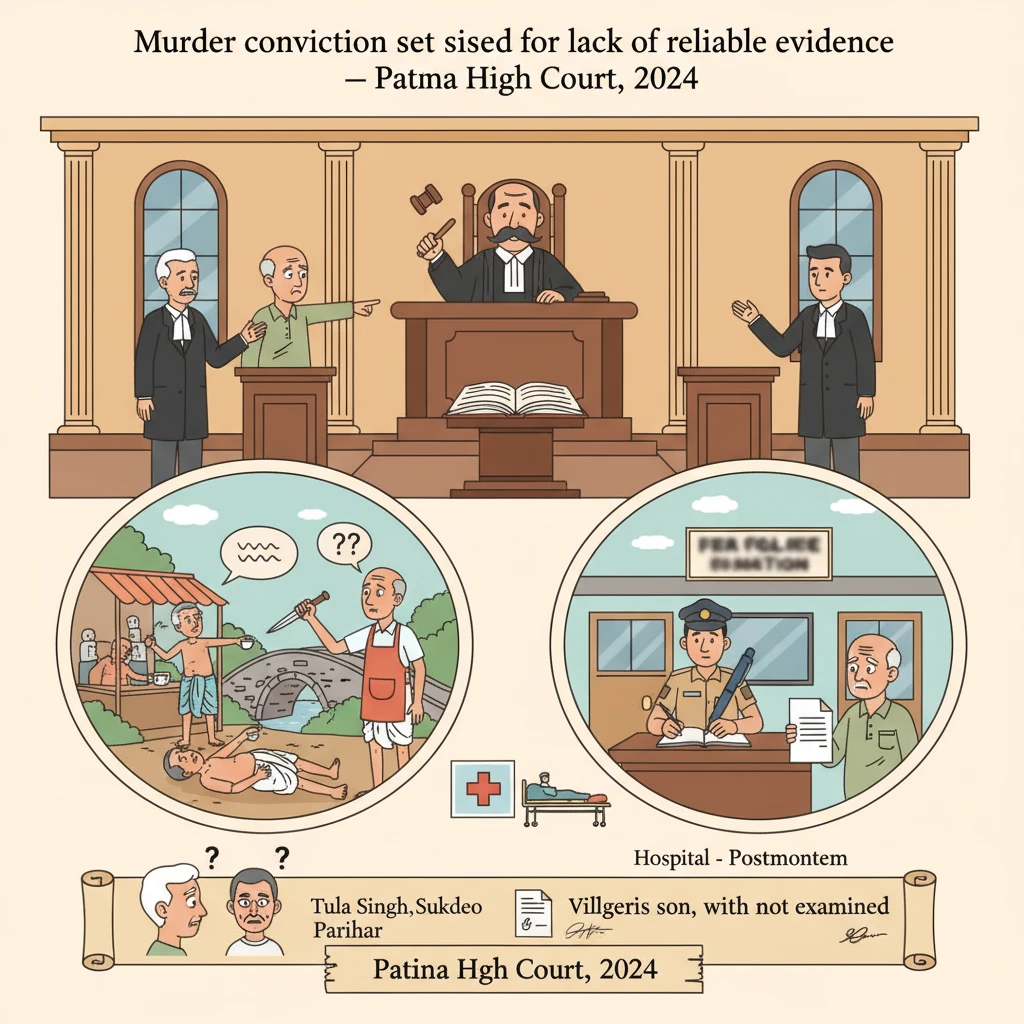
The case arose from an incident on 27.10.2015 at about 1:15 PM at a tea shop in village Amdosh, within Pranpur Police Station, district Katihar.
According to the written report lodged by the informant, Pyare Lal Singh (PW-2), his father, Chhutharu Singh, went to the tea shop of the appellant to take tea. While the father was taking tea, the shop owner (the appellant) allegedly abused him. When the father objected, the appellant is said to have assaulted him repeatedly with a dagger on the abdomen. The father fell down badly injured and died. When people from the neighbourhood started coming, the assailant allegedly fled.
On the basis of this written report (Exhibit 5), Pranpur P.S. Case No. 103 of 2015 was registered on 27.10.2015 under Section 302 of the Indian Penal Code. Investigation was taken up by the Officer-in-Charge of Pranpur Police Station, who later submitted a charge sheet under Section 302 IPC against the appellant.
The case was committed to the Court of Session. In Sessions Trial No. 30 of 2016, the Sessions Judge, Katihar framed charge under Section 302 IPC on 01.03.2016. The accused pleaded not guilty and claimed trial.
By judgment dated 25.05.2017, the Sessions Judge convicted the appellant under Section 302 IPC. By order dated 30.05.2017, the appellant was sentenced to rigorous imprisonment for life and a fine of Rs. 10,000/-, with six months’ simple imprisonment in default.
The appellant filed Criminal Appeal (DB) No. 985 of 2017 before the Patna High Court challenging both the conviction and the sentence.
What the Court Examined and Decided
The Division Bench of the Patna High Court (Hon’ble Mr. Justice Rajeev Ranjan Prasad and Hon’ble Mr. Justice Shailendra Singh) heard the appeal. Mr. Pratik Mishra appeared as Amicus Curiae for the appellant. Mr. Dilip Kumar Sinha, Additional Public Prosecutor, appeared for the State.
The High Court closely examined the evidence of the prosecution witnesses, the defence witnesses, and the conduct of the investigation. The entire prosecution case rested mainly on the statements of two sons of the deceased, Hira Lal Singh (PW-1) and Pyare Lal Singh (PW-2), who were projected as eyewitnesses.
Doubts about the very first report to police
PW-2 stated in court that when he reached the police station, the Munshi of the police station wrote out his application. According to PW-2, that written application was not read over and explained to him.
The written report (Exhibit 5) bears the signature of PW-2 as informant and the signatures of two attesting witnesses, Tula Singh and Sukdeo Parihar. None of these attesting witnesses was examined at trial.
The Investigating Officer (PW-6), the Officer-in-Charge of Pranpur Police Station, stated that the written application was actually in the handwriting of a literate constable, Rahim Singh. On its basis, the formal FIR was registered by another literate constable, Baleshwar Singh.
Despite this, neither the Munshi nor constable Rahim Singh nor constable Baleshwar Singh put their signatures on the written report, and none of them was examined. The informant consistently maintained that the contents were not read over to him.
The High Court held that when the informant had already reached the police station, there was no reason not to record his fardbeyan directly. Preparing a written report through a constable whose name and signature do not appear on the document, and then not examining that scribe, created serious doubt.
The Court concluded that non-examination of the scribe caused definite prejudice to the defence and suggested that the very first information given by PW-2 might have been suppressed or altered.
Conflicting versions of the two sons
To prove the murder, the prosecution relied mainly on PW-1 and PW-2.
PW-1 said that he had gone from home to call his father for lunch. When he was just ten steps away from the tea shop, he saw the occurrence. He named three persons, Bipin Singh, Atul Singh and Pammi Kumari, as being present at the shop. He also claimed that his father used to take part in Panchayati, and that there had been a Panchayati in a dispute involving the appellant, which allegedly led to prior quarrel and ultimately to the murder.
PW-2, on the other hand, stated that he went to call his father for lunch at the instance of his mother. According to him, he saw the attack from a distance of about sixty steps and clearly stated that there was nobody else present at the shop at that time. He also said that his brother PW-1 came later, after he had raised hulla, and that other brothers came after that.
PW-1 claimed that only he had gone to call his father and that his brothers were at home when the incident took place. This directly contradicted PW-2, who said he had gone first and PW-1 came later on hulla.
The informant’s mother, who supposedly sent him to call his father, was not examined. The other sons who allegedly came on hulla were also not examined.
Both PW-1 and PW-2 spoke in their depositions about a Panchayati between the appellant and a woman named Rabo (or Raibo) Devi, in which the deceased allegedly sided against the appellant. However, the Investigating Officer stated that neither PW-1 nor PW-2 had spoken about any Panchayati in their police statements. No document of Panchayati was produced, and Rabo Devi was never examined.
In cross-examination, PW-2 admitted that he had not told the police that he went to call his father for lunch. This was confirmed by the Investigating Officer. Thus, a key part of his story was missing from his earlier statement.
From these serious and direct contradictions, the High Court concluded that the presence of PW-1 and PW-2 at the exact time and place of occurrence was not proved beyond doubt. Their versions were not only inconsistent but actively contradicted each other.
Missing independent witnesses and gaps in investigation
The Court noted that several persons who could have given independent accounts were not examined:
- The three persons named by PW-1 as present at the shop (Bipin Singh, Atul Singh and Pammi Kumari).
- The wife of the deceased and his other sons, who allegedly sent and followed PW-1 or PW-2.
- Tula Ram Singh, Nakul Singh and Kobra Singh, who allegedly helped take the injured to the hospital.
- Kishan Singh, who signed the inquest report and the arrest memo.
- The two witnesses who attested the written report.
- Rabo (or Raibo) Devi, in whose dispute the alleged Panchayati had been held.
- Chowkidars Vikram Ray and Sheikh Jalil, who brought and identified the dead body for postmortem.
Relying on the Supreme Court judgment in Takhaji Hiraji vs. Thakore Kubersing Chamansing, the High Court held that non-examination of such material witnesses, who could have unfolded the genesis of the incident and filled gaps in the prosecution story, allowed the Court to draw an adverse inference against the prosecution.
The investigation of the place of occurrence was also found wanting. The inquest report and postmortem report showed multiple sharp-weapon injuries and bleeding. Yet the Investigating Officer admitted that he did not find any bloodstains or other incriminating material at the tea shop.
He claimed he first went to the place of occurrence and from there learnt that the injured had been shifted to Pranpur Primary Health Centre, where he prepared the inquest report. But the FIR itself clearly recorded that the victim had already died on the spot, and it was lodged within 30 minutes of the incident. The Court found that the Investigating Officer was aware from the FIR that the victim was dead and inferred that his version about first visiting the spot and then going to the hospital was not correct. It appeared to the Court that he mainly did paper work without promptly visiting the scene.
The arrest memo showed that the accused was arrested at 4:30 PM near Birla Mandir, about 100 metres from the tea shop. But in the case diary the time of arrest was mentioned as 22:00 hours and the names of arrest memo witnesses were not recorded. No weapon was recovered.
Place of occurrence accepted, assailant unknown
Both sides accepted that the death took place at the appellant’s tea shop. Even the defence witnesses, including the appellant himself examined as DW-2, stated that the killing occurred in his shop while he was present.
The defence story was that PW-2, and not the appellant, stabbed the deceased after a quarrel between father and son. The High Court did not record any clear acceptance of this version. Instead, it focused on whether the prosecution had proved its own case beyond reasonable doubt.
On the overall material, the Court concluded that while the place of occurrence was proved to be the tea shop of the appellant, it remained a mystery as to who actually killed the deceased.
Failure to put key circumstances to the accused
The High Court also examined the statement of the accused under Section 313 CrPC. Only three simple questions were put to him, broadly asking if he had heard the evidence, and whether he had committed the murder.
Important alleged circumstances were never put to him, such as:
- That he had abused the deceased and, on objection, stabbed him multiple times with a dagger.
- The alleged motive based on the Panchayati in favour of Rabo Devi.
- The claim that he was arrested while fleeing from the spot after being chased by police.
Relying on the Supreme Court judgment in Sujit Biswas vs. State of Assam, the High Court noted that incriminating circumstances not put to the accused in his Section 313 examination cannot be used against him. Using such un-confronted circumstances would violate the principles of natural justice.
The Sessions Court had still used the alleged conduct of fleeing and being caught on chase as a circumstance against the appellant, even though it had not been put to him under Section 313 CrPC. The High Court held this to be impermissible.
Omissions in FIR and late introduction of motive
The Court also considered the Supreme Court decision in Ram Kumar Pandey vs. State of M.P. on the effect of omissions of important facts in the initial report.
PW-2, being the son of the deceased and an informed witness, was expected to narrate all essential facts in the written report. Yet he did not mention any Panchayati or prior enmity in the FIR. Later, both PW-1 and PW-2 tried to introduce the Panchayati as the motive during trial, but the Investigating Officer confirmed that no such statement was made before him.
The High Court treated this omission of an alleged major motive as a factor undermining the credibility of the prosecution version.
Final conclusion and acquittal
After reviewing all evidence, the High Court applied the well-known rule stated by the Supreme Court in Kali Ram vs. State of Himachal Pradesh: where two views are possible on the evidence, one pointing to guilt and the other to innocence, the view favourable to the accused must be adopted.
The Court held that:
- The eye-witness accounts of PW-1 and PW-2 were not wholly reliable due to major contradictions about their presence, distance, and who was at the scene.
- There was no independent eyewitness to support either side.
- The genesis or motive of the occurrence was not proved.
- Investigative lapses and non-examination of several critical witnesses created serious gaps.
- Important incriminating circumstances were not put to the accused under Section 313 CrPC.
In these circumstances, the prosecution had failed to prove beyond reasonable doubt that the appellant had committed the murder.
The High Court therefore set aside the conviction and sentence under Section 302 IPC, gave the appellant benefit of doubt, and ordered that he be released forthwith if not wanted in any other case. The appeal was allowed.
Why This Judgment Matters
This judgment shows that even in serious offences like murder, courts will not uphold a conviction unless the evidence is clear, consistent and complete.
For families of victims and accused persons alike, it underlines that:
- Statements recorded at the police station must be carefully taken and properly proved.
- Close relatives who claim to be eyewitnesses must give consistent statements, and important facts should appear from the beginning, not be added later.
- Police must investigate the spot honestly, collect physical evidence, and examine all material witnesses.
- Courts must put all important incriminating circumstances to the accused under Section 313 CrPC, otherwise those points cannot be used to convict.
Where these safeguards are not followed, even a life sentence can be overturned. The Patna High Court here has reinforced that suspicion, however strong, cannot replace proof.
Legal Issues and Answers
- Issue: Whether the prosecution proved beyond reasonable doubt that the appellant stabbed and murdered the deceased at his tea shop under Section 302 IPC.
Answer: No. The Patna High Court found serious contradictions in the testimonies of the alleged eyewitnesses, non-examination of key witnesses, unexplained omissions in the FIR, and investigative lapses. It held that while the death at the appellant’s tea shop was proved, the identity of the assailant remained uncertain, entitling the appellant to benefit of doubt. - Issue: Whether the trial court could rely on alleged incriminating circumstances that were not put to the accused in his statement under Section 313 CrPC.
Answer: No. Following Supreme Court rulings including Sujit Biswas vs. State of Assam, the Court held that circumstances not put to the accused under Section 313 CrPC cannot be used against him. The trial court erred in drawing adverse inferences from alleged flight and motive which were never properly put to the appellant. - Issue: Whether non-examination of material witnesses and the scribe of the written report fatally affected the prosecution case.
Answer: Yes. Relying on Takhaji Hiraji and other precedents, the Court held that withholding such material witnesses, who could have explained the genesis of the incident and the earliest version, created serious doubts and justified drawing an adverse inference against the prosecution.
Cases Cited by the Court
- Rabindra Kumar Dey vs. State of Orissa, AIR 1977 SC 170 (cited by defence).
- Takhaji Hiraji vs. Thakore Kubersing Chamansing & Ors., (2001) 6 SCC 145 (2001 SCC (Cri) 1070).
- Sujit Biswas vs. State of Assam, (2013) 12 SCC 406.
- Hate Singh Bhagat Singh vs. State of Madhya Bharat, AIR 1953 SC 468.
- Shamu Balu Chaugule vs. State of Maharashtra, (1976) 1 SCC 438 : AIR 1976 SC 557.
- Harijan Magha Jesha vs. State of Gujarat, (1979) 3 SCC 474 : AIR 1979 SC 1566.
- Sharad Birdhichand Sarda vs. State of Maharashtra, (1984) 4 SCC 116.
- Bipin Kumar Mondal vs. State of West Bengal, (2010) 12 SCC 91 : AIR 2010 SC 3638.
- Matru vs. State of U.P., (1971) 2 SCC 75.
- Ram Kumar Pandey vs. State of M.P., (1975) 3 SCC 815 : AIR 1975 SC 1026.
- Kali Ram vs. State of Himachal Pradesh, (1973) 2 SCC 808 : AIR 1973 SC 2773.
Case Details
Case Number: Criminal Appeal (DB) No. 985 of 2017; arising out of Pranpur P.S. Case No. 103 of 2015; Sessions Trial No. 30 of 2016.
Case Title: Vijay Singh vs. The State of Bihar.
Citation: 2024 (4) PLJR 121.
Court: High Court of Judicature at Patna.
Coram: Hon’ble Mr. Justice Rajeev Ranjan Prasad; Hon’ble Mr. Justice Shailendra Singh.
Date of Patna High Court Judgment: 02.09.2024 (uploaded on 11.09.2024).
Trial Court: Court of Sessions Judge, Katihar.
Trial Court Judgment and Order: Judgment of conviction dated 25.05.2017 and order of sentence dated 30.05.2017 under Section 302 IPC (life imprisonment and fine of Rs. 10,000/-, with six months’ simple imprisonment in default).
Final Outcome in Appeal: Conviction and sentence set aside; appellant acquitted of charge under Section 302 IPC and directed to be released forthwith if not wanted in any other case.
Advocates: Mr. Pratik Mishra, Amicus Curiae for the appellant; Mr. Dilip Kumar Sinha, Additional Public Prosecutor, for the State of Bihar.
Nature of Case: Criminal appeal (Division Bench) against conviction and sentence for offence under Section 302 IPC.
Link to Judgment: Click here to access the full Patna High Court judgment
If you found this explanation helpful and wish to stay informed about
how legal developments may affect your rights in Bihar,
you may consider following Samvida Law Associates for more updates.







