

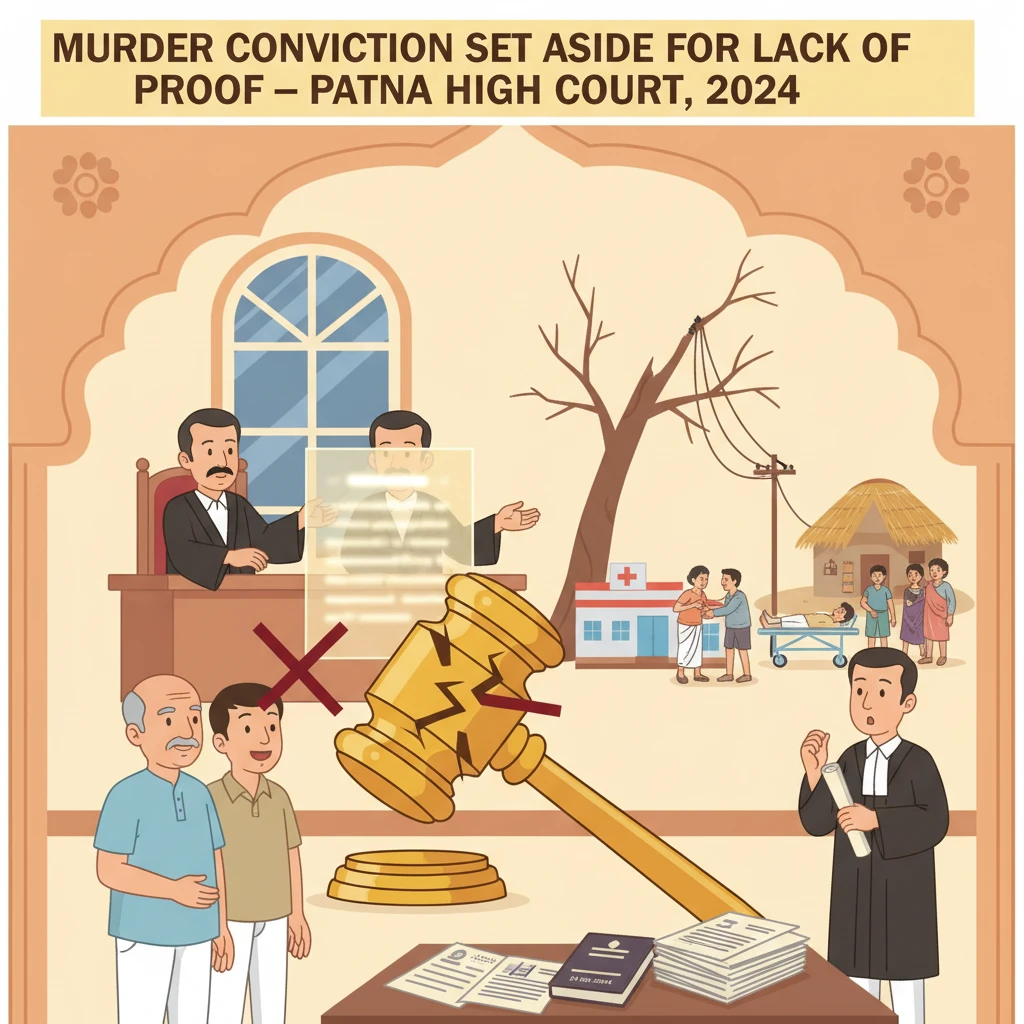
Case Background
This case arose from an incident on 29.05.2004 in a village under Phulwari Sharif Police Station, Patna. One Birendra Kumar suffered a serious head injury and later died while under treatment at Rajeshwar Nursing Home, a private hospital in Patna.
On the same day, his father, Prahlad Sharma (P.W. 7), gave a written report to the Inspector-cum-Officer-in-Charge of Phulwari Sharif Police Station. In this first report, he alleged that his neighbour, appellant no. 1, along with appellant no. 2 and two other sons, came near his house around 2:00 P.M., abused his son, and then assaulted him. According to this version, on the order of appellant no. 1 to kill Birendra Kumar, appellant no. 2 and juvenile Niraj Kumar caught hold of the deceased, and Niraj allegedly struck him on the head with a lathi. The victim fell, became unconscious and was assaulted further with fists and slaps. Neighbours gathered on hearing the alarm and the injured man was taken to Rajeshwar Nursing Home, Patna.
Initially, the police registered Phulwari Sharif P.S. Case No. 372 of 2004 on 29.05.2004 under Sections 307, 341, 323 and 34 of the Indian Penal Code. At the time of the first report, the medical condition of Birendra Kumar was serious but he was alive.
Birendra Kumar died in Rajeshwar Hospital on 31.05.2004 at about 6:00 A.M. After his death, P.W. 7 gave a second fardbeyan the same day, adding more details about the background of the incident. In this second statement, he gave a specific reason for the quarrel: while a dried-up Sheesham tree belonging to him was being cut, an overhead electric wire allegedly drawn illegally by the appellants got damaged, which supposedly provoked the attack.
Both statements were merged into the same case, Phulwari Sharif P.S. Case No. 372 of 2004, and Section 302 IPC was added by order dated 01.06.2004. During investigation, police found the allegations against the appellants and the two younger sons of appellant no. 1 to be “true”. However, the two younger sons, Niraj Kumar and Dhiraj Kumar, were found to be juveniles, so their cases were sent to the Juvenile Justice Board. Only the father and elder son (the present appellants) faced trial in Sessions Trial No. 893/2005/199/2018 before the Fast Track Court-II, Patna.
On 26.09.2018, the Trial Court convicted both appellants under Section 302/34 IPC and, by order dated 28.09.2018, sentenced them to rigorous imprisonment for life. They then filed Criminal Appeal (DB) No. 1222 of 2018 before the Patna High Court.
What the Court Examined and Decided
The Division Bench of Hon’ble Mr. Justice Ashutosh Kumar and Hon’ble Mr. Justice Jitendra Kumar heard the appeal. As no lawyer was appearing for the appellants, the Court appointed Mr. Anil Singh as Amicus Curiae, who assisted the Court.
The central question was whether the prosecution had proved, beyond reasonable doubt, that the appellants participated in a murderous assault which caused the death of Birendra Kumar.
The Amicus Curiae argued that the case against the appellants was false and unreliable. He attacked both the written reports given by P.W. 7, the trustworthiness of the family witnesses, and the quality of the police investigation.
First, he drew the Court’s attention to the first fardbeyan (Ext.-1), which was scribed by one Sanjay, who was not examined in court. In this initial document, P.W. 7 first narrated the allegation about the assault. Only as an “appendage” at the end did he mention the supposed cause of the quarrel: the damage to the appellants’ overhead electric wire while a dried Sheesham tree was being cut.
The defence pointed out that P.W. 7 had signed the report before this appended part was written. According to the Amicus, this showed interpolation to create a motive later. He argued that it would appear strange if neighbours suddenly assaulted a man without any cause, so the prosecution inserted the Sheesham tree-electric wire story later to fill this gap. This, he suggested, supported the possibility that Birendra had actually fallen from the tree and injured himself.
The Court noted that relations between the two families were admittedly not good, with a dispute over a passage between their houses coming out in the cross-examination. However, the investigation did not support the prosecution’s Sheesham tree story. The Investigating Officer (P.W. 15), Arun Kumar, inspected the place of occurrence but did not find any Sheesham tree or even the stump of a felled tree. He also did not find blood at the spot and failed to seize the bloodstained clothes of the deceased.
The second major area examined by the Court was the witness evidence. Six close relatives of the deceased, P.Ws. 1 to 6 (brothers, wife, aunt and cousin) and P.W. 7, claimed at trial to be eye-witnesses. However, the Investigating Officer confirmed that, during investigation, none of P.Ws. 1 to 6 had stated that they had seen the occurrence. Only P.W. 7 had claimed to be present. Despite this, at the trial, all of them claimed to have seen the assault in detail.
The Court treated this as a serious exaggeration. Their earlier silence during investigation and later claim to be eye-witnesses made their testimony unreliable. Several other prosecution witnesses, including some official witnesses (P.Ws. 8, 9, 11, 12, 13), turned hostile, further weakening the prosecution’s version. No independent neighbour, although said to be present at the time of incident, was examined.
The Court then looked closely at the medical evidence. Post-mortem was conducted on 31.05.2004 by Dr. Bishnudeo Prasad (P.W. 10). He found a stitched wound on the vertex, around three inches above the glabella, and extradural hemorrhage inside the skull. He gave the cause of death as shock and hemorrhage due to head injury.
However, P.W. 10 candidly admitted that he could not determine the “nature of violence” because of prior surgical intervention at Rajeshwar Hospital. For the same reason, he could not clearly speak about the exact nature of the injury. This made his evidence incomplete regarding how the injury was caused — by a lathi blow, a fall, or some other manner.
In these circumstances, the Court considered it essential that the doctors who treated Birendra Kumar at Rajeshwar Nursing Home should have been examined. They would have been able to describe the injuries before surgery, the history given at the time of admission, and the time and manner in which the patient was brought. Their evidence could have clarified whether the injuries looked like those from an assault or from a fall.
But the prosecution did not examine any treating doctor from the private hospital. This, in the Court’s view, created a serious gap in the prosecution case. The Court even raised the unanswered question: was the patient admitted as a case of fall from a tree? The record did not reveal this either way.
The timing of the First Information Report also troubled the Court. The police station was only seven kilometres from the place of occurrence. The incident allegedly happened at 2:00 P.M. on 29.05.2004. The victim was taken to the private hospital by around 3:15 P.M., and P.W. 7 stayed at the hospital till about 7:00 P.M. Yet, the information was received at the police station only around 8:40 P.M.
Further confusion appeared because, in cross-examination, P.W. 7 stated that policemen from Phulwari Sharif Police Station came to his house at 8:00 P.M. This did not align with the record showing first information reaching the police station only at 8:40 P.M. According to the defence, this mismatch suggested that the real facts and timing were different from what was projected later in the written report.
The Court also noted a significant fact: appellant no. 1 was a Dafadar attached to the local police station. Given his position and the delay in reporting, the Court found it even more necessary for the prosecution version to be free from doubt, which it was not.
Another important aspect was the delay in placing the FIR before the Chief Judicial Magistrate. Though the case was registered on 29.05.2004, the endorsement of the Chief Judicial Magistrate appeared only on 31.05.2004, the day the victim died and the second fardbeyan was recorded. The Court held that this delay made the prosecution version more doubtful, especially in the context of the supplementary statement and evolving story.
Taking all these points together, the High Court found:
- P.Ws. 1 to 6 had not come out with the true version and had falsely claimed to be eye-witnesses.
- P.W. 7’s evidence contained inconsistencies and apparent extrapolation, especially the appended reason in the first fardbeyan and the second fardbeyan after death.
- Independent witnesses from the neighbourhood, though stated to be present, were not examined.
- The investigation suffered from serious lapses, such as not seizing bloodstained clothes, not finding any Sheesham tree or stump, and not properly documenting the scene.
- The medical evidence was incomplete due to non-examination of treating doctors and the post-mortem doctor’s inability to specify the nature of violence.
- There was a real possibility of false implication of the entire family of the appellants, including their minor sons, against the background of enmity and neighbourhood disputes.
Because of these serious doubts, the Bench held that the prosecution had not proved its case beyond reasonable doubt. The Court declined to accept the Trial Court’s conclusion that the appellants were guilty of murder with common intention.
Accordingly, the Patna High Court allowed the appeal, set aside the conviction under Section 302/34 IPC and the life sentences, and acquitted both appellants by giving them the benefit of doubt.
Appellant no. 1, who was in jail since the date of the Trial Court judgment, was directed to be released forthwith if not required in any other case. Appellant no. 2, who was on bail, was discharged from his bail bond obligations.
Before closing, the Court placed on record its appreciation of the assistance given by the Amicus Curiae, Mr. Anil Singh. It directed the Bihar State Legal Services Authority to pay him Rs. 15,000/- as professional fee. Directions were also issued to send a copy of the judgment to the concerned jail superintendent for compliance and to return the records to the Trial Court.
Why This Judgment Matters
This decision of the Patna High Court is important for anyone facing serious criminal charges based mainly on family witnesses and weak investigation. It shows that even in a grave offence like murder, the Court will not uphold a conviction if the evidence is doubtful or incomplete.
The judgment highlights that relatives can be reliable witnesses, but only when their evidence is consistent and matches earlier statements given to the police. If they change their stand later to become eye-witnesses, courts may treat their evidence with caution.
For victims’ families, the case underlines the need for timely and accurate reporting to the police, and for cooperating in a proper medical and forensic examination. Delays, second statements and missing independent witnesses can seriously weaken a case.
For the police and prosecutors, the ruling is a reminder that basic steps — like seizing bloodstained clothes, examining treating doctors, and promptly placing the FIR before the Magistrate — are not mere formalities. Neglecting these can lead to acquittals, even when a life has been lost.
Legal Issues and Answers
- Issue: Did the prosecution prove beyond reasonable doubt that the appellants, acting with common intention, committed the murder of Birendra Kumar under Section 302/34 IPC?
Answer: No. Due to inconsistent witness statements, doubtful fardbeyans, non-examination of independent and medical witnesses, and investigative lapses, the Court held that the prosecution failed to prove guilt beyond reasonable doubt and acquitted the appellants.
Cases Cited by the Court
- The judgment does not mention or rely on any specific earlier case law by name or citation.
Case Details
Case Number: Criminal Appeal (DB) No. 1222 of 2018, arising out of Phulwari Sharif P.S. Case No. 372 of 2004; Sessions Trial No. 893/2005/199/2018 (Fast Track Court-II, Patna).
Case Title: Vinod Sharma @ Vinod Singh and another v. The State of Bihar.
Coram: Hon’ble Mr. Justice Ashutosh Kumar and Hon’ble Mr. Justice Jitendra Kumar.
Citation: 2024 (4) PLJR 102.
Advocates: Mr. Anil Singh, Amicus Curiae, for the appellants; Mr. Abhimanyu Sharma, APP, for the State.
Nature of the Case: Criminal appeal (Division Bench) against conviction and sentence for murder under Section 302/34 IPC.
Link to Judgment: https://patnahighcourt.gov.in/viewjudgment/NSMxMjIyIzIwMTgjMSNO-kvl94BWJLh8=
If you found this explanation helpful and wish to stay informed about how legal developments may affect your rights in Bihar, you may consider following Samvida Law Associates for more updates.







