

Case Background
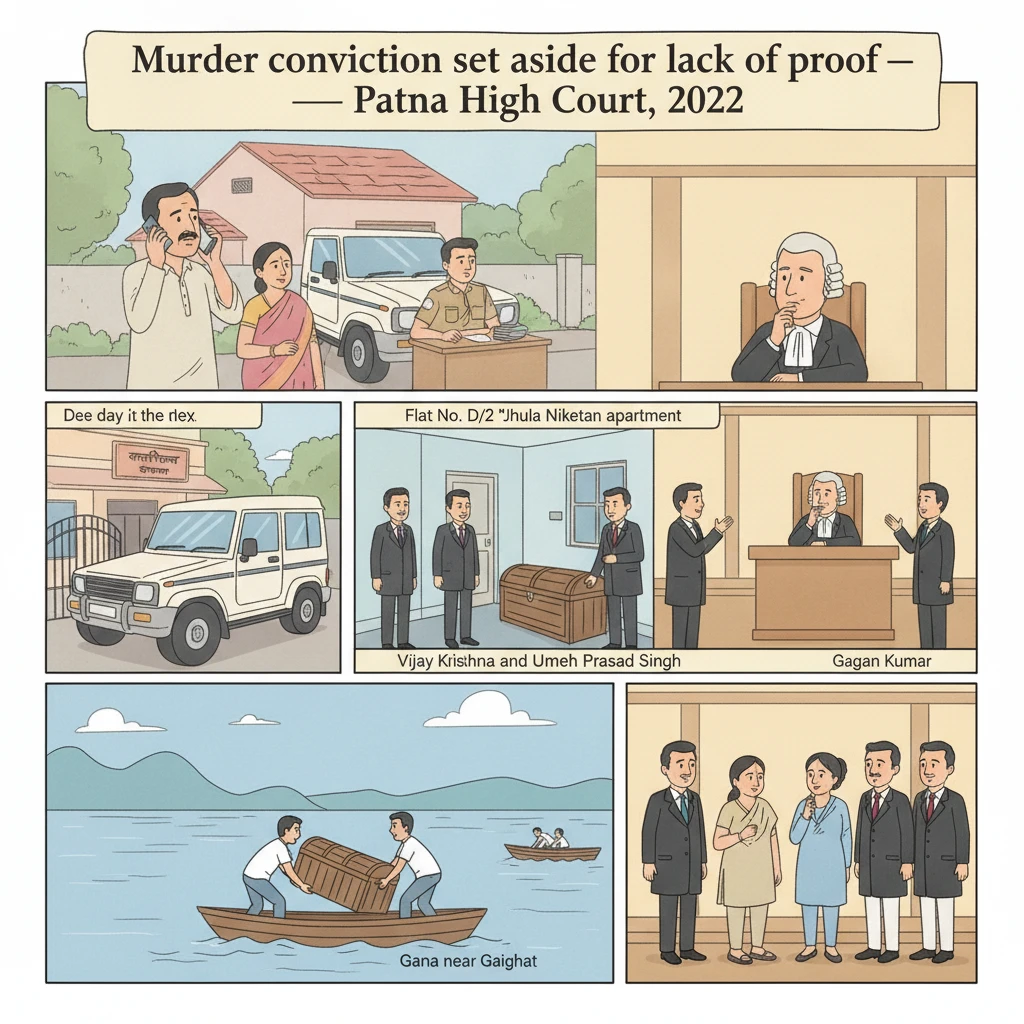
The case arose from the disappearance and death of one Satyendra Prasad Singh in May–June 2009 in Patna. On 23.05.2009, he left his house in a Sumo Victa vehicle and did not return. His brother, who later became the informant, and other family members tried calling him on his mobile phones, but the numbers were either switched off or unanswered.
Late in the night, a complaint was made to the police control room. On 24.05.2009, a written report by the brother led to registration of Shri Krishna Puri P.S. Case No. 110 of 2009 under Sections 365, 364, 302, 201, 120B of the Indian Penal Code and Section 27 of the Arms Act against unknown persons.
During investigation, the police treated a local ex‑Member of Parliament (appellant Vijay Krishna), his son (appellant Chanakya @ Guddu), a bodyguard (appellant Umesh Prasad Singh) and a servant (appellant Gagan Kumar) as suspects. The theory developed by the police was that the deceased was lured to MLA Flat No. 83, taken to Flat No. D/2 in Jhula Niketan apartment, murdered there by firearm, his body packed in a trunk and thrown into the Ganga near Gaighat.
The dead body was recovered from the river Ganga at Dullighat on 11.06.2009, identified by relatives mainly on the basis of clothes and a tailor’s label, and sent for post‑mortem. The doctor opined that death had occurred two to three weeks before autopsy and was due to head injury caused by firearm.
After investigation, charge‑sheets were filed against the four appellants for offences under Sections 364, 302, 201, 120B IPC and Section 27 Arms Act. The case was committed to the Sessions Court. The Additional District & Sessions Judge, Xth, Patna, conducted Sessions Trial Nos. 1007, 1008 and 1009 of 2010. On 02.12.2013, the trial court convicted Chanakya @ Guddu under Sections 302, 201, 120B IPC and Section 27 Arms Act, and the other three appellants under Sections 302/34, 201/34 and 120B IPC.
On 04.12.2013, the trial court imposed life imprisonment and fines on all appellants. They were not separately sentenced under Section 120B IPC. All sentences were to run concurrently.
The four convicts filed Criminal Appeal (DB) Nos. 44, 165, 167 and 211 of 2014 before the Patna High Court. The Division Bench of Hon’ble Mr. Justice A.M. Badar and Hon’ble Mr. Justice Sunil Kumar Panwar reserved judgment and delivered a common CAV judgment on 20.05.2022.
What the Court Examined and Decided
The Patna High Court closely examined the prosecution version, which rested entirely on circumstantial evidence. There was no eye‑witness to any part of the alleged murder or disposal of the body. The main links relied upon by the State were:
(i) that the deceased was last seen in the company of appellant Vijay Krishna and his bodyguard Umesh Prasad Singh; (ii) that there was a motive linked to political rivalry; (iii) that the murder occurred inside Flat No. D/2, Jhula Niketan, used by appellant Chanakya @ Guddu and servant Gagan Kumar; (iv) that the dead body was thrown into the Ganga by the appellants; and (v) that bloodstains in the flat and alleged confessional statements connected them to the crime.
The Court analysed witness after witness to see if this chain was proved beyond reasonable doubt.
The “last seen” story depended mainly on driver Vivek Singh (P.W. 8). According to statements recorded during investigation, he was supposed to have driven the deceased on 23.05.2009 from the house to MLA Flat No. 83, and then to Jhula Niketan with Vijay Krishna and bodyguard Umesh Prasad Singh, where only the two appellants came down and left, leaving the deceased upstairs.
However, when examined at trial, P.W. 8 completely denied going anywhere on 23.05.2009 with the deceased. He denied visiting the residence of the deceased that morning and did not identify any accused in court. The High Court noted that other prosecution witnesses like the informant, the deceased’s wife and nephew spoke about this journey only as hearsay, based on what they claimed to have been told by P.W. 8.
Because the star witness of “last seen” resiled from his earlier statement, the Court held that no one had actually seen the deceased with the appellants either at MLA Flat No. 83 or at Jhula Niketan on the crucial day.
Security guards Dharmendra Kumar (P.W. 13) and Chunkeshwar Prasad (P.W. 14) were projected as independent witnesses who had seen people coming and going from Flat No. D/2 and had heard a sound like a gunshot. Their earlier statements under Section 164 Cr.P.C. supported the prosecution theory. But in court both stated that they had been tortured and forced by police to sign such statements, denied seeing any of the appellants or the deceased on 23.05.2009, and denied any seizure of bloodstained articles in their presence.
These witnesses were declared hostile. The High Court, relying on Supreme Court rulings in R. Shaji v. State of Kerala and Somasundaram @ Somu v. State, underlined that a statement under Section 164 Cr.P.C. is not substantive evidence and can only be used to contradict or corroborate court testimony. Here, since the witnesses had clearly retracted and alleged coercion, their earlier statements could not be treated as proof of last seen or use of the flat for murder.
The Bench then looked at the alleged conspiracy evidence. Driver Rajeev Kumar (P.W. 11) claimed that 4–5 days before the incident, he had gone to Jhula Niketan with Vijay Krishna and Umesh Prasad Singh, where Vijay allegedly told his son Chanakya @ Guddu to shoot the deceased and throw the body in the Ganga in a box. However, this witness admitted that he did not warn the deceased, his family or the police at any time, not even when he later witnessed searches and seizure at the same flat.
His police statement was recorded six months after the incident. The High Court found it highly unnatural that a person aware of such a grave plot would remain silent. The Court described his conduct as apathetic and his evidence as concocted, based on surmises, and therefore unsafe to rely upon.
On motive, the Court noted that family witnesses including the deceased’s wife (P.W. 17) and brother (P.W. 1) accepted that relations between the deceased and appellant Vijay Krishna were cordial. The Investigating Officer (P.W. 20) admitted in cross‑examination that no family member had spoken of prior enmity between them during investigation. In these circumstances, the suggested political motive remained unproved.
The Court then examined the alleged place of occurrence, Flat No. D/2 in Jhula Niketan. The Investigating Officer stated that he opened the flat on 26.05.2009 and again on 27.05.2009, both times in the presence of a Magistrate and officials of the Forensic Science Laboratory (FSL). On those two days, despite scientific inspection, “no useful clue” was found. He admitted that from 26.05.2009 onwards the key of the flat remained in his custody.
Later, on 31.05.2009 and 03.06.2009, after alleged confessional statements by appellant Gagan Kumar, the same flat was again opened and this time a bloodstained cleaning cloth (pochha), blood on the bottom of a bucket and in a bathroom drain, and a bloodstained white shirt were “found” and seized.
The High Court saw serious doubt in this sequence. For two days, even with experts present, no trace of blood had been found; only later, when the key was continuously with the Investigating Officer, incriminating articles appeared. The Court accepted the defence argument that the possibility of planting evidence in Flat No. D/2 could not be ruled out.
Further, although FSL officer Shiva Kumar (P.W. 19) confirmed that the seized articles contained human blood of group AB, the prosecution did not prove that this matched the deceased’s blood. Samples of the deceased’s daughter were taken for DNA testing, but no report establishing a match with the seized stains was produced.
The trial court had nonetheless treated the recovery of human blood from the flat, coupled with the accused’s alleged confessional statements, as sufficient to link them to the murder. The High Court held that this approach was wrong. It emphasized that under Section 27 of the Evidence Act, only that part of an accused’s information which leads directly to discovery of a fact is admissible, and cited Supreme Court observations in Venkatesh @ Chandra v. State of Karnataka about the improper practice of putting entire confessional statements on record.
Here, not only were the confessional statements themselves questionable, but the prosecution had also failed to prove that the discoveries were genuinely connected with the deceased, as no blood‑group or DNA matching was shown.
Regarding recovery of the dead body, the Court accepted that the body recovered from the Ganga at Dullighat on 11.06.2009 was that of Satyendra Prasad Singh, based on identification by relatives and clothing linked to Fine Tailor. But this, in the Court’s view, only proved homicidal death by firearm. It did not, by itself, connect the appellants to the killing.
The prosecution theory was that the body had been locked in a trunk and thrown in the river by Gagan Kumar and Umesh Prasad Singh. Yet the body was found floating in the river without any trunk, and the Investigating Officer admitted that no box was recovered despite search in the nearby area. The Court held that the prosecution had not explained how the body came out of the trunk or where the trunk disappeared, thereby weakening this part of the story.
The Bench also rejected the attempt to rely on mobile call detail records as a linking circumstance. The Investigating Officer stated that on 23.05.2009 at 9:37 a.m., there was a call between Chanakya @ Guddu and Umesh Prasad Singh, with the latter’s location near Gandhi Setu. But he also admitted that he had not seized any of the relevant phones. The Court noted that all parties were residing in Patna and had ongoing relationships, so mere phone contact and common tower locations in Patna could not be treated as incriminating.
Summing up, the High Court applied the classic tests laid down by the Supreme Court in Sharad Birdhichand Sarda v. State of Maharashtra, Kanhaiya Lal v. State of Rajasthan and Navaneethakrishnan v. State. In a case based purely on circumstantial evidence, each circumstance must be firmly proved, the circumstances must form a complete chain consistent only with the guilt of the accused, and they must exclude every reasonable hypothesis of innocence.
In this case, the chain was riddled with missing links: no reliable last‑seen evidence, no proved motive, doubtful place of occurrence, potentially planted bloodstains not connected to the deceased, absence of the alleged trunk, non‑recovery of weapon, and crucial witnesses turning hostile or giving hearsay accounts.
The Court concluded that the prosecution had “utterly and miserably failed” to bring home the charges beyond reasonable doubt. Suspicion, however strong, could not take the place of proof.
Accordingly, all four appeals were allowed. The judgment of conviction dated 02.12.2013 and order of sentence dated 04.12.2013 were quashed and set aside. The appellants were acquitted of all charges. Vijay Krishna and Umesh Prasad Singh, who were in jail, were ordered to be released forthwith if not wanted in any other case. Gagan Kumar and Chanakya @ Guddu, who were on bail, were discharged from their bail bonds.
Why This Judgment Matters
This judgment is important for anyone facing criminal charges where the case rests only on circumstances and police‑built stories, not on direct eye‑witnesses.
The Patna High Court made it clear that:
• Statements recorded under Section 164 Cr.P.C., if later retracted, cannot by themselves be the basis of conviction.
• Evidence like bloodstains must be properly collected, scientifically linked to the victim and free from suspicion of planting.
• Mere suspicion, phone calls, or rumours about gunshots are not enough; the prosecution must show a complete and logical chain pointing only to the accused.
For laypersons, it shows that courts will scrutinise police investigations, especially when key witnesses complain of torture or when important physical evidence suddenly appears after being “missed” in earlier searches.
For lawyers, particularly in Bihar, the judgment is a reminder to test every link in the circumstantial chain and to insist on strict compliance with rules on confessions, seizures, and forensic proof.
Legal Issues and Answers
Issue: Whether the circumstantial evidence was sufficient to uphold the conviction of the appellants for murder, conspiracy, destruction of evidence and related offences.
Answer: No. The Patna High Court held that the prosecution failed to establish a complete, reliable chain of circumstances, and acquitted all appellants.
Issue: Whether statements of witnesses recorded under Section 164 Cr.P.C., later retracted in court, could be treated as substantive evidence of “last seen” and presence at the flat.
Answer: No. Relying on Supreme Court precedents, the Court held such statements are not substantive evidence and, in this case, were rendered unreliable due to clear retraction and allegations of coercion.
Issue: Whether the alleged discoveries from Flat No. D/2 and the river Ganga, based on confessional statements, were enough to connect the appellants to the crime under Section 27 of the Evidence Act.
Answer: No. The Court found the recoveries doubtful, not scientifically linked to the deceased, and partly inconsistent with the prosecution story; therefore, they could not be safely relied upon.
Cases Cited by the Court
- R. Shaji v. State of Kerala, (2003) 14 SCC 266 – on evidentiary value of statements under Section 164 Cr.P.C.
- Somasundaram @ Somu v. State, AIR 2020 SC 3327 – on non‑substantive nature of Section 164 Cr.P.C. statements.
- Sharad Birdhichand Sarda v. State of Maharashtra, (1984) 4 SCC 116 – principles governing circumstantial evidence.
- Kanhaiya Lal v. State of Rajasthan, (2014) 4 SCC 715 – limits of “last seen together” doctrine.
- Navaneethakrishnan v. State, AIR 2018 SC 2027 – need for complete chain of circumstances and warning against conjecture replacing proof.
- Venkatesh @ Chandra & Anr v. State of Karnataka, Criminal Appeal Nos. 1476–1477 of 2018 – on improper use of entire confessional statements under Section 27 Evidence Act.
Case Details
Case Number: Criminal Appeal (DB) No. 44 of 2014 with Criminal Appeal (DB) Nos. 165, 167 and 211 of 2014; arising out of Shri Krishna Puri P.S. Case No. 110 of 2009.
Case Title: Vijay Krishna v. State of Bihar; Gagan Kumar v. State of Bihar; Chanakya @ Guddu v. State of Bihar; Umesh Singh @ Umesh Prasad Singh v. State of Bihar.
Coram: Hon’ble Mr. Justice A.M. Badar and Hon’ble Mr. Justice Sunil Kumar Panwar.
Citation: 2022 (3) PLJR 6
Date of High Court Judgment: 20.05.2022.
Trial Court: Court of the Additional District & Sessions Judge, Xth, Patna in Sessions Trial Nos. 1007, 1008 and 1009 of 2010.
Nature of the Case: Criminal appeals (Division Bench) against conviction and sentence in a murder and conspiracy case based on circumstantial evidence.
Advocates:
For the appellants in all appeals: Mr. Ajay Kumar Thakur, Advocate; Mr. Rajesh Singh, Advocate; Mr. Ram Binay Singh, Advocate.
For the informant: Mr. Jai Prakash Singh, Advocate; Mr. Amit Narayan, Advocate.
For the State: In Criminal Appeal (DB) No. 44 of 2014 – Dr. Mayanand Jha, APP; in Criminal Appeal (DB) Nos. 165, 167, 211 of 2014 – Mr. Abhimanyu Sharma, APP.
Link to Judgment: Patna High Court Judgment dated 20.05.2022
If you found this explanation helpful and wish to stay informed about
how legal developments may affect your rights in Bihar,
you may consider following Samvida Law Associates for more updates.







