
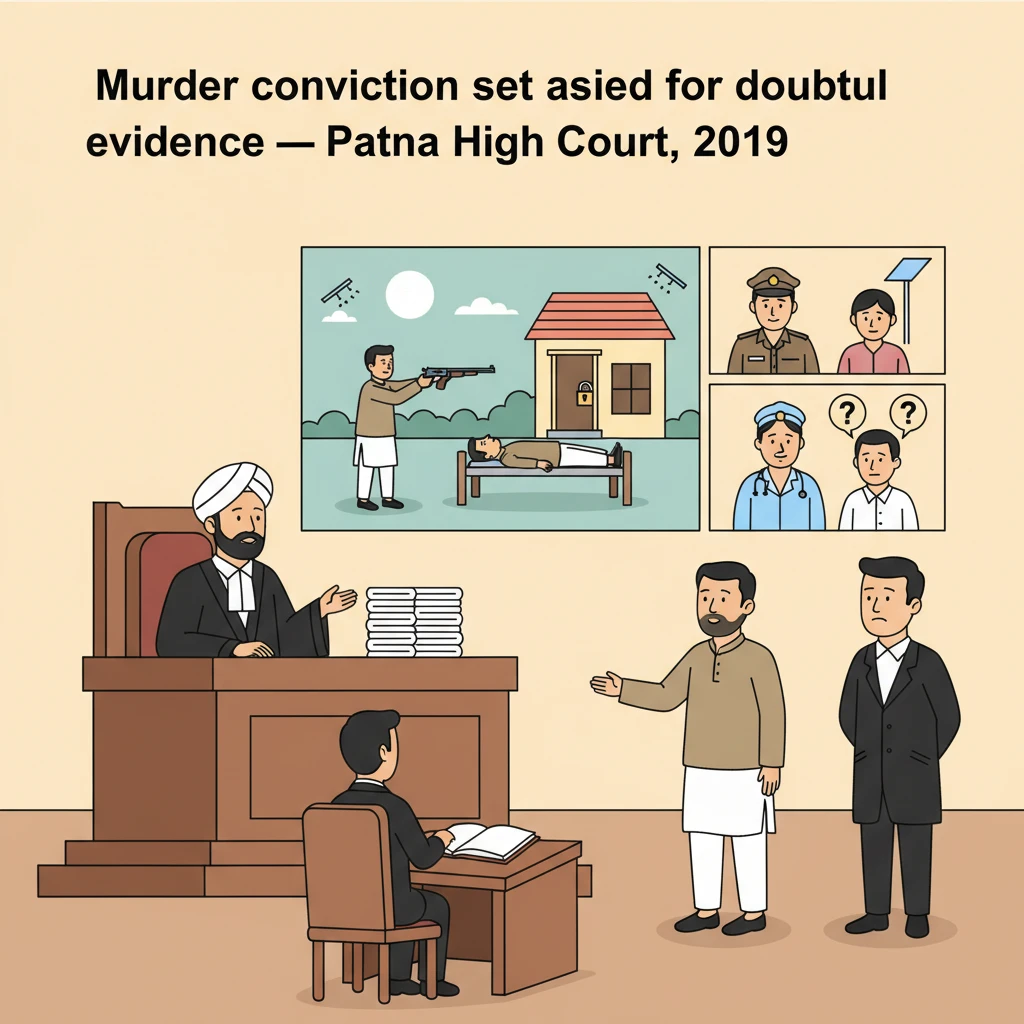
The Court found major contradictions in their statements and no supporting physical evidence.
It held that the prosecution failed to prove the case beyond reasonable doubt.
The conviction was cancelled and the accused was ordered to be released.
Case Background
A criminal case was registered as Medni Chawki P.S. Case No. 51 of 2010 against one accused for serious offences under Sections 384, 302 and 504 of the Indian Penal Code and Section 27 of the Arms Act. The allegation was that on 23.11.2010 at about 8:30 p.m., the accused came to the house of the informant armed with a pistol and rifle, demanded extortion money of Rs. 50,000/-, fired many rounds, and shot dead the informant’s father.
The written report was given by the informant, son of the deceased. On that basis, the police started investigation. After investigation, the Investigating Officer (I.O.) submitted charge-sheet against the accused.
The Magistrate took cognizance and committed the case to the Court of Sessions. On transfer, the matter came before the Adhoc Additional Sessions Judge-V, Lakhisarai, and was registered as Sessions Trial No. 300 of 2011.
The trial court framed charges under Sections 387, 504 and 302 of the Indian Penal Code and Section 27 of the Arms Act. The accused pleaded not guilty and claimed trial.
After trial, by judgment dated 22.03.2013 and order of sentence dated 23.03.2013, the Sessions Court convicted the accused under Sections 302, 387, 504 IPC and Section 27 of the Arms Act. He was sentenced to life imprisonment with fine of Rs. 10,000/- for Section 302 IPC, five years’ rigorous imprisonment with fine of Rs. 5,000/- under Section 387 IPC, one year simple imprisonment under Section 504 IPC, and three years’ rigorous imprisonment with fine of Rs. 3,000/- under Section 27 Arms Act. All sentences were to run concurrently.
Feeling aggrieved, the convicted person filed Criminal Appeal (DB) No. 648 of 2013 before the Patna High Court. The Division Bench, comprising Hon’ble Mr. Justice Rakesh Kumar and Hon’ble Mr. Justice Prakash Chandra Jaiswal, heard the appeal and delivered the oral judgment on 22.01.2019.
What the Court Examined and Decided
The central question before the Patna High Court was whether the prosecution had proved, beyond all reasonable doubt, that the accused had committed the murder and other offences.
During trial, the prosecution examined seven witnesses. Out of them, five were material witnesses about the incident, including the informant and his relatives. Two of these material witnesses (PW-2 and PW-5), who were said to be independent co-villagers, turned hostile and did not support the prosecution case. The other two important witnesses were PW-1 and PW-4, brothers of the informant, and PW-3, the informant himself.
The defence of the accused was a complete denial of the occurrence. He did not produce any evidence, but relied on cross-examination of prosecution witnesses to show contradictions and gaps.
Contradictions about who saw the firing
The High Court first compared the written report with the later oral evidence. In the written report, the informant stated that when the accused started indiscriminate firing, he (the informant) bolted the door from inside, climbed on the roof alone, and from there saw the accused firing and finally shooting his father, who was sitting on a cot in the verandah (dalan).
However, in his examination-in-chief during trial, the informant (PW-3) stated that after the firing started, all three brothers, including PW-1 and PW-4, climbed to the roof and saw the incident from there. This was a clear change from the initial written report, where only he was said to be on the roof.
When the Court examined the statements of PW-1 and PW-4, it found further inconsistency. PW-1 said in his examination-in-chief that when the accused came and opened fire, he bolted the door from inside out of fear. He did not say that he went to the roof and watched the incident from there, contrary to what PW-3 had said.
PW-4, in his examination-in-chief, only said that on hearing the firing they rushed onto the roof, but he did not clearly say who else went with him, nor did he clearly say that he saw the actual shooting from the roof. Thus, the three key family witnesses gave different versions about where they were and whether they actually saw the fatal shot.
The Court noted these differences as “vital and material contradictions”. Because the only eye-witnesses were close relatives of the deceased and informant, the Court said their evidence must be examined very cautiously. On such careful scrutiny, their accounts did not match on important points.
Doubt about how and when the police were informed
The High Court then looked at the evidence about the first information given to the police.
In cross-examination, the informant (PW-3) stated that he called the Sub-Inspector between 8:00 and 8:30 p.m., but the officer came only half an hour after the death. He further said the public did not allow the officer near the dead body for one and a half to two hours. According to him, the Deputy Superintendent of Police (DSP) arrived at 11:00 p.m., and it was to the DSP that he handed over his written report, which was then given to the Station House Officer, Suryagadha, for investigation.
This suggested that the written report given to the DSP was the first formal information.
In contrast, PW-4, the informant’s brother, stated in cross-examination that his statement was recorded by police at about 8:30 p.m. on the very date and time of occurrence. He added that the police arrived 10–15 minutes after the incident, on their own, and recorded both his and the informant’s statements at the spot immediately after the occurrence.
If this version were correct, there should have been an earlier statement to police, amounting to a First Information Report. However, no such earlier statement was produced or proved. This unexplained discrepancy about when and how the first information was recorded created another serious doubt in the mind of the Court about the reliability of the prosecution narrative.
Missing physical evidence: bullet marks and blood
The Court also focused on physical evidence at the scene.
The informant (PW-3) said in cross-examination that there were 8–10 firing marks on the walls of his house and that he had shown these marks to the I.O. He also claimed that two bullet projectiles were found on another part of the roof and that he had shown these to the I.O. on the third day.
But PW-1 contradicted this by saying that no bullet hit either the cattle or the wall of the house. The I.O. (PW-7), in his own cross-examination, clearly stated that he did not find any firing mark in the house and had not mentioned finding anything in the house in the case diary. He said that had he recovered any important article like empty cartridges or the dead body etc., he would have recorded it.
Regarding blood, PW-1 said the bed and cover on which the deceased was sitting were drenched in blood. PW-4 said blood had fallen on the ground within a distance of “one bitta”. But the I.O. did not find or record any bloodstains on the ground, bed, or bedding, nor was any such blood-stained material seized.
The Court held that these contradictions between witnesses and the absence of any seized physical evidence like bullets, cartridges, blood-stained articles or recorded bullet marks created a serious doubt about the exact place and manner of occurrence as projected by the prosecution.
Non-examination of independent witnesses
The informant stated that the houses of three neighbours lay between his house and that of another co-villager. He also admitted that during the firing about 100 people from the village gathered at the place of occurrence, though no one dared to catch the accused as he had a firearm.
However, none of these independent persons were examined as witnesses, except PW-2 and PW-5, who turned hostile. The prosecution did not give any convincing reason for not examining other independent witnesses, despite their availability.
The High Court noted that the remaining supporting witnesses were all close relatives of the deceased and therefore “interested witnesses”. In such a situation, when their evidence was inconsistent and not backed by independent or scientific evidence, it was unsafe to maintain a conviction for murder.
Legal principle applied and final outcome
The Court reiterated the settled principle that evidence of interested witnesses, such as close family members, cannot be rejected only because of their relationship. But their statements must be tested very carefully. If on such scrutiny their testimony is found to be full of material contradictions on important aspects like who saw the incident, what happened at the scene, and how the case started, then it cannot be the sole basis for conviction in a criminal case where proof beyond reasonable doubt is required.
After going through the whole evidence, the Patna High Court concluded that the prosecution had “utterly and miserably failed” to prove the charges against the appellant beyond reasonable doubt. Because of serious doubts about the occurrence, place of occurrence, the presence of physical evidence and the first information, the accused was entitled to benefit of doubt.
Accordingly, the Court set aside the judgment of conviction and sentence passed by the trial court. It acquitted the appellant of all charges, giving him the benefit of doubt, and directed that he be released forthwith if not wanted in any other case. The criminal appeal was allowed.
Why This Judgment Matters
This judgment is important for criminal cases, especially those involving serious offences like murder, where conviction is based largely on family witnesses.
The Patna High Court made it clear that even where a heinous crime is alleged, courts cannot rely on doubtful and contradictory evidence. The prosecution must give a clear and consistent story, supported by physical evidence where available, and by independent witnesses if they exist.
For victims and their families, this decision shows that early, accurate reporting of the incident and preservation of physical evidence are very important. For accused persons, it underlines that if the prosecution’s case is weak, inconsistent, or not backed by objective evidence, the benefit of doubt will go to the accused.
The ruling also sends a message to investigating agencies. Failure to properly record the first information, seize blood-stained materials, record bullet marks, or examine available independent witnesses can seriously weaken the case and may result in acquittal.
Legal Issues and Answers
Issue: Did the prosecution prove beyond reasonable doubt that the appellant committed murder and related offences under the IPC and Arms Act?
Answer: No. The Patna High Court found major contradictions in the testimonies of key witnesses, absence of supporting physical evidence, unexplained gaps in investigation and non-examination of independent witnesses. It held that the prosecution failed to establish the charges and acquitted the appellant by giving benefit of doubt.
Cases Cited by the Court
- The judgment only refers to the “settled principle of law” on the appreciation of evidence of interested witnesses and does not name or rely on any specific earlier case. No individual precedent is cited.
Case Details
Case Number: Criminal Appeal (DB) No. 648 of 2013; arising out of Medni Chawki P.S. Case No. 51 of 2010; Sessions Trial No. 300 of 2011
Case Title: Babloo Yadav v. The State of Bihar
Coram: Hon’ble Mr. Justice Rakesh Kumar and Hon’ble Mr. Justice Prakash Chandra Jaiswal
Citation: 2019 (3) PLJR 186
Advocates: Mr. Uma Shankar, Advocate for the appellant; Mr. Ajay Mishra, APP for the State
Nature of the Case: Criminal appeal (Division Bench) against conviction and sentence passed by the Sessions Court in a murder and extortion case under the Indian Penal Code and Section 27 of the Arms Act
Date of Patna High Court Judgment: 22.01.2019
Outcome: Conviction and sentence set aside; appellant acquitted by giving benefit of doubt; appeal allowed; release directed if not wanted in any other case.
Link to Judgment: Click here to read the full Patna High Court judgment
If you found this explanation helpful and wish to stay informed about
how legal developments may affect your rights in Bihar,
you may consider following Samvida Law Associates for more updates.







