
Case Background
This criminal appeal (DB) No. 199 of 1996 arose from Sessions Trial No. 365/94, 38/94 decided by the 1st Additional Sessions Judge, Nawada. By judgment dated 25.04.1996 and order dated 26.04.1996, both accused had been convicted under Sections 302/34 of the Indian Penal Code and sentenced to rigorous imprisonment for life.
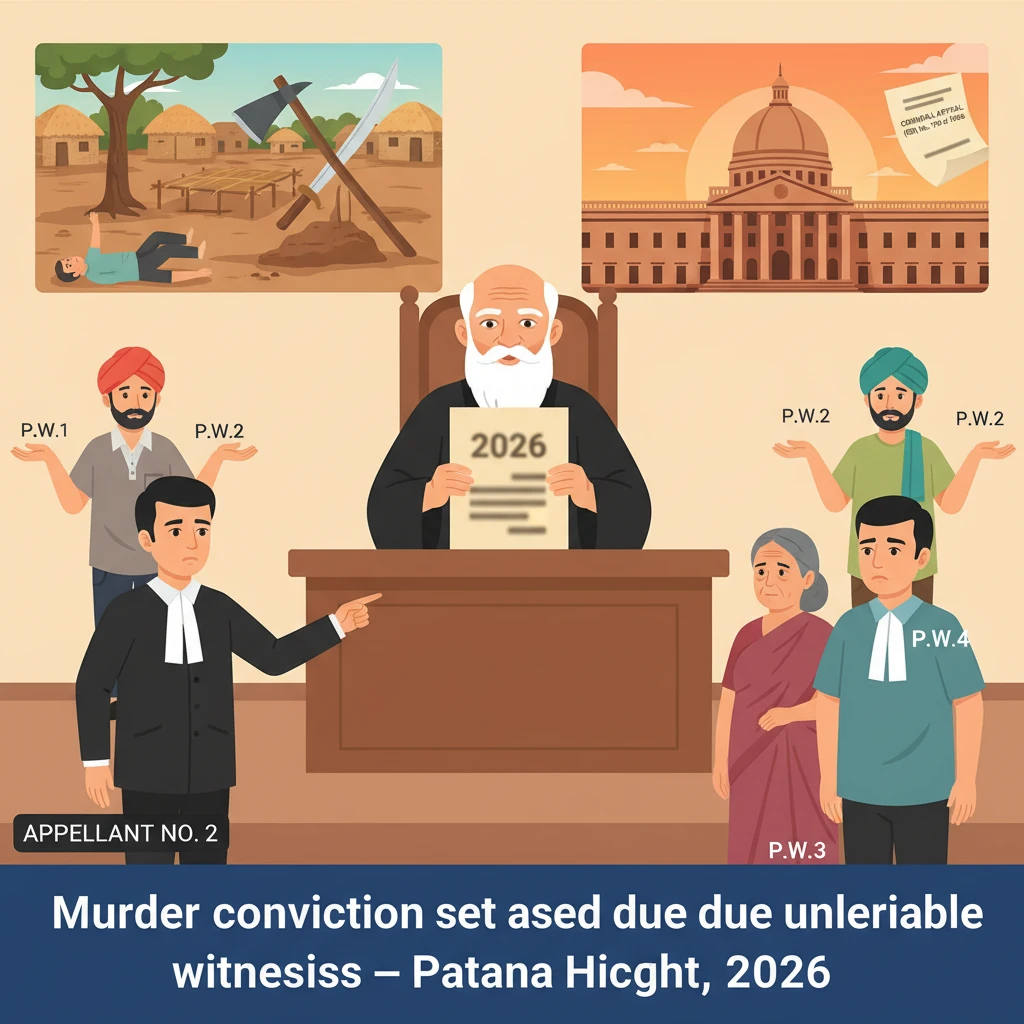
The allegation was that on 15.07.1994 at about 6:00 P.M., a quarrel broke out in village Derma, P.S. Akbarpur, District Nawada, over construction of an “olti” (a mud platform/structure) adjacent to the “olti” of the deceased, Kameshwar Manjhi. According to the written report given by his son (P.W.4), Kameshwar objected to the accused raising the new structure, leading to an altercation.
The informant claimed that the accused went back to their house and soon returned armed, one with a sword and the other with a garansa (sharp cutting implement). It was alleged that one accused struck the deceased on the head with a sword, causing him to fall, and the other accused assaulted him on the eyebrow with a garansa and then gave two sword blows on his face and neck. On alarm, the informant’s brother and mother (P.W.3) allegedly came out, by which time the accused fled.
On the basis of the written application, Akbarpur P.S. Case No. 96 of 1994 dated 16.07.1994 was registered under Sections 302/34 IPC. The police investigated, submitted charge-sheet, and the case was committed to the Court of Session on 03.10.1994 in G.R. Case No. 906 of 1994. Cognizance was taken on 21.09.1994. Charges were framed under Sections 302/34 IPC; both accused pleaded not guilty and faced trial.
During appeal, both original accused were appellants. However, appellant no. 1 died in Central Jail, Gaya on 07.01.2001. By order dated 01.03.2002, the Patna High Court abated the appeal as to him. The appeal thus continued only in respect of appellant no. 2.
What the Court Examined and Decided
The trial court had relied mainly on the evidence of P.W.3, the wife of the deceased, treating her as an eyewitness whose presence was “natural” as the incident occurred near her house. It also found support in the medical evidence of the post-mortem doctor (P.W.5) and in parts of the testimony of the informant son (P.W.4), despite his partial hostility in cross-examination. The trial court treated lapses in investigation, such as not sending blood-stained earth for forensic examination and not producing it in court, as minor irregularities. On that basis, it convicted both accused under Sections 302/34 IPC.
Before the Patna High Court, senior counsel for appellant no. 2 attacked the conviction on several grounds. He argued that the appellant was falsely implicated due to local differences over the “olti” construction, and referred to a separate earlier murder case involving the deceased to suggest possible enmity from others. More centrally, he highlighted:
- Serious contradictions between P.W.3 (wife) and P.W.4 (son and informant) on whether they actually saw the incident.
- Alleged overwriting and interpolation in the date on the fardbeyan and doubts about the timing of the FIR, suggesting ante-dating.
- Delay in sending the FIR (Akbarpur P.S. Case No. 96 of 1994) to the Court of the Chief Judicial Magistrate.
Counsel relied on Supreme Court and Patna High Court decisions, including Suraj Mal v. The State (Delhi Administration), AIR 1979 SC 1408 and Abdul Rahman v. State of Bihar, (1992) 1 PLJR 161, to argue that when witnesses are unreliable and FIR handling is doubtful, conviction cannot stand.
The State, through the learned APP, strongly opposed the appeal. It maintained that the appellant had committed a gruesome act clearly proved by the prosecution evidence, especially the naming of the accused at the earliest stage. On the alleged ante-dating, the State pointed out that the FIR was dated 16.07.1994 and was received by the learned Chief Judicial Magistrate, Nawada on 19.07.1994. Any confusing notings on the FIR, according to the State, were only clerical mistakes.
Regarding the fardbeyan, the State submitted that it was recorded in the night of 16.07.1994. Even if the date near the heading appears overwritten, the body of the fardbeyan clearly mentions the date 16.07.1994 in the fourth line, the scribe also wrote 16.07.1994 while signing at the end, and the forwarding note of the Sub-Inspector also bears that date. The APP therefore argued that the defence plea of interpolation did not pass muster.
On the contradictions in evidence, the State took the stand that minor discrepancies cannot demolish an otherwise reliable prosecution case, especially in a village murder. It argued that P.W.4 had clearly supported the prosecution in examination-in-chief and only resiled in cross-examination after admitting a compromise with the accused, which should not be allowed to benefit the appellant.
The High Court, after carefully examining the entire record, first noted what was not in dispute: that the informant’s father died due to injuries caused by a sharp cutting weapon, as confirmed by the post-mortem evidence of P.W.5. The main question was whether the prosecution had proved beyond reasonable doubt that it was the appellant who caused those injuries with the requisite intention, acting with common intention as alleged.
The Court scrutinised each key witness:
P.W.1 and P.W.2 were categorised as hearsay witnesses. P.W.1 only stated that he had heard of a fight between the deceased and the now-dead co-accused and was declared hostile. P.W.2 also admitted that he had not seen the occurrence and only came to know of it two to three hours later.
P.W.3, the widow, deposed that one accused assaulted the deceased by “saif” and the appellant assaulted him with garasa, causing bleeding injuries. Crucially, in cross-examination she stated that except for the accused, she alone was present at the time of occurrence. She specifically denied being informed of the incident by P.W.2 and asserted that she herself had seen the entire occurrence. She further said that after the occurrence nobody came there.
P.W.4, the son and informant, in his examination-in-chief stated that he saw both accused armed with sword and garasa respectively and that they assaulted his father on head, neck and nose, following which his father fell and died while being taken for treatment. He identified his thumb impressions on the fardbeyan, seizure list and inquest report and confirmed that the I.O. collected blood-stained soil.
However, in cross-examination P.W.4 stated that he had not seen the person who assaulted his father and did not know how and with what weapon the assault took place. He added that the Sub-Inspector took his thumb impression on plain paper. In the next paragraph he admitted that he had compromised with the accused and did not wish to depose further.
The Investigating Officer, P.W.6, supported the formal steps: recording the fardbeyan, preparing the inquest report, seizing blood-stained soil, describing the place of occurrence with boundaries, and registering the FIR. He admitted that the sealed blood-stained soil remained at Akbarpur police station, was not sent for forensic laboratory examination and was not produced in court.
On this material, the High Court focused on the core inconsistency between P.W.3 and P.W.4. Both claimed at different stages to be eyewitnesses. P.W.4’s fardbeyan and examination-in-chief described him as present, raising alarm that drew his mother and others to the spot. Yet P.W.3 in the witness box insisted that only she, apart from the accused, was present at the time and that nobody else came after the incident. Thus, each effectively denied the other’s presence as an eyewitness.
The Court compared this situation with the Supreme Court’s decision in Kannaiya v. State of Madhya Pradesh, 2025 SCC OnLine SC 2270. In that case, the Supreme Court treated a supposed eyewitness whose name did not appear in the FIR and whose presence was doubtful as a “wholly unreliable witness.” The Patna High Court particularly relied on paragraphs 38–40 and 58 of Kannaiya, including a quotation from Pankaj v. State of Rajasthan, which stresses that when the very genesis and manner of the incident become doubtful, and when evidence lacks quality and credibility, it is unsafe to convict and the accused must get benefit of doubt.
Applying these principles, the Bench held that the prosecution case here rested substantially on P.W.3 and P.W.4. Their starkly contradictory versions about who witnessed the occurrence, coupled with P.W.4’s later denial of having seen the assault and his admitted compromise, created serious doubt. In such a situation, the Court held, it would not be safe to uphold the conviction of appellant no. 2 on their testimonies.
The Court did not find it necessary to rest its decision solely on the alleged interpolation or delay in FIR transmission. Instead, it concluded that, on the core question of who committed the crime, the evidence lacked the reliability required for sustaining a conviction for murder. Following the settled law that when doubt exists about the genesis and manner of occurrence, the accused is entitled to benefit of doubt, the Court set aside the conviction and sentence.
Consequently, the Patna High Court allowed the appeal. The judgment of conviction dated 25.04.1996 and order of sentence dated 26.04.1996 passed by the 1st Additional Sessions Judge, Nawada in Sessions Trial No. 365/94, 38/94 were quashed insofar as they related to appellant no. 2. He was acquitted of all charges.
Since appellant no. 2 was already on bail, he was discharged from his existing bail bonds. However, in terms of Section 437A of the Code of Criminal Procedure, he was directed to execute fresh bail bonds with sureties within three weeks to the satisfaction of the trial court, to ensure his appearance before the Supreme Court if any appeal or petition is filed against this judgment. These bonds will remain in force for six months. The lower court records were ordered to be sent back along with a copy of the High Court judgment.
Why This Judgment Matters
This decision of the Patna High Court is significant for criminal trials that depend mainly on family eyewitnesses. Rural murder cases often turn on such evidence. Here, the Court shows that even close relatives of the victim are not automatically believed if their statements clash on crucial points.
For accused persons, the judgment underlines that clear and material contradictions in eyewitness accounts can support an acquittal, even where death by violence is undisputed. For victims’ families and informants, it highlights the importance of giving consistent statements from the start and not changing versions later, especially after any compromise.
The ruling also sends a message to investigating agencies. While minor lapses like non-production of seized material may sometimes be ignored, failure to support the prosecution with solid, coherent eyewitness evidence can make a case collapse on appeal.
Finally, by relying on Supreme Court precedents about unreliable witnesses and doubtful genesis of incidents, the Patna High Court reinforces the principle that no one should remain convicted for murder unless the evidence is of sufficient quality and leaves no reasonable doubt.
Legal Issues and Answers
- Issue: Whether the conviction of appellant no. 2 for murder under Sections 302/34 IPC could stand when the main eyewitnesses gave contradictory and unreliable versions about the incident and their own presence at the scene.
Answer: No. The Patna High Court held that due to serious contradictions between the testimonies of P.W.3 and P.W.4, and the resulting doubt about the genesis and manner of the incident, it was unsafe to rely on their evidence. The appellant was given the benefit of doubt and acquitted. - Issue: Whether alleged defects in handling the FIR and investigation (interpolation in dates, delay in forwarding FIR, non-sending of blood-stained soil to FSL) justified setting aside the conviction.
Answer: The Court noted these aspects but did not base its decision solely on them. It treated investigation lapses as secondary and focused on the unreliability of the eyewitness testimonies as the main ground for overturning the conviction. - Issue: What procedural direction should follow an acquittal by the High Court in a serious offence case regarding future appearance before the Supreme Court.
Answer: The Court directed the acquitted appellant, who was already on bail, to execute fresh bail bonds with sureties under Section 437A CrPC, valid for six months, to secure his presence if the Supreme Court issues notice in any further proceeding.
Cases Cited by the Court
- Suraj Mal v. The State (Delhi Administration), AIR 1979 SC 1408 (relied upon by defence counsel in argument).
- Abdul Rahman v. State of Bihar, (1992) 1 PLJR 161 (relied upon by defence counsel).
- Kannaiya v. State of Madhya Pradesh, 2025 SCC OnLine SC 2270 (expressly relied upon by the Patna High Court).
- Pankaj v. State of Rajasthan (referred to and quoted in Kannaiya, emphasising that when the genesis and manner of the incident are doubtful, conviction cannot be sustained).
Case Details
Case Number: Criminal Appeal (DB) No. 199 of 1996
Case Title: Mahabir Manjhi & Anr v. State of Bihar
Citation: 2026 (3) PLJR 250
Court: High Court of Judicature at Patna
Bench (Coram): Hon’ble Mr. Justice Sanjay Kumar Singh; Hon’ble Mr. Justice Sourendra Pandey
Date of High Court Judgment: 09.04.2026
Trial Court Details: Judgment of conviction dated 25.04.1996 and order of sentence dated 26.04.1996 by 1st Additional Sessions Judge, Nawada in Sessions Trial No. 365/94, 38/94
Trial Court Offences and Sentence: Conviction under Sections 302/34 IPC; sentence of rigorous imprisonment for life
High Court Result: Appeal allowed; conviction and sentence set aside; appellant no. 2 acquitted; direction to execute bail bonds under Section 437A CrPC
Advocates:
- For the Appellants: Mr. S.K. Lal, Senior Advocate; Mr. Bharat Lal, Advocate
- For the State (Respondent): Ms. Shashi Bala Verma, APP
Nature of the Case: Criminal appeal (Division Bench) against conviction and sentence for murder under Sections 302/34 IPC
Link to Full Judgment: Click here to access the Patna High Court judgment
If you found this explanation helpful and wish to stay informed about
how legal developments may affect your rights in Bihar,
you may consider following Samvida Law Associates for more updates.







