

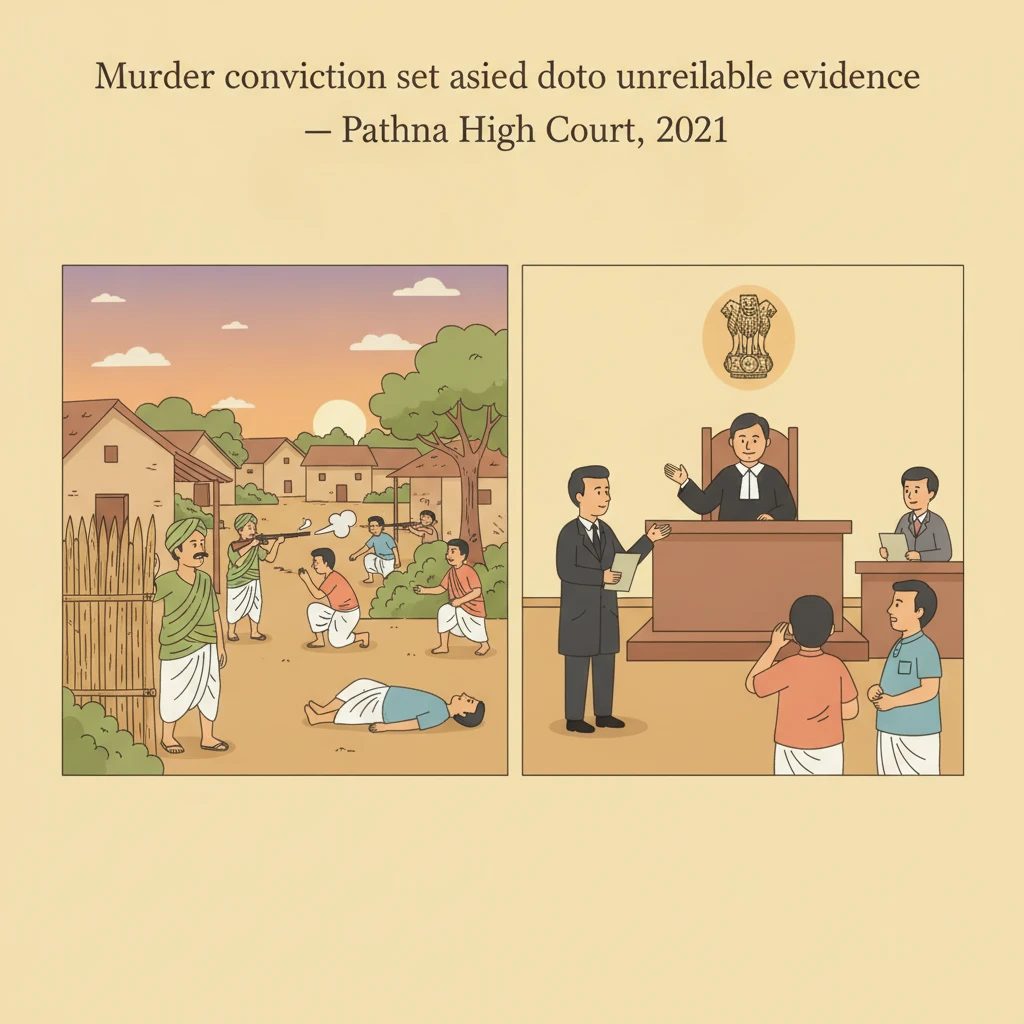
Case Background
The case started with Bairiya P.S. Case No. 62 of 2006, West Champaran. The allegation was that during the evening of 30.05.2006, the informant’s father, a candidate for Mukhiya, was killed by gunfire while canvassing for votes in village Fattu Chhapar, Purwari Tola.
According to the fardbeyan recorded that night, the informant claimed that the appellant and two others, all armed with rifles, were lying in wait with some unknown persons. They allegedly opened indiscriminate fire, killing the informant’s father due to old enmity and political conspiracy.
The Investigating Officer, Suman Mahto, conducted inquest, collected empty cartridges from near the alleged place of occurrence, obtained post-mortem report and submitted charge-sheet No. 125/2007 dated 30.09.2007 against the appellant and two others under Sections 302/34 IPC and 27 Arms Act.
The Chief Judicial Magistrate, Bettiah, took cognizance on 30.06.2010 and committed the case to the Court of Sessions, where it was registered as Sessions Trial No. 296 of 2010. Initially, charges were framed only against the present appellant because the two co-accused did not appear. Later, after one co-accused appeared, his trial was amalgamated back with Sessions Trial No. 296 of 2010.
In 2013, the Additional District and Sessions Judge–1st, Bettiah, convicted the appellant under Sections 302/34 IPC and 27 Arms Act and sentenced him to life imprisonment with fine, plus further imprisonment under the Arms Act, both sentences to run concurrently.
The appellant then filed Criminal Appeal (DB) No. 77 of 2014 before the Patna High Court challenging his conviction and sentence.
What the Court Examined and Decided
The Division Bench, speaking through Hon’ble Mr. Justice Madhuresh Prasad, closely re-examined the entire evidence, including the depositions of prosecution witnesses, the investigation steps, and the defence witnesses.
The Court first noted that the conviction rested mainly on alleged eye-witnesses from the deceased’s family, along with the medical evidence and the Investigating Officer’s testimony. However, on careful reading, the Court found deep inconsistencies at almost every crucial stage: first information, place of occurrence, manner of assault, number of assailants, and participation of named accused.
Problems with first information to police
The Investigating Officer (P.W.7) admitted that on 30.05.2006 he first recorded Station Diary Entry No. 563 at about 7:30 p.m. on receiving information about the occurrence, and then proceeded to village Fattu Chhapar. However, this station diary entry was never produced in court.
The High Court observed that this entry would have contained the earliest version of the incident: who gave the information and what was reported. Withholding this primary record meant the court could not verify the very first account, leaving “a large scope for embellishment.”
At the same time, there was confusion about where and when the fardbeyan itself was recorded. The fardbeyan shows it was recorded at 8:45 p.m. at the informant’s “darwaja.” But the informant (P.W.5), another relative (P.W.4) and the I.O. (P.W.7) gave differing versions:
- Some said the police came to the place of occurrence two to two-and-a-half hours after the incident and recorded the statement there itself.
- Others spoke of the inquest report being prepared at 7:30 p.m., that is, before the time mentioned on the fardbeyan.
- The I.O. said he recorded the fardbeyan at the informant’s house, yet witnesses suggested both the inquest and statement were done at the place of occurrence.
The Court highlighted that, according to prosecution witnesses, the inquest report was prepared after recording the fardbeyan. But the inquest report itself is timed 7:30 p.m., while the fardbeyan shows 8:45 p.m. This mismatch made the official sequence put forward by the prosecution plainly “unsustainable.”
Because the first recorded information (Sanha No. 563) was suppressed, and the timing and place of the fardbeyan were doubtful, the Court held that serious prejudice was caused to the accused and a “big shadow of doubt” fell over the prosecution story.
Contradictions about the role of co-accused
In the fardbeyan, the informant had clearly named three persons: the appellant, Nagendra Yadav and Mukesh Yadav, and alleged that all three had fired at his father. Yet, when the same informant and his close relatives came to testify in court, they unanimously stated that co-accused Mukesh Yadav was not involved in the incident.
This total change of stand regarding a specifically named alleged shooter, who had been charge-sheeted, was seen by the High Court as a major blow to the credibility of the prosecution witnesses, especially when the record itself showed long-standing enmity between the families.
Failure to establish the exact place of occurrence
Another important weakness was the shifting description of where exactly the victim was shot and where his body fell.
In the fardbeyan, the informant said his father fell near the ‘dalan’ of one Ramdeo Mukhiya. At the trial, the informant (P.W.5), his brother (P.W.1), their uncle (P.W.3) and other witnesses gave different versions:
- P.W.5 moved the place to near the house or ‘dalan’ of different mikhiyas as he described the chase and the shooting.
- P.W.1 placed the injuries near the houses of Daulat Mukhiya, Bhikhari Mukhiya and Kamu Mukhiya.
- P.W.3 said the incident took place two houses after the house of one Mukhlal in Purwari Tola, and that there were ten to twelve houses between Mukhlal’s house and that of Daulat Mukhiya.
- The I.O. (P.W.7), arriving after the occurrence, said he found the dead body in front of the ‘dalan’ of Daulat Mukhiya, describing surrounding huts and houses. This did not match the fardbeyan’s mention of Ramdeo Mukhiya’s ‘dalan’.
The Court found that instead of forming a clear, consistent picture, the location kept shifting from one mikhiyas’ house or ‘dalan’ to another. Given the importance of precisely proving where the incident took place, this inconsistency was not treated as a minor lapse but as another major doubt.
Three different stories about how the victim was shot
The heart of the case was the shooting itself. Here too, the Court found at least three different versions from the supposed eye-witnesses.
As per the fardbeyan:
- The appellant first fired but the deceased tried to save himself.
- Then Nagendra Yadav fired, causing the deceased to fall.
- When the deceased was writhing in pain, Mukesh Yadav fired at him.
In court, the informant (P.W.5) changed this sequence completely. He now said:
- The appellant first shot his father in the stomach, making him fall.
- The appellant again fired at him below the chest.
- Then Nagendra Yadav fired at his father’s face.
P.W.1 gave yet another order. According to him:
- The first bullet, fired by the appellant, hit the deceased on the face.
- The second bullet, fired by Nagendra Yadav, hit the deceased on the stomach.
P.W.3 largely followed P.W.1’s pattern, attributing a face injury to the appellant and stomach injury to Nagendra Yadav, though he added further details such as beating with the butt of the rifle.
P.W.4 frankly admitted he did not actually see the firing, only hearing shots and later seeing the dead body. P.W.2 turned hostile and denied the occurrence itself.
The Court compared these depositions and concluded that these were not minor discrepancies expected in any human recollection but “stark inconsistencies” on core facts from witnesses who all claimed to be eye-witnesses. The informant’s own complete change from his written fardbeyan particularly weakened the prosecution.
Number of assailants and defence witnesses
The Court also noticed inconsistency in the number of attackers: from three named men with “two-three unknown persons” in the fardbeyan, to five or six persons, to eight to ten or even ten to twelve miscreants in different versions, including those of defence witnesses.
Four defence witnesses, who said they were canvassing with the deceased, stated that five to twelve unknown miscreants opened fire suddenly and that none of them were from Fattu Chhapar, and that the appellant was not among the shooters. Some of them admitted they had been called by people from the appellant’s side to depose, which the Court noted but did not treat as conclusive either way.
Use of Supreme Court precedent
The State relied on the principle that minor inconsistencies do not demolish a prosecution case and cited general legal positions. The High Court, however, referred specifically to the Supreme Court judgment in Achhar Singh v. State of Himachal Pradesh, (2021) 5 SCC 543.
In that case, the Supreme Court had approved the High Court’s approach of separating exaggerations from a clear, consistent core of truth in eye-witness testimony and upholding conviction where the fatal blow could still be traced to a particular accused.
The Patna High Court contrasted that situation with the present case. Here, after going through all the evidence, the Bench said it could not find any “strain of consistent evidence” against the appellant. Unlike Achhar Singh, where the core story remained stable, in this appeal every crucial aspect – earliest report, place of occurrence, sequence of firing, specific roles of accused – was shifting.
Final finding and order
Taking the contradictions together with the suppression of Station Diary Entry No. 563 and the admitted long-standing enmity between the families, the Court held that the prosecution had failed to prove the charges beyond reasonable doubt.
The trial court, in the High Court’s view, had fallen into error by ignoring these serious weaknesses and still convicting the appellant for murder and Arms Act offences.
Accordingly, the Patna High Court allowed the appeal, set aside the judgment of conviction dated 27.11.2013 and the sentence dated 29.11.2013 passed in Sessions Trial No. 296 of 2010, and directed that the appellant be released forthwith, if not required in any other case.
Why This Judgment Matters
This judgment is important for anyone facing serious criminal charges, especially where the case rests mainly on family members’ testimony in a background of old enmity.
The Patna High Court sends a clear message: in a murder trial, the prosecution must present a clear and consistent story. If key records like the first station diary entry are hidden, if witnesses keep changing the place of occurrence and who fired which shot, and if even named accused are later disowned, the court will not uphold a conviction.
For villagers and ordinary people, it shows that courts carefully check whether the police and witnesses are telling a stable, reliable story. Life imprisonment cannot rest on guesswork or on evidence that shifts with each witness.
Legal Issues and Answers
-
Issue: Whether the prosecution proved beyond reasonable doubt that the appellant committed murder under Sections 302/34 IPC and an offence under Section 27 of the Arms Act.
Answer: No. The Court held that due to suppression of the earliest information, contradictions about the fardbeyan, place of occurrence, manner of assault, and role of the co-accused, there was no consistent, credible evidence against the appellant. The conviction was set aside. -
Issue: Whether inconsistencies in eye-witness accounts in this case could be treated as minor discrepancies not affecting the core prosecution story.
Answer: No. Given the multiple conflicting versions about who fired, from where, and at which part of the body, the Court held these were major contradictions that went to the root of the case and made the entire prosecution version doubtful. -
Issue: What is the effect of non-production of the initial Station Diary Entry containing the first information about the crime.
Answer: The Court held that withholding Station Diary Entry No. 563, when the prosecution relied on a later fardbeyan, created scope for embellishment, caused grave prejudice to the accused, and seriously undermined the prosecution case.
Cases Cited by the Court
- Achhar Singh v. State of Himachal Pradesh, (2021) 5 SCC 543 – cited to explain how courts may separate exaggeration from consistent core evidence, and why that principle did not assist the prosecution on the facts of this case.
Case Details
Case Number: Criminal Appeal (DB) No. 77 of 2014; arising out of Bairiya P.S. Case No. 62 of 2006; Sessions Trial No. 296 of 2010
Case Title: Sanjay Yadav v. The State of Bihar
Citation: 2022(1) PLJR 238
Court: High Court of Judicature at Patna
Coram: Hon’ble Mr. Justice Ashwani Kumar Singh and Hon’ble Mr. Justice Madhuresh Prasad
Date of Judgment: 02.12.2021
Advocates:
- For the Appellant: Mr. Ajay Kumar Thakur, Advocate; Md. Imteyaz Ahmad, Advocate; Mr. Amir Alam, Advocate; Mr. Ritwik Thakur, Advocate; Ms. Vaishnavi Singh, Advocate
- For the State (Respondent): Dr. Maya Nanda Jha, A.P.P.
Nature of the Case: Criminal appeal (Division Bench) against judgment of conviction and sentence passed by the Sessions Court in a murder case under Sections 302/34 IPC and Section 27 of the Arms Act.
Result: Appeal allowed; conviction and sentence set aside; appellant to be released if not required in any other case.
Link to Judgment: https://patnahighcourt.gov.in/viewjudgment/NSM3NyMyMDE0IzEjTg==-RsPQXIxvRcE=
If you found this explanation helpful and wish to stay informed about how legal developments may affect your rights in Bihar, you may consider following Samvida Law Associates for more updates.







