
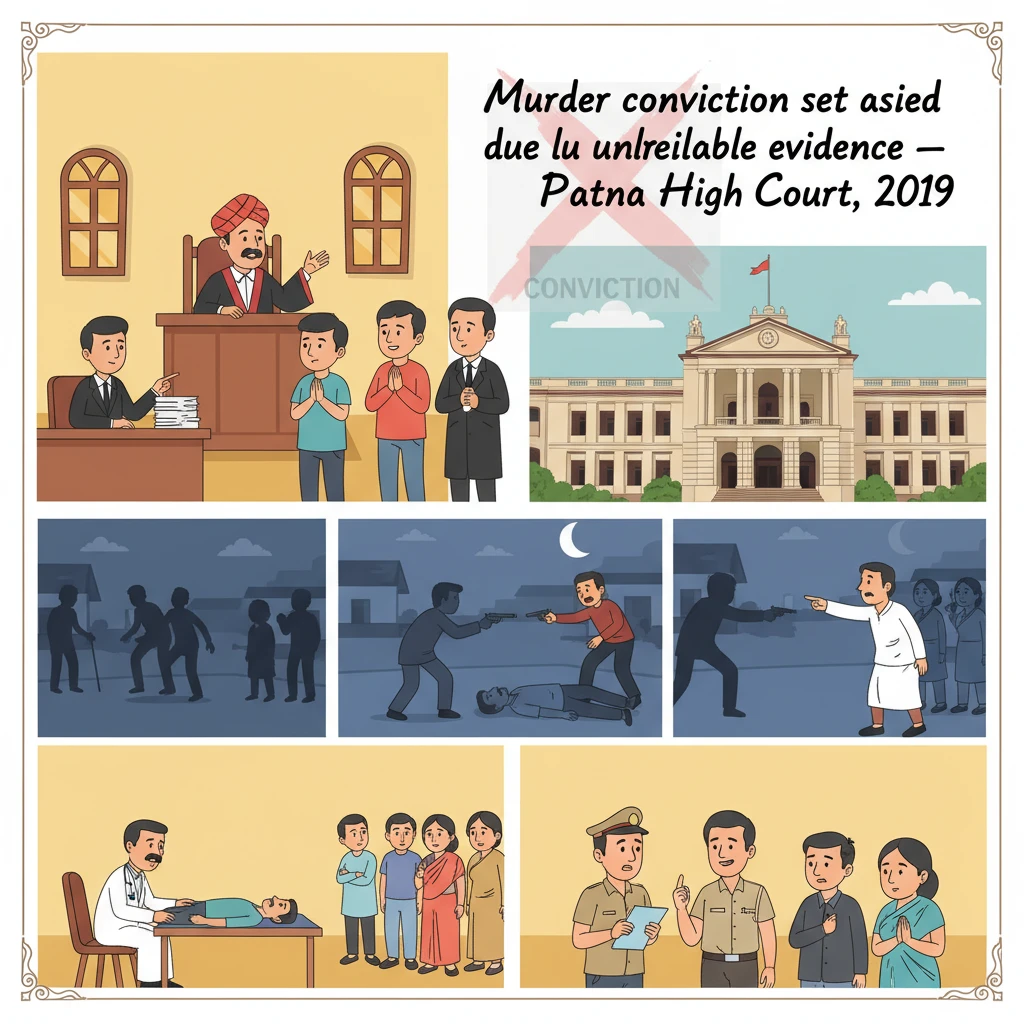
Case Background
The case arose from an incident in village Bali, under Gourichak Police Station, district Patna. According to the prosecution, one Kameshwar Ram was shot dead in the early hours of 07.03.1996. The written report was treated as fardbeyan and Fatuha (Gourichak) P.S. Case No. 44 of 1996 dated 07.03.1996 was registered under Sections 147, 148, 149, 452 and 302 of the Indian Penal Code and Section 27 of the Arms Act.
The prosecution alleged that the killing was linked to a Holi dispute. On 06.03.1996, villagers were singing Holi songs at Gauraiya Asthan. It was said that Ranjit, son of the deceased, poured colour on Kanchan Kumari, daughter of Rajendra Paswan. An altercation followed but was pacified by villagers. The informant later claimed that, because of this incident of colouring Kanchan Kumari, his father was killed.
Police investigated the case and submitted charge sheet on 31.05.1996 against all accused persons. Cognizance was taken on 05.06.1996, and the matter was committed to the Court of Sessions on 30.09.1996. Charges under Sections 302, 149 of the IPC and Section 27 of the Arms Act were framed on 28.07.1998 against all accused, including the present appellants. They pleaded not guilty and faced trial in Sessions Trial No. 1080 of 1996 before the Additional District and Sessions Judge-VI, Patna City.
By judgment dated 17.04.2013 and order of sentence dated 26.04.2013, the trial court convicted Arun Paswan and Diwali Paswan under Section 302 IPC and Section 27 of the Arms Act and sentenced them to life imprisonment with fine, along with three years’ rigorous imprisonment under the Arms Act. Lalkishun Paswan was convicted under Section 302 read with Section 149 IPC and was also sentenced to life imprisonment with fine.
All three filed criminal appeals (DB) before the Patna High Court: Criminal Appeal (DB) No. 539 of 2013, Criminal Appeal (DB) No. 487 of 2013 and Criminal Appeal (DB) No. 488 of 2013. These were heard together and decided by a Division Bench on 01.05.2019.
What the Court Examined and Decided
The Patna High Court, speaking through Hon’ble Mr. Justice Arvind Srivastava, examined the entire evidence. Nine prosecution witnesses had been examined, including claimed eye-witnesses, the widow and son of the deceased, the doctor who conducted the post-mortem, and the investigating officer.
P.W.1 Deo Kumar Ram stated that the incident occurred at 4 a.m. one day after the Holi dispute. He claimed that all accused, including the appellants, came armed with rifles and pistols, dragged the deceased out and, on the order of Lalkishun, Arun fired on the chest and Diwali on the left hand of the deceased, who died on the spot. He admitted that there was “little darkness” at the time. He also confirmed that almost all key witnesses were related to the deceased.
P.W.2 Devashray Ram, another relative, also spoke of the Holi dispute on 06.03.1996 and the killing around 4 a.m. on 07.03.1996. He said that the appellants carried rifles and others carried pistols, dragged the deceased while he was sleeping and shot him in the gali opposite his house. He said that about 10–12 persons were present at the place of occurrence. He further admitted that there was no light in the gali at the time and confirmed that nobody took the deceased to the hospital or informed police immediately.
P.W.3 Kamlesh Ram gave a different time and date. He claimed the incident took place on 06.03.1996 at about 5 p.m. in the evening while he was present at the darwaja of the deceased. According to him, the accused dragged the deceased and, on the order of Lalkishun, Arun fired on the chest and Diwali on the arm. He also spoke about a land dispute involving some of the accused and admitted that all prosecution witnesses were related to him.
P.W.4 Birendra Ram also placed the incident on 06.03.1996 at 5–6 p.m. in the evening. He too described accused dragging the deceased to the darwaja of Devashray and firing on him on the direction of Lalkishun. He confirmed that there were several other criminal cases and proceedings under Section 144 Cr.P.C. between his side and the accused, including one case of murder of a boy in village Sataisa Sangat and another case under Section 307 IPC.
P.W.5 Suranga Ram, again a relative, stated that the incident took place on 07.03.1996 at 4 a.m. He said the accused dragged the deceased and, on the order of Lalkishun, Arun and Diwali fired causing his death on the spot. He too accepted that there were prior criminal cases and a Section 144 Cr.P.C. proceeding between him, the deceased and the accused. He claimed that police recorded the fardbeyan of Dev Kumar and registered the FIR on that basis, which conflicted with the investigating officer’s version.
P.W.6 Urmila Devi, the wife of the deceased, stated that she and her husband were sleeping in the dalan at 4 a.m. on 07.03.1996 when she heard a sound and saw several accused, including the appellants, dragging her husband. She raised alarm; her son and others came. She claimed that on the order of Lalkishun, Arun fired at her husband’s chest and Diwali fired at his “pakhura” (shoulder/arm area), causing his death on the spot. She said she cuddled her husband and blood stained her clothes. She clearly admitted that there was no light at the place of occurrence. She too traced the cause to the Holi colour incident involving Kanchan Kumari.
P.W.7 Arvind Ram, informant and son of the deceased, stated that he was sleeping in his dalan at 4 a.m. on 07.03.1996 when, on hearing the sound of his parents, he woke up and saw his father being dragged towards the door of Devashray. On the order of Lalkishun, Arun shot his father in the chest with a rifle and Diwali shot him in the arm. He asserted that he and his mother hugged the body and their clothes got stained with blood, which they handed to the police along with the deceased’s clothes. He also confirmed there was no light at the place of occurrence.
P.W.8 Dr. N.K. Singh, Assistant Professor, Forensic Medicine, N.M.C.H., Patna, conducted the post-mortem on 07.03.1996 at 2:30 p.m. He found firearm injuries on the chest and right arm, including wounds of entry and exit and fracture of the lower end of the humerus. In his opinion, death was due to shock and haemorrhage caused by the firearm injuries. Importantly, he opined that death had occurred “within 48 hours and more than six hours” prior to the post-mortem. In cross-examination he clarified that if death occurs within 24 hours they write “within 24 hours”; beyond that, they write “within 48 hours”.
P.W.9 Bishwanath Prasad, the Investigating Officer, deposed that he recorded the fardbeyan of the informant Arvind Ram on 07.03.1996, on the basis of which the formal FIR was drawn. He prepared the inquest report and seizure list for blood-stained soil. He also stated that he was investigating Fatuha (Gourichak) P.S. Case No. 263 of 1996 and, during that investigation, he came to know that Kameshwar Ram had been killed. He admitted that no empty cartridges were found at the place of occurrence, no blood was found on the dalan, and there was no note of any light or matchbox in the case diary. Crucially, he stated that though he recorded the statements of the wife and son of the deceased, their clothes were not seized and there was no mention of blood-stained clothes in the diary. He denied having registered the case on Dev Kumar’s fardbeyan.
After examining this evidence, the High Court turned to the arguments of the appellants’ counsel. The defence highlighted several points that, in the Court’s view, had force.
First, the supposed motive was the Holi colour incident concerning Kanchan Kumari, daughter of Rajendra Paswan. Yet no relative of Rajendra Paswan was made an accused, and neither Kanchan nor Ranjit (the boy who allegedly poured colour) was produced as a witness. The accused had “no concern” with Kanchan or her father, making the alleged motive doubtful.
Second, the Court noted that the incident was said to have happened at 4 a.m. in a narrow village lane with no light. Still, witnesses claimed to have clearly identified each accused and specified which weapon each carried and which body part they hit. The Court found this difficult to accept, especially when several witnesses admitted there was darkness and no light source.
Third, the doctor’s post-mortem report conflicted with the prosecution timeline. The doctor said death had occurred within 48 hours of 2:30 p.m. on 07.03.1996. This could place the time of death as early as 06.03.1996 afternoon or evening, which did not fit with the prosecution version of death at 4 a.m. on 07.03.1996 (i.e., about 10–12 hours before post-mortem). This inconsistency was seen as serious.
Fourth, there were contradictions about the date and time of occurrence among witnesses themselves. P.W.3 and P.W.4 fixed the incident on 06.03.1996 in the evening at 5–6 p.m., whereas others maintained it occurred at 4 a.m. on 07.03.1996. There were also discrepancies about the exact place of the shooting: the widow spoke of the outward area of the house, while other witnesses placed it in front of Devashray’s house.
Fifth, the High Court noted the investigating officer’s evidence that no blood-stained clothes were seized from the wife or son, contrary to their claim that they cuddled the bleeding body and then gave those clothes to police. There was also no blood found at the dalan where the deceased was said to have been dragged from.
Sixth, the Court took note of multiple criminal and enmity backgrounds admitted by the witnesses: prior murder cases, a case under Section 307 IPC, and proceedings under Section 144 Cr.P.C. between the sides. All key witnesses were close relatives of the deceased and there was no independent witness, despite the incident allegedly occurring in a village lane where 10–12 people were present. The Court treated this as another factor requiring careful scrutiny of their testimony.
Seventh, the defence also pointed to confusion about how and when the FIR was actually lodged. The informant claimed that he went to the police station with others, whereas the investigating officer said he recorded the fardbeyan at the place of occurrence. One witness said he and five others had gone to the police station and given information to the Sub-Inspector. Another claimed the case was registered on the fardbeyan of Dev Kumar, not Arvind. These contradictions created doubt about the origin of the FIR.
Eighth, the Court viewed as unnatural the conduct of witnesses who, by their own version, saw the deceased being shot but made no effort to take him to hospital or seek immediate help, even though the time and place could have allowed such steps.
Ninth, the Court noted that all prosecution witnesses in their examination-in-chief seemed to give an almost identical story “word by word,” which the defence suggested was indicative of tutoring rather than natural recollection.
Considering these cumulative factors—doubtful motive, absence of relevant accused connected with that motive, contradictions about date, time and place, lack of light, mismatch between medical and oral evidence, non-seizure of supposed blood-stained clothes, absence of independent witnesses, admitted enmity, confusion about the FIR, and unnatural conduct—the High Court concluded that the prosecution story could not be safely relied upon.
The Court held that the submissions of the appellants’ counsel had force and agreed with them. As a result, it allowed all three appeals, setting aside the conviction and sentences passed by the trial court in Sessions Trial No. 1080 of 1996.
Since the conviction and sentence were quashed, the Court directed that appellant Diwali Paswan, who was in custody, be released forthwith if not wanted in any other case. The remaining appellants, who were already on bail, were discharged from their bail bonds.
Why This Judgment Matters
This judgment is important for people facing false implication in serious criminal cases, particularly in rural settings where group enmity and old disputes are common. The Patna High Court shows that even in a murder case, the Court will not uphold a conviction merely because several relatives speak in one voice.
The Court emphasised that where there are serious doubts about when the death happened, how the FIR was lodged, who actually had a quarrel with the deceased, and whether the witnesses could really see anything in the dark, the benefit must go to the accused. Medical evidence, site inspection, seizure of material objects, and independent witnesses matter greatly.
For families of victims, the case shows that it is essential to give truthful, consistent statements from the very beginning and to support them with real physical evidence where possible. For accused persons, it highlights that contradictions and investigative lapses can be grounds for acquittal in appeal.
More broadly, the decision signals that Patna High Court will carefully examine trial court findings, especially where life imprisonment has been imposed, and will interfere if it finds that the conviction is based on shaky and unreliable evidence.
Legal Issues and Answers
Issue: Whether the prosecution proved beyond reasonable doubt that the appellants participated in the murder of Kameshwar Ram as alleged.
Answer: No. Due to contradictions among witnesses, doubtful motive, inconsistencies with medical evidence, non-seizure of key material evidence, absence of independent witnesses and other serious doubts, the Court held that the prosecution case was unreliable and the appellants were entitled to acquittal.
Issue: Whether the trial court’s conviction under Sections 302, 302/149 IPC and Section 27 of the Arms Act could be sustained on the available evidence.
Answer: No. The Patna High Court set aside the judgment of conviction and order of sentence, holding that the trial court had erred in relying on such infirm evidence.
Cases Cited by the Court
- The judgment text does not record any prior case law being cited or relied upon by the Patna High Court. The decision is based on appreciation of evidence on record.
Case Details
Case Number: Criminal Appeal (DB) No. 539 of 2013 with Criminal Appeal (DB) No. 487 of 2013 and Criminal Appeal (DB) No. 488 of 2013; arising out of Sessions Trial No. 1080 of 1996; Fatuha (Gourichak) P.S. Case No. 44 of 1996.
Case Title: Diwali Paswan vs. The State of Bihar; Arun Paswan vs. The State of Bihar; Lal Kishun Paswan vs. The State of Bihar.
Citation: 2019 (3) PLJR 310.
Coram: Hon’ble Mr. Justice Rakesh Kumar and Hon’ble Mr. Justice Arvind Srivastava (CAV Judgment per Hon’ble Mr. Justice Arvind Srivastava).
Advocates: For the appellants in all appeals – Mr. Ajay Kumar Thakur, Senior Advocate; with Mr. Sanjay Kumar @ Manu, Advocate in Criminal Appeal (DB) No. 539 of 2013 and No. 488 of 2013; with Mr. Radhe Shyam, Advocate in Criminal Appeal (DB) No. 487 of 2013. For the State – Mr. Ajay Mishra, A.P.P.; Mr. S.N. Prasad, A.P.P. in Criminal Appeal (DB) No. 487 of 2013; Mr. S.C. Mishra, A.P.P. in Criminal Appeal (DB) No. 488 of 2013.
Nature of the Case: Criminal appeals (Division Bench) against a judgment of conviction and order of sentence for offences under Sections 302, 302/149 IPC and Section 27 of the Arms Act.
Link to Judgment: Patna High Court Judgment – 01.05.2019
If you found this explanation helpful and wish to stay informed about how legal developments may affect your rights in Bihar, you may consider following Samvida Law Associates for more updates.







