

Case Background
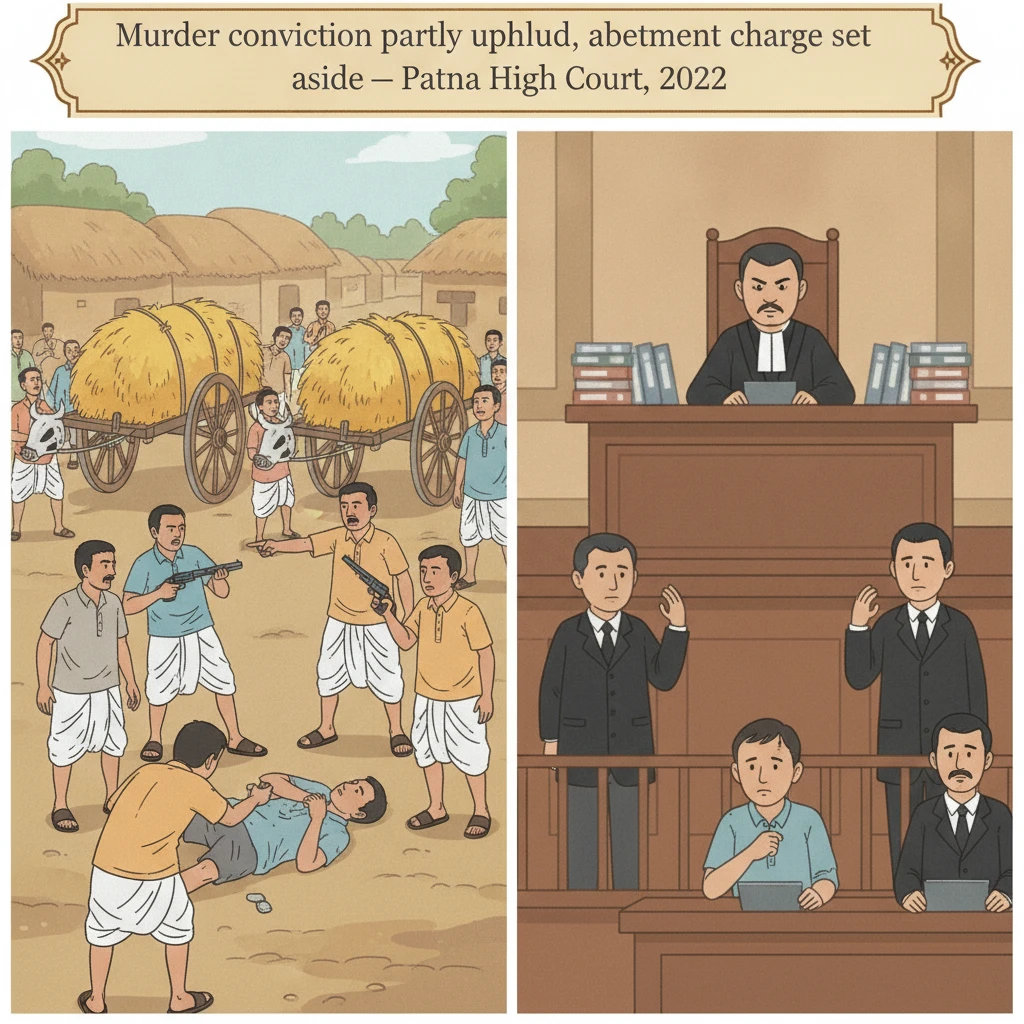
This case arises from an incident dated 03.03.1989 in village Chak Pariyag, Police Station Parbatta, District Khagaria. According to the prosecution, there was a dispute over “khar” (straw) stored in an agricultural field.
The informant, examined as PW-8, stated in his fardbayan that around 1:00 p.m. he went to his field at Mauja Chakprayag to watch his stored khar. There he allegedly saw several accused, including the two appellants, lifting bundles of khar and loading them on two bullock carts.
When he protested, the accused allegedly abused him. Out of fear, he retreated to his house and informed his family members, including his cousin, the later deceased, Buchi Chaudhary.
At about 2:30 p.m., the same group of accused allegedly reached an unmetalled road in front of the house of PW-3, near the Ring Bandh, with khar loaded on the bullock carts. The informant and the deceased went there and questioned them about the khar bundles.
The trial in Sessions Trial No. 564 of 1989, arising out of Parbatta P.S. Case No. 26 of 1989, ended in 1995 with conviction of appellant no.1 under Section 302 IPC and appellant no.2 under Sections 302/114 IPC. Other co-accused facing charges under Sections 302/149 IPC were acquitted. The two convicted accused then filed Criminal Appeal (DB) No. 259 of 1995 before the Patna High Court.
What the Court Examined and Decided
The Division Bench of the Patna High Court, comprising Hon’ble Mr. Justice A.M. Badar and Hon’ble Mr. Justice Sunil Kumar Panwar, examined the evidence led at trial and the reasoning behind the convictions.
According to the prosecution, when the informant and the deceased confronted the accused near the house of PW-3, three of the accused jumped down from the bullock carts and ran to their houses. They allegedly returned armed: appellant no.1 with a country-made gun, one co-accused with a double-barrel gun, and another with a pistol. Some others allegedly came armed with lathis.
The core allegation was that appellant no.2 Umesh Roy ordered appellant no.1 Parsuram Roy to shoot, and appellant no.1 then fired from his country-made gun at the chest of the deceased, who fell on the spot and later died.
The investigation was conducted by PW-9, the Investigating Officer, who registered the FIR as Parbatta P.S. Case No. 26 of 1989 under Sections 147, 148, 149, 379, 307, 302 IPC and Section 27 of the Arms Act. After investigation, charge-sheet was submitted against all named accused, and the case was committed to the Sessions Court.
At trial, the prosecution examined nine witnesses. Among them, PWs 3, 4 and 8 were projected as eye-witnesses. PW-6, the doctor, proved the postmortem report and described the firearm injury. PW-9 detailed the investigation and the place of occurrence.
PW-6, Dr. Awadhesh Kumar Yadav, found one circular lacerated firearm wound of entry over the right second intercostal space in the right mid-clavicular line, with inverted margins and surrounding charring. The third right rib was fractured, the pleura and right lobe of the lung were ruptured, and the right thoracic cavity was full of blood. A cylindrical cardboard wad was recovered from the lung. In his opinion, the injury was antemortem, caused by firearm, and sufficient in the ordinary course of nature to cause death. Time since death was within 12 to 24 hours of postmortem.
The defence of the appellants was that they had been falsely implicated due to enmity. In support, one defence witness, a chaukidar (DW), stated that he saw the dead body and heard women and children crying but that the informant did not tell him the names of the assailants when they went to the police station.
On appeal, the learned amicus curiae for the appellants argued that the trial court ought to have discarded the testimony of the eye-witnesses (PWs 3, 4 and 8) as they were interested, partisan and had made contradictory statements. It was urged that their evidence could not safely support a conviction.
The State, on the other hand, contended that PWs 3, 4 and 8 had consistently supported the prosecution version and that their ocular evidence was fully in line with the medical evidence of PW-6. It was argued that the deceased died of a gunshot fired by appellant no.1, allegedly on the order of appellant no.2.
The High Court carefully went through the prosecution evidence. It noted that PWs 1, 2, 3, 4, 7 and 8 all supported the general prosecution story. PWs 3, 4 and 8, in particular, claimed to be eye-witnesses to the firing incident.
The Court accepted the medical evidence of PW-6 as fully corroborating the prosecution case that the deceased suffered a single fatal gunshot injury on the right side of the chest. The nature and location of the injury, and the presence of the cardboard wad in the lung, supported the allegation of a close-range firearm shot, consistent with the eye-witness version.
The Bench also addressed the argument about “interested witnesses.” It observed that PW-8, the informant, was a family member of the deceased. The Court reiterated the settled principle that evidence of related witnesses must be scrutinized with care and caution, but it is not to be discarded merely because of the relationship. If, on close scrutiny, the Court finds the testimony consistent and trustworthy, it can be relied upon.
On examining the depositions, the Bench found that the eye-witnesses were broadly consistent on key points such as place of occurrence, time, and manner of the assault. Only minor contradictions appeared, which the Court regarded as natural variations arising from different vantage points and passage of time. The Judges noted that a “parrot-like” reproduction of facts would in fact be suspicious; some minor differences strengthen, rather than weaken, the impression of truthful testimony.
On this basis, the Court concluded that the prosecution had clearly established that appellant no.1, Parsuram Roy, fired the fatal shot at the deceased with a firearm, causing his death. The conviction of appellant no.1 under Section 302 IPC and the life sentence imposed by the trial court were therefore confirmed.
The more difficult question before the High Court was the conviction of appellant no.2, Umesh Roy, under Sections 302/114 IPC. The trial court had treated him as an abettor present at the scene, on the footing that he allegedly ordered appellant no.1 to fire at the deceased.
The High Court explained that, for Section 114 IPC to apply, there must be prior abetment of the offence, and the abettor must then be present when the offence is committed. The section presupposes circumstances clearly constituting abetment, such as prior instigation, conspiracy, or intentional aid. It does not apply where any supposed “abetment” occurs at the very moment of the offence and the person merely helps in its commission.
The prosecution case against appellant no.2 was that, at the scene, he ordered appellant no.1 to fire, and on that order appellant no.1 shot the deceased. The Court examined the evidence of PW-8, the informant, who stated that after the accused returned armed, appellant no.2 told appellant no.1 to fire, whereupon appellant no.1 fired at the chest of the deceased.
The Bench found that this evidence did not show that appellant no.2 knew about the firearm being carried by appellant no.1 from the house or that there was any prior meeting of minds to commit murder. PWs 3 and 4 had deposed that appellant no.1 and others had first run to the house and then returned armed with guns. From this, the Court inferred that there was no prior conspiracy or planned abetment between appellant no.1 and appellant no.2.
The Court further observed that appellant no.2 was not carrying any deadly weapon at the time of the incident. There was no evidence that appellant no.1 committed the offence on the basis of prior instigation from appellant no.2, or that appellant no.2 had any knowledge that appellant no.1 had fetched a firearm for the purpose of killing the deceased.
In these circumstances, the Court held that the bare allegation that appellant no.2 “ordered” appellant no.1 to fire, without proof of intention or prior knowledge, could not amount to abetment in law. A mere advice or simple suggestion, or a word uttered in anger or emotion without intending the consequences to follow, does not constitute “instigation” for abetment.
Accordingly, the High Court held that the ingredients for applying Section 114 IPC against appellant no.2 were not made out. His conviction under Sections 302/114 IPC was therefore quashed and set aside, and he was acquitted of the charge.
In conclusion, the appeal was partly allowed. The conviction and life sentence of appellant no.1 under Section 302 IPC were affirmed, while appellant no.2 was acquitted. The Court also recorded appreciation for the assistance rendered by the amicus curiae and fixed her fee.
Why This Judgment Matters
This judgment of the Patna High Court is significant for criminal cases arising from village disputes, especially in Bihar. It shows that the Court will uphold a murder conviction where trustworthy eyewitnesses and medical evidence clearly support the prosecution case.
At the same time, the decision offers protection to those who may be falsely roped in as “abetters” or “supporters” without strong proof. The Court made it clear that a person cannot be punished for abetment of murder merely because they were present or allegedly shouted something in the heat of the moment.
The ruling highlights that for abetment under Section 114 IPC, there must be clear evidence of prior instigation or intentional support, plus presence at the crime scene. Mere relationship with the main accused, or presence at the spot, or loose words spoken in anger, are not enough.
For villagers and ordinary citizens, this means that while those who actually commit the crime will face strict punishment, courts will closely examine the role of others before branding them as abettors. For lawyers, the case underlines the need to carefully prove or contest the elements of abetment in murder trials.
Legal Issues and Answers
- Issue: Whether the conviction of appellant no.1 for murder under Section 302 IPC was supported by reliable evidence.
Answer: Yes. The Patna High Court held that consistent eye-witness testimony, supported by medical evidence, proved beyond doubt that appellant no.1 fired the fatal gunshot causing the death of the deceased, and his conviction and life sentence were confirmed. - Issue: Whether appellant no.2 could be held guilty of abetment of murder under Sections 302/114 IPC on the allegation that he ordered appellant no.1 to fire.
Answer: No. The Court found no evidence of prior abetment, prior knowledge of the firearm, or intention to instigate murder. Mere alleged words of command at the spot, without more, were insufficient to constitute abetment, and his conviction was set aside.
Cases Cited by the Court
- The judgment does not record any specific earlier case law citations relied upon by the Patna High Court. The Court applied settled principles on appreciation of related witness testimony and the scope of Section 114 IPC without naming particular precedents.
Case Details
Case Number: Criminal Appeal (DB) No. 259 of 1995
Case Title: Parsuram Roy & Anr. v. State of Bihar
Court: High Court of Judicature at Patna
Bench / Coram: Hon’ble Mr. Justice A.M. Badar and Hon’ble Mr. Justice Sunil Kumar Panwar
Date of Judgment: 02.03.2022
Trial Court: 2nd Additional Sessions Judge, Khagaria in Sessions Trial No. 564 of 1989 (arising out of Parbatta P.S. Case No. 26 of 1989)
Citation: 2022(2) PLJR 194
Advocates: Mr. Anukriti Jaipuriyar, Advocate (Amicus Curiae for the appellants); Ms. Shashi Bala Verma, APP (for the State)
Nature of the Case: Criminal appeal (Division Bench) against judgment of conviction and order of sentence in a murder case under Section 302 IPC and abetment under Sections 302/114 IPC
Offence(s) Alleged in FIR: Sections 147, 148, 149, 379, 307, 302 of the Indian Penal Code and Section 27 of the Arms Act
Result in Appeal: Conviction and life sentence of appellant no.1 under Section 302 IPC confirmed; conviction of appellant no.2 under Sections 302/114 IPC quashed; appeal partly allowed.
Link to Full Judgment: Patna High Court Judgment (Official Website)
If you found this explanation helpful and wish to stay informed about how legal developments may affect your rights in Bihar, you may consider following Samvida Law Associates for more updates.







