

Case Background
The case began with an incident in village Sohariya, under Valmikinagar Police Station, West Champaran. In the early hours of 08.06.1992, the village chowkidar, Bhimal Mushahar, was allegedly taken away from his house by a group of men.
On the same morning, at about 7 a.m., Sub-Inspector B.K. Pandey of Valmikinagar Police Station recorded the oral statement of Bhimal’s wife, Bhutahi Devi. She said that around 3 a.m. some men came to their house, asked her husband to open the door, and then took him away towards the east while threatening to kill him and throw away his body.
On the basis of this statement, Valmikinagar P.S. Case No. 15 of 1992 was registered on 08.06.1992 under Section 364 of the Indian Penal Code against five unknown persons. Initially, no person was named.
After investigation, a charge-sheet dated 30.09.1992 (Charge-sheet No. 26 of 1992) was submitted before the jurisdictional Magistrate. Eight persons, including the later appellants Fagu Mushahar and Govind Mahto, were charged under Sections 364, 302, 201 and 120B IPC. At that time some accused were in custody and some, including these appellants, were shown as absconders.
After committal to the Sessions Court, the cases of absconding accused were split. Trial against those already in custody concluded earlier. Years later, appellant Fagu Mushahar was arrested on 25.05.2003 and appellant Govind Mahto surrendered on 27.05.2003. Their trial proceeded in Sessions Trial No. 162 of 1996 before the 3rd Additional Sessions Judge, Bagaha (West Champaran).
By judgment dated 07.06.2016, the trial court convicted both appellants under Sections 302, 364, 201 and 120B IPC. On 09.06.2016 it sentenced them to rigorous imprisonment for life with fine for murder, ten years with fine for kidnapping, seven years with fine for causing disappearance of evidence, and no separate sentence for conspiracy.
Against this conviction and sentence, the appellants filed Criminal Appeal (DB) No. 772 of 2016 and Criminal Appeal (DB) No. 791 of 2016 before the Patna High Court.
What the Court Examined and Decided
The Patna High Court had to decide whether the conviction of the appellants could stand on the basis of the evidence produced. The entire prosecution case, so far as these two appellants were concerned, ultimately rested on two witnesses: P.W.1 Bhutahi Devi (wife of the victim) and P.W.2 Timal Mushahar (brother of the victim).
In total, six witnesses were examined. Three witnesses, P.W.4 Vishwanath Mushahar, P.W.5 Doctor Mahto and P.W.6 Man Bahali Mushahar, did not support the prosecution and were declared hostile. P.W.3 Moti Mushahar, another brother of the deceased, did not return for full cross-examination, so the trial court itself discarded his evidence.
Thus, only P.W.1 and P.W.2 remained as supporting witnesses. The trial court also relied on a statement of co-accused Ravindra Mahto recorded under Section 164 CrPC, marked as Exhibit 1, to support conviction.
Evidence of the wife (P.W.1)
P.W.1 repeated in court what she had earlier stated to the police: that in the night of 07.06.1992, at about 3 a.m., she was sleeping in the inner room while her husband slept in the outer room. Some persons came and asked her husband to open the door. One was armed with a gun and another with a lathi. They told her husband to come out, and she followed him. Outside, three more persons stood, two with lathis. The men took her husband towards the east, saying that this time he would not be spared and would be killed and his body thrown away.
She had earlier said one man had covered his face with a gamchha, and she could identify the others if given a chance, as they spoke in Bhojpuri and she saw their faces in the moonlight. In court she directly identified the appellants as two of the persons who caught hold of her husband and took him away.
However, under cross-examination serious weaknesses came out. She admitted that she had told the police she could not identify any accused by face and that unknown miscreants had abducted her husband. She then tried to correct herself by saying that she had actually told police she would be able to identify the men if given an opportunity.
She further admitted that no Test Identification Parade (TIP) had ever been held. She also agreed that the appellants, who lived about two kilometres away, had no earlier dispute with her husband, and her niece was married in their village. She denied defence suggestions that she had falsely implicated them, but the contradictions in her earlier statement remained.
Evidence of the brother (P.W.2)
P.W.2, Timal Mushahar, stated that he was sleeping at his door at the time of incident. After hearing voices, he woke up and saw two men holding his brother and taking him outside, with his sister-in-law following. In all, he said there were five accused persons, one with a gun and the rest with lathis, and they declared they would kill his brother.
He claimed he could identify the appellants among the miscreants, and also one Balkishun, who had covered his face, but was still recognized by him. He said his brother had a land dispute over 18 dhur of homestead land with Balkishun, who had allegedly captured it and threatened to kill Bhimal when asked to vacate.
In cross-examination, P.W.2 admitted that his statement had been recorded by police the next day, and that he had told police that unknown persons had abducted his brother. He also admitted that he already knew the appellants by name at the time of occurrence, because his niece was married in their village and he used to visit there. He insisted that he had identified them during the occurrence, but this sat uneasily with his earlier statement describing the kidnappers as unknown.
He accepted that the appellants had no concern with the disputed homestead land, which was said to be occupied by another accused, Balkishun. He denied suggestions that he named the appellants at someone else’s instance, but again the contradiction with his earlier police statement remained.
Arguments for the appellants
Counsel for the appellants, Mr. Bashishtha Narayan Mishra, argued that the trial court had failed to properly appreciate these contradictions. If P.W.2 really knew and identified the appellants at the time of the occurrence, he should have given their names to police immediately, and P.W.1 would also have mentioned them in her first statement.
He stressed that the Investigating Officer (I.O.) was never examined during the trial. Because of this, although the defence drew P.W.1’s and P.W.2’s attention to their earlier police statements, the contradictions could not be formally proved through the I.O. This caused serious prejudice to the defence.
He also submitted that since the appellants were not named in the FIR and no TIP was conducted after their arrest or surrender, the identification of the appellants for the first time in court, after many years, could not be a safe basis for conviction. Finally, he questioned the reliance placed by the trial court on the statement of co-accused Ravindra Mahto under Section 164 CrPC, stating that such a statement is not substantive evidence and cannot be used to convict co-accused.
Arguments for the State
The Additional Public Prosecutor, Mr. Dilip Kumar Sinha, supported the trial court’s view. He argued that P.W.1 and P.W.2 were eye-witnesses whose evidence was clear and consistent with the FIR. He said dock identification (identification in court) is substantive evidence and there was no reason to disbelieve them.
On the issue of TIP, he argued that the appellants themselves were responsible for the delay because they had absconded during investigation and were charge-sheeted as absconders. Therefore, they could not later complain that no TIP was held. He also submitted that the Section 164 CrPC statement of co-accused Ravindra Mahto was a public document under Section 74 of the Evidence Act and admissible under Section 80 without calling the Magistrate who recorded it.
Findings of the Patna High Court
The High Court agreed only partially with the State.
On the Test Identification Parade issue, the Court accepted that the appellants had been shown as absconders in the 1992 charge-sheet, and that they appeared in court only in May 2003, more than ten years later. In these circumstances, the Court held that the appellants could not object that no TIP was held during investigation. On this limited point, the State’s argument was accepted.
However, the Court disagreed strongly with the trial court’s use of the Section 164 CrPC statement of co-accused Ravindra Mahto. The Court held that although such a statement is a public document and is presumed to be genuine under Section 80 of the Evidence Act, it is not substantive evidence. It can only be used to corroborate or contradict the maker of the statement, under Sections 157 and 145 of the Evidence Act, when he appears as a witness.
The Court further explained that a confession can be used against the person who makes it, but the confession of one accused is not evidence against a co-accused. In this case, the appellants had made no confession before any Magistrate, and the trial of Ravindra Mahto was held separately. Therefore, his Section 164 statement could not be relied upon at all to prove guilt of these appellants. The trial court was wrong to treat Exhibit 1 as supporting evidence against them.
After excluding this improper material, the High Court closely examined the remaining evidence of P.W.1 and P.W.2. It noted that the kidnapping occurred at about 3 a.m. on 08.06.1992 and that P.W.1’s statement was recorded at 7 a.m. the same morning. This meant that P.W.1 and P.W.2 had four hours to discuss what had happened.
Yet, both of them had admitted in cross-examination that they told police that “unknown persons” had abducted Bhimal. At the same time, P.W.2 said he already knew the appellants by name from earlier visits to their village and claimed to have identified them during the occurrence itself. The Court found it highly doubtful that, in such a situation, the names of the appellants would not be mentioned in the first statement if they had indeed been recognized.
The Court held that non-disclosure of the names at the earliest opportunity, despite alleged prior knowledge and alleged identification, created “serious doubt” about the correctness of their dock identification many years later. It found it “surprising” that persons known to the witnesses were still described as unknown in the initial police statements.
On this basis, the Court concluded that P.W.1 and P.W.2 were not trustworthy witnesses. The trial court, in its view, had “erroneously” treated them as reliable and based the conviction on their testimony.
The Court then noted another serious flaw: the non-examination of the Investigating Officer. Without the I.O., the defence could not formally prove the contradictions between the witnesses’ statements in court and their earlier statements to police. The Court held that this failure “certainly caused prejudice to the appellants.”
Taking all these infirmities together — doubtful identification, unreliable witnesses, improper use of a co-accused’s statement, and absence of the Investigating Officer — the High Court held that the prosecution case suffered from “serious infirmities.”
Therefore, it ruled that the conviction and sentences passed by the trial court could not be sustained in law.
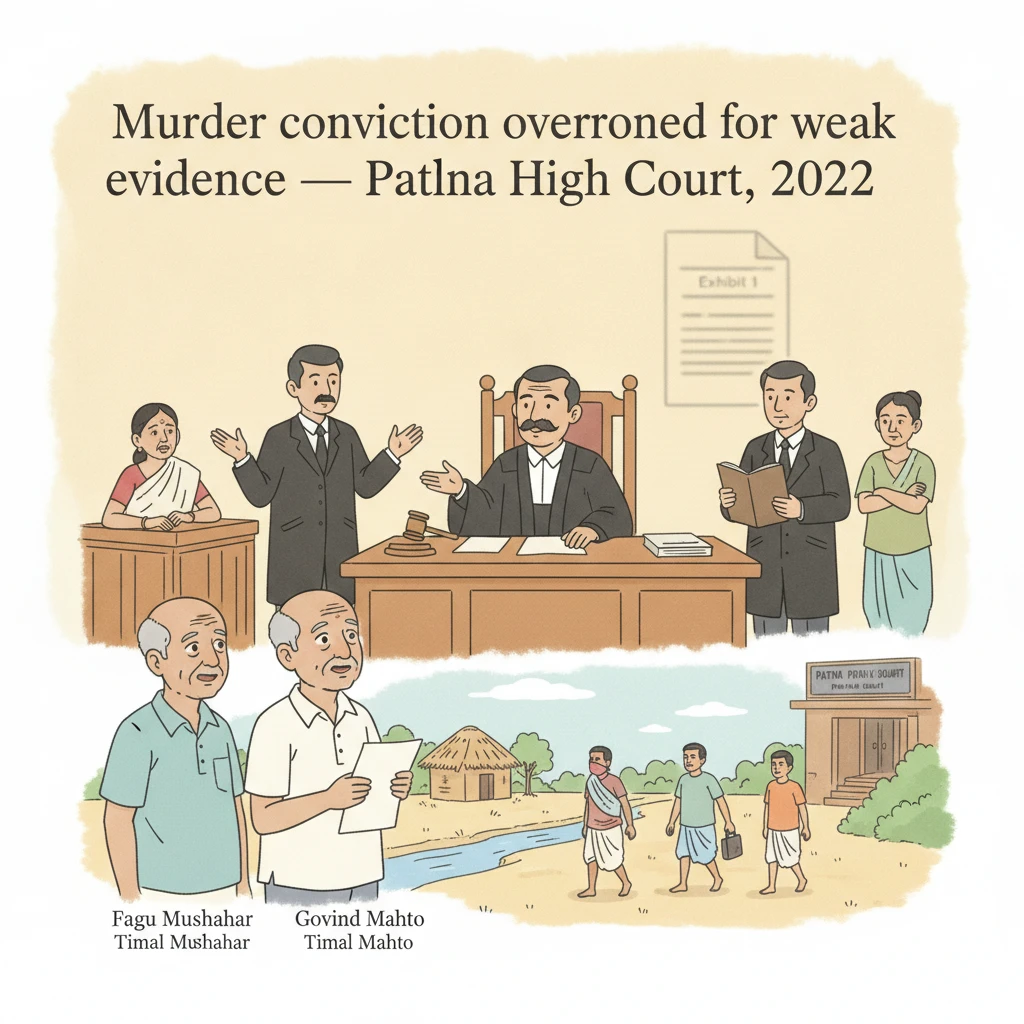
In the result, the Patna High Court allowed both criminal appeals. It set aside the judgment of conviction dated 07.06.2016 and the order of sentence dated 09.06.2016 passed by the 3rd Additional Sessions Judge, Bagaha (West Champaran) in Sessions Trial No. 162 of 1996 arising out of Valmikinagar P.S. Case No. 15 of 1992. The appellants Fagu Mushahar and Govind Mahto were acquitted of all charges and directed to be released forthwith, unless required in any other case.
Why This Judgment Matters
This judgment shows that in serious criminal cases like kidnapping and murder, courts will not uphold conviction unless the evidence is strong and reliable.
For families of victims, it underlines the importance of giving clear statements at the first opportunity. For accused persons, it confirms that they cannot be convicted only because of doubtful in-court identification or on the basis of another accused’s confession.
The Patna High Court also highlighted that failure to examine the Investigating Officer can seriously weaken the prosecution, especially where contradictions in statements are alleged. This affects how police and prosecutors must handle investigations and trials in Bihar.
Legal Issues and Answers
Issue: Can a conviction be based mainly on dock identification when the accused were not named in the FIR and were earlier described as “unknown” by the main witnesses?
Answer: No. The Court held that when witnesses, who already knew the accused, still described the kidnappers as “unknown” in their first police statements, later dock identification becomes doubtful and unsafe for conviction.
Issue: Can a co-accused’s statement recorded under Section 164 CrPC be treated as substantive evidence against other accused persons tried separately?
Answer: No. Such a statement is not substantive evidence; it can only be used to corroborate or contradict the maker when he appears as a witness. A confession of one accused is not evidence against a co-accused.
Issue: Does non-examination of the Investigating Officer affect the fairness of the trial where contradictions in witness statements are alleged?
Answer: Yes. The Court held that absence of the Investigating Officer prevented the defence from properly proving contradictions and caused clear prejudice to the appellants, contributing to setting aside the conviction.
Cases Cited by the Court
- The judgment does not mention or rely on any reported precedent by name. It applies settled principles regarding Section 164 CrPC statements and the Evidence Act without citing specific earlier cases.
Case Details
Case Number: Criminal Appeal (DB) No. 772 of 2016 with Criminal Appeal (DB) No. 791 of 2016; arising out of Valmikinagar P.S. Case No. 15 of 1992; Sessions Trial No. 162 of 1996.
Case Title: Fagu Mushahar v. The State of Bihar (Criminal Appeal (DB) No. 772 of 2016); Govind Mahto v. The State of Bihar (Criminal Appeal (DB) No. 791 of 2016).
Coram: Hon’ble Mr. Justice Ashwani Kumar Singh and Hon’ble Mr. Justice Partha Sarthy.
Date of Judgment: 11.05.2022.
Citation: 2022 (3) PLJR 78.
Advocates: For the appellants in both appeals – Mr. Bashishtha Narayan Mishra, Advocate and Mr. Brij Kishor Mishra, Advocate. For the State – Mr. Dilip Kumar Sinha, Additional Public Prosecutor.
Nature of the Case: Criminal appeals (Division Bench) against judgment of conviction and order of sentence passed by the 3rd Additional Sessions Judge, Bagaha (West Champaran), in a case under Sections 302, 364, 201 and 120B of the Indian Penal Code.
Link to Judgment: Patna High Court official judgment link
If you found this explanation helpful and wish to stay informed about how legal developments may affect your rights in Bihar, you may consider following Samvida Law Associates for more updates.







