

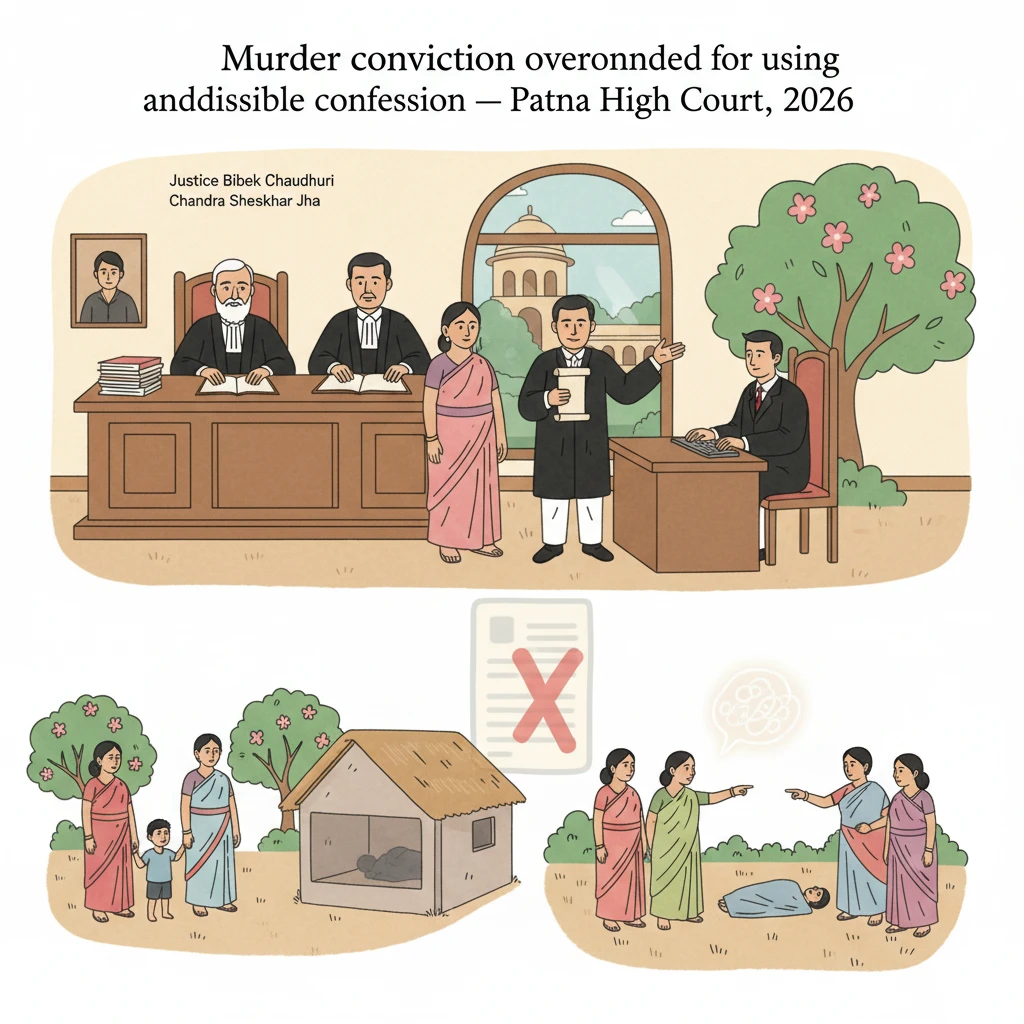
Case Background
This case arises from a tragic incident in village Bhargama, District Araria, where a young boy named Dilkhush was found dead in May 2017.
On 17 May 2017, Bhargama P.S. Case No. 84 of 2017 was registered under Sections 302, 201 and 120B of the Indian Penal Code (IPC) against two women. The FIR was based on the statement of the child’s mother, Mehroon Nisha, also described as Mehroon Khatoon in the evidence.
She stated that she was the first wife of Md. Kamil and had one son and one daughter. A few days before the complaint, her husband had married a second time to one of the accused, Chunni Praveen, who already had one son and two daughters.
The informant alleged that after this second marriage, relations in the household became strained. She said Chunni Praveen used to beat her and her children and threaten them. Because of frequent quarrels, her father-in-law built a separate room for her, and she maintained herself and her children by working as a daily wage labourer.
About 15 days before the FIR, she alleged that Chunni Praveen assaulted her son Dilkhush by pressing his neck. The boy cried and she somehow rescued him. Villagers then mediated between them.
She further stated that Chunni Praveen later made friendly gestures towards the child by giving him chocolates and sweets. On 15 May 2017 around 9:00 a.m., according to the FIR, Chunni Praveen and her mother, co-accused Sayara Bano, came to her house. Around 4:00 p.m., they allegedly enticed Dilkhush and took him to a nearby mango grove to play. By 6:00 p.m., the two women returned without him.
When questioned, they allegedly replied that they did not know his whereabouts. The mother and villagers searched for the child. During the search, one villager, Md. Munna, reportedly said he had seen the two women coming out of a room used to store cattle feed (“Bhusa Ghar”).
According to the FIR, on 17 May 2017 in the morning, both accused allegedly confessed before villagers that they had strangled Dilkhush inside that Bhusa Ghar and thrown his body in the forest. The villagers then searched the forest, found the dead body and noticed marks of violence.
On this basis, the police registered the case and started investigation. After investigation, a charge-sheet was submitted under Sections 302, 201 and 120B IPC.
The case was committed to the Sessions Court. The Sessions Judge, Araria, transferred it to the court of the Additional Sessions Judge, 3rd Court, Araria. On 4 August 2017, charges under Sections 302/34 and 201/34 IPC were framed against both accused.
After trial, by judgment dated 20 July 2018 in Sessions Case No. 272 of 2017 (Sessions Trial No. 91 of 2017), the trial court convicted both accused. On 21 July 2018, they were sentenced to life imprisonment and fines under Section 302/34 IPC, and to five years’ rigorous imprisonment and fines under Section 201/34 IPC, with sentences to run concurrently.
Aggrieved by this conviction and sentence, the two women filed Criminal Appeal (DB) No. 1102 of 2018 before the Patna High Court.
What the Court Examined and Decided
The Division Bench of the Patna High Court, comprising Hon’ble Mr. Justice Bibek Chaudhuri and Hon’ble Mr. Justice Chandra Shekhar Jha, examined the entire evidence produced in the trial court.
The prosecution had examined eight witnesses.
P.W. 1, Md. Shafir-ur Rahman, and P.W. 2, Md. Mati-ur Rahman, were uncles of the deceased. P.W. 3, Md. Kadish, P.W. 4, Md. Kausar Alam, and P.W. 6, Md. Munna @ Munna Mustaq, were local villagers. P.W. 5 was the Investigating Officer. P.W. 7 was the informant-mother. P.W. 8 was the autopsy surgeon.
The High Court first looked at the mother’s evidence (P.W. 7). She confirmed that on the day of occurrence, her son was playing in the mango grove of one Faiyaz Mukhiya, along with the children of Chunni Praveen and another woman, Sahana Khatun.
In the evening, her son did not return. She searched, but he remained missing for two days. On the third day, the dead body was found in the corn field of Faiyaz Mukhiya. She stated that villagers suspected the two accused. Under villagers’ pressure, Chunni Praveen allegedly confessed that the body was lying in that field and that she and her mother had strangled the child in a cattle feed room and thrown the body in the corn field.
However, in cross-examination, she admitted that she came to know about her son’s murder only on the third day of his disappearance around 8:00 p.m. from her neighbours Nehal, Jabar and Azim Master. She also confirmed that the police came after the body was found, recorded her statement, took her thumb impression, prepared an inquest and sent the body for post-mortem.
P.W. 1 stated that the child’s grandfather had gifted five khathas of land to the mother, which caused enmity from Chunni Praveen. He deposed that on 15 May 2017 around 4–4:30 p.m., both accused took Dilkhush to a mango grove beside their house. The child did not return and remained missing despite search.
He claimed that on the third day the accused disclosed that the boy had been strangled inside the Bhusa Ghar of one Jalal Mukhiya and the body thrown in the jungle. Police then came and recorded the informant’s statement; he signed as a witness.
In cross-examination, he admitted that the husband of the informant was his uncle’s son and both families lived in the same house. He also confirmed that on the date of occurrence, Chunni Praveen took her three children and Dilkhush to the mango grove and later returned only with her children.
P.W. 2 gave a similar version to P.W. 1. P.W. 3 was not present at the time of occurrence and his evidence was not significant for the incident itself.
P.W. 6, Md. Munna, said that around 4:30 p.m. on the date of occurrence, while going to his agricultural land, he saw the two accused, the children of Chunni Praveen and Dilkhush playing in the mango grove of Jalal Mukhiya. After sunset, he returned home and heard that Dilkhush was missing. For two days they searched but could not find the child.
He claimed that, when villagers questioned the accused, they admitted that they had murdered the child and thrown the body in a corn field. Acting on this, villagers went to the corn field of Jalal Mukhiya and recovered the body.
In cross-examination, he admitted that his house was around two kilometres away from the place of occurrence, and that police came after the body was recovered.
P.W. 8, Dr. Kanisk Kunal, conducted the post-mortem. He opined that the child died due to asphyxia caused by manual strangulation with the help of a ligature, which led to dislocation of cervical bones and opening of thoracic and abdominal cavities. Thus, the medical evidence clearly established homicidal death by strangulation.
After reviewing all depositions, the Patna High Court noted a crucial gap: no one had seen the accused actually murdering the child. No one had even seen them taking the child into the Bhusa Ghar of Jalal Mukhiya.
The only direct link used by the trial court to convict the accused was the alleged confession made by them, treated as Exhibit 5. The High Court examined how this confession had been used.
The Bench found that the trial judge had relied on the purported confessional statement made before the Investigating Officer and treated it as substantive evidence against the accused. The High Court described this as “surprisingly” wrong, especially from an Additional Sessions Judge.
The Court reminded that under Section 25 of the Indian Evidence Act, no confession made to a police officer is admissible in evidence against an accused. Additionally, Section 162 of the Code of Criminal Procedure provides that any statement made to a police officer during investigation cannot be signed by the maker and cannot be used at any inquiry or trial, except to contradict the witness in the manner described in Section 145 of the Evidence Act.
The Bench emphasised that such a statement cannot be used as the basis for conviction. At most, parts of it can be used by the defence, and with the court’s permission by the prosecution, only for contradiction and not as independent proof of guilt.
Applying these clear rules, the Court held that the trial court had wrongly based conviction and sentence on inadmissible evidence. The alleged confessional statement to police should not have been marked and relied upon as Exhibit 5 for proving guilt.
The High Court further observed that apart from this inadmissible confession, there was “absolutely no evidence” against the accused. There was no eyewitness, no proof that they took the boy into the Bhusa Ghar, and no evidence that they placed the body in the corn field. The prosecution had not established a complete chain of circumstances unerringly pointing to the guilt of the accused.
Because criminal conviction requires proof beyond reasonable doubt, the Bench concluded that the appellants were entitled to acquittal.
Consequently, the High Court allowed the appeal. It set aside the judgment of conviction and order of sentence dated 20 July 2018 and 21 July 2018 passed by the Additional Sessions Judge-III, Araria. The Court directed that the accused be released at once, if in custody and not wanted in any other case.
Why This Judgment Matters
This judgment of the Patna High Court is important for both accused persons and victims’ families.
It shows that even in very serious cases like the murder of a child, courts cannot ignore basic rules of evidence. A confession made to the police during investigation cannot, by itself, be used to send someone to prison for life.
For poor and less-educated people, this ruling underlines that:
Police statements are not the same as court evidence. The law protects accused persons from being convicted only because they allegedly “confessed” before police or villagers, unless such confession is proved in the manner allowed by law.
Trial courts must carefully check what type of evidence they are relying on. If a court bases its decision on something the law says is inadmissible, a higher court can and will correct that mistake.
The decision also reminds investigating agencies to collect proper, independent evidence—such as eyewitness accounts, scientific evidence or other legally admissible material—rather than depending mainly on alleged confessions.
Legal Issues and Answers
- Issue: Can a criminal conviction for murder be based mainly on a confessional statement made by accused persons to the police during investigation?
Answer: No. The Patna High Court held that such a confession is inadmissible under Section 25 of the Evidence Act and Section 162 Cr.P.C., and cannot be the basis of conviction. - Issue: Was there sufficient admissible evidence on record to prove beyond reasonable doubt that the appellants murdered the child and disposed of his body?
Answer: No. The Court found that nobody saw the murder or the alleged disposal of the body, and there was “absolutely no evidence” apart from the inadmissible confession. The appellants were therefore acquitted.
Cases Cited by the Court
- The judgment does not mention or rely on any previous decided cases by name.
Case Details
Case Number: Criminal Appeal (DB) No. 1102 of 2018; arising out of Bhargama P.S. Case No. 84 of 2017
Case Title: Chunni Praveen & Anr. v. The State of Bihar
Citation: 2026(3) PLJR 223
Court: High Court of Judicature at Patna
Coram: Hon’ble Mr. Justice Bibek Chaudhuri; Hon’ble Mr. Justice Chandra Shekhar Jha
Date of Patna High Court Judgment: 30 March 2026
Trial Court Judgment and Sentence: Conviction dated 20 July 2018 and sentence dated 21 July 2018 in Sessions Case No. 272 of 2017 (Sessions Trial No. 91 of 2017) by Additional Sessions Judge-III, Araria
Offences Alleged: Sections 302, 201, 120B IPC at FIR stage; charges framed under Sections 302/34 and 201/34 IPC
Outcome in Appeal: Appeal allowed; conviction and sentence set aside; appellants directed to be released if not required in any other case
Nature of Case: Criminal appeal (division bench) against conviction and sentence passed by the Sessions Court
For the Appellants: Mr. Ravi Shankar Sahay, Advocate; Mr. Kanhaiya Rao, Advocate; Mr. Rakesh Kumar Mishra, Advocate
For the State/Respondent: Mr. Ajay Mishra, APP
Link to Full Judgment: Click here to read the official Patna High Court judgment
If you found this explanation helpful and wish to stay informed about how legal developments may affect your rights in Bihar, you may consider following Samvida Law Associates for more updates.







