

Case Background
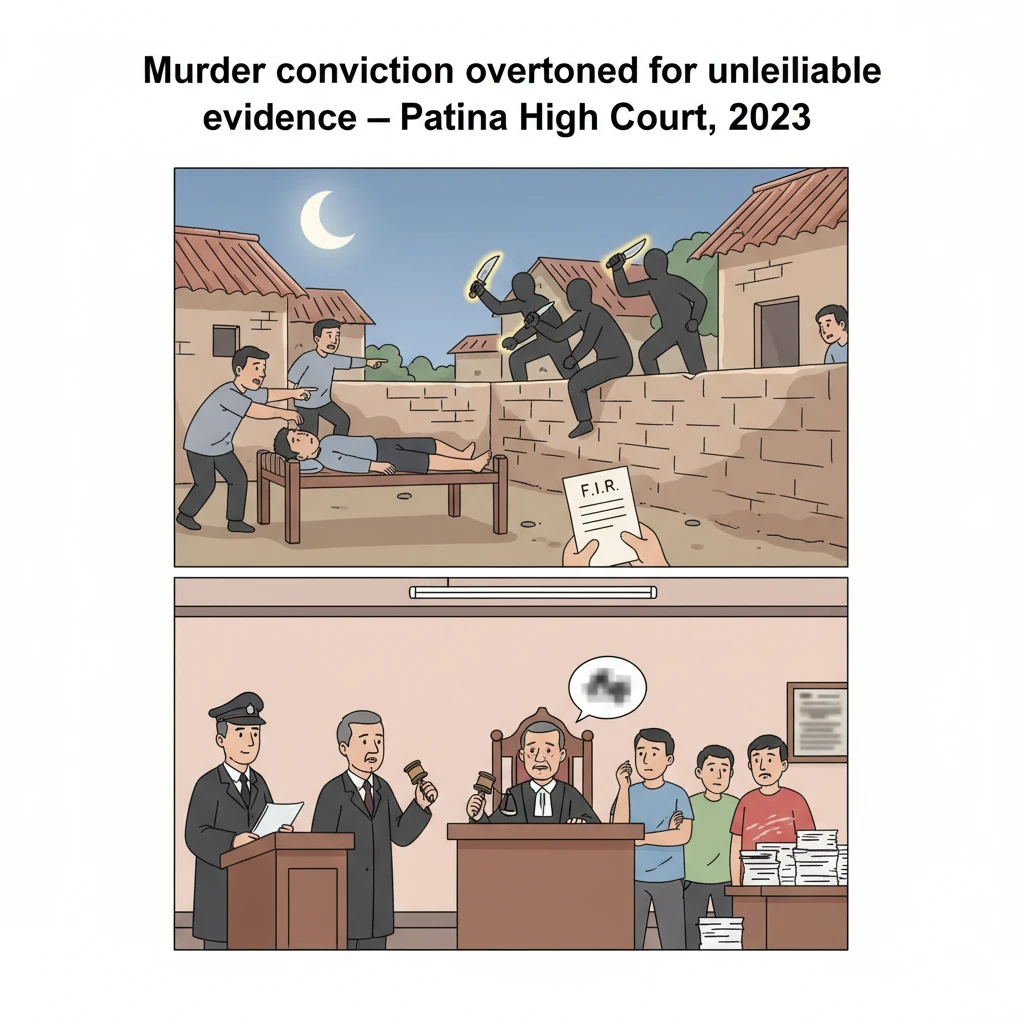
This case arises from a night-time murder in Village Bhuigaon, P.S. Garkha, District Saran, in the night between 25 and 26 July 2009. The deceased was sleeping on a cot inside a mosquito net in the courtyard of his house.
According to the prosecution, at about 12:30 a.m., the deceased raised loud cries. His nephew, who lived in the neighbouring house, claimed that he and others woke up on hearing the alarm and rushed to the spot.
The nephew (later examined as P.W. 5) stated in his fardbeyan that he saw the three appellants and some others assaulting the deceased with a gupti and a knife. On seeing people approach, the assailants allegedly fled by scaling the boundary wall.
P.W. 5 claimed that the injured man was still alive and made an oral dying declaration, saying that the appellants had attacked him with knife and gupti. The relatives attempted to take him to hospital, but he died shortly thereafter.
Sub-Inspector Mahesh Kumar (P.W. 10) reached the deceased’s house and recorded the fardbeyan of P.W. 5 there at about 4:45 a.m. on 26 July 2009. On that basis, Garkha P.S. Case No. 129 of 2009 was registered at 7:45 a.m. the same morning under Section 302 read with Section 34 of the Indian Penal Code.
The police investigated and filed a charge-sheet against the present appellants. The case was tried as Sessions Trial No. 696 of 2010 (new 369/2014) in the Court of the Xth Additional District and Sessions Judge, Saran at Chapra.
On 28 February 2017, the Trial Court convicted all three appellants for murder with common intention under Section 302/34 IPC. On 8 March 2017, they were sentenced to life imprisonment and a fine of Rs. 10,000 each, with six months’ simple imprisonment in default. The fine was directed to be paid to the son of the deceased.
The Trial Court largely relied on the eyewitness accounts of P.Ws. 1 to 5 and on the supposed oral dying declaration. It also treated an alleged land dispute involving appellant Prabhu Rai as providing the motive.
Aggrieved, the three convicts filed this Criminal Appeal (DB) No. 421 of 2017 before the Patna High Court. The appeal was heard by a Division Bench comprising Hon’ble Mr. Justice Ashutosh Kumar and Hon’ble Mr. Justice Alok Kumar Pandey, which delivered its oral judgment on 3 October 2023.
What the Court Examined and Decided
The Patna High Court carefully re-examined the evidence of the prosecution witnesses, the medical evidence, and the conduct of the investigation. While the prosecution projected several close relatives as eyewitnesses and claimed a detailed oral dying declaration, the Court found major inconsistencies and doubts.
First, the Court examined the testimony of P.W. 1, one of the three sons of the deceased. According to the prosecution, the other two sons had also rushed to the spot, but they were never examined at the trial.
P.W. 1 stated that he saw the assault from some distance and that when they reached near the deceased the appellants ran away. He also said that he and others tried to stop the bleeding by tying cloth over the wounds and that the police arrived after two to three hours, seizing the mosquito net, mattress and blood-stained earth. He further admitted that he did not sign the inquest report.
Crucially, P.W. 1 stated that he gave his statement to the police for the first time three to four days after the incident. He denied the suggestion that he was actually in Hyderabad at the time and only came back to the village after getting a phone call about his father’s death.
The Investigating Officer (P.W. 10), however, contradicted P.W. 1. P.W. 10 deposed that P.W. 1 never claimed to be an eyewitness before him. Instead, P.W. 1 admitted to him that he and his two brothers were working in a cable manufacturing company at Hyderabad. According to the I.O., P.W. 1 told him that he came home only after his cousin P.W. 5 informed him on the phone that his father had been murdered.
In light of this, the High Court found P.W. 1’s presence at the scene of occurrence highly doubtful. His failure to lodge the fardbeyan despite being the son of the deceased, his absence from the inquest report, and the delay of three to four days in giving his statement all supported the I.O.’s version that he came home only later.
Once P.W. 1’s evidence as an eyewitness was disbelieved, the Court turned to the other relatives who claimed to have seen the assault or heard the dying declaration.
P.W. 2, another nephew, broadly supported P.W. 5’s story in chief-examination. But in cross-examination he stated that when they reached the spot, the deceased was already about five yards away from the cot and died within five minutes. He admitted there was no time to provide any first aid or bandage the wounds. This raised a serious question how the deceased could have given a detailed oral statement naming his assailants.
P.W. 3, the real brother of the deceased, said he reached five to six minutes after the cries and claimed that the assailants’ faces were uncovered. In contrast, P.W. 4, mother of the informant and another close relative involved in the land dispute, said she saw the assailants with their faces covered. The I.O. testified that P.W. 4 had not told him anything about the manner of occurrence or the specific role of each appellant. The High Court therefore treated P.W. 4 as an unreliable witness as to presence and identification.
The Court then analysed the deposition of P.W. 5, the informant and main prosecution witness. P.W. 5 accepted that the land conveyed to his mother and uncles by Yogendra Singh was purchased later in time than the same land conveyed earlier to the wife of appellant Prabhu Rai by Birendra Singh, Yogendra’s brother. Several other witnesses (P.Ws. 6 and 11) confirmed this, showing that the main civil dispute was between P.Ws. 2 to 5 and appellant Prabhu Rai, not between the deceased and the appellants.
This weakened the prosecution claim that the motive for murder was the deceased’s deposition against appellant Prabhu Rai in a civil case. The Court noted that the land dispute and the title suit were actually between the nephews and relatives (P.Ws. 2 to 5) and appellant Prabhu Rai.
P.W. 5 further claimed that hundreds of villagers gathered after the occurrence, but he could not name them. He also stated that after the assault the deceased came out of the courtyard on his own, which the Court found to be an exaggeration given the nature of injuries.
Most importantly, P.W. 5 admitted that he went in the night to inform the village Dafadar, Ibne Ali (P.W. 14). P.W. 14 testified that P.W. 5 told him that “criminals” had killed his uncle and requested that the police be informed. P.W. 14 was categorical that P.W. 5 did not disclose any names of assailants at that time, even though P.W. 14’s house was about one kilometre away and he was the first person informed.
The I.O. claimed that P.W. 14 had telephonically given him the names of the appellants as well. However, this was directly contradicted by P.W. 14’s evidence. The prosecution also did not produce in court the Station Diary Entry No. 661 of 2009, which recorded the first information from P.W. 14 to P.W. 10. The High Court treated this non-production as a serious lapse, indicating that the names of the appellants were probably not available when the police first came at 4:45 a.m., before recording the fardbeyan.
From these facts, the Court inferred that the witnesses had sufficient time after the incident to deliberate and decide to name the appellants, with whom P.Ws. 2 to 5 admittedly had a serious property dispute and “axe to grind”. The promised title documents for the disputed land were never produced at trial despite P.W. 5’s assurance.
The Court next considered the medical evidence of P.W. 8, the doctor who conducted the post-mortem on 26 July 2009 at 10:30 a.m. He found four deep incised penetrating wounds on the chest, below the left axilla, on the left forearm and on the right side of the chest, all cavity deep and dangerous to life, and one lacerated wound on the right leg. The lungs and liver were ruptured. In his opinion, death resulted from the composite effect of these injuries and the resulting haemorrhage and shock.
In this background, the High Court asked whether the deceased, with such severe injuries and heavy blood loss, could have given a detailed oral statement naming his assailants as claimed by P.Ws. 2 to 5. The Court had “great doubts” about this, particularly when P.W. 2 himself said there was no time even to apply bandages and that the deceased died within minutes.
The Bench then set out the legal position on dying declarations, relying on the Supreme Court decision in Paniben v. State of Gujarat, (1992) 2 SCC 474. It reiterated that while a dying declaration can be the sole basis of conviction, it must be proved to be true, voluntary and reliable; the maker must be in a fit physical and mental condition; and the statement must not suffer from material infirmities. Special caution is needed where the witnesses are related or interested and there is potential animosity against the accused.
The Court also referred to the Supreme Court judgment in C. Mangesh and Ors. v. State of Karnataka, (2015) 5 SCC, which emphasises that evidence of related or partisan witnesses must be scrutinised with extra care, checking for discrepancies and overall probability.
Applying these principles, the Court concluded that the alleged oral dying declaration in this case did not pass the test. The statements of P.Ws. 2 to 5 were inconsistent on key points such as the condition of the deceased and the identification of assailants. Their conduct in not naming the appellants at the earliest opportunity to P.W. 14, and the delay and contradictions in their police statements, further eroded their credibility.
The Bench also noted that although appellant Prabhu Rai had raised a plea of alibi and given supporting papers to the I.O., the investigation on this point was not properly carried out despite instructions from superior officers.
In sum, the Court found that:
- P.W. 1 was not present at the time of occurrence and his claim of being an eyewitness was false.
- P.Ws. 2 to 5 gave contradictory and unreliable accounts and appeared to be “agenda-driven”, using the case to frame the appellants with whom they had a civil land dispute.
- The oral dying declaration, allegedly heard only by these interested relatives, was doubtful and unsafe to rely upon.
- The initial omission to name the appellants before P.W. 14 and in the non-produced Station Diary Entry created a serious gap in the prosecution story.
- There was no clear motive for the appellants to kill the deceased, who was not in direct civil litigation with them.
Given these weaknesses, the High Court held that the conviction under Section 302/34 IPC was “absolutely unjustified” and the sentence “not condign”. The benefit of doubt had to go to the accused.
The Court therefore set aside the conviction and sentence of all appellants in Sessions Trial No. 696 of 2010 (new 369/2014), arising out of Garkha P.S. Case No. 129 of 2009 and G.R. No. 2536 of 2009, and acquitted them of all charges.
Since all appellants were still in jail, the Court directed that they be released forthwith if not wanted in any other case. The Bench also clarified a technical error that had delayed appellant no. 1’s release: in the appeal memo, the Sessions Trial number was wrongly typed as 626 of 2010 and should be read as 696 of 2010. A copy of the judgment was ordered to be sent immediately to the concerned jail and the trial court for necessary action. The appeal was allowed, and all interlocutory applications were disposed of.
Why This Judgment Matters
This Patna High Court judgment shows how closely higher courts scrutinise murder convictions based only on related witnesses and alleged oral dying declarations.
The Court emphasised that when key witnesses are close relatives who are already locked in a land dispute with the accused, their statements must be checked against medical evidence, early information to authorities, and overall probability.
For families involved in property disputes, this case is a reminder that criminal cases cannot be used to settle civil scores. Courts will look carefully at whether names were mentioned in the very first information, whether documents like station diary entries are produced, and whether witnesses have changed their version over time.
The judgment also highlights that delays and mistakes in investigation, like ignoring a plea of alibi or not producing crucial records, can seriously damage the prosecution case. An oral dying declaration, especially when recorded only by interested relatives without independent support, will not automatically lead to conviction.
Finally, the case underlines that a person can spend many years in jail before an appeal corrects a wrongful conviction. It underlines the importance of careful, honest investigation and truthful witness testimony from the very beginning.
Legal Issues and Answers
- Issue: Whether the conviction of the appellants for murder under Section 302/34 IPC could be sustained on the basis of related eyewitnesses and an alleged oral dying declaration.
Answer: No. The Patna High Court held that the eyewitness accounts and the oral dying declaration were doubtful and unreliable, and therefore the conviction could not stand. - Issue: Whether the alleged oral dying declaration of the deceased, as narrated by P.Ws. 2 to 5, met the legal standards to form the sole basis of conviction.
Answer: No. Given the severe injuries, conflicting evidence about the deceased’s condition, and inconsistencies in the relatives’ statements, the Court found that the oral dying declaration did not satisfy the tests laid down in Paniben and other Supreme Court decisions. - Issue: Whether the existence of a civil land dispute between the prosecution witnesses and appellant Prabhu Rai affected the credibility of the prosecution case.
Answer: Yes. The Court held that the land dispute showed clear animus, making it necessary to treat the relatives’ evidence with great caution. Their conduct and contradictions led the Court to view their testimony as agenda-driven and unsafe for conviction.
Cases Cited by the Court
- Paniben v. State of Gujarat, (1992) 2 SCC 474
- C. Mangesh and Ors. v. State of Karnataka, (2015) 5 SCC
Case Details
Case Number: Criminal Appeal (DB) No. 421 of 2017, arising out of Garkha P.S. Case No. 129 of 2009; Sessions Trial No. 696 of 2010 new 369/2014; G.R. No. 2536 of 2009
Case Title: Prabhu Rai and Ors. v. State of Bihar
Citation: 2024 (1) PLJR 400
Court: High Court of Judicature at Patna
Coram: Hon’ble Mr. Justice Ashutosh Kumar; Hon’ble Mr. Justice Alok Kumar Pandey
Date of Judgment: 03-10-2023
Advocates: Mr. Ranjay Kumar Singh, Advocate for the appellants; Mr. Shankar Kumar, Advocate for the appellants; Mr. Manoj Kumar, Advocate for the informant; Mr. Dilip Kumar Sinha, APP for the State
Nature of the Case: Criminal appeal (Division Bench) against conviction and sentence for murder under Section 302 read with Section 34 of the Indian Penal Code
Link to Judgment: Click here to read the full Patna High Court judgment
If you found this explanation helpful and wish to stay informed about
how legal developments may affect your rights in Bihar,
you may consider following Samvida Law Associates for more updates.







