
Case Background
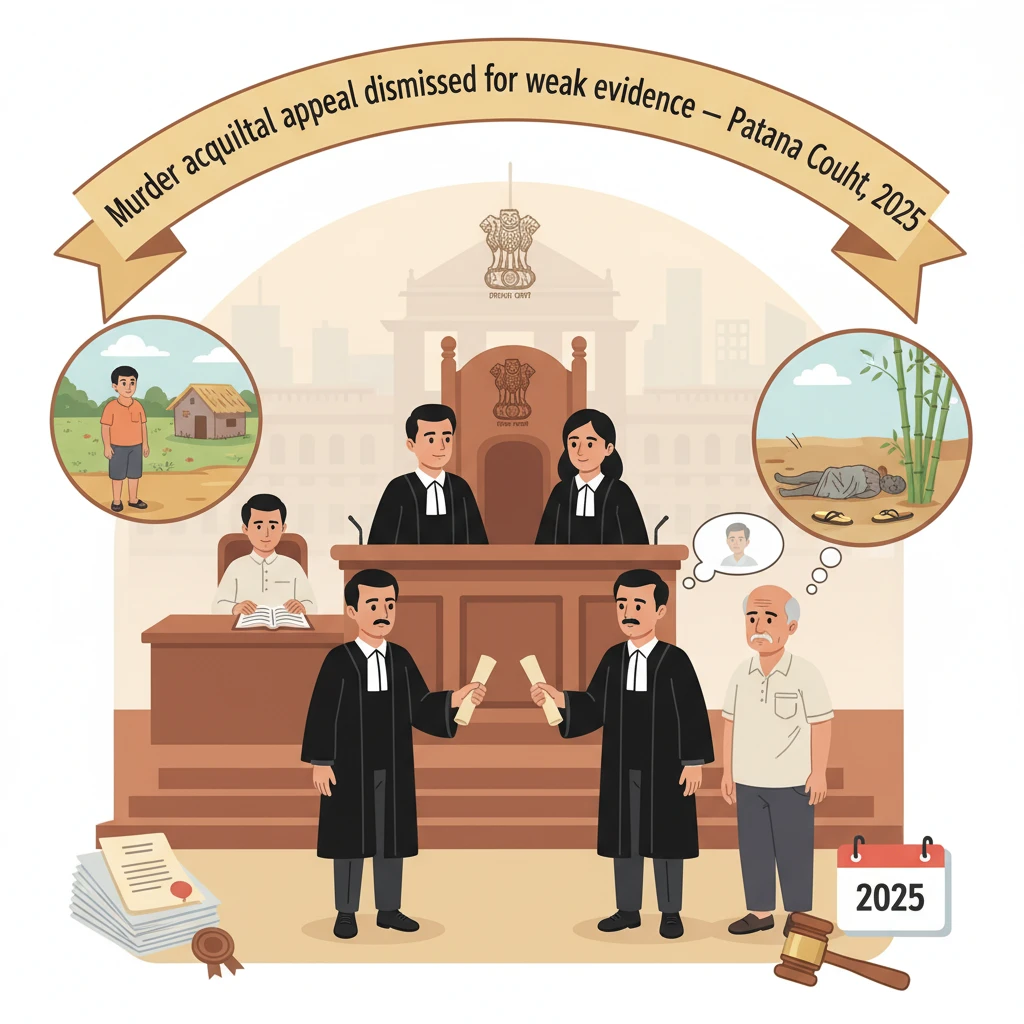
This case arose from Masrakh P.S. Case No. 198 of 2004, related to the death of the informant’s father, a resident of village Madarpur in Saran district. The informant used to sell fruits and vegetables in Siliguri and was away from his village at the relevant time.
According to the fardbeyan, on 11.09.2004 at about 9:00 p.m., the informant’s daughter-in-law informed him that his father had gone the previous evening with the wife of Respondent No. 2 to see her ailing buffalo, but had not returned. The informant and his mother came back from Siliguri to their village and searched for his father, but could not find him.
On 14.09.2004 at about 2:00 p.m., after receiving information about a foul smell near the “Baans-Kathi” of one Heeralal Ram, the informant and others went there. They found a decomposed dead body, which they identified as that of the informant’s father from a piece of dhoti and chappal. The informant suspected that the wife of Respondent No. 2, with the help of others, had committed the murder and thrown the body near the Baans-Kathi.
On this basis, Masrakh P.S. Case No. 198 of 2004 was registered under Sections 302/34 and 201/34 of the Indian Penal Code. After investigation, the police submitted charge-sheet against Respondent No. 2. Cognizance was taken, and the case was committed to the Court of Sessions, where it was registered as Sessions Trial No. 242 of 2010.
Charges under Sections 302/34 and 201/34 IPC were framed against the accused, who pleaded not guilty and claimed to be tried. During trial, the prosecution examined eight witnesses, including the informant, family members, another villager, and the doctor who examined the body. Several documents were exhibited, including signatures on the fardbeyan, protest petition, applications, and the doctor’s bone injury report. No defence witness was examined. Statements of the accused were recorded under Section 313 Cr.P.C., after which the trial court acquitted Respondent No. 2.
The informant then filed the present Criminal Appeal (DB) No. 203 of 2025 before the Patna High Court, under Section 413 of the Bharatiya Nagarik Suraksha Sanhita, 2023, challenging the acquittal order dated 20.06.2024 passed by the learned Additional District and Sessions Judge-9th, Saran, Chapra.
On 03.04.2025, the High Court issued notice to Respondent No. 2. He appeared by filing his Vakalatnama through his counsel. The matter was then heard on merits and decided by a Division Bench.
What the Court Examined and Decided
The Patna High Court, speaking through Hon’ble Mr. Justice Sudhir Singh (for the Bench also comprising Hon’ble Mr. Justice Rajesh Kumar Verma), focused on a single central question: whether the acquittal ordered by the trial court required interference in appeal.
The Court first noted the trial court’s reasoning. The trial court had treated the case as one based purely on circumstantial evidence. It stressed that for conviction on circumstantial evidence, all links in the chain must connect and support one another. The trial court found that:
- no one had seen the deceased going with the accused,
- the accused appeared to have been implicated due to past enmity, and
- the prosecution witnesses were inconsistent, lacked coherence, and even contradicted each other.
On that basis, the trial court held that the prosecution failed to prove the charges under Sections 302/34 and 201/34 IPC beyond reasonable doubt and acquitted the accused.
In appeal, counsel for the appellant (the informant) argued that the trial court had ignored important evidence, particularly the testimony of PW-7 Champa Devi. According to the appellant, PW-7 stated that the deceased was taken away by Respondent No. 2 and others on the pretext of going to see his ailing she-buffalo, and thereafter the deceased was found dead. It was further submitted that there was no motive for the informant to falsely implicate Respondent No. 2.
On the other hand, counsel for Respondent No. 2 supported the trial court’s judgment, submitting that there was no perversity and that the prosecution had failed to establish guilt. Therefore, no interference by the appellate court was warranted.
After hearing both sides and examining the record, the High Court undertook a close scrutiny of the evidence, particularly on three key aspects: date and time of occurrence, nature and condition of the dead body, and completeness of the circumstantial chain.
First, the Court pointed out serious inconsistency in the witnesses’ statements regarding the time of occurrence. PW-1 said the incident happened around 8–10 years back at about 8:00 p.m. PW-2 spoke of the occurrence as being about 12–13 years ago and stated he saw the deceased at around 10:00 p.m. PW-3 said it took place about 11 years back at about 9:00 p.m. The Court held that these variations created “material inconsistency” regarding date and time.
The Court then compared these statements with the FIR. As per the FIR, the occurrence fell between 10.09.2004 (when the deceased was said to have been last seen) and 14.09.2004 (when the body was discovered). The FIR was lodged on 14.09.2004 itself, and post-mortem was conducted the same day.
However, PW-8, the doctor who examined the body, gave a different picture. He stated that the soft tissues of the body were decomposed and opined that death had occurred 1–2 months prior to the examination. If this medical opinion was accepted, then the date of occurrence alleged in the FIR was not proved and the body could not have been missing for just a few days. The Court observed that this meant no case appeared to have been instituted for 1–2 months from the alleged missing of the deceased. As a result, the prosecution failed to clearly establish the date of occurrence.
Second, the Court considered contradictions regarding the condition of the dead body and the supposed manner of death. PW-3 had deposed that the body was recovered from a gunny bag and had been cut into pieces. PW-4, in cross-examination, also said the body was in pieces, with legs and throat cut off. But the post-mortem report and the doctor’s evidence revealed a different reality: a decomposed yet intact body, not in pieces. This clear conflict led the Court to conclude that the alleged manner of occurrence was not proved.
Third, the Court assessed the reliability of the evidence said to show the deceased was last seen with the accused side. In this case, the prosecution’s case was essentially built on circumstantial evidence and the “last seen” theory. Yet the only independent witness, PW-2, was declared hostile. He stated merely that he saw the deceased going at around 10:00 p.m. and had no other knowledge about the incident. Importantly, PW-2 also stated before the trial court that he had not made any statement to the police. The Investigating Officer was not examined at all during the trial.
These factors together created serious doubt about the prosecution version, both regarding how and when the deceased died and who might be responsible.
The High Court then revisited the settled law on circumstantial evidence, quoting the Supreme Court decision in C. Chenga Reddy v. State of A.P., (1996) 10 SCC 193. The Supreme Court had held that in cases based on circumstantial evidence:
- all circumstances from which guilt is inferred must be fully proved,
- they must be conclusive in nature,
- they must form a complete chain leaving no gap, and
- they must be consistent only with the guilt of the accused and totally inconsistent with innocence.
Applying these principles, the Court held that the prosecution in this case had failed to complete the chain of circumstances. The date of occurrence was not reliable, the manner of occurrence was not established, and the “last seen” circumstance lacked firm support.
The Court then turned to the special standard for appeals against acquittal. It relied on several Supreme Court judgments: Surajpal Singh v. State, 1951 SCC 1207; Chandrappa v. State of Karnataka, (2007) 4 SCC 415; and Mrinal Das v. State of Tripura, (2011) 9 SCC 479.
From these judgments, the Court summarised key principles:
- An appellate court has full power to review and re-appreciate evidence in an appeal against acquittal.
- However, the presumption of innocence is strengthened after an acquittal, creating a “double presumption” in favour of the accused.
- An acquittal can be reversed only for very substantial and compelling reasons, such as perversity or clear unreasonableness in the trial court’s findings.
- If two reasonable conclusions are possible on the evidence, the appellate court should not disturb an acquittal.
In the present case, the High Court held that there was no illegality or perversity in the trial court’s assessment. The evidence contained significant doubts and contradictions. In such a situation, the accused was entitled to the benefit of doubt. The legal presumption of innocence, already present, was further reinforced by the trial court’s acquittal.
The Bench concluded that there were no compelling or substantial reasons to interfere with the acquittal. The appeal was accordingly dismissed. Any pending applications were also disposed of. The Court also recorded that Ms. Aashi Wats, counsel for the appellant, had assisted the Court with her best ability and full sincerity.
Why This Judgment Matters
This judgment is important for families and villagers who may seek justice in old murder cases based only on suspicion and incomplete facts. The Patna High Court has made it clear that:
In a criminal case, especially one based on circumstantial evidence, the prosecution must present a clear, consistent story supported by reliable witnesses and medical evidence. If the date of the incident, condition of the body, and presence of the accused are all doubtful or contradictory, the court will not convict.
The ruling also reminds litigants that an acquittal by the trial court is not easily overturned. Once a person is acquitted, the burden on the appellant in the Patna High Court is very heavy. Unless the trial court’s findings are clearly unreasonable or perverse, the appellate court will not interfere.
Practically, this judgment warns that:
- delayed, vague, or conflicting statements about when a person was last seen alive weaken a case,
- medical evidence must match the eyewitness accounts, and
- the investigating officer’s evidence is crucial in supporting the prosecution story.
For lawyers and complainants, it reinforces that criminal law requires proof “beyond reasonable doubt,” not just strong suspicion or village rumours. For accused persons, it shows that where serious doubts exist in the evidence, the courts will protect the presumption of innocence.
Legal Issues and Answers
- Issue: Should the Patna High Court interfere with the trial court’s acquittal of the accused in a murder case based purely on circumstantial evidence?
Answer: No. The Court held that the prosecution failed to prove the date and manner of occurrence, and did not establish a complete chain of circumstances. There was no perversity or illegality in the trial court’s judgment, so the acquittal could not be disturbed. - Issue: Did the prosecution successfully establish a reliable “last seen” circumstance against the accused?
Answer: No. The sole independent witness was declared hostile and only said he saw the deceased going at 10:00 p.m., without linking the deceased to the accused. There was no other conclusive corroborative evidence. - Issue: What standard governs appellate interference with an order of acquittal?
Answer: The appellate court may reappreciate evidence but will interfere with acquittal only for very substantial and compelling reasons, such as perversity or clearly unreasonable findings. The double presumption of innocence in favour of the accused must be respected.
Cases Cited by the Court
- C. Chenga Reddy v. State of A.P., (1996) 10 SCC 193 – on the necessity of a complete and conclusive chain of circumstances in cases based on circumstantial evidence.
- Surajpal Singh v. State, 1951 SCC 1207 – on the limits of appellate interference with acquittal and the reinforced presumption of innocence.
- Chandrappa v. State of Karnataka, (2007) 4 SCC 415 – summarising general principles governing appeals against acquittal.
- Mrinal Das v. State of Tripura, (2011) 9 SCC 479 – reaffirming that acquittal should be interfered with only for compelling and substantial reasons, and emphasising the appellate court’s duty to marshal evidence while respecting the presumption of innocence.
Case Details
Case Number: Criminal Appeal (DB) No. 203 of 2025; arising out of Masrakh P.S. Case No. 198 of 2004
Case Title: Jhalku Sah v. The State of Bihar & Anr.
Coram: Hon’ble Mr. Justice Sudhir Singh and Hon’ble Mr. Justice Rajesh Kumar Verma
Citation: 2025 (4) PLJR 469
Date of High Court Judgment: 10.09.2025
Trial Court Judgment Challenged: Judgment of acquittal dated 20.06.2024 passed by the learned Additional District and Sessions Judge-9th, Saran, Chapra in Sessions Trial No. 242 of 2010
Statutory Provisions Involved: Section 413 of the Bharatiya Nagarik Suraksha Sanhita, 2023; Sections 302/34 and 201/34 of the Indian Penal Code
Advocates:
- For the Appellant: Ms. Aashi Wats, Advocate
- For Respondent No. 2: Mr. Manoj Kumar Yadav, Advocate
- For the State: Mr. Sujit Kumar Singh, A.P.P.
Nature of the Case: Criminal appeal (Division Bench) against an order of acquittal in a sessions trial for offences under Sections 302/34 and 201/34 IPC
Link to Judgment (Patna High Court website): Click here to read the full judgment
If you found this explanation helpful and wish to stay informed about
how legal developments may affect your rights in Bihar,
you may consider following Samvida Law Associates for more updates.







