

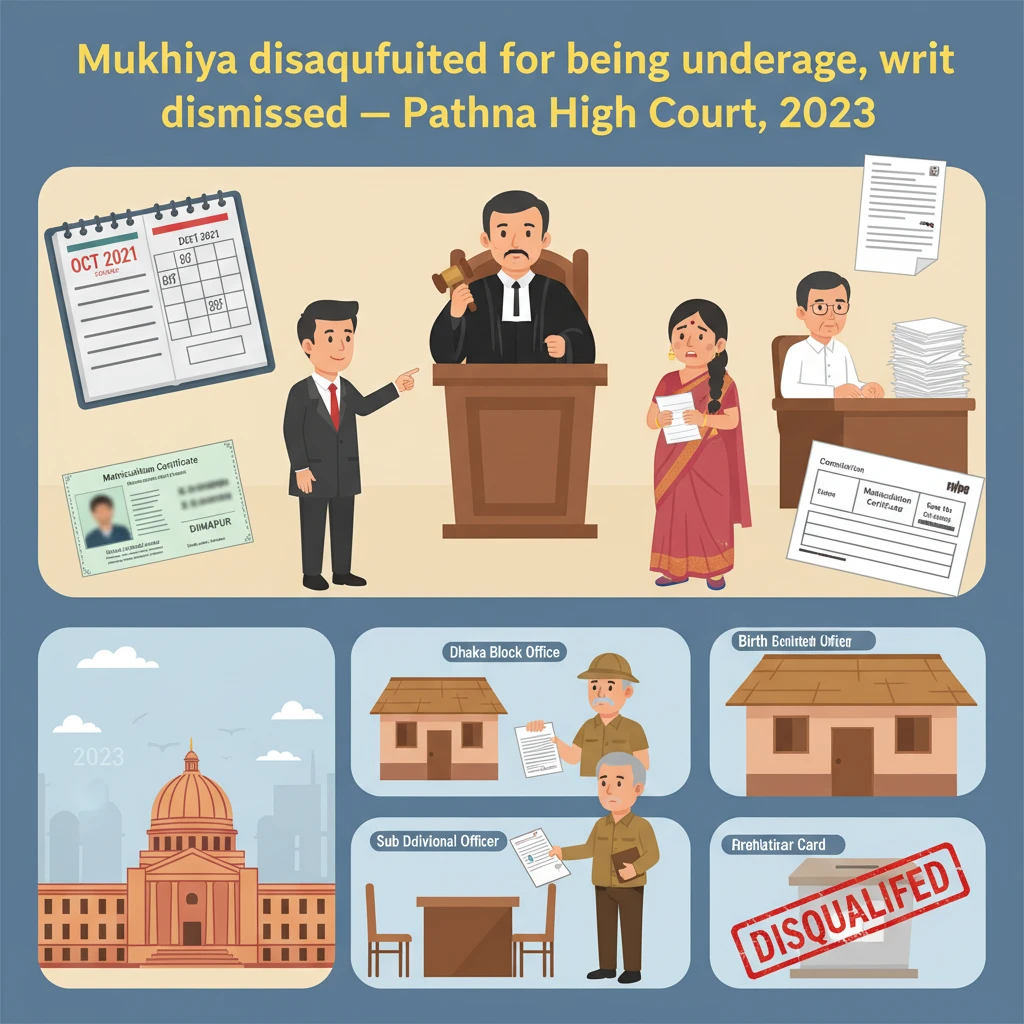
Case Background
In October 2021, elections were notified for the post of Mukhiya of Gram Panchayat Raj, Gahai under Dhaka Block in East Champaran district.
The petitioner filed her nomination for Mukhiya on 27.09.2021. In her nomination paper she declared that she was 21 years old and mentioned her date of birth as 25.01.1999.
Her nomination was scrutinised. No objection was raised at that stage. She was allowed to contest and was ultimately declared the returned candidate for the post of Mukhiya.
The private respondent (respondent no. 7), who had lost the election, later filed Complaint Case No. 5/2022 before the State Election Commission. She alleged that the petitioner was underage on the date of nomination and therefore not qualified to contest for the office of Mukhiya.
The complaint relied on the petitioner’s matriculation certificate, which recorded her date of birth as 25.01.2002. On this basis, the complainant claimed that on 27.09.2021, the petitioner was only 19 years, 8 months and 10 days old, short of the minimum 21 years required under Section 136(1)(b) of the Bihar Panchayat Raj Act, 2006.
The State Election Commission registered the complaint and issued notice to the petitioner to appear with her documentary evidence. Parallelly, the Returning Officer-cum-Block Development Officer, Dhaka, by letter dated 07.02.2022, requested the District Panchayat Raj Officer, East Champaran, to conduct an enquiry on the complaint.
After considering the material, the State Election Commissioner passed Memo No. 05/2022 dated 27.03.2023. By this memo, the petitioner was removed from the post of Mukhiya for being underage. The District Magistrate, East Champaran, Motihari was also directed to take legal action under Section 125(Ka)(3) of the Panchayat Raj Act and Sections 177 and 181 of the Indian Penal Code, 1860.
The petitioner then approached the Patna High Court under Article 226 of the Constitution. She sought quashing of Memo No. 05/2022 and a direction that the order should not be given effect during the pendency of the writ petition.
What the Court Examined and Decided
The Patna High Court heard detailed arguments from all sides: the petitioner, the State Election Commission, the State of Bihar, and the private respondent.
The core factual dispute was simple but serious: what was the petitioner’s correct date of birth, and could she be treated as underage on the election date?
Petitioner’s stand on her age
The petitioner’s case rested mainly on four sets of documents and an explanation of how the alleged error occurred.
First, she said her true date of birth is 25.01.1999, which was recorded in the records of Vidhya Bhawan Higher Secondary School, K. Kire Colony, Dimapur, Nagaland, where she had studied earlier.
Second, she produced documents showing her date of birth as 25.01.1999: her Voter ID card, PAN card, Aadhaar card, a birth certificate issued by the Department of Economics and Statistics, Government of Nagaland, and a transfer certificate from Vidhya Bhawan Higher Secondary School, Dimapur.
Third, she explained the discrepancy. According to her, after her father’s retirement the family shifted to Motihari in 2012. She then took admission in DAV Public School, Narha, Panapur. Due to a clerk’s mistake, her date of birth was recorded as 25.01.2002 instead of 25.01.1999. She claimed that her maternal uncle had taken her for admission, and the mistake occurred in his presence, even though a birth certificate issued in 2005 already showed her birth as 25.01.1999.
Fourth, she relied heavily on a letter dated 17.03.2022 from Vidhya Bhawan Higher Secondary School, Dimapur. The school stated that the petitioner had been admitted there on 12.01.2006, left on 14.12.2012, and that the school register recorded her date of birth as 25.01.1999.
Legally, the petitioner argued that while a matriculation certificate is an important document, it is not “sacrosanct” or beyond challenge. She referred to Section 12/17 of the Registration of Births and Deaths Act, 1969 and Rule 8 of the Nagaland Registration of Births and Deaths (Amendment) Rules, 1999 to support the reliability of the birth certificate from Nagaland. She also cited Supreme Court decisions in Brij Mohan Singh v. Priya Brat Narain Sinha (AIR 1965 SC 282) and Birad Mal Singhvi v. Anand Purohit (AIR 1988 SC 1796) to argue that the date of birth in a school or matriculation record can be questioned.
She further submitted that the question of age is a pure question of fact and therefore a pure election dispute. Under the Full Bench judgment in Rajani Kumari v. State Election Commission (2019) 6 BLJ 1 (FB), the State Election Commission could decide only those disputes which were undisputed and rested on unimpeachable documents. Since the date of birth was seriously disputed, the Commission should have first recorded a preliminary finding whether the matter was an election dispute fit for its summary jurisdiction, and in any event should have relegated the parties to an appropriate court.
State Election Commission and private respondent’s case
The State Election Commission and the private respondent contested every limb of the petitioner’s case.
They pointed out that the petitioner had declared herself as 21 years old on the basis of the voter list and her Voter ID card, but that the age or date of birth in such cards cannot be treated as legal proof. The Commission relied on several judgments, including Mamta Kumari v. State of Bihar (2022) 5 BLJ 599, where such documents were held to have weak evidentiary value compared to a matriculation certificate.
The Commission examined the school and college records in detail. The transfer certificate from Vidhya Bhawan School, Dimapur, recorded her date of birth as 25.01.1999 and showed that she left the school on 14.12.2012 after being promoted to Class 8. However, she was later admitted in DAV Public School, Panapur, East Champaran, on 05.07.2013 in Class VII, not Class VIII, and there her date of birth was recorded as 25.01.2002.
The principal of DAV Public School, in response to a query from the Sub Divisional Officer, Pakridayal, certified by letter dated 22.02.2022 that the petitioner’s result/marksheet, attached with the letter, was correct as per school records, including the date of birth 25.01.2002. Similarly, the Principal of Ramdeo Rambhajan Senior Secondary School wrote on 19.02.2022 that the petitioner had been admitted in Class XI in 2017 on the basis of DAV’s transfer certificate, which also carried the date of birth 25.01.2002.
Regarding the birth certificates from Nagaland, the Commission argued that they were not in consonance with Section 13 of the Registration of Births and Deaths Act, 1969. It noted that one birth certificate had been issued on 17.12.2005, and yet another certificate dated 09.09.2008 had also been issued in favour of the petitioner by the same authority. The place of birth differed between the two documents, their registration numbers and dates were different, and in the 09.09.2008 certificate even the date of issuance was missing. All this created serious suspicion.
The Commission further highlighted that the petitioner had passed matriculation in 2017 and intermediate in 2019, both showing her date of birth as 25.01.2002. Despite these examinations and the availability of the alleged birth certificate from 2005, she had never attempted to correct the date of birth with the examination board.
The private respondent added that the writ petitioner had not challenged the report submitted by the District Magistrate to the State Election Commission regarding her age, nor produced any supporting document before the District Magistrate showing her date of birth as 25.01.1999. According to the private respondent, the petitioner later fabricated documents, including the Nagaland birth certificate, transfer certificate, Aadhaar card, PAN card and Voter ID card, after the dispute arose. This, it was argued, amounted to perjury and justified further legal action.
It was also brought on record that when the Sub Divisional Officer, Pakridayal, issued notice to the petitioner to appear with her educational and other certificates on 14.02.2022, she did not appear, citing ailment. Instead, her father-in-law appeared and claimed that her matriculation certificate had been lost. He then produced the Nagaland birth certificate, transfer certificate and other identity documents in support of the date of birth 25.01.1999. The private respondent argued that this conduct weakened the petitioner’s case.
High Court’s approach to judicial review
The Patna High Court first clarified the limited scope of judicial review in such matters. It stated that in writ jurisdiction the Court mainly examines whether there were errors in the decision-making process, such as arbitrariness or perversity. The Court does not normally reappreciate facts or substitute its own view on merits if the authority’s view is reasonable and supported by material.
With this in mind, the Court framed the central question: can the matriculation certificate be considered an “unimpeachable document” for the State Election Commission, under Section 136(2) of the Bihar Panchayat Raj Act, 2006, to disqualify a returned candidate for being underage?
Why the Court preferred the matriculation certificate
The Court noted that the petitioner herself had declared her educational qualification as intermediate in the nomination affidavit. Both her matriculation and intermediate certificates consistently recorded her date of birth as 25.01.2002. At no point had she taken any steps to correct this date with the Central Board of Secondary Education or the concerned board.
The Court stressed that at the time of registration for the CBSE matriculation examination, all particulars are filled up by the student and countersigned by the parents. In such a system, the chance of inadvertent mistake is minimal. Even if a mistake occurs, there is a specific procedure to rectify it. The petitioner had not used this procedure at any time.
The Court treated the other documents relied upon by the petitioner—Voter ID, PAN card, Aadhaar card, and even the transfer certificate and birth certificates from Nagaland—as much weaker evidence.
In particular, the Court observed that it had itself examined the two birth certificates issued by the Department of Economics and Statistics, Government of Nagaland. The differences in registration number, registration date, parental address at the time of birth, and the missing issuance date in the 09.09.2008 certificate undermined their credibility. The Court found these inconsistencies significant.
The Court relied on several Division Bench decisions of the Patna High Court which had already addressed similar disputes:
In Babita Kumari v. State of Bihar, 2019(1) PLJR 130, the Court held that where a matriculation certificate exists and its genuineness is not disputed, there is no reason to rely on a transfer certificate, which is not conclusive proof of age and must be proved like any other piece of evidence.
In Rani Devi v. State Election Commission, 2019(1) PLJR 153, following the Supreme Court decision in Sushil Kumar v. Rakesh Kumar, (2003) 8 SCC 673, the Court held that once a candidate’s date of birth is recorded in the school admission register on the basis of disclosure by family members, the burden lies on the candidate to prove, by evidence, how that entry is wrong and what the correct date is. Electoral roll entries were held to have inconclusive value for determination of date of birth.
In Mamta Kumari v. State of Bihar, 2022(5) BLJ 599, the Division Bench faced varying dates of birth in school and college records vis-à-vis the nomination form. It ultimately held that the date of birth in the matriculation certificate must prevail.
The Court also referred to a subsequent decision in Arti Kumar v. Bihar State Election Commission, 2023(3) BLJ 558, which again gave primacy to the matriculation certificate where there was a dispute about date of birth.
Against this consistent line, the Court found the petitioner’s reliance on the Constitution Bench judgment in Brij Mohan Singh distinguishable. In that case, the alleged wrong entry in the school register was explained and found acceptable on its own facts. Here, however, the petitioner, as a CBSE student, had herself filled the registration form countersigned by her parents, and yet made no move to rectify the entry for several years, including during intermediate admission on the same basis. Therefore, she could not be allowed to repudiate those particulars now.
Final conclusion of the Court
After reviewing the impugned order of the State Election Commission, the Patna High Court found no perversity or illegality. It held that in the facts of this case, the matriculation certificate carried greater evidentiary value than the certificates and documents cited by the petitioner.
The Court emphasised that the veracity of the particulars in the matriculation certificate had never been formally challenged or disproved by the petitioner. When someone does not disapprove, the law treats it as approval. In other words, by accepting and acting upon the matriculation certificate for years, the petitioner had effectively accepted that date of birth.
Accordingly, the Court held that the State Election Commission was justified in treating the petitioner as underage based on her matriculation date of birth and in disqualifying her from the post of Mukhiya.
The writ petition was dismissed on merits, with no order as to costs.
Why This Judgment Matters
This judgment has direct practical impact on candidates for Panchayat posts in Bihar and other local bodies.
First, it clearly reinforces that the matriculation certificate is the primary and most reliable proof of age in election matters. If your school board records show you as under 21, it will be very difficult to rely on later documents like Aadhaar, PAN, Voter ID, transfer certificates or even birth certificates with doubtful entries.
Second, it warns candidates that they must correct any error in their school and board records at the earliest. Waiting until after winning an election and then blaming a “clerk’s mistake” is unlikely to succeed in court, especially where no correction process was ever started with the education board.
Third, the judgment shows that the Patna High Court will not lightly interfere with the State Election Commission’s decisions if the Commission has relied on consistent official records and conducted a fair enquiry. Writ jurisdiction will not be used to re-check every factual dispute unless there is clear perversity or procedural unfairness.
Finally, the ruling signals that filing or relying on doubtful or conflicting documents about age can invite not only disqualification but also possible criminal action, as seen from the direction issued to consider proceedings under the Panchayat Raj Act and the Indian Penal Code.
Legal Issues and Answers
- Issue: Can the State Election Commission rely on a candidate’s matriculation certificate to hold that she was underage and disqualify her from the post of Mukhiya under Section 136 of the Bihar Panchayat Raj Act, 2006?
Answer: Yes. The Patna High Court held that where the matriculation certificate’s genuineness is not challenged and it consistently records the candidate’s date of birth, it has greater evidentiary value than other conflicting documents. The State Election Commission was justified in treating the petitioner as under 21 on the nomination date and disqualifying her. - Issue: Did the High Court find any arbitrariness or perversity in the State Election Commission’s order removing the petitioner from the office of Mukhiya?
Answer: No. The Court held that the Commission’s decision was based on relevant material, including educational records and enquiry reports, and reflected a reasonable view. Hence, there was no ground for interference in writ jurisdiction. - Issue: Do identity documents like Voter ID, PAN card, Aadhaar card or electoral roll entries conclusively prove age in such disputes?
Answer: No. Relying on earlier precedents, the Court reiterated that these documents, prepared largely on self-declarations, have inconclusive evidentiary value for determining age, especially when they conflict with school and matriculation records.
Cases Cited by the Court
- Rajani Kumari v. State Election Commission, (2019) 6 BLJ 1 (FB) PHC
- Brij Mohan Singh v. Priya Brat Narain Sinha and others, AIR 1965 SC 282
- Birad Mal Singhvi v. Anand Purohit, AIR 1988 SC 1796
- Babita Kumari v. State of Bihar, 2019(1) PLJR 130
- Rani Devi v. State Election Commission, 2019(1) PLJR 153
- Sushil Kumar v. Rakesh Kumar, (2003) 8 SCC 673
- Mamta Kumari v. State of Bihar, 2022(5) BLJ 599
- Arti Kumar v. Bihar State Election Commission, 2023(3) BLJ 558
- Other Patna High Court decisions cited in argument: 2019(1) PLJR 141, 2014(4) PLJR 667
Case Details
Case Number: Civil Writ Jurisdiction Case No. 6226 of 2023
Case Title: Smt. Ragini Kumari @ Ragni Kumari Roy vs. The State of Bihar & Ors.
Court: High Court of Judicature at Patna
Coram: Hon’ble Mr. Justice Harish Kumar
Date of Judgment: 24.11.2023
Citation: 2024 (1) PLJR 373
Advocates:
- For the Petitioner: Mr. Y. V. Giri, Senior Advocate; Mr. Pranav Kumar, Advocate; Ms. Shristi Singh, Advocate
- For the State: Mr. Kumar Alok, SC-7; Ms. Rashmi Ranjan, AC to SC-7; Mr. Satyeshwar Prasad, AC to SC-7
- For the State Election Commission: Mr. Sanjeev Nikesh, Advocate; Mr. Girish Pandey, Advocate
- For the Private Respondent (Respondent No. 7): Mr. S. B. K. Manglam, Advocate; Mr. Avnish Kumar, Advocate; Mr. Kumar Gaurav, Advocate
Nature of the Case: Writ petition under Article 226 of the Constitution challenging the State Election Commission’s order disqualifying and removing an elected Mukhiya on the ground of being underage, and directing initiation of legal action under the Panchayat Raj Act and the Indian Penal Code.
Impugned Order: Memo No. 05/2022 dated 27.03.2023 issued by the State Election Commissioner, Bihar, removing the petitioner from the post of Mukhiya, Gram Panchayat Raj, Gahai, and directing legal action under Section 125(Ka)(3) of the Bihar Panchayat Raj Act and Sections 177 and 181 IPC.
Link to Judgment: Click here to access the official Patna High Court judgment
If you found this explanation helpful and wish to stay informed about how legal developments may affect your rights in Bihar, you may consider following Samvida Law Associates for more updates.







