

Case Background
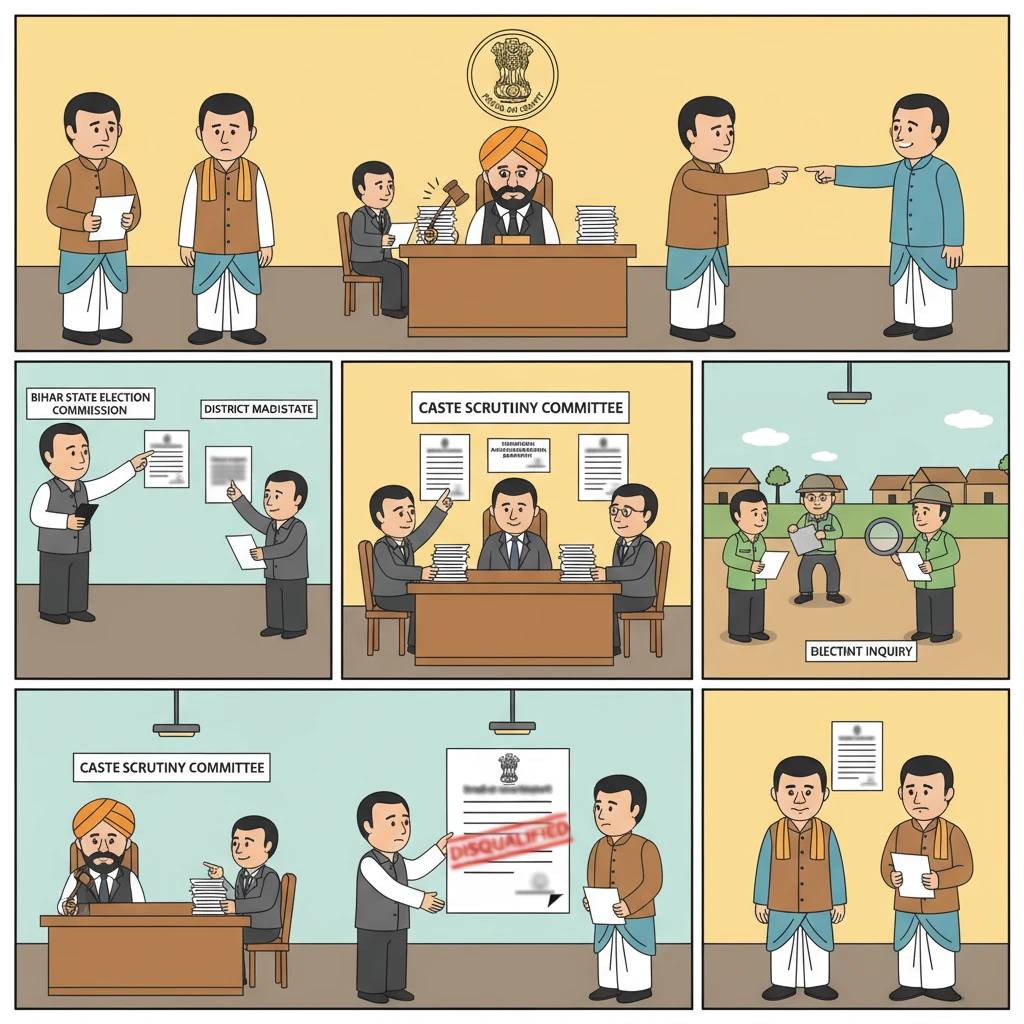
The two writ petitions were heard together because they raised the same legal issue. Both petitioners were elected as Mukhiya in the 2021 Panchayat elections.
One petitioner was elected Mukhiya of Gram Panchayat Raj Siur under Roh Block of Nawada district. The other was elected Mukhiya of Gram Panchayat Raj Wari under Singhiya Block of Samastipur district.
In both Gram Panchayats, the post of Mukhiya was reserved for members of Extremely Backward Classes (EBC). Each petitioner claimed to belong to an EBC community and filed nomination papers on that basis.
The petitioners stated that at the time of filing nomination and during scrutiny by the Returning Officer, no candidate or voter objected to their caste certificates. After the polling and counting of votes, both were declared elected as Mukhiyas.
After the declaration of results, defeated candidates filed complaints before the Bihar State Election Commission under Section 136(2) of the Bihar Panchayat Raj Act, 2006. They alleged that the petitioners did not actually belong to EBC communities and therefore were disqualified from contesting from reserved seats.
On receiving the complaints, the State Election Commissioner initiated proceedings. In one case (CWJC No. 10059 of 2023), the matter was referred directly to the Caste Scrutiny Committee under the General Administration Department. In the other (CWJC No. 12148 of 2023), the Commissioner first sought an enquiry from the District Magistrate-cum-District Election Officer (Panchayat). Other authorities also inquired into the caste status, and their reports were sent to the Commission.
As the reports of different authorities varied, the State Election Commission ultimately referred both matters to the Caste Scrutiny Committee. The General Administration Department placed the matters before the Committee, and the Criminal Investigation Department carried out a detailed enquiry.
The petitioners were given opportunity to file show-cause or written statements and to produce supporting documents. After considering the CID reports and materials available, the Caste Scrutiny Committee unanimously accepted the CID reports and rejected the petitioners’ claims regarding their caste status.
Based on the Committee’s decision, the General Administration Department treated the petitioners as not belonging to the EBC category. Thereafter, the State Election Commissioner passed orders declaring them disqualified to hold the post of Mukhiya, as the seats were reserved for EBC candidates.
The petitioners separately challenged the orders of the Caste Scrutiny Committee by filing CWJC No. 9348 of 2023 and CWJC No. 9607 of 2023 before the Patna High Court. Those writ petitions were still pending when the State Election Commission passed the disqualification orders.
Aggrieved by the disqualification, the petitioners filed the present writ petitions, CWJC No. 10059 of 2023 and CWJC No. 12148 of 2023, assailing the orders of the State Election Commissioner.
What the Court Examined and Decided
The central dispute before the Patna High Court was narrow but important. Could the State Election Commission disqualify an elected Mukhiya on the basis of a Caste Scrutiny Committee decision, when that decision was already under challenge before the High Court and had not yet attained finality?
The petitioners, represented by counsel, advanced several arguments. They relied heavily on the Full Bench decision of the Patna High Court in Rajani Kumari v. State of Bihar, reported in 2019 (4) PLJR 673, and on the Supreme Court judgment in Kumari Madhuri Patil and Another v. Additional Commissioner, Tribal Development and Others, reported in 1994 (6) SCC 241.
First, they contended that under Rajani Kumari, the State Election Commission can act under Section 136(2) of the Bihar Panchayat Raj Act, 2006 only when there is “unimpeachable” evidence regarding disqualification. According to them, once the orders of the Caste Scrutiny Committee were challenged by way of writ petitions under Article 226 of the Constitution, those orders stopped being unimpeachable. They became disputed and could not be treated as final material to disqualify them.
Second, the petitioners argued that the Supreme Court in Kumari Madhuri Patil made it clear that decisions of the Caste Scrutiny Committee are subject to challenge under Article 226. Since they had already exercised that right by filing CWJC No. 9348 of 2023 and CWJC No. 9607 of 2023, the Committee’s decisions had not attained finality. On that basis, they claimed the State Election Commissioner lacked jurisdiction to pass disqualification orders while their writ petitions were pending.
Third, they pointed out that they had sought time before the Commission to pursue out-of-turn hearing of their writ petitions. Their request was rejected, and the Commission proceeded to disqualify them. They claimed this was unfair and contrary to the legal scheme.
The counsel for the State Election Commission firmly opposed these submissions. He explained that the Caste Scrutiny Committee in Bihar was created by the General Administration Department in compliance with the directions of the Supreme Court in Kumari Madhuri Patil. The Committee is designed to be the apex fact-finding body for determining social status or caste.
He referred again to Rajani Kumari, where the Full Bench had held that whenever there is a dispute regarding caste in the context of elections under Section 136(2), the State Election Commission must rely on the decision of a competent fact-finding body, such as the Caste Scrutiny Committee, instead of itself recording evidence.
The Commission’s counsel drew attention to paragraph 184 of Rajani Kumari. There, the Full Bench recognised that the State Election Commission has power to decide pre- or post-election disqualification issues, but must do so based on “unimpeachable materials”. If there are complicated or disputed facts, the Commission must direct the parties to a competent court, tribunal or fact-finding body and wait for that body’s decision.
Once the Caste Scrutiny Committee, an apex fact-finding authority, gives its decision on caste status, the Commission’s counsel argued, it becomes an unimpeachable material for the Commission, unless and until it is set aside by a competent court. He emphasised that mere filing of a writ petition does not automatically stay or nullify the Committee’s findings.
He also relied on two recent decisions: Khushboo Ara v. State of Bihar & Ors., reported in 2023 (5) BLJ 114, and Manoj Kumar v. State of Bihar & Ors., reported in 2023 (5) BLJ 669. In Khushboo Ara, a co-ordinate Bench of the Patna High Court had already held that the finding of the Caste Scrutiny Committee is unimpeachable evidence unless it is set aside by a competent court.
Justice Harish Kumar considered the record and the rival submissions. He first examined the Supreme Court judgment in Kumari Madhuri Patil. Paragraphs 13(11) and 13(13) were quoted to show that orders of the Scrutiny Committee are final and conclusive, “only subject to the proceedings under Article 226 of the Constitution”. The Supreme Court also urged High Courts to dispose such matters as expeditiously as possible, preferably within three months, and indicated that ordinarily there would be no intra-court appeal from a Single Judge’s order, except by special leave under Article 136 of the Constitution.
The High Court then revisited the Full Bench ruling in Rajani Kumari. Paragraph 184 was reproduced in full. It clarified that the State Election Commission can examine disqualification issues under Section 136(2) of the Bihar Panchayat Raj Act, 2006, both before and after elections. However, in cases involving complex factual disputes, the Commission must send the parties to a competent court, tribunal or fact-finding body, and only act on the basis of “unimpeachable materials” received from such body.
From these authorities, the Court drew a key principle: the Commission must rely on the decision of the Caste Scrutiny Committee when caste status is in dispute, because that Committee is specifically set up as an apex fact-finding authority for that purpose.
The crucial question then was whether a Caste Scrutiny Committee decision loses its “unimpeachable” character merely because it is under challenge in a writ petition.
The Court answered this in the negative. Justice Harish Kumar noted the settled law that merely questioning the legality of a decision, or merely filing an appeal (or writ) against it, does not stay its operation. An order continues to be valid and operative until it is actually stayed, modified, or set aside by a higher court or authority.
The Court referred to the co-ordinate Bench ruling in Khushboo Ara, where it had been held that the Committee’s finding is unimpeachable evidence unless set aside by a competent court. Once the Committee concludes that a person does not belong to the reserved category, that person cannot claim benefits of reservation based on that caste. The Commission was found justified in disqualifying the candidate in that case, and its action was held consistent with Rajani Kumari.
Justice Harish Kumar also cited the Division Bench decision in Baidhnath Singh v. State of Bihar and Ors., reported in 2022 (4) BLJ 638. There, the Court clarified that in Bihar, caste certificates are issued by Revenue Authorities, but after Kumari Madhuri Patil, the power to verify or cancel such certificates lies only with the Caste Scrutiny Committee, not with the issuing authority such as the Circle Officer. The Division Bench set aside a Circle Officer’s cancellation order and directed that any challenge must be taken to the Scrutiny Committee, which should decide disputes preferably within three months.
In this backdrop, the Court held that the Caste Scrutiny Committee’s decisions in the present cases were valid and binding unless and until quashed. The mere pendency of the petitioners’ writ petitions (CWJC No. 9348 of 2023 and CWJC No. 9607 of 2023) did not change the legal status of those decisions. They remained effective unimpeachable materials for the State Election Commission.
Therefore, when the Commission used these decisions to declare the petitioners disqualified under Section 136(2) of the Bihar Panchayat Raj Act, 2006, it acted strictly in accordance with the law laid down in Rajani Kumari and the Supreme Court’s guidance in Kumari Madhuri Patil.
The Court concluded that there was no illegality or lack of jurisdiction in the Commission’s orders. The writ petitions challenging the disqualification orders were found to be without merit.
Accordingly, the Patna High Court dismissed both writ petitions and made no order as to costs. The disqualification of the petitioners from holding the offices of Mukhiya of their respective Gram Panchayats stands.
Why This Judgment Matters
This judgment has important consequences for local body elections in Bihar, particularly where posts are reserved for specific caste categories.
First, it confirms that once the Caste Scrutiny Committee concludes that a person does not belong to a reserved category, that finding can be used immediately by the State Election Commission to disqualify the person from a reserved post. This holds true even if the Committee’s decision is under challenge in a writ petition, unless a court stays or sets it aside.
Second, it reassures defeated candidates and voters that complaints about false caste claims are not ignored. There is a proper channel—through the State Election Commission and the Caste Scrutiny Committee—to address such disputes after elections.
Third, it serves as a warning for aspiring candidates. Anyone seeking to contest from a reserved seat must ensure their caste claim is genuine and capable of withstanding scrutiny. Even after winning an election, the seat can be lost if the Scrutiny Committee later finds that the caste certificate is not valid.
Finally, the ruling strengthens the role of the Caste Scrutiny Committee as the primary fact-finding body on caste issues in Bihar, and clarifies that lower authorities or the Election Commission itself cannot override its decisions unless a competent court intervenes.
Legal Issues and Answers
- Issue: Can the State Election Commission disqualify an elected Mukhiya on the basis of a Caste Scrutiny Committee decision when that decision is under challenge before the High Court?
Answer: Yes. The Patna High Court held that the Caste Scrutiny Committee’s finding remains effective and is “unimpeachable” evidence for the Commission unless it is stayed or set aside by a competent court. - Issue: Does filing a writ petition against the Caste Scrutiny Committee’s order prevent the State Election Commission from acting on that order under Section 136(2) of the Bihar Panchayat Raj Act, 2006?
Answer: No. Mere filing of a writ petition does not amount to a stay. The order of the Committee continues to operate until it is quashed or stayed, so the Commission can rely on it to declare disqualification. - Issue: What constitutes “unimpeachable materials” for the State Election Commission when deciding disqualification on caste grounds?
Answer: According to the Court, a decision of the Caste Scrutiny Committee, constituted in terms of Kumari Madhuri Patil, is an unimpeachable material for the Commission, unless invalidated by a higher court.
Cases Cited by the Court
- Kumari Madhuri Patil and Another v. Additional Commissioner, Tribal Development and Others, 1994 (6) SCC 241.
- Rajani Kumari v. State of Bihar and Others, 2019 (4) PLJR 673 (Full Bench, Patna High Court).
- Khushboo Ara v. State of Bihar & Ors., 2023 (5) BLJ 114.
- Manoj Kumar v. State of Bihar & Ors., 2023 (5) BLJ 669.
- Baidhnath Singh v. State of Bihar and Ors., 2022 (4) BLJ 638.
Case Details
Case Numbers: Civil Writ Jurisdiction Case No. 10059 of 2023; Civil Writ Jurisdiction Case No. 12148 of 2023.
Case Titles: Pooja Kumari v. The State of Bihar & Ors.; Jagannath Pauddar v. The State of Bihar & Ors.
Citation: 2024 (1) PLJR 391.
Coram: Hon’ble Mr. Justice Harish Kumar.
Date of Judgment: 24-11-2023.
Advocates (CWJC No. 10059 of 2023):
- For the petitioner: Mr. S.B.K. Manglam, Advocate; Mr. Awnish Kumar, Advocate.
- For the State respondents: Mr. Kumar Alok, SC-7; Ms. Rashmi Ranjan, Advocate; Mr. Anu Priyadarshi, Advocate.
- For respondent no. 11: Mr. Ranjeet Choubey, Advocate.
- For the State Election Commission (Panchayat): Mr. Sanjeev Nikesh, Advocate; Mr. Girish Pandey, Advocate.
Advocates (CWJC No. 12148 of 2023):
- For the petitioner: Mr. Awnish Kumar, Advocate.
- For the State respondents: Ms. Rashmi Ranjan, Advocate; Mr. Anu Priyadarshi, Advocate.
- For the State Election Commission (Panchayat): Mr. Sanjeev Nikesh, Advocate; Mr. Girish Pandey, Advocate.
Nature of the Case: Writ petitions under Article 226 of the Constitution of India challenging post-election disqualification orders passed by the State Election Commissioner under Section 136(2) of the Bihar Panchayat Raj Act, 2006.
Link to Judgment: Patna High Court Judgment – CWJC No. 10059 of 2023 and CWJC No. 12148 of 2023
If you found this explanation helpful and wish to stay informed about how legal developments may affect your rights in Bihar, you may consider following Samvida Law Associates for more updates.







