
Case Background
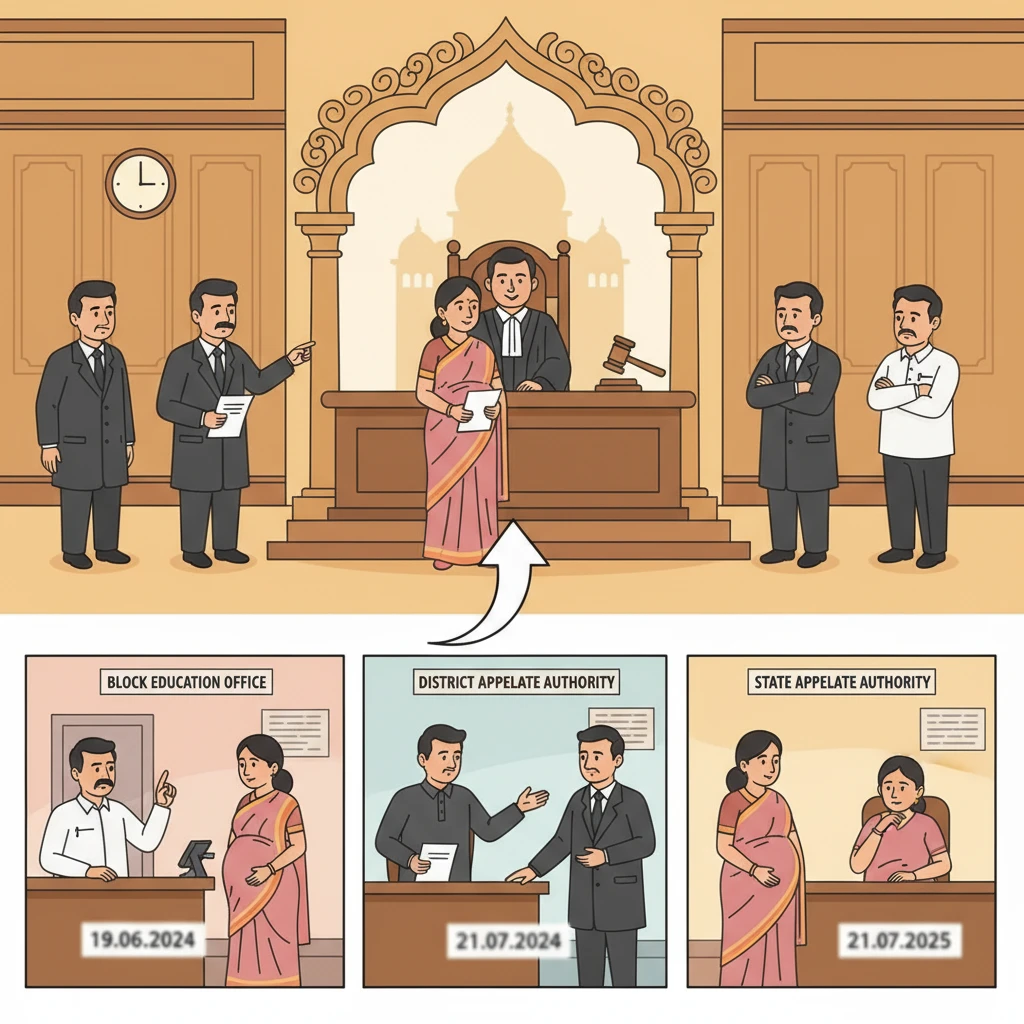
The case arose from a dispute between a woman teacher and the education authorities in Bihar over the grant of maternity leave.
The petitioner is a woman teacher working under the Bihar Panchayat Elementary School system. She sought maternity leave from 23.03.2023 to 19.09.2023. She claimed that, under Rule 20(1)(iii) of the Bihar Panchayat Elementary School Service (Appointment, Promotion, Transfer, Disciplinary Proceeding and Service Condition) Rules, 2020, she is entitled to 180 days of maternity leave.
Her application was not sanctioned by the Block Education Officer, which led her to challenge the decision before the District Appellate Authority, Patna. In Appeal Case No. 94 of 2023, the District Appellate Authority, by order dated 19.06.2024 (Annexure 5), refused to grant her maternity leave.
The petitioner then approached the State Appellate Authority. In Appeal No. 70 of 2024, the Chairperson, State Appellate Authority, Bihar, Patna, by order dated 21.07.2025 (Annexure 6), upheld the District Appellate Authority’s order and disallowed the appeal.
Feeling aggrieved, the petitioner filed Civil Writ Jurisdiction Case No. 12632 of 2025 before the Patna High Court. She prayed for quashing both appellate orders, for a direction to grant her maternity leave as provided in the 2020 Rules, and for other consequential reliefs including compensation and action against the responsible authorities.
What the Court Examined and Decided
The matter was heard by Hon’ble Mr. Justice Purnendu Singh on 05.08.2025. The Court heard Mr. Ravi Kant Kumar, counsel for the petitioner, and Mr. Subodh Kumar, AC to SC(26), for the State.
The petitioner’s main grievance was that the Block Education Officer had not sanctioned her maternity leave in accordance with Rule 20 of the 2020 Rules. She relied on the provision which makes 180 days of maternity leave available to women teachers. She asserted that the refusal to grant such leave was contrary to statutory rules and to the protections under the Maternity Benefit Act and the Constitution of India.
The Court recorded that Rule 20 of the Bihar Panchayat Elementary School Service (Appointment, Promotion, Transfer, Disciplinary Proceeding and Service Condition) Rules, 2020 is in conformity with Section 3(C) of the Maternity Benefits Act and Article 15(3) of the Constitution of India. Thus, the rule reflects a legislative and constitutional intent to protect women employees during maternity.
The Court then referred to an important decision of the Supreme Court in Deepika Singh v. Central Administrative Tribunal & Ors., Civil Appeal No. 5308 of 2022 (arising out of SLP (C) No. 7772 of 2021). In that case, the Supreme Court dealt with denial of maternity-related leave on the basis of technical interpretation of service rules.
The Supreme Court in Deepika Singh had noted that the husband of the appellant had two children from his first marriage, which ended with the death of his first wife. The appellant’s maternity leave was rejected on the ground that, as per Rule 43(C) of the Central Civil Services (Leave) Rules, 1972, Child Care Leave and maternity leave were applicable to only two children, and she had already availed such leave in respect of two children.
The Apex Court held that such a narrow interpretation ignored the real purpose of maternity and child care leave. The Court emphasized that a child requires proper care and that a woman who has conceived may be compelled by social circumstances to give up work after childbirth if support from the employer is denied. On that reasoning, the Supreme Court allowed maternity leave in those circumstances.
Relying on that precedent, the Patna High Court observed that the petitioner’s case is covered by the law laid down in Deepika Singh. The High Court accepted that maternity leave must be interpreted and granted in a beneficial manner, keeping in view the object of the law and constitutional protections for women.
The Court then turned to examine the validity of the orders passed by the District Appellate Authority and the Chairperson, State Appellate Authority.
Regarding the order dated 21.07.2025 passed by the Chairperson, State Appellate Authority, Bihar, Patna in Appeal No. 70 of 2024, the Court held that it is not sustainable. The reason was that the order had been passed by an officer of the Indian Administrative Service (IAS), but the composition of the Tribunal, as required by Rule 4(3) of the Bihar State School Teachers and Employees Disputes Redressal Rules, 2015, had not been fulfilled.
The Court noted that the Tribunal quorum under the 2015 Rules is mandatory. Since this quorum requirement was not met, the order suffered from lack of proper jurisdiction. In support, the Court referred to the Supreme Court’s judgment in State of Gujarat v. Utility Welfare Association, reported in (2018) 6 SCC 21, which addresses issues of jurisdiction and the validity of orders passed without proper authority or composition.
On this basis, the Court held that both the impugned order dated 19.06.2024 of the District Appellate Authority in Appeal No. 94 of 2023 and the order dated 21.07.2025 of the Chairperson, State Appellate Authority in Appeal No. 70 of 2024 are without jurisdiction and therefore liable to be set aside and quashed.
The Court also rejected the clarification given by the Block Education Officer, stating that it “cannot be sustained.” This indicates that any justification offered by the Block Education Officer for denying the maternity leave did not stand up to legal scrutiny.
The Court went further to underline the constitutional dimension. It held that the employment unit is required to sanction maternity leave as per the mandate of Article 21 of the Constitution of India, which safeguards the right to life and personal liberty. Non-grant of maternity leave, the Court stated, has resulted into a miscarriage of justice.
In paragraph 7 of the judgment, the Court clearly held that the petitioner is entitled to maternity leave of 180 days, in light of the law laid down by the Supreme Court in Deepika Singh. This directly affirms her right to the leave period she had claimed (23.03.2023 to 19.09.2023), which roughly spans 180 days.
The petitioner had also prayed for heavy compensation on the ground that due to the respondents’ actions her newborn child had died and that her EPF had become irregular. She had additionally sought “proper action” against the responsible authorities for allegedly adopting a pick-and-choose method without following law and procedure.
However, the judgment, as recorded, does not grant compensation or direct specific punitive action against officers. The Court’s operative directions are confined to quashing the impugned appellate orders, disapproving the Block Education Officer’s clarification, and directing that maternity leave be sanctioned as required by law. There is no separate award of compensation or specific directions against individual officers mentioned in the text of the judgment.
Finally, the Court disposed of the writ application, with an express statement that there would be no order as to costs.
Why This Judgment Matters
This judgment has important practical consequences for women teachers and other employees under the Bihar education system.
First, it reinforces that maternity leave of 180 days available under Rule 20 of the 2020 Rules is a real and enforceable right, not something that can be denied on narrow or technical grounds by local officers like Block Education Officers.
Second, the Patna High Court links the grant of maternity leave to fundamental rights under Article 21 of the Constitution and to beneficial legislation such as the Maternity Benefit Act. This underlines that refusal of maternity leave can amount to serious injustice, not just a minor service dispute.
Third, the judgment clarifies that appellate bodies like the District Appellate Authority and the State Appellate Authority must function strictly within the limits of their jurisdiction and composition prescribed by the Bihar State School Teachers and Employees Disputes Redressal Rules, 2015. If the required quorum or structure is not fulfilled, their orders can be declared without jurisdiction and quashed.
For women employees, particularly Panchayat school teachers, this decision is a strong signal that the Patna High Court will protect their maternity rights and will not permit authorities to bypass statutory rules and constitutional protections.
Legal Issues and Answers
- Issue: Whether the petitioner, a Panchayat school teacher, was entitled to 180 days of maternity leave under Rule 20 of the 2020 Rules, in harmony with the Maternity Benefit Act and constitutional protections.
Answer: Yes. The Court held that she is entitled to 180 days of maternity leave, relying on Rule 20, Section 3(C) of the Maternity Benefits Act, Article 15(3) and Article 21 of the Constitution, and the Supreme Court’s ruling in Deepika Singh. - Issue: Whether the orders of the District Appellate Authority and the Chairperson, State Appellate Authority, refusing her maternity leave, were legally valid.
Answer: No. The Court held that both orders were without jurisdiction as the Tribunal quorum under Rule 4(3) of the 2015 Rules was not fulfilled, and therefore those orders were set aside and quashed. - Issue: Whether the clarification of the Block Education Officer justifying denial of maternity leave could be sustained.
Answer: No. The Court explicitly stated that the clarification given by the Block Education Officer cannot be sustained, and directed the employment unit to sanction maternity leave as mandated by law.
Cases Cited by the Court
- Deepika Singh v. Central Administrative Tribunal & Ors., Civil Appeal No. 5308 of 2022 (arising out of SLP (C) No. 7772 of 2021)
- State of Gujarat v. Utility Welfare Association, (2018) 6 SCC 21
Case Details
Case Number: Civil Writ Jurisdiction Case No. 12632 of 2025
Case Title: Shobha Kumari v. The State of Bihar & Ors.
Citation: 2025(4) PLJR 01
Court: High Court of Judicature at Patna
Coram: Hon’ble Mr. Justice Purnendu Singh
Date of Judgment: 05.08.2025
Advocates:
For the petitioner: Mr. Ravi Kant Kumar, Advocate
For the respondents/State: Mr. Subodh Kumar, AC to SC(26)
Respondents: State of Bihar through Additional Chief Secretary, Education Department, and other education authorities including District Education Officer, Block Education Officer, Head Master of the concerned school, District Appellate Authority, and Chairperson, State Appellate Authority.
Nature of the case: Writ petition under Article 226 challenging denial of maternity leave and the orders of the District Appellate Authority and State Appellate Authority in service/maternity benefits matter.
Link to Judgment: Patna High Court Judgment in CWJC No. 12632 of 2025
If you found this explanation helpful and wish to stay informed about
how legal developments may affect your rights in Bihar,
you may consider following Samvida Law Associates for more updates.







