
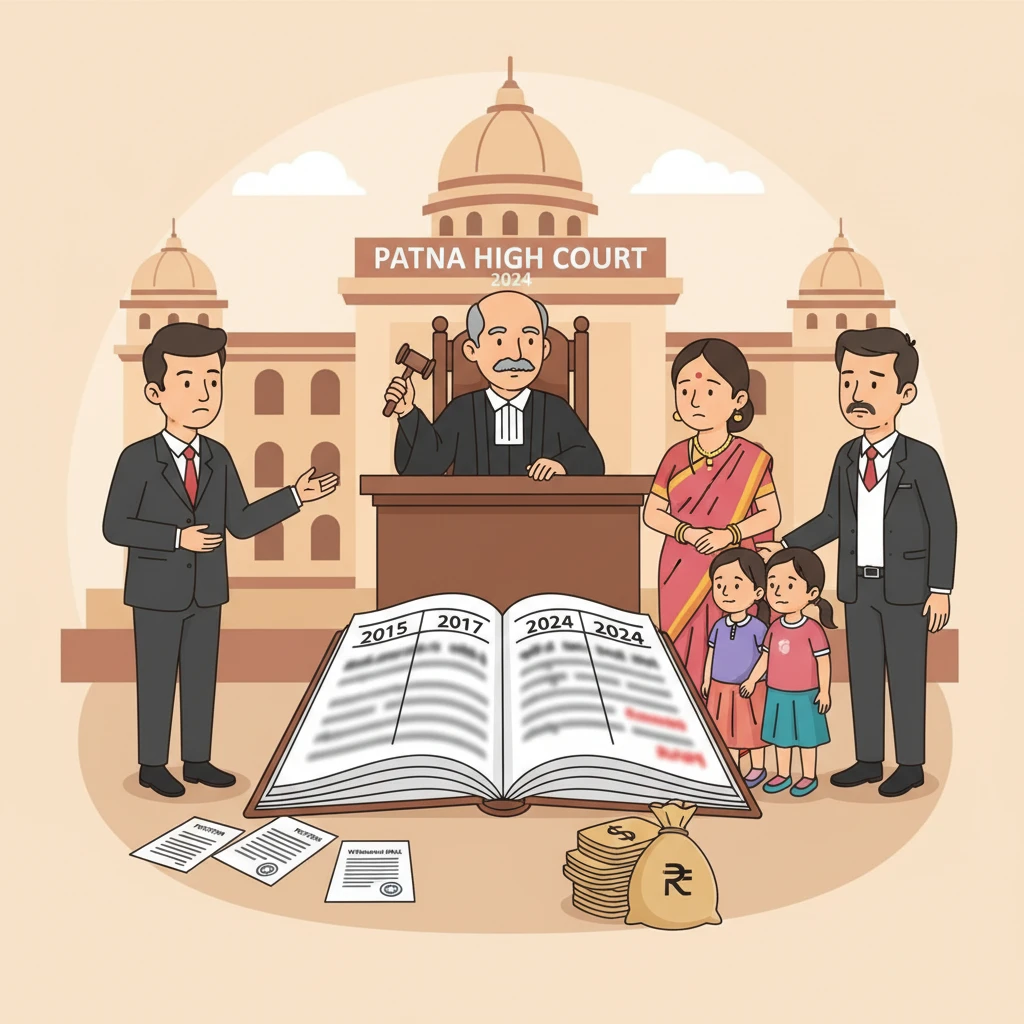
Case Background
The petitioner (husband) and opposite party no.2 (wife) were married on 27.02.2009 according to Hindu rites and rituals. From this marriage, they had a son (opposite party no.3) and a daughter (opposite party no.4).
The wife later lodged Mahila P.S. Case No. 15 of 2015 under Sections 341, 327, 498A, 379, 504, 506 and 34 of the Indian Penal Code and under Sections 3 and 4 of the Dowry Prohibition Act against her husband and his family members. She alleged that on 30.10.2014 her in-laws assaulted her, snatched her belongings, and drove her out of her matrimonial home.
On 01.04.2015, the wife filed M.R. Case No. 82 of 2015 under Section 125 Cr.P.C. before the Principal Judge, Family Court, Madhubani, seeking maintenance from her husband. The husband appeared in that case and filed his written statement on 23.03.2017.
Later, on 25.07.2017, both husband and wife jointly filed M.M. Case No. 176 of 2017 for divorce by mutual consent under Section 13B of the Hindu Marriage Act, 1955. This mutual consent divorce petition also contained terms about a one-time financial settlement.
The present criminal revision (Criminal Revision No. 1104 of 2019) arose from the order dated 27.06.2019 passed in M.R. Case No. 82 of 2015, by which the Principal Judge, Family Court, allowed the wife’s maintenance petition and granted her Rs. 3,500/- per month. The husband challenged this maintenance order before the Patna High Court.
What the Court Examined and Decided
The key dispute before the Patna High Court was whether the wife, after having entered into a mutual consent divorce settlement and receiving part of the agreed amount, could still withdraw her consent to divorce and, at the same time, claim monthly maintenance under Section 125 Cr.P.C.
The husband’s main stand was based on the mutual consent divorce case, M.M. Case No. 176 of 2017. He claimed that both parties had agreed to a one-time permanent alimony of Rs. 1,31,000/-. Out of this, Rs. 65,500/- was paid at the time of the first motion in the mutual consent divorce proceedings. The balance of Rs. 65,500/- was to be paid at the time of the second motion.
According to the husband, it was agreed that this amount would be full and final one-time permanent alimony and that the wife would not claim anything further thereafter. On the same day, the wife was examined as a witness in that mutual consent divorce case. He also stated that both sides had agreed to compromise their criminal disputes and that the wife would withdraw M.R. Case No. 82 of 2015.
The husband argued that after receiving Rs. 65,500/- in the first motion, the wife failed to appear in the mutual consent divorce proceedings for the second motion, despite the Court’s direction on 02.03.2021 to deposit the remaining Rs. 65,500/-. In compliance with this order, the husband deposited a demand draft of Rs. 65,500/- on 25.03.2021.
He complained that after getting the first instalment, the wife filed an application to withdraw her consent from the mutual divorce joint petition. Therefore, according to him, she had acted unfairly and, having once agreed to permanent alimony, she could no longer claim monthly maintenance under Section 125 Cr.P.C.
The husband also claimed that he worked as a cook and earned only Rs. 5,000/- per month. He felt that the Family Court failed to consider his limited income and the earlier payment of Rs. 65,500/- while granting Rs. 3,500/- per month as maintenance.
On the other hand, counsel for opposite party nos. 2 to 4 (wife and children) argued that the compromise in the mutual consent divorce case had clearly failed. They accepted that a mutual consent divorce case (M.M. Case No. 176 of 2017) had been filed, and that in the first motion, Rs. 65,500/- was paid and accepted by the wife in the Court premises.
However, at the stage of the second motion, the wife did not appear and instead filed an application on 23.04.2019 stating that she wanted to live with the husband along with their minor children as wife and husband. In this petition, she also alleged that the husband, his parents and his brother had threatened, pressured and tortured her for the second motion in the Court campus, and under those circumstances she wished to withdraw her consent given in the joint petition for mutual divorce.
The wife’s counsel highlighted that under Section 13B(2) of the Hindu Marriage Act, 1955, one of the parties is legally permitted to withdraw consent at any stage before the decree of divorce is passed. Therefore, if a party withdraws consent before the second motion, the Court cannot grant a decree for divorce by mutual consent, and any compromise based on such mutual consent cannot bind the withdrawing party.
To support this legal position, the wife’s counsel relied on the Supreme Court decision in Smt. Sureshta Devi vs. Om Prakash, reported in (1991) 2 SCC 25. They also pointed out that the husband subsequently filed Matrimonial (Divorce) Case No. 281 of 2023 under Sections 13(1)(a) and 13(1)(b) of the Hindu Marriage Act for dissolution of marriage, and that this fact had been suppressed by him while challenging the maintenance order.
Justice Sandeep Kumar of the Patna High Court examined the two grounds raised by the husband against the maintenance order dated 27.06.2019:
- That a joint petition under Section 13B for divorce by mutual consent had been filed, and the first motion was allowed.
- That the wife had already received Rs. 65,500/- in the first motion as part of permanent alimony and, therefore, could not later claim maintenance.
The Court first turned to the law on mutual consent divorce. Referring to the Supreme Court’s judgment in Smt. Sureshta Devi vs. Om Prakash, the Court noted that:
- Filing of a mutual consent divorce petition does not automatically entitle the parties to a decree of divorce.
- There is a waiting period of 6 to 18 months between the first and second motions, meant to allow the parties to reconsider their decision.
- Mutual consent must exist not only at the time of filing the petition, but also at the time of the second motion when the Court is requested to pass the decree.
- If one party withdraws consent before the decree, the Court has no jurisdiction to grant a divorce by mutual consent.
The Court quoted paragraphs 13 and 14 of the Sureshta Devi decision, emphasising that if, at the time of hearing, one party says “I have withdrawn my consent” or “I am not a willing party to the divorce”, the Court cannot pass a decree of divorce by mutual consent.
The Patna High Court then referred to another Supreme Court decision, Smruti Pahariya v. Sanjay Pahariya, (2009) 13 SCC 338, where a three-Judge Bench held that mutual consent of the parties is a jurisdictional fact for passing a decree under Section 13B. The Court must be satisfied about the existence of mutual consent on clear and tangible materials.
Further, the Court cited Hitesh Bhatnagar vs. Deepa Bhatnagar, (2011) 5 SCC 234, where the Supreme Court reaffirmed that:
- The second motion must be made within 18 months from filing of the petition.
- Either party can withdraw consent at any time before the decree is passed.
- The most important requirement for a mutual consent divorce is the free consent of both parties till the final stage.
The principle in Hitesh Bhatnagar had already been followed by a coordinate Bench of the Patna High Court in Smt. Anupama Devi @ Anupama vs. Shailendra Kumar Dubey (C.W.J.C. No. 2299 of 2016), and this was also noted in the judgment.
Applying these settled principles, Justice Sandeep Kumar held that in a proceeding for divorce by mutual consent, either party can withdraw their consent at any point between the first and second motions. If consent is withdrawn, the other party cannot insist that divorce must still be granted as if the earlier consent were irrevocable.
In the present case, the wife (opposite party no.2) had withdrawn her consent before the second motion. Therefore, divorce by mutual consent could not be granted. Once this is accepted, the entire basis of the husband’s argument—that the wife is bound by the earlier compromise and cannot claim maintenance—collapsed.
The Court also noted that the Principal Judge, Family Court, had considered the wife’s situation and found that she was unemployed. Given this, the Family Court granted what the High Court described as a “meagre amount” of Rs. 3,500/- per month as maintenance.
Justice Sandeep Kumar also recorded that a separate divorce case, Matrimonial (Divorce) Case No. 81 of 2023, for dissolution of marriage, was pending adjudication.
In light of the legal position on withdrawal of consent in mutual consent divorce, and the factual finding that the wife was unemployed and in need of support, the Patna High Court held that there was no illegality in the Family Court’s order dated 27.06.2019 granting maintenance under Section 125 Cr.P.C.
Accordingly, the criminal revision petition filed by the husband was dismissed, and the maintenance order of Rs. 3,500/- per month in favour of the wife was upheld.
Why This Judgment Matters
This judgment is important for women and men who enter into mutual consent divorce settlements but later have second thoughts. The Patna High Court has clearly reaffirmed that consent to mutual divorce is not final until the Court actually passes a decree.
If one spouse withdraws consent before the second motion, the mutual consent divorce cannot be forced upon them. Even if some money has been paid under a proposed “one-time settlement”, that alone does not wipe out the right of a spouse—especially a financially dependent wife—to claim maintenance under Section 125 Cr.P.C., unless there is a final, binding legal order to that effect.
The decision also sends a message that Family Courts must look at the real financial need of the wife and whether she is employed, rather than being controlled by incomplete or failed compromises. Here, the Court protected the right of an unemployed wife to basic monthly support despite an earlier failed effort at mutual divorce.
For laypersons, especially in Bihar, this judgment clarifies that:
- Agreeing once to mutual divorce does not permanently lock you in, if you genuinely change your mind before the final decree.
- Your right to claim maintenance under Section 125 Cr.P.C. is not automatically lost just because you once accepted some money in a failed settlement.
- Courts will carefully apply Supreme Court law to ensure that mutual consent is truly free and continuing, not forced or extracted under pressure.
Legal Issues and Answers
-
Issue: Can a spouse who has filed a joint petition for divorce by mutual consent under Section 13B of the Hindu Marriage Act, accepted part of a proposed one-time settlement, and then withdrawn consent before the second motion, still claim maintenance under Section 125 Cr.P.C.?
Answer: Yes. The Patna High Court held that consent in a mutual consent divorce can be withdrawn any time before the decree, and once withdrawn, the joint petition and compromise are not binding. The Family Court was right to consider the wife’s claim for maintenance and to grant Rs. 3,500/- per month. -
Issue: Is consent given in the first motion of a Section 13B Hindu Marriage Act petition irrevocable so as to bar later withdrawal or maintenance claims?
Answer: No. Relying on Supreme Court decisions in Smt. Sureshta Devi vs. Om Prakash, Smruti Pahariya v. Sanjay Pahariya and Hitesh Bhatnagar vs. Deepa Bhatnagar, the Court held that mutual consent must continue till the time the decree is passed. Either party can withdraw consent in the interregnum, and in such a case, the Court cannot grant divorce by mutual consent and the earlier consent does not bar maintenance.
Cases Cited by the Court
- Smt. Sureshta Devi vs. Om Prakash, (1991) 2 SCC 25
- Smruti Pahariya v. Sanjay Pahariya, (2009) 13 SCC 338
- Hitesh Bhatnagar vs. Deepa Bhatnagar, (2011) 5 SCC 234
- Smt. Anupama Devi @ Anupama vs. Shailendra Kumar Dubey, C.W.J.C. No. 2299 of 2016 (Patna High Court)
Case Details
Case Number: Criminal Revision No. 1104 of 2019 (arising out of M.R. Case No. 82 of 2015; linked with Mahila P.S. Case No. 15 of 2015; M.M. Case No. 176 of 2017; Matrimonial (Divorce) Case No. 81 of 2023 / 281 of 2023 as referred)
Case Title: Saroj Chandra Jha vs. The State of Bihar & Ors.
Coram: Hon’ble Mr. Justice Sandeep Kumar
Citation: 2025(4) PLJR 641
Advocates:
- For the Petitioner (Husband): Mr. V.N. Prasad Singh, Senior Advocate; Mr. Rajesh Kumar, Advocate
- For the State: Mr. Shyam Kumar Singh, APP
- For Opposite Party Nos. 2 to 4 (Wife and Children): Mr. Jitendra Kumar, Advocate; Mr. Manish Kumar No. 13, Advocate; Mr. Rohit Kumar, Advocate
Nature of the Case: Criminal revision against an order of maintenance under Section 125 Cr.P.C. passed by the Principal Judge, Family Court, Madhubani.
Date of High Court Judgment: 24.10.2024 (C.A.V. judgment; CAV date 27.06.2024; uploading date 24.10.2024; transmission date 24.10.2024)
Impugned Order: Order dated 27.06.2019 in M.R. Case No. 82 of 2015 granting Rs. 3,500/- per month to the wife as maintenance.
Outcome: Criminal Revision dismissed; maintenance order upheld.
Link to Judgment: View full judgment of Patna High Court
If you found this explanation helpful and wish to stay informed about
how legal developments may affect your rights in Bihar,
you may consider following Samvida Law Associates for more updates.







