

Case Background
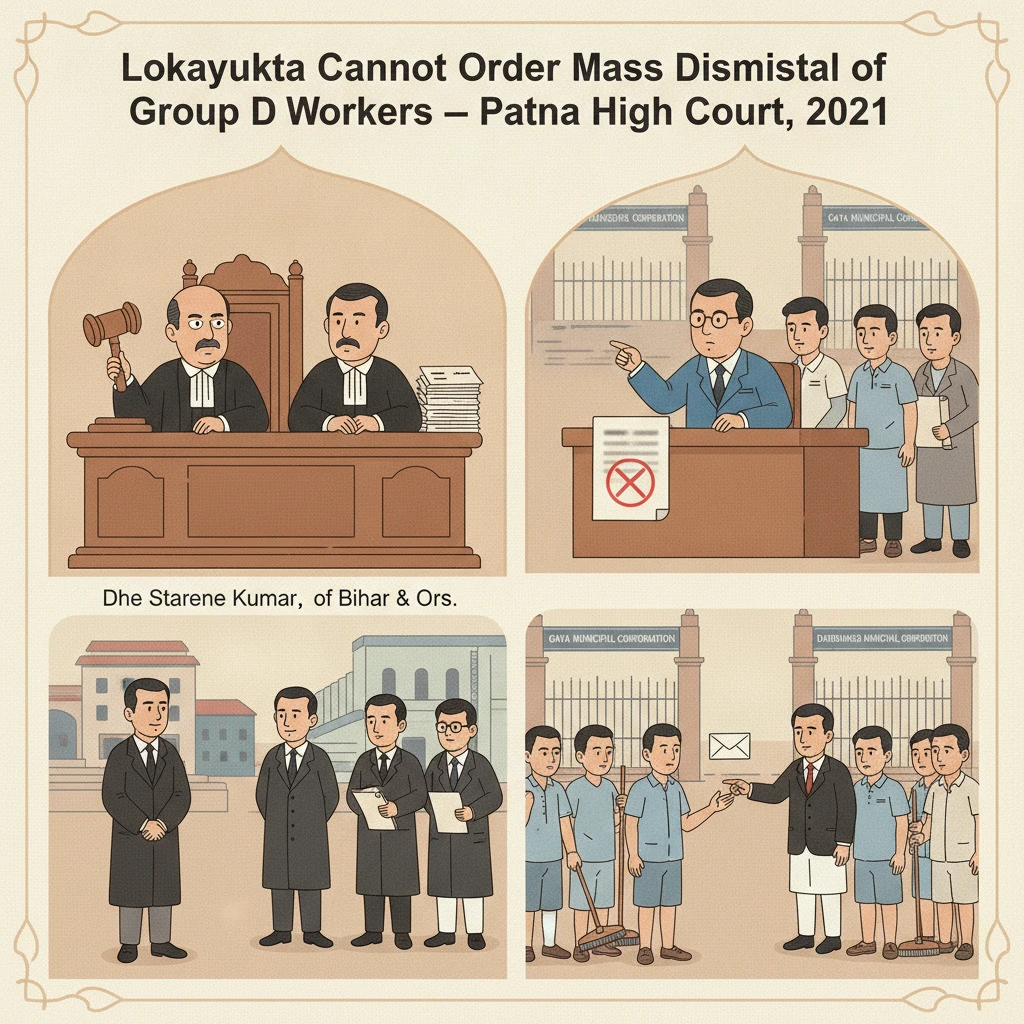
The case arose out of an order dated 28.11.2019 passed by the Hon’ble Member (Judicial), Lokayukta, Bihar in Case No. 1/Lok/(Urban Development)/31/2010 titled Md. Saifuddin v. Mayor Municipal Corporation.
In that Lokayukta proceeding, the Member (Judicial) relied upon a Government policy for outsourcing Group D services in all municipal bodies. He recorded that engagement of Group D employees on daily wage basis was, in his view, a “perennial source of corruption”, and that municipal bodies which had not outsourced such services had “some agenda for subverting” the policy.
On that basis, the Lokayukta directed that municipal bodies which had not yet outsourced Group D services must submit explanations for non-compliance with the Government decision. They were also required to report how many daily wage employees were being engaged and to show cause why a direction should not be issued for stopping this practice from April 2020.
The Lokayukta made it “clear” that if municipal bodies, including Patna Municipal Corporation and Muzaffarpur Municipal Corporation, failed to submit the report, an order would be passed restraining engagement of any Group D employees with effect from 01.04.2020. The order also specifically warned Darbhanga Municipal Corporation that its request for further extension to continue daily wagers would not be entertained if outsourcing was not completed by 31.01.2020.
In furtherance of this order, the Additional Secretary, Office of the Lokayukta, Bihar communicated the direction to the Deputy Secretary, Urban Development and Housing Department, Bihar by letter dated 09.12.2019 for compliance.
Consequently, the Special Secretary, Urban Development and Housing Department issued directions to all Municipal Commissioners across Bihar, including Gaya Municipal Corporation, to stop taking services of Group D employees on daily wages.
These Group D workers included many sweepers. As recorded by the High Court, the evident result of stopping their services was that the entire Gaya Municipal Corporation area, a national tourist place, became “completely flooded with garbage”.
Against this background, the writ petitioner, a resident of Gaya, filed Civil Writ Jurisdiction Case No. 3599 of 2020 on 15.02.2020 before the Patna High Court.
The petitioner challenged the Lokayukta’s order and its fallout, primarily on two grounds: first, that the order restraining daily wage Group D employees of Gaya Municipal Corporation was arbitrary, without jurisdiction, and beyond the mandate of the Bihar Lokayukta Act, 2011; and second, that the Lokayukta overstepped his jurisdiction by directing the authorities to implement such an order.
What the Court Examined and Decided
The Division Bench, comprising Hon’ble the Chief Justice and Hon’ble Mr. Justice S. Kumar, framed three central questions:
1. What is the role and scope of the institution of Lokayukta under the Bihar Lokayukta Act, 2011?
2. Does the Act permit the Lokayukta to take up service matters?
3. Whether termination of services of a group of employees, as ordered by the Lokayukta, fits within the vision laid down for such an institution?
In the counter affidavit filed by the State (through respondent Nos. 1 and 2), the Urban Development and Housing Department explained the steps it had taken after the Lokayukta’s order. Initially, by Memo No.406 dated 28.01.2020, all municipal local bodies were directed, in compliance with the Lokayukta’s order, to restrain services of Group D employees from outsourcing.
However, after considering the matter “in totality”, the Department issued Memo No.454 dated 03.02.2020 staying the earlier letter till 31.03.2020. Subsequently, due to the Covid-19 pandemic and lockdown, the outsourcing service facility for Group D employees was extended till 01.06.2020 (letter no.1430 dated 30.03.2020) and then till 01.09.2020 (letter no.1869 dated 29.05.2020).
Later, letter no.3603 dated 12.10.2020 was issued to the Municipal Commissioner, Darbhanga, with copies to all municipal local bodies, extending outsourcing service benefits of Group D employees till March 2021. The same letter also directed maintenance of status quo in light of an interim order dated 28.05.2020 passed by the Patna High Court in CWJC No.5713 of 2020 (Bihar Local Bodies Employee Federation and Ors v. State of Bihar and Ors). The outsourcing services of Group D employees continued.
The High Court reproduced in full the interim order of 28.05.2020 in CWJC No.5713 of 2020. In that case, the Court had granted an interim order of status quo to protect about 25,000 daily wage workers/scavengers from being removed from 01.06.2020, and had directed that the impugned orders not be given effect to till the next date of hearing.
Turning to the core legal questions, the Bench undertook a detailed analysis of the legislative background and scope of the Lokayukta institution.
It traced the genesis of the ombudsman concept from the Administrative Reforms Commission’s Interim Report of 1966, which proposed Lokpal at the Centre and Lokayukta at the State level. The report envisaged that these bodies would investigate administrative acts of ministers and senior officials where citizens claimed to have suffered injustice.
The Court also quoted from the report to show that institutions like Lokpal and Lokayukta were designed as independent bodies supplementing parliamentary control, free from political influence, outside normal administrative hierarchy, and meant to remove a citizen’s sense of injustice while maintaining public confidence in administration.
Next, the Court referred to the Lokpal and Lokayuktas Act, 2013 and its preamble, which clearly states that these institutions are meant “to inquire into allegations of corruption against certain public functionaries”. The 77th Report of the Department-related Parliamentary Standing Committee was cited to underline that the Act was enacted to set up an “independent and empowered anti-corruption institution”.
The Bihar Lokayukta Act, 2011 was examined in detail. The preamble of the Bihar Act, as reproduced by the Bench, clarifies that it aims at “expeditious investigation and prosecution relating to allegations involving corruption against public servants of all grades”.
The Court highlighted key provisions:
Section 2(b) defines “allegation” in relation to a public servant in terms of abuse of position, personal interest or corrupt motives, or lack of integrity.
The term “mal administration” is defined with reference to unreasonable, unjust, oppressive or discriminatory actions, or negligence or undue delay in administrative functions.
Section 16 sets out the jurisdiction of the Lokayukta. It authorizes the Lokayukta to inquire into matters arising from allegations or grievances against public servants such as the Chief Minister, Ministers, Members of the State Legislature, officers of specified bodies, and heads or employees of local authorities, corporations, government companies, societies, NGOs and other subsidised institutions, but always in connection with “allegation or grievance” as defined in the Act.
Section 28A prescribes how the Lokayukta must act when, after investigation, it finds that an administrative action has resulted in injustice or undue hardship. In such cases, it has to issue a written report recommending remedial action to the concerned public servant and competent authority, who must respond within three months. If the Lokayukta is not satisfied with the action taken, it can submit a special report to the Governor.
Section 38(1)(a) allows the Lokayukta, where it is prima facie satisfied that leases, licences, permissions, contracts or agreements were obtained by corrupt means, to recommend their cancellation or modification and blacklisting of those involved. Section 38(1)(b) allows it, during an investigation, to recommend preventive action in public interest, such as staying implementation of a decision to prevent ongoing corruption.
Importantly, Section 38(1)(i) allows the Lokayukta to impose punishments like dismissal, removal or reduction in rank, but this power relates to “its functionaries” — that is, officers and staff of the Lokayukta itself — not to employees of other departments or municipal bodies.
From this statutory scheme, the Patna High Court drew a clear conclusion: the jurisdiction of the Lokayukta is intrinsically connected with allegations of corruption or mal-administration by public servants. Any action must be in relation to such allegations and must follow the procedure of recommendation to the competent authority, not direct orders taking over executive functions.
The Court supported this interpretation by citing Supreme Court decisions. In Institution of A.P. Lokayukta/Upa-Lokayukta v. T. Rama Subba Reddy, (1997) 9 SCC 42, the Supreme Court emphasized that Lokayukta and Upa-Lokayukta are meant to function as real ombudsmen to maintain public faith in public bodies, and that their decisions should be capable of implementation. However, even that judgment indicated that the Government is not automatically bound by their recommendations, and the legislature may need to clarify compliance mechanisms.
The Bench also quoted extensively from Justice Chandrashekharaih (Retired) v. Janekere C. Krishna & Ors., (2013) 3 SCC 117, where the Supreme Court reiterated the intended independence and limited remit of Lokpal/Lokayukta-type institutions.
Further, the Court relied on its own earlier Single Judge decision in Bipin Bihari Singh v. State of Bihar (CWJC No. 18053 of 2019, decided on 03.06.2020). There, it was held that any decision sans jurisdiction is non est; a statutory body cannot act beyond the powers conferred by its parent statute; and the Lokayukta is “certainly not a super executive” nor does it have powers of judicial review like a High Court under Article 226 of the Constitution.
Applying these principles, the Bench held that termination of people from service falls squarely within “service jurisprudence”. Such service matters, including continuation or non-continuation of employment of Group D employees, lie outside the jurisdiction of the Lokayukta under the Bihar Act.
The Court noted that although the Member (Judicial) had recorded that engagement of Group D employees on daily wage basis was a perennial source of corruption, no investigation report was on record to support this conclusion. There was no comprehensive report under Section 28A recommending specific remedial action to the competent authority and no process of consideration by that authority within three months, or any special report to the Governor.
Instead, the Lokayukta had directly issued orders and directions to restrain the engagement of Group D daily wage employees from a specified date and to require explanations for non-implementation of Government policy. In the High Court’s view, such direct orders could not be sustained either in the “letter, much less spirit of the law”. The statutory design is that the Lokayukta recommends; it does not itself terminate services or shut down categories of employment in municipal bodies.
The Court therefore concluded that the questions relating to continuation of employment of Group D or any other service do not fall within the jurisdiction of the Institution of Lokayukta, Bihar. Any action taken in furtherance of the impugned order was declared void.
Accordingly, the High Court set aside the Lokayukta’s order dated 28.11.2019 in Case No.1/Lok/(Urban Development)/31/2010. It held that the order is non-est in law, and that all actions taken based on it have no legal effect.
Why This Judgment Matters
This judgment is important for municipal workers, especially daily wage Group D workers like sweepers, and for citizens who depend on basic civic services.
First, it protects employees from being abruptly removed from service by orders of a body that has no power over service matters. The Court made it clear that the Lokayukta cannot directly order termination or restrain employment of entire categories of workers.
Second, it clarifies that the Bihar Lokayukta is an anti-corruption watchdog, not a super administrator. Its role is to inquire into corruption and mal-administration, and then to make recommendations to competent authorities, following the procedure given in Sections 28A and 38 of the Bihar Lokayukta Act, 2011.
Third, it underlines that even anti-corruption measures must stay within the four corners of the law. Good intentions do not justify actions taken without jurisdiction. Where urban sanitation and livelihoods are affected, decisions must be taken by the statutory employers and the Government, not by an institution whose powers are limited to investigation and recommendation.
For citizens and workers across Bihar, the ruling sends a clear signal: if any authority goes beyond its legal powers and its decision affects jobs or basic services, such action can be questioned before the Patna High Court.
Legal Issues and Answers
-
Issue: Can the Bihar Lokayukta, under the Bihar Lokayukta Act, 2011, deal with service matters and direct termination or restraint of employment of Group D employees in municipal bodies?
Answer: No. The Patna High Court held that questions relating to continuation of employment of Group D or any other service fall outside the jurisdiction of the Lokayukta. Its mandate is confined to inquiries into allegations of corruption and related mal-administration, followed by recommendations, not direct service orders. -
Issue: Was the Lokayukta’s order dated 28.11.2019, restraining the engagement of Group D daily wage employees from a future date, valid in law?
Answer: No. The Court declared the order non-est in law, as it exceeded the powers given by the Bihar Lokayukta Act, 2011. The Act does not authorize the Lokayukta to issue such direct commands on employment; it can only recommend actions to competent authorities after proper investigation. -
Issue: What is the effect of actions taken by government departments and municipal bodies in compliance with the impugned Lokayukta order?
Answer: The Court held that any action taken in furtherance of the impugned order is void. Since the foundational order lacked jurisdiction, all consequent steps have no legal force.
Cases Cited by the Court
- Institution of A.P. Lokayukta/Upa-Lokayukta v. T. Rama Subba Reddy, (1997) 9 SCC 42.
- Justice Chandrashekharaih (Retired) v. Janekere C. Krishna & Ors., (2013) 3 SCC 117.
- Bipin Bihari Singh v. State of Bihar, CWJC No.18053 of 2019, Patna High Court, decided on 03.06.2020.
- CWJC No.5713 of 2020, Bihar Local Bodies Employee Federation and Ors v. State of Bihar and Ors (interim order dated 28.05.2020).
Case Details
Case Number: Civil Writ Jurisdiction Case No.3599 of 2020
Case Title: Dharmendra Kumar v. The State of Bihar & Ors
Coram: Hon’ble the Chief Justice; Hon’ble Mr. Justice S. Kumar
Citation: 2022(1) PLJR 267
Date of Judgment: 06-12-2021
Advocates:
- For the Petitioner: Mr. Ranjeet Kumar, Advocate; Mr. Kundan Kumar, Advocate; Ms. Vagisha Pragya Vacaknavi, Amicus Curiae.
- For the Respondents: Mr. Pawan Kumar, AC to AG; Mr. Rabindr Kumar Priyadarshi, Advocate.
Nature of the Case: Civil writ petition under Article 226 challenging the legality and jurisdiction of an order passed by the Member (Judicial), Lokayukta, Bihar, and consequential executive directions affecting Group D daily wage workers in municipal bodies.
Link to Full Judgment: Patna High Court Judgment in CWJC No.3599 of 2020
If you found this explanation helpful and wish to stay informed about how legal developments may affect your rights in Bihar, you may consider following Samvida Law Associates for more updates.







