
Case Background
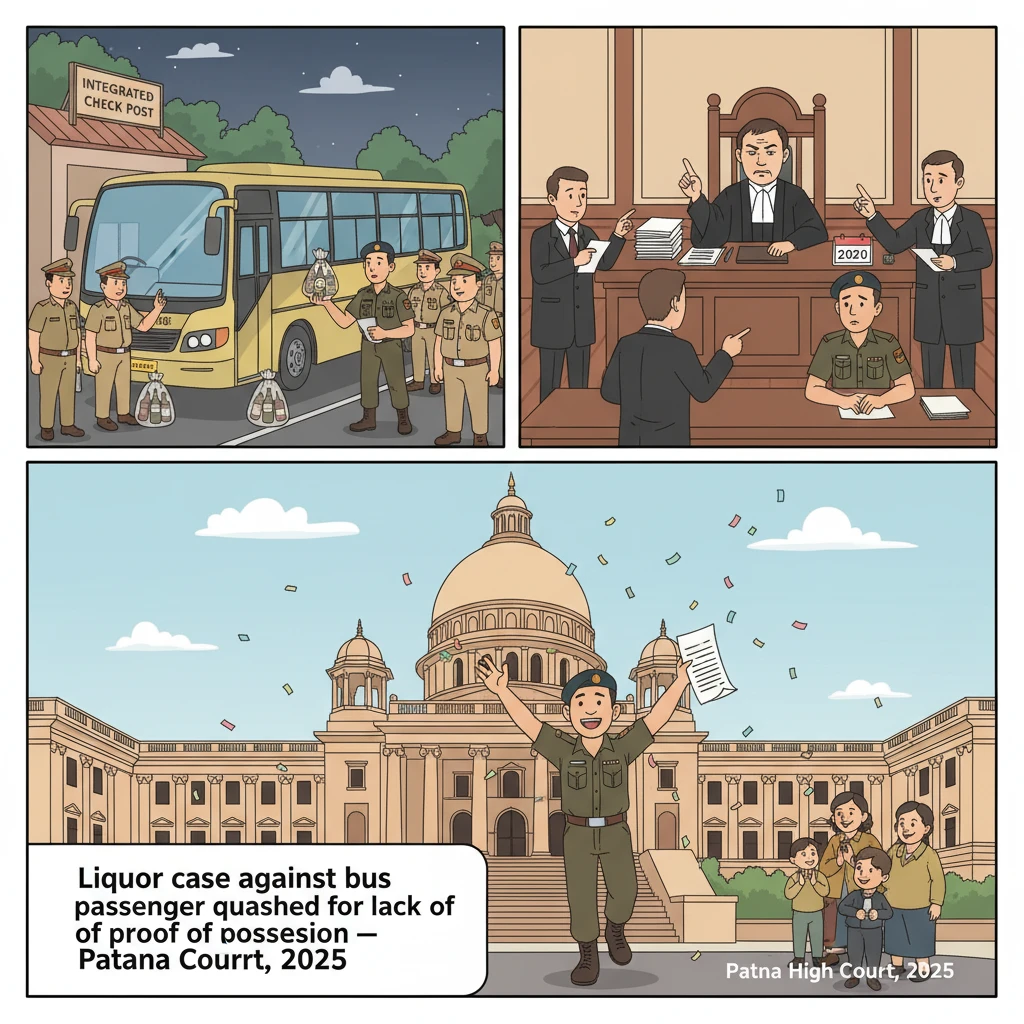
The case arose from a midnight checking operation on 11.08.2017 at about 01:30 AM at the Integrated Check Post, Rajouli, in Nawada district.
A bus bearing Registration No. BR-06PA/6651 was travelling from Ranchi towards Raxaul. The Inspector (Excise), Nawada, along with other excise officials and SAP force, stopped the bus for checking.
During the search, the team recovered a bag containing 6.75 litres of illicit liquor from in front of the seat where the petitioner, a Lance Naik in the Indian Army, was sitting. The liquor was seized and a seizure list was prepared.
Based on this recovery, G.O. Case No. 837 of 2017 was registered. On 20.03.2020, the learned ADJ-II cum Special Judge, Nawada, took cognizance of an offence under Section 30(a) of the Bihar Prohibition and Excise Act, 2016 against the petitioner.
In 2025, the petitioner approached the Patna High Court by filing Criminal Miscellaneous No. 73433 of 2025 under Section 528 of the Bharatiya Nagarik Suraksha Sanhita, 2023. He sought quashing of the cognizance order dated 20.03.2020 and the criminal proceeding on the ground that the liquor did not belong to him and was not in his conscious possession.
What the Court Examined and Decided
The Patna High Court heard Ms. Bharti Kumari, counsel for the petitioner, and Mrs. Shaheen Begum, APP for the State of Bihar.
On behalf of the petitioner, it was submitted that on the date of the incident he was coming from Ranchi and was on his way to Varanasi. The leave granted to him by the Army for this journey was brought on record as Annexure-2.
The defence version was that the excise team searched the bus and found 12 bottles of liquor lying in front of the petitioner’s seat. According to the petitioner, the liquor did not belong to him, but he was forced to sign the seizure list merely because the bag was lying near his seat.
Learned counsel argued that no illicit liquor was recovered from the conscious possession of the petitioner, as could be seen from the prosecution report and seizure list. Therefore, making him face full criminal trial would be an abuse of process of law.
She also relied on the well-known judgment of the Supreme Court in State of Haryana vs. Bhajan Lal, reported in AIR 1992 SC 604, to submit that the High Court has power to quash criminal proceedings where the allegations, even if taken at face value, do not disclose the commission of any offence.
On the other hand, the learned APP for the State submitted that cognizance had been taken on the basis of materials on record, supported by witnesses and evidence. It was contended that the Special Judge had committed no error in taking cognizance under Section 30(a) of the Bihar Prohibition and Excise Act, 2016.
The Court then turned to the legal framework governing such cases. It reproduced Section 30(a) of the Bihar Prohibition and Excise Act, 2016, which provides penalty for unlawful manufacture, import, export, transport, possession, sale, purchase, distribution, etc., of any intoxicant or liquor in contravention of the Act.
The Court also reproduced Section 56 of the same Act, which lists things liable for confiscation whenever an offence under the Act is committed. This includes intoxicated or liquor unlawfully dealt with, vehicles used to carry liquor, and premises used for storing or manufacturing liquor. The provision also allows the State Government to issue directions regarding search, seizure and confiscation.
Further, the Court reproduced Section 100 of the Code of Criminal Procedure, 1973. This section lays down the procedure for search of closed places and requires, as far as practicable, that searches be conducted in the presence of two or more independent and respectable inhabitants of the locality. It also requires preparation of a seizure list signed by witnesses and by the person searched or the occupant.
On the basis of these provisions, the Court summarised that the statutory scheme demands fairness, transparency and credibility in search and seizure operations. The Bihar Prohibition and Excise Act does not function in isolation; it incorporates the procedural safeguards of the Cr.P.C. for search, seizure and arrest.
After noting the legal framework, the Court examined the specific facts on record. It recorded that the petitioner is a Lance Naik in the Indian Army and that the illicit liquor was allegedly seized from a bag lying in front of his seat in the bus, not from his body or luggage under his control.
The Court noted that the petitioner was travelling from Ranchi to Varanasi and that the seizure took place at Rajouli Chowk. The petitioner had claimed that he was forced to sign and receive the seizure list though he had disowned the liquor.
Importantly, the Court observed that the record showed the petitioner, being a Lance Naik, is allotted monthly liquor quota as per his rank in the Army. In this background, the Court recorded that “there was no question of carrying liquor to be sold in the State of Jharkhand.”
The seizure list further showed that all seized bottles bore labels stating “only for sale in Jharkhand” and were lying in front of the petitioner’s seat. This raised the crucial question: did the seized liquor actually belong to the petitioner?
The Court held that if the answer to this question is in the negative, then continuation of criminal proceedings would amount to abuse of process of law.
To clarify the concept of “possession” in criminal law, the Court relied on the Supreme Court judgment in Mohan Lal v. State of Rajasthan, reported in (2015) 6 SCC 222. Quoting from this decision, the Court highlighted that “possession” must mean conscious possession involving dominion and control coupled with knowledge. Mere physical proximity or presence near the contraband is not enough to fix criminal liability.
The Supreme Court in Mohan Lal, drawing from legal scholarship, had pointed out that factors like degree of physical control, knowledge about the item, and intention (animus possidendi and animus domini) are all relevant for deciding whether a person can be said to be in possession for the purpose of a criminal law rule.
Applying these principles, the Patna High Court found that, on the admitted position, the alleged recovery was from the front seat of the bus, not from the petitioner’s body, bag, or any place over which he had exclusive control.
The Court then examined the principles laid down in State of Haryana vs. Bhajan Lal (AIR 1992 SC 604). In that case, the Supreme Court had listed illustrative categories in which High Courts can exercise their extraordinary power to quash criminal proceedings, such as:
Where the allegations in the FIR or complaint, taken at face value, do not constitute any offence; where the uncontroverted allegations and evidence do not make out a case; where allegations are absurd and inherently improbable; or where the continuation of the proceeding would amount to abuse of process of the court.
In the present case, the High Court found that there was no material to show that the petitioner had conscious knowledge, control, or dominion over the liquor. The fact that the bag was lying in front of his seat, without more, and in the background of his status as an Army personnel with his own official quota, was not enough to establish conscious possession under Section 30(a) of the Bihar Prohibition and Excise Act.
The Court concluded that the essential ingredients of the offence under Section 30(a) were “conspicuously absent.” Without proof of conscious possession, mere suspicion or proximity could not justify pushing the petitioner through a full criminal trial.
Accordingly, applying the principles of Bhajan Lal, the Court held that continuation of the criminal proceedings would be an abuse of process of law. The order dated 20.03.2020, by which the learned ADJ-II cum Special Judge, Nawada had taken cognizance in G.O. Case No. 837 of 2017, was quashed and set aside.
As a result, the quashing application filed by the petitioner was allowed and the criminal proceedings against him stood terminated.
Why This Judgment Matters
This judgment is significant for passengers and ordinary citizens who travel by public transport within Bihar or across state borders, especially in the context of strict prohibition laws.
The Patna High Court has clearly reaffirmed that a person cannot be criminally prosecuted merely because liquor is found near his or her seat in a bus, train or other public vehicle. The prosecution must show conscious possession—that the person knew about the liquor and had control over it.
The Court has also reminded enforcement agencies that Bihar Prohibition and Excise Act cases must follow the safeguards of the Code of Criminal Procedure for search and seizure. This ensures that search operations are fair and transparent, and are not used to harass innocent travellers.
For members of the armed forces or other disciplined services, the judgment recognises that they may already have a lawful quota of liquor, and mere suspicion cannot override the need for concrete evidence of illegal possession.
Overall, the ruling acts as a check on misuse of prohibition laws and shows that the Patna High Court will intervene to quash cases where basic ingredients of the offence are missing.
Legal Issues and Answers
- Issue: Whether the presence of a bag containing liquor in front of a bus seat is sufficient to prosecute the passenger sitting there under Section 30(a) of the Bihar Prohibition and Excise Act, 2016.
Answer: No. The Court held that without proof of conscious possession—knowledge, control and dominion over the liquor—the essential ingredients of the offence are absent, and prosecution would be abuse of process. - Issue: Whether the High Court should exercise its power to quash the cognizance order and criminal proceedings in such circumstances.
Answer: Yes. Relying on State of Haryana vs. Bhajan Lal, the Court held that where allegations and materials do not disclose an offence, it can quash proceedings to prevent misuse of criminal law.
Cases Cited by the Court
- Mohan Lal v. State of Rajasthan, (2015) 6 SCC 222 – cited on the meaning of “possession” and requirement of conscious possession for criminal liability.
- State of Haryana vs. Bhajan Lal, AIR 1992 SC 604 – cited for the principles governing quashing of criminal proceedings where continuation would be abuse of process.
Case Details
Case Number: Criminal Miscellaneous No. 73433 of 2025
Arising out of: G.O. Case No. 837 of 2017, P.S. Case No. 837 of 2017, Thana – Government Official Comp., District – Nawada
Case Title: Raj Kumar Singh v. The State of Bihar & Anr.
Coram: Hon’ble Mr. Justice Purnendu Singh
Date of Judgment: 16.12.2025
Citation: 2026(1) PLJR 420
Advocates: Ms. Bharti Kumari, Advocate for the petitioner; Mrs. Shaheen Begum, APP for the State/opposite parties
Nature of the Case: Criminal miscellaneous application under Section 528 of the BNSS, 2023 seeking quashing of order taking cognizance under Section 30(a) of the Bihar Prohibition and Excise Act, 2016
Link to Judgment: Click here to read the full judgment of the Patna High Court
If you found this explanation helpful and wish to stay informed about
how legal developments may affect your rights in Bihar,
you may consider following Samvida Law Associates for more updates.







