

Case Background
The case arises out of Domestic Violence Case No. 21 of 2018, filed by a wife against her husband under the Protection of Women from Domestic Violence Act, 2005.
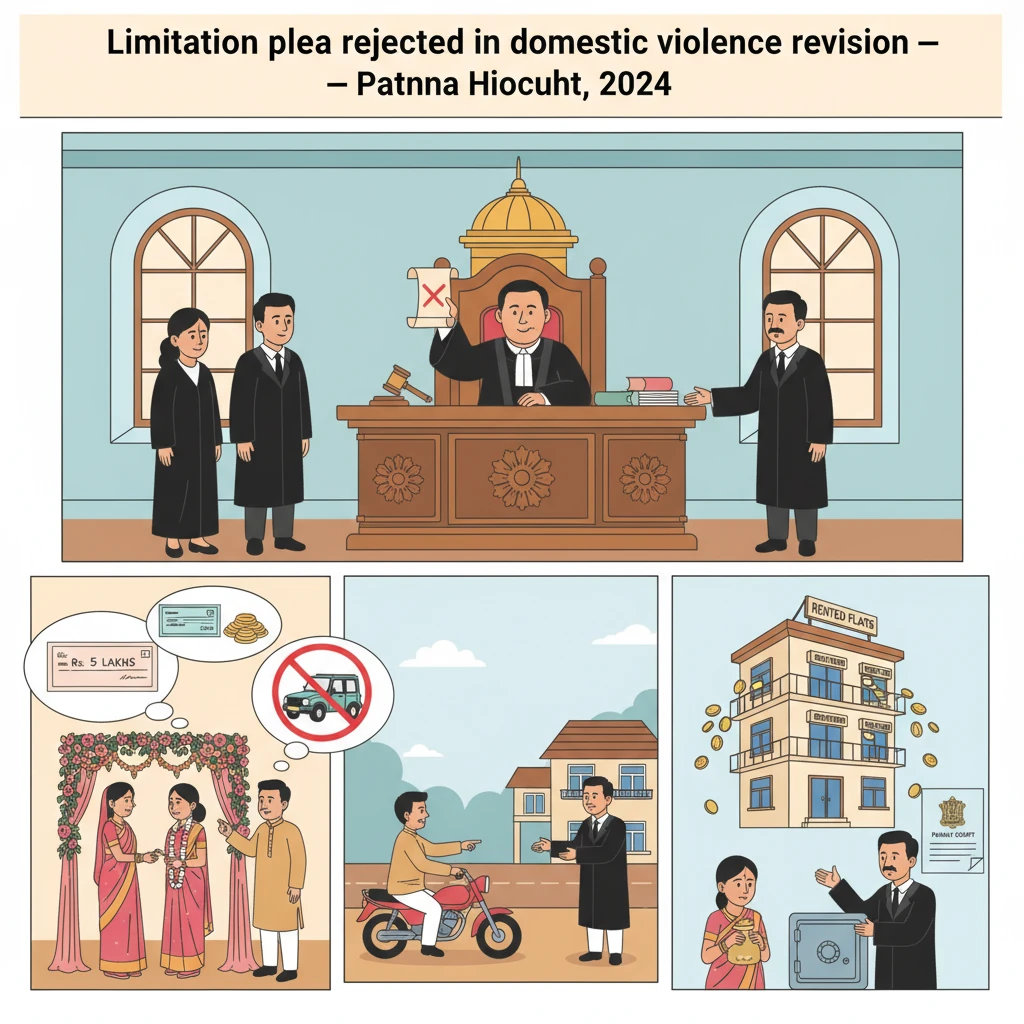
The parties were married on 30.01.2013 according to Hindu rites at Noorani Bagh, Alamganj, Patna. The wife alleged that her parents gave Rs. 5 lakhs by cheque in her name, spent Rs. 6 lakhs on the marriage, and provided gold, utensils and other household items.
According to her complaint, after she went to the matrimonial home, her mother-in-law kept all her gold ornaments. On her mother-in-law’s instigation, the husband allegedly began demanding a Scorpio vehicle from her parents. She stated that she faced abuse and torture but tolerated it hoping things would improve.
She further alleged that on the pretext of taking her to her parental home, the husband took her on a motorcycle, left her midway and went back. When her father and brother approached the husband’s family to request that she be kept with dignity, they were allegedly abused and turned out while the vehicle demand was repeated.
The wife then filed Complaint Case No. 1670(C)/2013 against the husband, his mother and other relatives for mental and physical cruelty. Cognizance was taken by the learned S.D.J.M., Patna. During consideration of bail in the High Court in that case, the husband was ordered to pay Rs. 2,000 per month as maintenance. She claimed this amount was inadequate.
Meanwhile, the husband filed Complaint Case No. 1334(C)/2013 before the Chief Judicial Magistrate, Patna against her father and brother, which she described as based on false allegations. He also filed Matrimonial Case No. 355 of 2013 under Section 9 of the Hindu Marriage Act for restitution of conjugal rights, but allowed it to be dismissed in default.
Later, the husband instituted Matrimonial Case No. 1271 of 2016 before the Principal Judge, Family Court, Patna seeking divorce. That case is still pending. In that proceeding, on 30.11.2017, the Family Court directed him to pay an additional Rs. 2,000 per month as interim maintenance plus litigation cost. The wife alleged that he did not comply with this order.
She stated that the husband is a practising lawyer at Hazaribagh and has agricultural land and other properties. She also asserted that at Mohalla-Sheikhpura, Shastri Nagar, Patna there is a four-storeyed house, standing on about 1½ kathas of land, where she and her husband lived in one flat after marriage. According to her, that flat is now locked and the remaining flats are let out, earning around Rs. 50,000 per month. She claimed to have no independent income.
On these facts she sought a protection order under Section 17 of the Domestic Violence Act, asserting her right to reside in the shared household at Shastri Nagar, Patna.
What the Court Examined and Decided
The wife’s application for interim residence relief was taken up by the Additional Chief Judicial Magistrate-IV, Patna on 15.03.2018. The Magistrate considered the pleadings, including an objection filed by the husband on 08.10.2018.
The husband’s first major objection was limitation. He claimed the wife had been living at her parental home since 13.04.2013 and that the domestic violence case was filed after four years and eleven months from the alleged incident and separation. Relying on Section 468 of the Code of Criminal Procedure, 1973, which prescribes a one-year limitation for certain offences, and on the Supreme Court judgment in Inderjit Singh Grewal v. State of Punjab, he argued that the complaint was barred by time.
Secondly, he argued that there was no existing “domestic relationship” between them after 15.04.2013, when they had allegedly separated. Therefore, he claimed, the Domestic Violence Act could not apply.
Thirdly, referring to the Supreme Court decision in S.R. Batra v. Taruna Batra, he contended that the Shastri Nagar house was exclusively owned by his mother. Hence, it was not a “shared household” and the wife could not claim residence there.
After considering these objections, the Magistrate passed an interim order on 08.01.2019 directing the husband to cooperate with the proceedings and to arrange for a room with attached bathroom in the matrimonial house situated within Shastri Nagar Police Station limits. This direction was made subject to the final outcome of the case.
The husband challenged this interim order in Criminal Appeal No. 37 of 2019 before the Additional Sessions Judge XIV, Patna. On 21.10.2019, the appellate court allowed his appeal, set aside the Magistrate’s order, and effectively denied the wife interim residence relief.
The appellate court held that:
- The complaint was barred by Section 468 Cr.P.C. as it was filed nearly four years after the alleged incident, following the reasoning in Inderjit Singh Grewal.
- Since the wife herself said she had been living at her parental home since 13.04.2013, there was no continuing domestic relationship as defined in Section 2(f) of the Domestic Violence Act.
- The Shastri Nagar property belonged exclusively to the husband’s mother, and therefore could not be treated as a “shared household” for the purpose of right of residence.
Aggrieved, the wife filed Criminal Revision No. 1544 of 2019 before the Patna High Court, seeking to set aside the appellate order and restore the Magistrate’s interim protection order.
Before the High Court, her counsel argued that the appellate court had misread the definitions of “domestic relationship” in Section 2(f), “domestic violence” in Section 3, and “shared household” in Section 2(s) of the Domestic Violence Act. They submitted that once parties have lived together in a shared household in a marital relationship at any point of time, the bond remains a “domestic relationship” for the purposes of the Act, even if they later live apart.
They also argued that the appellate court misapplied Section 468 Cr.P.C. and misunderstood the Supreme Court ruling in Inderjit Singh Grewal. According to them, limitation under Section 468 Cr.P.C. applies only when a court is taking cognizance of a criminal offence, not when a woman seeks civil-type protective and residence orders under the Domestic Violence Act.
On the issue of “shared household” and S.R. Batra, they contended that only after evidence was taken could the court decide whether the Shastri Nagar property was joint family property or otherwise, and whether the wife had in fact lived there after marriage. At the interim stage, it was wrong to conclude that she had no right of residence.
Counsel for the husband argued that Section 28 of the Domestic Violence Act specifically applies Cr.P.C. procedure to proceedings under Sections 12, 18 to 23 and 31. Relying on the co-ordinate Bench decision in Santosh Kumar v. State of Bihar (Cr. Misc. No. 41318 of 2016) and decisions of the Karnataka High Court, he maintained that Section 468 Cr.P.C. barred the complaint itself.
Justice Rajeev Ranjan Prasad first analysed the scheme of the Domestic Violence Act in detail. He reproduced and examined the statutory definitions of “domestic relationship”, “domestic violence”, and “shared household” under Sections 2(f), 3 and 2(s). He emphasised that Section 2(f) covers relationships between two persons who “live or have, at any point of time, lived together in a shared household” when related by marriage or otherwise.
On a plain reading, the Court held that the definition does not say that the parties must still be living together at the time of filing the complaint. It is enough if they have lived together in a shared household at any time in the past as spouses. In this case, the couple were married in 2013 and had lived together, hence a “domestic relationship” clearly existed.
The Court then examined the allegations of demand for a Scorpio vehicle and physical and mental cruelty for dowry. Reading Section 3 and its explanations, the Court held that the complaint clearly alleged acts that fall within “domestic violence”, especially physical, verbal/emotional and economic abuse linked to dowry demands.
Next, the Court explained the structure of reliefs under the Act—protection orders (Section 18), residence orders (Section 19), monetary relief (Section 20), custody (Section 21), and compensation (Section 22)—which are all granted on an application under Section 12. These are primarily protective and remedial, rather than punitive.
Coming to limitation, the Court closely read Sections 31 and 32 of the Domestic Violence Act together with Section 468 Cr.P.C. Section 31 makes it an “offence” for the respondent to breach a protection order or interim protection order. Such breach is punishable with imprisonment up to one year or fine up to Rs. 20,000, or both. Section 32 declares this offence cognisable and non-bailable, and triable by the Magistrate who passed the protection order.
The Court held that Section 468 Cr.P.C. relates to the stage when a court takes cognizance of an “offence” and therefore can apply only to prosecutions for breach of a protection order under Section 31. It cannot apply to the filing of an original application before the Magistrate seeking protection or residence orders, because at that point no offence is being taken cognizance of.
The Court clarified that the Domestic Violence Act “is more concerned with providing relief to the victim” and is not purely criminal in nature. There is no provision in the Act prescribing any time limit for filing a complaint seeking protection or residence orders.
On this reasoning, the High Court disagreed with the husband’s argument and with the appellate court’s view that Section 468 Cr.P.C. barred the complaint. It distinguished both Inderjit Singh Grewal and Santosh Kumar on facts.
In those earlier cases, the parties already had decrees of divorce, and the question was whether an ex-wife could file a complaint or whether limitation would apply when the High Court was exercising power under Section 482 Cr.P.C. Here, there was no decree of divorce, and the dispute concerned only the wife’s right to pursue protections under the Domestic Violence Act.
Regarding “shared household” and the Shastri Nagar property, the Court noted that although the husband said the property was in his mother’s name, the mother herself had not challenged the Magistrate’s order. The wife’s specific case was that after marriage she lived with her husband in one of the flats of that building, and that other flats were rented out.
The appellate court had held, without evidence, that the property belonged neither to the husband nor to a joint family. The High Court found no material on record at this interim stage to justify such a finding. Whether the property is joint, self-acquired, or otherwise, and whether it qualifies as a “shared household”, are questions that must be decided after both sides lead evidence before the Magistrate.
The Court also distinguished the Supreme Court’s decision in S.R. Batra, pointing out that in that case there was a clear factual finding that the wife was not in possession of the premises and the property undeniably belonged to the mother-in-law. In contrast, in the present case, the facts about ownership and the nature of occupation were disputed and yet to be proved.
Finally, the High Court answered three specific questions:
- The husband was not right in claiming that no domestic relationship existed merely because the wife had been living separately since 13.04.2013.
- Whether the Shastri Nagar house is a “shared household” or not will depend on evidence produced before the Magistrate.
- The wife’s domestic violence complaint and her prayer for a protection order are not barred by Section 468 Cr.P.C.
On this basis, the Patna High Court held that the appellate court had erred in law. It set aside the appellate judgment dated 21.10.2019, restored the Magistrate’s interim order granting residence relief, and directed the A.C.J.M.-IV, Patna to proceed with the domestic violence case and pass appropriate final orders in accordance with law.
Why This Judgment Matters
This judgment is important for women living separately from their husbands for long periods due to abuse or dowry demands. It clarifies that they do not lose their right to approach the court under the Domestic Violence Act just because some years have passed or because they are staying with their parents.
The Patna High Court has made it clear that limitation rules in the Cr.P.C. do not cut off a woman’s right to seek residence and protection orders under the Domestic Violence Act. Limitation comes into play only if there is a later criminal case for disobeying a court’s protection order, not at the stage of filing the original complaint.
The Court has also underlined that whether a property is a “shared household” cannot be decided casually on pleadings alone when facts are disputed. Evidence must be recorded before denying a woman’s right to live in the house where she says she stayed after marriage.
For victims of domestic violence, this ruling signals that the law remains open to them even if they have silently suffered for years or have left the matrimonial home. For lawyers and trial courts in Bihar, it offers a clear roadmap on how to understand “domestic relationship”, “shared household”, and the role of limitation under the Domestic Violence Act.
Legal Issues and Answers
- Issue: Does a domestic relationship under the Domestic Violence Act end simply because the wife has been living separately for several years?
Answer: No. If the parties were married and lived together at any point in a shared household, a domestic relationship exists for the purpose of the Act, regardless of later separation. - Issue: Is a woman’s application for protection and residence orders under the Domestic Violence Act barred by Section 468 Cr.P.C. if filed after one year of separation?
Answer: No. Section 468 applies only to taking cognizance of offences, such as breach of a protection order under Section 31 of the Act. It does not limit the filing of an application under Section 12 for protection or residence orders. - Issue: Can the Shastri Nagar house, registered in the mother-in-law’s name, be ruled out as a shared household at the interim stage?
Answer: Not at this stage. Whether it is a shared household depends on evidence about ownership, joint family status and the wife’s residence there, and must be decided after trial.
Cases Cited by the Court
- Inderjit Singh Grewal v. State of Punjab & Ors., (2011) 12 SCC 588
- S.R. Batra & Anr. v. Smt. Taruna Batra, AIR 2007 SC 1118
- Bharat Petroleum Corporation v. N.R. Vairamani & Anr., (2004) 8 SCC 579
- Santosh Kumar v. The State of Bihar & Anr., Cr. Misc. No. 41318 of 2016 (Patna High Court)
- Japani Sahoo v. Chandra Sekhar Mohanty, AIR 2007 SC 2762 (referred in Santosh Kumar)
- Noida Entrepreneurs Association v. Noida & Ors., (2011) 6 SCC 508 (referred in Santosh Kumar)
- Smt. Sureshta Devi, AIR 1992 SC 1304 (referred in Inderjit Singh Grewal)
- Amit Agarwal & Ors. v. Sanjay Aggarwal, III (2016) DMC 97 (P&H) (referred in Santosh Kumar)
Case Details
Case Number: Criminal Revision No. 1544 of 2019 (arising out of Domestic Violence Case No. 21 of 2018)
Case Title: Madhuri Kumari v. The State of Bihar & Anr.
Citation: 2024(2) PLJR 783
Court: High Court of Judicature at Patna
Coram: Hon’ble Mr. Justice Rajeev Ranjan Prasad
Date of Judgment: 30.01.2024
Advocates:
- For the Petitioner (wife): Mr. Dhanendra Chaubey, Advocate
- For the State: Mr. Md. Fahimuddin, APP
- For Opposite Party No. 2 (husband): Mr. Vijay Kumar Sinha, Advocate
Nature of the Case: Criminal revision against appellate order in a proceeding under the Protection of Women from Domestic Violence Act, 2005, challenging setting aside of an interim residence/protection order.
Link to the Judgment: Click here to read the full Patna High Court judgment
If you found this explanation helpful and wish to stay informed about
how legal developments may affect your rights in Bihar,
you may consider following Samvida Law Associates for more updates.







