

Case Background
This criminal appeal was filed by two appellants against the judgment of conviction dated 06.06.2016 and order of sentence dated 13.06.2016 passed by the 1st Additional Sessions Judge, Purnea, in Sessions Case No. 417 of 2015/Trial No. 376 of 2015, arising out of Khajanchi Hat (K. Hat) P.S. Case No. 517 of 2015, District Purnea.
The trial court had convicted both appellants under Sections 364A, 302, 120B and 201 of the Indian Penal Code. They were sentenced to rigorous imprisonment for life with fines for Sections 364A, 302 and 120B IPC, and seven years’ rigorous imprisonment with fine for Section 201 IPC, with all sentences to run concurrently.
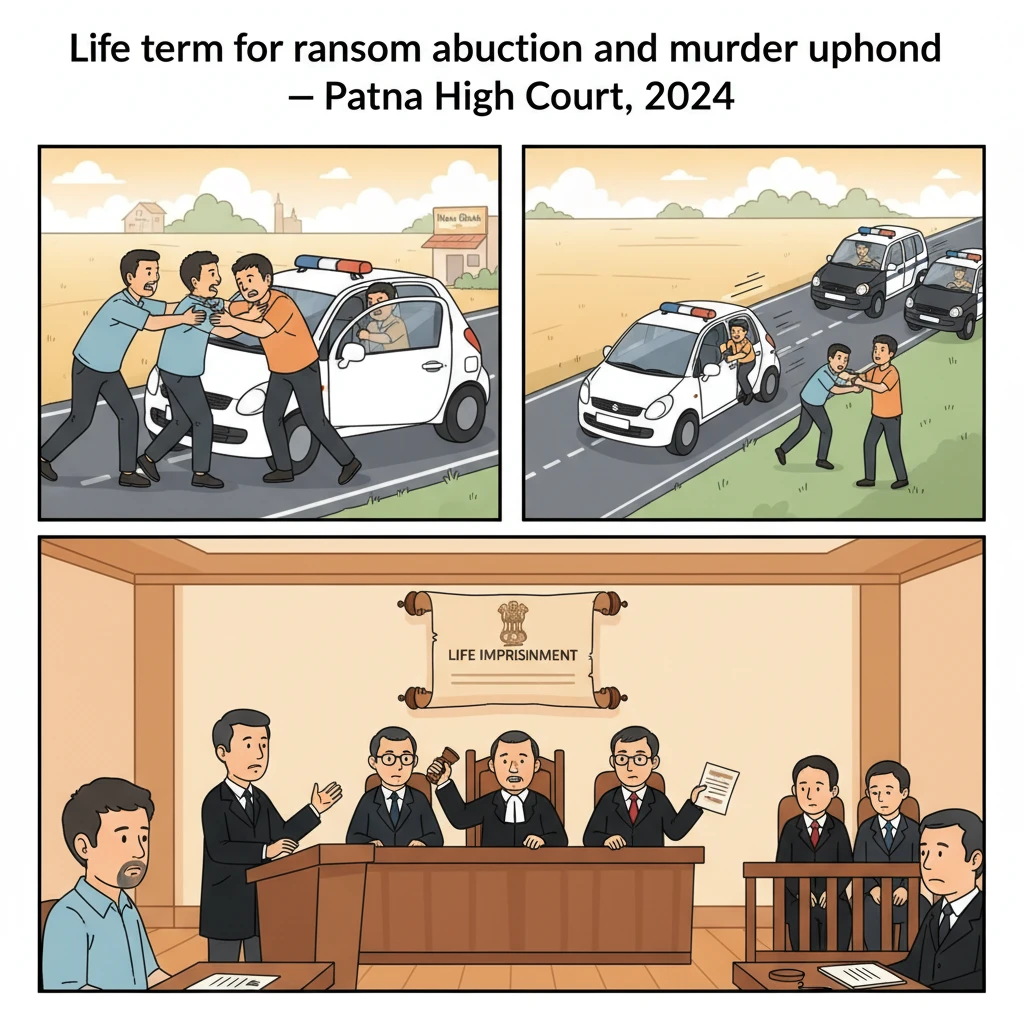
The prosecution case began with a written report lodged by the victim’s uncle (PW‑4, the informant) on 03.08.2015. According to him, around 12:30 p.m. that day, he and his nephew Punit Kumar (the deceased) were on a motorcycle near the house of appellant no. 1 when the appellants stopped them, demanded “Rangdari” (extortion money), assaulted them, and forcibly pushed the victim into a white Maruti Ritz car bearing registration no. BR 11M‑4242. The informant tried to resist but was threatened at pistol‑point.
The car first moved towards Ufrail Chowk and then towards Mewalal Chowk. The informant chased on foot, raising alarm, and then rushed to Maranga Police Station to lodge the written report, on the basis of which K. Hat Maranga P.S. Case No. 517 of 2015 was registered at 2:20 p.m. under Section 364A/34 IPC; Section 302 IPC was added later when the victim’s dead body was recovered.
Investigation followed. Within about three hours of the abduction, the police intercepted the described car near “Maa Kaali Dhaba” on NH‑57 under Kasba P.S., apprehended the appellants and seized the car. On the basis of a disclosure statement by appellant no. 1, the police recovered the dead body of Punit Kumar around 5:50 p.m. near the “kamat” (farm house) of one Rajendra Khirahari, with visible bleeding injuries on his head and body.
After investigation, a charge‑sheet was filed for offences under Sections 364A, 302, 120B and 201 IPC read with Section 34 IPC. Cognizance was taken by the Chief Judicial Magistrate, Purnea, and the case was committed to the Sessions Court. The appellants denied the charges and claimed trial.
What the Court Examined and Decided
The Division Bench of Hon’ble Mr. Justice Rajeev Ranjan Prasad and Hon’ble Mr. Justice Shailendra Singh (authoring the judgment) examined the entire evidence afresh in the appeal. The case essentially had two parts: (1) abduction of the victim in broad daylight for ransom; and (2) recovery of his dead body within a few hours.
The prosecution examined nine witnesses (PW‑1 to PW‑9) and produced several documents, including the FIR, inquest report, post‑mortem report, seizure memos and the confessional/disclosure statement of appellant no. 1 recorded by police (Ext.‑6). The defence examined three witnesses (DW‑1 to DW‑3) and produced a sale deed (Ext.‑A).
The core of the prosecution story rested on PW‑4, the informant and uncle of the deceased. The Court treated him as the most important witness. He described how, on 03.08.2015 around 12:15‑12:30 p.m., after visiting a CEAT tyre showroom with Punit, they were stopped outside appellant no. 1’s house. The appellants accused Punit of earning money but not paying extortion, threatened to kill him if money was not paid, and assaulted him when he resisted. They then forced him into the white Maruti Ritz car. When PW‑4 tried to save him, both appellants pulled out pistols and pointed them at him, threatening to shoot.
PW‑4 stated that appellant no. 1 drove the car while appellant no. 2 sat with Punit inside. The vehicle went towards Ufrail Chowk, then turned towards Mewalal Chowk. PW‑4 chased, raising alarm, but could not stop them. He immediately went to Maranga P.S., submitted his written report, and then accompanied police back to the spot. Later, he reached the place where the dead body was found and signed the inquest report (Ext.‑1/c) and identified his signatures on the written report (Ext.‑1/d).
The High Court carefully scrutinised PW‑4’s testimony because he was a related witness. It noted that his cross‑examination was lengthy but did not shake his account. He explained why he had come to Purnea a day earlier, how he and Punit spent the morning (visiting the bus stand office, then the CEAT showroom), and how he went to the police station and later to the place of recovery. His timeline and movements appeared natural and consistent.
Importantly, the defence could not suggest or prove any previous enmity between the appellants and the victim or his family that might motivate false implication. The Court held that merely being a relative does not make a witness unreliable, and that PW‑4’s version matched the FIR lodged within about two hours of the abduction, leaving little scope for concoction.
The appellants argued that PW‑4’s credibility was doubtful because, though he signed in English, the written report was in Hindi and he did not say who wrote it. The Court rejected this, observing that many people sign in English without knowing the language. More importantly, defence never cross‑examined him on this point. Applying the Supreme Court’s ruling in Laxmibai v. Bhagwantbuva, the Court held that un‑challenged parts of testimony must be accepted.
PW‑1 and PW‑2, relatives of the victim, claimed to be eyewitnesses of the abduction. However, the High Court found their presence at the scene doubtful in light of their own statements and the distance between the victim’s house and the spot (about one kilometre as per PW‑3). Their accounts conflicted with each other and with PW‑4 on key details, such as who was threatened with the pistol. The Court therefore agreed that they were not true eyewitnesses of the abduction, though it treated their evidence as relevant for events immediately after the incident (searching for the victim with police).
PW‑3, a neighbour whose house was adjacent to the place of abduction, admitted that he had litigation with appellant no. 1, indicating some enmity. The defence tried to use this to discredit him. But the Court noted that his presence near the scene was natural; cross‑examination showed no particular intimacy with the victim’s family or the informant; and his evidence about the abduction was consistent, including his statement under Section 164 CrPC. The Court therefore accepted him as a supporting eyewitness, though the main weight remained on PW‑4.
On the second part of the case – recovery of the body – the prosecution relied on the disclosure statement of appellant no. 1 leading to discovery of the dead body near the kamat of Rajendra Khirahari. The defence contended that the place was open and accessible to all and that, in terms of Section 27 of the Evidence Act and Supreme Court decisions such as Manjunath v. State of Karnataka, recovery from an open place should not be used against the accused.
The High Court distinguished those rulings. It stressed several facts: the abduction at about 12:30 p.m.; alerting of nearby police stations; interception and arrest of the appellants with the described car near Maa Kaali Dhaba between 3:00 and 4:00 p.m.; recording of the disclosure statement of appellant no. 1 while in custody; and recovery of the dead body around 5:50 p.m. at the place indicated by him. Defence witness DW‑2, Santosh Kumar Mehta, himself stated that he came to know of the appellants’ arrest at Maa Kaali Dhaba around 3:00‑4:00 p.m. and that they were then taken towards the farm house, thereby corroborating the prosecution’s timeline.
The Court acknowledged that the body was found near a farm house in an open area, but observed that the defence had not elicited any evidence that the body was in normal public view. Referring to State of Himachal Pradesh v. Jeet Singh, it held that the key question is not whether a place is accessible to others, but whether the object was ordinarily visible. An article (or here, the body) hidden in a field or roadside area may still be discovered only when pointed out by the person who concealed it.
Another strong circumstance noted was that there was active bleeding from the nose, forehead and back of the deceased at the time of inquest, showing that death had occurred only a few hours earlier. Combined with the clear proof that the victim was last seen alive in the custody of the appellants and that they offered no explanation of what happened to him, the Court held that the prosecution had established a complete chain of circumstances.
Relying on cases such as Paramsivam v. State, Sucha Singh v. State of Punjab, and State of W.B. v. Mir Mohammad Omar, the Bench reiterated that when it is proved that a person was abducted by the accused and soon thereafter is found murdered, the accused must explain what happened while he was in their custody. In the absence of such explanation, the Court can safely infer that the abductors are the murderers.
The appellants also attacked the prosecution on technical grounds. They argued that non‑mention of the FIR number in the inquest report and post‑mortem report showed that the FIR was recorded later after deliberation, citing Meharaj Singh v. State of U.P., and that there was non‑compliance of Section 157 CrPC because the FIR allegedly reached the Magistrate late.
The High Court rejected these contentions. It noted that the FIR was formally registered at 2:20 p.m. on 03.08.2015, the body was recovered at about 5:50 p.m., and the post‑mortem was conducted at 8:30 p.m. that same night. During this short span, the police were in the field chasing the abductors, arresting them, recording the disclosure and supervising recovery. In such fast‑moving circumstances, failure to write the FIR number on inquest and post‑mortem papers could not, by itself, undermine the prosecution.
The Court further emphasised that inquest and post‑mortem reports are not substantive evidence; any discrepancy in them is not by itself fatal, as held in Shambhu Das alias Bijoy Das v. State of Assam. As for Section 157 CrPC, the record showed that the FIR reached the court of the Chief Judicial Magistrate, Purnea, by 12:05 p.m. on 04.08.2015, i.e. the very next day. There was thus no inordinate delay. Moreover, the investigating officer was never cross‑examined on this alleged delay, so the appellants could not later take advantage of it, in line with Manga alias Man Singh v. State of Uttarakhand and Jafarudheen v. State of Kerala.
The defence also argued that motive for murder was not proved. The Court observed that the first part of the incident clearly showed a motive for abduction for ransom: the demand for extortion money, threats to kill if payment was not made, and forced taking away of the victim in a car. Once the abductors found themselves surrounded by police from several stations, and unable to extract money while safely keeping the victim, it was reasonable to infer that they decided to kill him to destroy the main evidence of abduction. Citing Jeet Singh, the Court reminded that while motive can be relevant, failure to prove it does not by itself render the prosecution case doubtful where other circumstances unerringly point to guilt.
In the final analysis, the Bench held that the prosecution had proved beyond reasonable doubt: the abduction of Punit Kumar by the appellants; their possession of the car used in the crime; their arrest within hours; the disclosure by appellant no. 1 while in custody; the recovery of the body at the disclosed spot; and the medical and inquest evidence showing recent homicidal death. The chain of circumstances was complete and consistent only with the guilt of the appellants.
Accordingly, the Patna High Court affirmed the conviction and sentences imposed by the trial court and dismissed the appeal.
Regarding sentence execution, the Court noted that appellant no. 1 was on four‑month provisional bail on medical grounds granted by the Hon’ble Supreme Court in SLP (Crl.) No. 9601 of 2024. It directed that after expiry of that provisional bail period, he must surrender before the trial court and serve the remaining sentence, unless the Supreme Court extends or modifies his bail. If he fails to surrender, the trial court shall secure his presence in accordance with law.
Why This Judgment Matters
This judgment is significant for families of kidnapping and extortion victims as well as for criminal law practice in Bihar. The Patna High Court shows that even when there is no direct eyewitness to the murder, a conviction can be sustained if the prosecution proves a tight chain of events: abduction, last seen in the custody of accused, quick police action, arrest, disclosure and immediate recovery of the dead body.
The Court gives strong weight to prompt reporting by relatives and realistic conduct, such as rushing to the police station rather than trying to negotiate with abductors. It also reassures that minor technical lapses by police—like not mentioning the FIR number on inquest or post‑mortem reports—will not automatically help the accused when the core facts are clear.
For police and prosecutors, the ruling underscores the importance of swift coordination among stations, properly recording disclosure statements and seizures, and ensuring that key witnesses like informants are thoroughly examined and cross‑examined. For accused persons, it is a reminder that remaining silent about what happened to a person last seen in their custody can allow the Court to presume their involvement in the killing.
Legal Issues and Answers
- Issue: Whether the abduction of the victim for ransom by the appellants was proved beyond reasonable doubt.
Answer: Yes. The Court relied mainly on the clear, consistent and promptly‑reported eyewitness account of PW‑4, supported by PW‑3 and contemporaneous police action, to hold that the appellants abducted the victim at gunpoint in the described car. - Issue: Whether, in absence of direct eyewitnesses, the murder of the abducted victim by the appellants was established on circumstantial evidence.
Answer: Yes. The Court held that the established circumstances—swift arrest with the same car, disclosure by appellant no. 1 while in custody, recovery of the fresh dead body at the disclosed spot, and the victim being last seen alive with the appellants—formed a complete chain pointing only to their guilt, attracting the presumption applied in abduction‑cum‑murder cases. - Issue: Whether alleged procedural lapses (non‑mention of FIR number in inquest/post‑mortem, supposed delay in sending FIR to Magistrate, recovery from an “open place”) created sufficient doubt to acquit the appellants.
Answer: No. The Court found reasonable explanation for these aspects, treated inquest and post‑mortem reports as non‑substantive evidence, noted that the FIR reached the Magistrate the next day, and held that recovery from a place not shown to be in normal public view was valid under Section 27 Evidence Act.
Cases Cited by the Court
- Sharad Birdhichand Sarda v. State of Maharashtra, (1984) 4 SCC 116.
- State of W.B. v. Mir Mohammad Omar and Others, (2000) 8 SCC 382.
- Paramsivam and Others v. State through Inspector of Police, (2015) 13 SCC 300.
- Sucha Singh v. State of Panjab, (2001) 4 SCC 375.
- State of Himachal Pradesh v. Jeet Singh, (1999) 4 SCC 370.
- Lochan Shrivas v. State of Chhattisgarh, (2022) 15 SCC 401.
- Manjunath and Others v. State of Karnataka, 2023 SCC OnLine SC 1421.
- Laxmibai (dead) through L.Rs. and Another v. Bhagwantbuva (dead) through L.Rs. and Others, AIR 2013 SC 1204.
- Meharaj Singh v. State of U.P., (1994) 5 SCC 188.
- Shambhu Das alias Bijoy Das and Another v. State of Assam, (2010) 10 SCC 374.
- Chotkau v. State of Uttar Pradesh, (2023) 6 SCC 742.
- Jafarudheen v. State of Kerala, (2022) 8 SCC 440.
- Hari Prasad @ Kishan Sahu v. State of Chhattisgarh, (2024) 2 SCC 557.
- Manga alias Man Singh v. State of Uttarakhand, (2013) 7 SCC 629.
- Arjun Marik and Others v. State of Bihar, 1994 Supp (2) SCC 372.
- Sunil Kumar Jha @ Sunil Jha v. State of Bihar, 2024 (4) BLJ 528.
Case Details
Case Number: Criminal Appeal (DB) No. 732 of 2016, arising out of K. Hat P.S. Case No. 517 of 2015, District Purnea.
Case Title: Niraj Yadav @ Niraj Kumar Chaudhri & Anr. v. The State of Bihar.
Citation: 2024 (4) PLJR 248.
Coram: Hon’ble Mr. Justice Rajeev Ranjan Prasad; Hon’ble Mr. Justice Shailendra Singh (CAV judgment authored by Hon’ble Mr. Justice Shailendra Singh).
Advocates: For the appellants – Mr. Y.V. Giri, Senior Advocate; Mr. Devashish Giri, Advocate; Mr. Birendra Kumar Singh, Advocate. For the State – Mr. Ajay Mishra, Additional Public Prosecutor.
Nature of the Case: Criminal appeal (Division Bench) against conviction and sentence in a sessions trial for offences under Sections 364A, 302, 120B and 201 IPC read with Section 34 IPC.
Date of Patna High Court Judgment: 09.09.2024.
Link to Full Judgment: Click here to read the official Patna High Court judgment.
If you found this explanation helpful and wish to stay informed about
how legal developments may affect your rights in Bihar,
you may consider following Samvida Law Associates for more updates.







