

Case Background
This criminal appeal was filed against the judgment of conviction and sentence dated 18 April 1994, passed by the 2nd Additional Sessions Judge, East Champaran, Motihari in Sessions Trial No. 62 of 1993.
The trial court had convicted the appellant under Section 302/34 of the Indian Penal Code for the murder of his maternal aunt and sentenced him to rigorous imprisonment for life. He was also charged, along with a co-accused, under Section 394 IPC for robbery, but was acquitted of that charge.
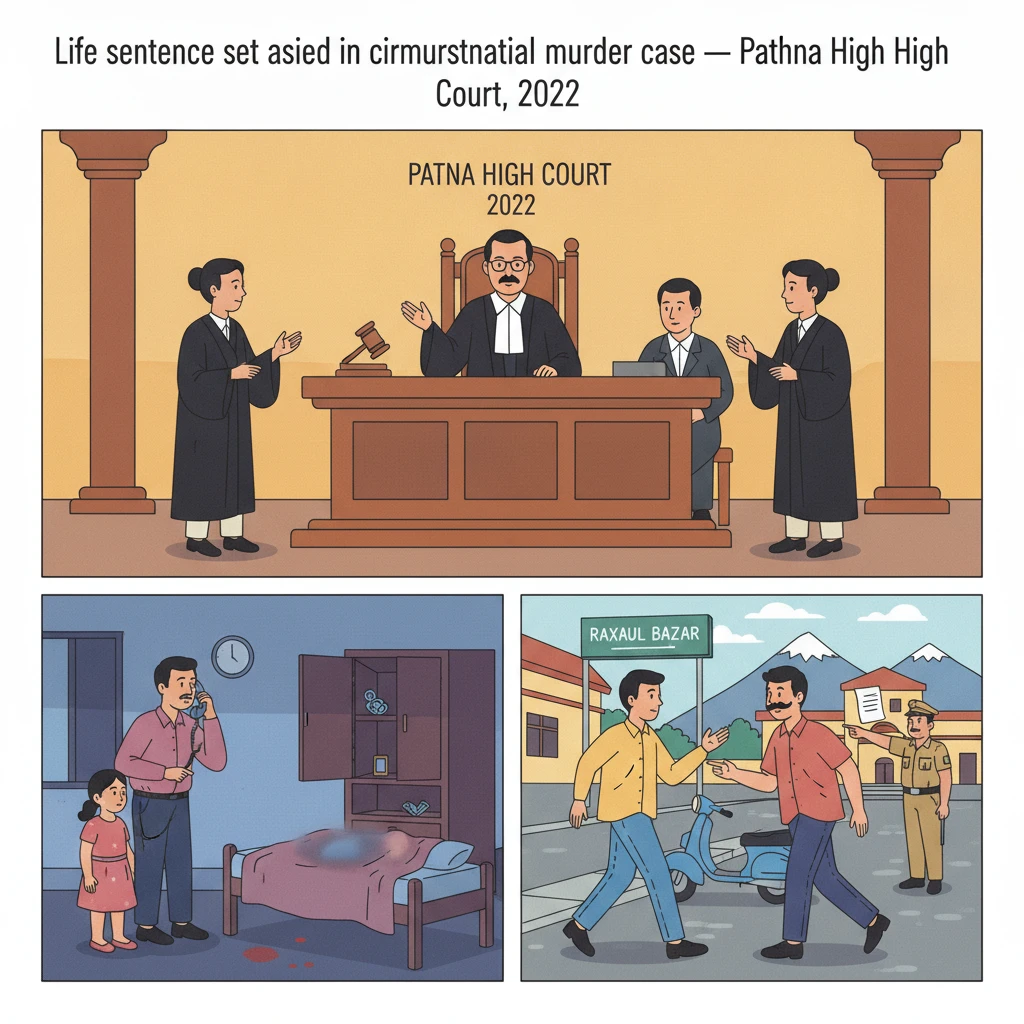
The prosecution case began with a statement given by the informant, the husband of the deceased, P.W.8. On 12 August 1992, around 3 p.m., he claimed to have returned home from his shop at Laxmipur and seen his nephew, Pradeep Kumar (the appellant), along with another person, coming out of his house and moving towards Raxaul Bazar.
After entering the house, the informant met his daughter Sunita (P.W.7), who had come from a neighbour’s house. On asking about her mother, she allegedly said that her mother had been talking to Pradeep Kumar and his friend in the middle room of the house about half an hour earlier. When they went to that room, they allegedly found the deceased lying dead under the bed with blood on the floor. The informant also claimed to have found his son’s almirah broken and ornaments missing.
At about 3:25 p.m. on 12 August 1992, the informant gave a telephonic message to the police about the murder of his wife. On this information, station diary entry No. 226 dated 12.08.1992 was made. The Investigating Officer (P.W.10) reached the spot, recorded the statement of the informant (Exhibit 3), and on that basis the FIR (Exhibit 4) was registered, in which for the first time the appellant’s name appeared in connection with the crime.
Investigation was carried out, charge sheet submitted, cognizance taken, and the case was committed to the court of sessions. Initially, the appellant and co-accused Arun Kumar Singh faced trial under Sections 302/34 and 394 IPC. The co-accused was ultimately acquitted. Only the appellant was convicted under Section 302/34 IPC, leading to this appeal before the Division Bench of the Patna High Court.
What the Court Examined and Decided
The Division Bench of Hon’ble Mr. Justice A.M. Badar and Hon’ble Mr. Justice Sunil Kumar Panwar heard the appeal. The judgment was authored by Hon’ble Mr. Justice Sunil Kumar Panwar and delivered on 3 March 2022.
The prosecution examined ten witnesses. P.Ws. 1 to 6 were described as highly interested or formal witnesses. The main reliance of the trial court had been on P.W.7, the daughter of the deceased, P.W.8, the informant and husband of the deceased, P.W.9, the doctor, and P.W.10, the Investigating Officer.
P.W.1 to P.W.4 were essentially hearsay witnesses. P.W.1 stated that he had seen Arun Singh and Hriday Singh washing clothes with red spots near a river, while Pradeep Kumar stood by with a scooter carrying a cloth bundle which also had red spots. Later, he heard that Pradeep and his friend had killed his maternal aunt. P.W.2 claimed to have seen the appellant in a restless state with two others and a bundle of cloth near Pankaj Talkies. P.W.3, a tea stall owner near Pankaj Cinema Hall, deposed that the appellant and two associates had tea at his shop and later he heard that the appellant had killed his maternal aunt and committed dacoity. P.W.4 similarly spoke about seeing the appellant with a scooter and cloth bundle with red spots near a canal and hearing later that he had killed his aunt and looted the house.
P.W.5 and P.W.6 were seizure witnesses. P.W.5 signed the seizure list for a pair of black plastic chappals seized from the place of occurrence, and admitted there was no blood stain on them. P.W.6, the full brother of the informant, stated that there was no blood in the courtyard, the room with the dead body was locked from outside, no smell came out on opening the door, and the blood on the floor in the room was frozen.
P.W.7, Sunita Kumari, the daughter of the informant, was treated as a star witness. She stated that on the day of occurrence she and her mother were at home and no male member was present. According to her, the appellant and his friend came at about 1 p.m. and spoke with her mother in the middle room. At around 2 p.m. she went to her friend Guddi’s house and returned at about 3 p.m., when she met her father and took him to the middle room. After her father switched on the light, they found her mother murdered under the bed with blood on the floor and the almirah in her brother’s room broken. In cross-examination she admitted that there was no conflict with the appellant, who used to visit their house frequently, and that she and her mother had taken their meal before the appellant’s arrival. She also said her mother had not called her during the one hour the appellant stayed in the house.
P.W.8, the informant, deposed that he usually went to his shop around 11–11:30 a.m. and normally returned home between 7–8 p.m. On 12 August 1992, he said he returned at about 3 p.m. and saw the appellant and another unknown person coming out of his house. When he requested the appellant to stop, the latter replied that he was in a hurry. Inside the house, his daughter told him that their mother had been talking with the appellant and another person in the middle room. They then went to that room and found the body under the bed and the broken almirah upstairs. In cross-examination, P.W.8 admitted he had made no telephonic contact with his family that day but suddenly returned home by rickshaw without any specific reason. He also stated that he had first informed the police by telephone about the murder at around 3:25–3:30 p.m.
P.W.9, the doctor, conducted the postmortem on 13 August 1992 at 12 noon. He found several serious incised wounds, including one extending from back of the left shoulder to the back of the right side of the neck, almost amputating the neck from behind except for a flap of skin and part of the sternomastoid muscle in front. Other injuries included a large incised wound on the upper part of the abdomen causing protrusion of stomach, injuries to fingers of both hands, and an incised wound on the upper right arm. He opined that the injuries were caused by a sharp cutting weapon, death was not natural, and injury No. 1 was sufficient in the ordinary course of nature to cause death. He also noted that no rigor mortis was present and that time elapsed since death was within 48 hours of the postmortem.
P.W.10, the Investigating Officer, deposed that the appellant had been taken into custody during investigation and that on the basis of his confessional statement, a scooter allegedly used in the incident was recovered with the help of Nepal Police. In cross-examination, he admitted that no blood was found on the seized chappal and that blood-stained material collected from the place of occurrence was not sent to the Forensic Science Laboratory for chemical examination.
On behalf of the appellant, the learned Amicus Curiae attacked the prosecution on two main fronts. First, he argued that the medical evidence did not match the prosecution timeline. According to the prosecution, death occurred around 3 p.m. on 12 August 1992. The postmortem was conducted at 12 noon on 13 August 1992. The doctor’s opinion that death had occurred within 48 hours suggested a larger possible time window, and the defence pointed out that the version of a death around 3 p.m. the previous day fitted only within 24 hours, not 36–48 hours, as mentioned during arguments. Second, he submitted that there was no clear motive for the appellant, who was a close relative, to kill the deceased, and that the only circumstance relied upon—his alleged presence and conversation with the deceased before her death, as narrated by related witnesses—could not safely sustain a conviction.
The State, however, supported the conviction, arguing that the circumstantial evidence, particularly the testimonies of P.W.7 and P.W.8, was strong and trustworthy and had been rightly accepted by the trial court.
The High Court carefully reviewed the evidence. It noted that the appellant, a nephew of the informant, had been convicted purely on circumstantial evidence. Referring to the Supreme Court decision in Sharad Birdhichand Sharda v. State of Maharashtra, AIR 1984 SC 1622, the Court reiterated the well-settled requirements in a case based on circumstantial evidence: the circumstances must be fully proved; must be consistent only with the hypothesis of guilt; must be conclusive in nature; must exclude every possible hypothesis except guilt; and must form a complete chain leaving no reasonable ground for innocence.
Against this legal standard, the Court found significant gaps in the prosecution story. The case of robbery during which murder was allegedly committed had already been disbelieved by the trial court and not established in evidence. The co-accused had been acquitted. The blood-stained materials were not sent for forensic examination, weakening the scientific support for the investigation. The I.O. himself admitted this lapse.
Further, there was inconsistency between the medical evidence and the prosecution timeline. The postmortem opinion on time since death did not clearly support the claim that death occurred around 3 p.m. on 12 August 1992. The Court also highlighted the unusual fact that P.W.8, who normally returned home between 7–8 p.m., came back at 3 p.m. on the exact day and time of the alleged incident without any telephonic call or compelling explanation.
Most importantly, there was no eye-witness to the killing. The only direct evidence was of the presence of the appellant in the house some time before the body was discovered, testified to by family members who were themselves interested witnesses. The alleged motive of robbery was not proved; indeed, the trial court had found the robbery aspect not established. The High Court found that these circumstances, taken together, did not form a complete and unbroken chain pointing only to the guilt of the appellant.
In paragraph 29, the Bench concluded that the prosecution had failed to prove the case beyond reasonable doubt. The chain of evidence was incomplete. As a result, the Court allowed the appeal, set aside the conviction and sentence dated 18 April 1994, and discharged the appellant from the liability of his bail bonds.
The Court also recorded its appreciation for the assistance given by the learned Amicus Curiae and directed the Patna High Court Legal Services Committee to pay him Rs. 5,000.
Why This Judgment Matters
This judgment is important for anyone facing criminal charges where there are no direct eye-witnesses and the case rests only on circumstances.
The Patna High Court emphasised that, in such situations, courts cannot rely on suspicion, family testimony alone, or incomplete investigation. The prosecution must link each circumstance together so tightly that no other explanation is possible.
In this case, the Court found that the medical evidence did not firmly match the claimed time of death, the alleged robbery was not proved, forensic steps like sending blood-stained materials to the FSL were not taken, and the behaviour of the informant himself raised unanswered questions. Because of these gaps, the benefit of doubt went to the accused.
The decision reassures citizens that even in serious offences like murder, courts will insist on strict proof. For investigators and prosecutors, it is a reminder that proper forensic support and a clear, consistent chain of evidence are crucial for sustaining convictions in the Patna High Court and beyond.
Legal Issues and Answers
-
Issue: Whether the circumstantial evidence on record was sufficient to uphold the appellant’s conviction under Section 302/34 IPC for the murder of the deceased.
Answer: No. The Patna High Court held that the chain of circumstances was incomplete, the medical evidence did not fully support the prosecution version, and the case was not proved beyond reasonable doubt. The conviction and life sentence were therefore set aside. -
Issue: Whether the alleged robbery linked with the murder was established during trial.
Answer: No. The Court agreed that the robbery aspect was not proved; the trial court had already disbelieved this part of the case, acquitting the appellant of the Section 394 IPC charge and acquitting the co-accused altogether.
Cases Cited by the Court
- Sharad Birdhichand Sharda v. State of Maharashtra, AIR 1984 SC 1622 – cited for the principles governing cases based on circumstantial evidence.
Case Details
Case Number: Criminal Appeal (DB) No. 269 of 1994
Case Title: Pradeep Kumar v. State of Bihar
Citation: 2022 (2) PLJR 139
Coram: Hon’ble Mr. Justice A.M. Badar and Hon’ble Mr. Justice Sunil Kumar Panwar
Advocates:
- Mr. Amis Kumar, Amicus Curiae, for the appellant
- Mr. S.N. Prasad, Additional Public Prosecutor, for the State
Nature of the Case: Criminal appeal (Division Bench) against conviction and sentence in a sessions trial for offences under Sections 302/34 and 394 IPC
Final Outcome: Appeal allowed; conviction and life sentence set aside; appellant discharged from bail bond obligations.
Link to Full Judgment: Patna High Court Judgment
If you found this explanation helpful and wish to stay informed about
how legal developments may affect your rights in Bihar,
you may consider following Samvida Law Associates for more updates.







